Austria Microcrystalline Cellulose Market Size Growth Rate
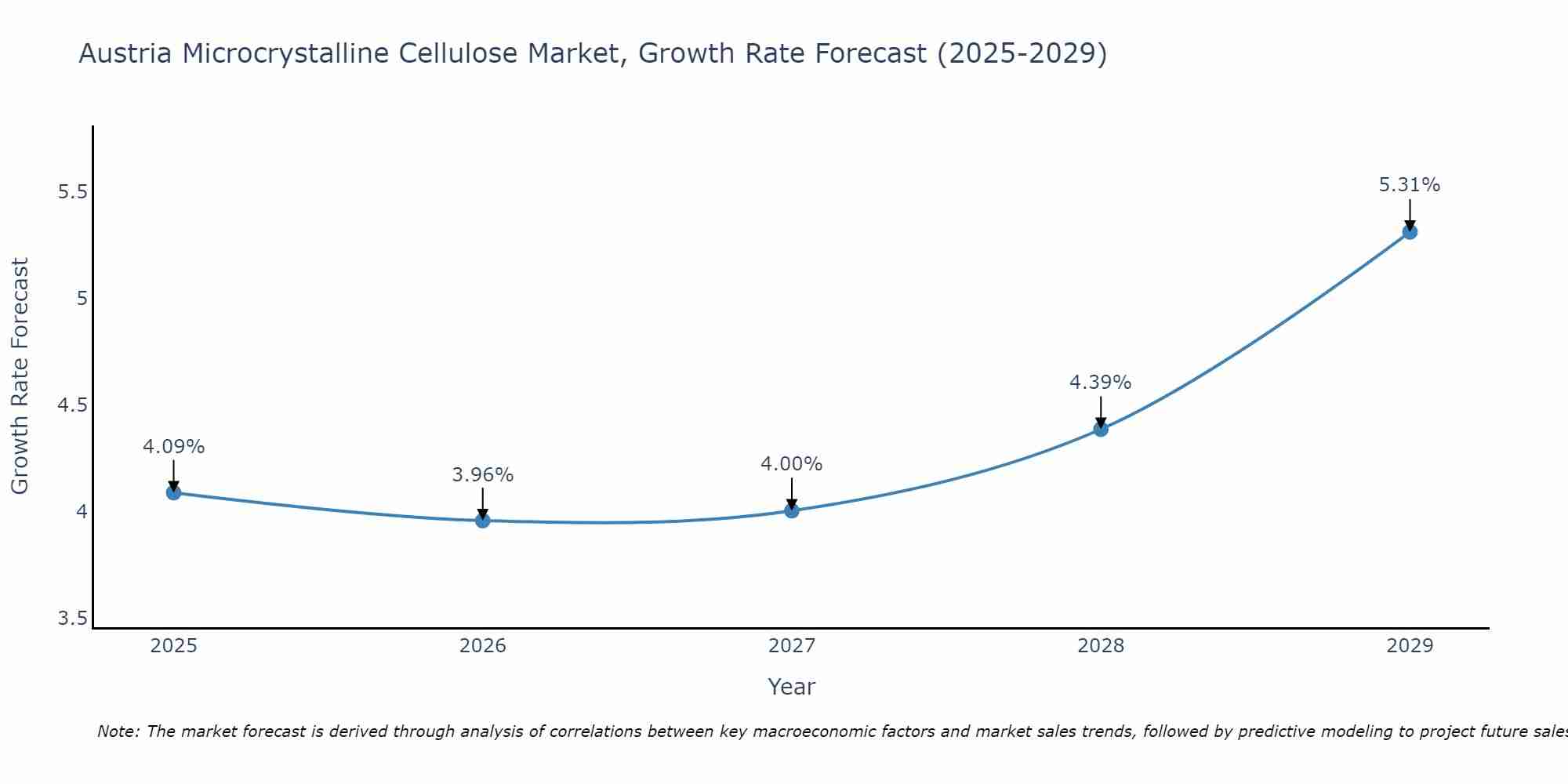
The Austria Microcrystalline Cellulose Market is projected to witness mixed growth rate patterns during 2025 to 2029. From 4.09% in 2025, the growth rate steadily ascends to 5.31% in 2029.
Microcrystalline Cellulose Market: Austria vs Top 5 Major Economies in 2027 (Europe)
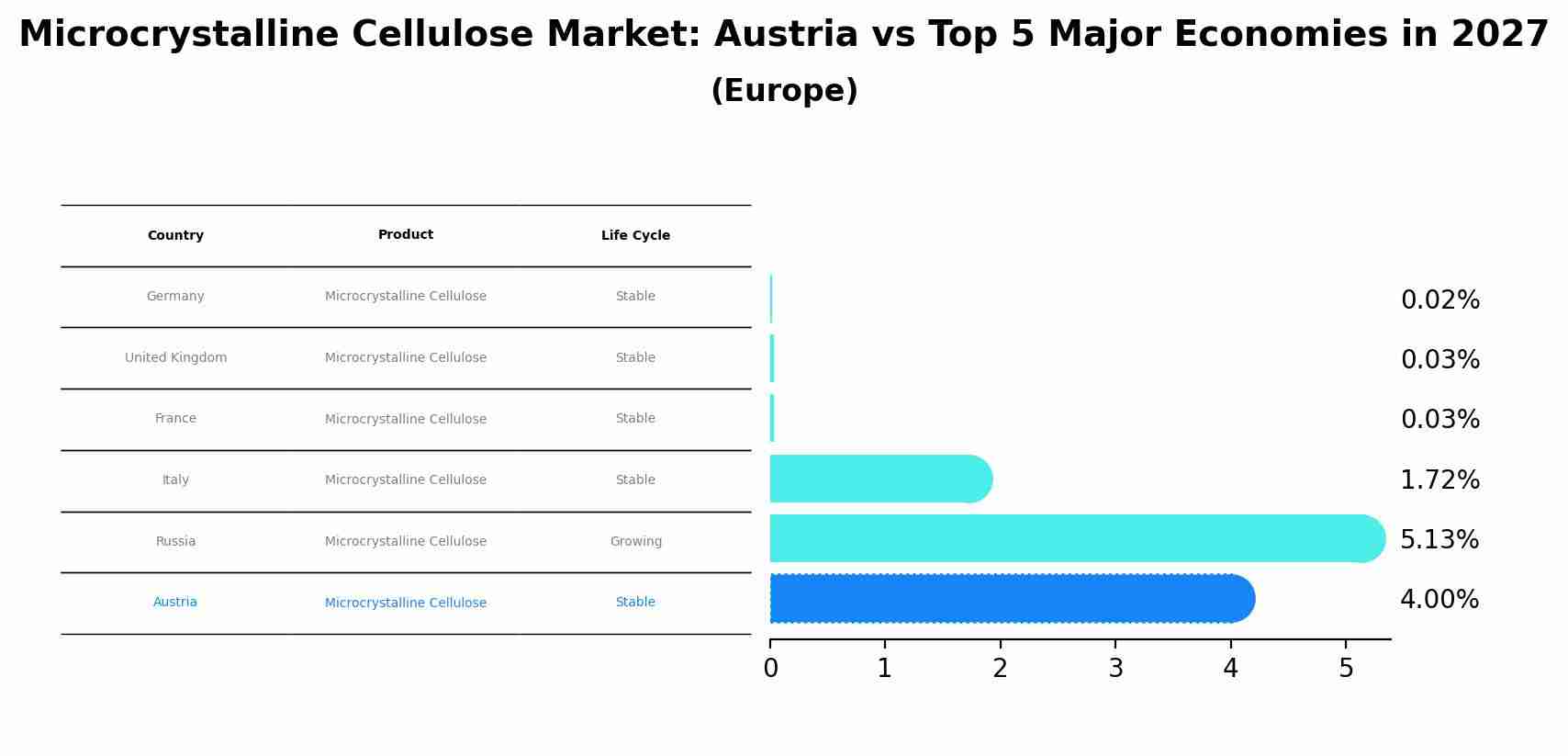
By 2027, Austria's Microcrystalline Cellulose market is forecasted to achieve a stable growth rate of 4.00%, with Germany leading the Europe region, followed by United Kingdom, France, Italy and Russia.
Austria Microcrystalline Cellulose Market Overview
The Microcrystalline Cellulose market in Austria produces cellulose-based excipients used in pharmaceutical tablets, food supplements, and cosmetic formulations. Austrian suppliers offer high-purity microcrystalline cellulose with controlled particle size distribution and binding properties, supporting drug delivery, nutritional supplements, and personal care products.
Drivers of the market
The Microcrystalline Cellulose market in Austria benefits from pharmaceutical formulations, food additives, and personal care products requiring inert, versatile excipients with binding and disintegration properties. Austrian producers supply microcrystalline cellulose derived from sustainable wood pulp, offering improved tablet compressibility, drug release profiles, and ingredient stability in dietary supplements, pharmaceutical tablets, and cosmetic formulations. Market expansion is driven by pharmaceutical R&D investments, clean label trends, and advancements in cellulose processing technologies, supporting product innovation and regulatory compliance in global markets.
Challenges of the market
Challenges in the microcrystalline cellulose market include sourcing sustainable cellulose feedstock for pharmaceutical and food applications, ensuring consistent particle size and purity in cellulose production, and complying with pharmacopeial standards and regulatory requirements.
Government Policy of the market
Pharmaceutical regulations and drug formulation guidelines impact the microcrystalline cellulose market in Austria. Government initiatives promoting pharmaceutical innovation and generic drug production drive demand for cellulose excipients in tablet manufacturing. Incentives for pharmaceutical manufacturers to source sustainable cellulose materials or comply with pharmacopeial standards support market growth and drug formulation advancements.
Key Highlights of the Report:
- Austria Microcrystalline Cellulose Market Outlook
- Market Size of Austria Microcrystalline Cellulose Market, 2024
- Forecast of Austria Microcrystalline Cellulose Market, 2031
- Historical Data and Forecast of Austria Microcrystalline Cellulose Revenues & Volume for the Period 2021-2031
- Austria Microcrystalline Cellulose Market Trend Evolution
- Austria Microcrystalline Cellulose Market Drivers and Challenges
- Austria Microcrystalline Cellulose Price Trends
- Austria Microcrystalline Cellulose Porter`s Five Forces
- Austria Microcrystalline Cellulose Industry Life Cycle
- Historical Data and Forecast of Austria Microcrystalline Cellulose Market Revenues & Volume By Source Type for the Period 2021-2031
- Historical Data and Forecast of Austria Microcrystalline Cellulose Market Revenues & Volume By Non-Wood Based for the Period 2021-2031
- Historical Data and Forecast of Austria Microcrystalline Cellulose Market Revenues & Volume By Wood-Based for the Period 2021-2031
- Historical Data and Forecast of Austria Microcrystalline Cellulose Market Revenues & Volume By End-use for the Period 2021-2031
- Historical Data and Forecast of Austria Microcrystalline Cellulose Market Revenues & Volume By Binder/Diluent for the Period 2021-2031
- Historical Data and Forecast of Austria Microcrystalline Cellulose Market Revenues & Volume By Bulking agent for the Period 2021-2031
- Historical Data and Forecast of Austria Microcrystalline Cellulose Market Revenues & Volume By Emulsifiers for the Period 2021-2031
- Historical Data and Forecast of Austria Microcrystalline Cellulose Market Revenues & Volume By Stabilizer for the Period 2021-2031
- Historical Data and Forecast of Austria Microcrystalline Cellulose Market Revenues & Volume By Anti-Caking Agent for the Period 2021-2031
- Historical Data and Forecast of Austria Microcrystalline Cellulose Market Revenues & Volume By Others for the Period 2021-2031
- Historical Data and Forecast of Austria Microcrystalline Cellulose Market Revenues & Volume By Application for the Period 2021-2031
- Historical Data and Forecast of Austria Microcrystalline Cellulose Market Revenues & Volume By Pharmaceutical for the Period 2021-2031
- Historical Data and Forecast of Austria Microcrystalline Cellulose Market Revenues & Volume By Food & Beverage for the Period 2021-2031
- Historical Data and Forecast of Austria Microcrystalline Cellulose Market Revenues & Volume By Cosmetics & Personal Care for the Period 2021-2031
- Historical Data and Forecast of Austria Microcrystalline Cellulose Market Revenues & Volume By Paints & coatings for the Period 2021-2031
- Historical Data and Forecast of Austria Microcrystalline Cellulose Market Revenues & Volume By Others for the Period 2021-2031
- Austria Microcrystalline Cellulose Import Export Trade Statistics
- Market Opportunity Assessment By Source Type
- Market Opportunity Assessment By End-use
- Market Opportunity Assessment By Application
- Austria Microcrystalline Cellulose Top Companies Market Share
- Austria Microcrystalline Cellulose Competitive Benchmarking By Technical and Operational Parameters
- Austria Microcrystalline Cellulose Company Profiles
- Austria Microcrystalline Cellulose Key Strategic Recommendations






































