Austria Packaged Water Market: Import Trend Analysis
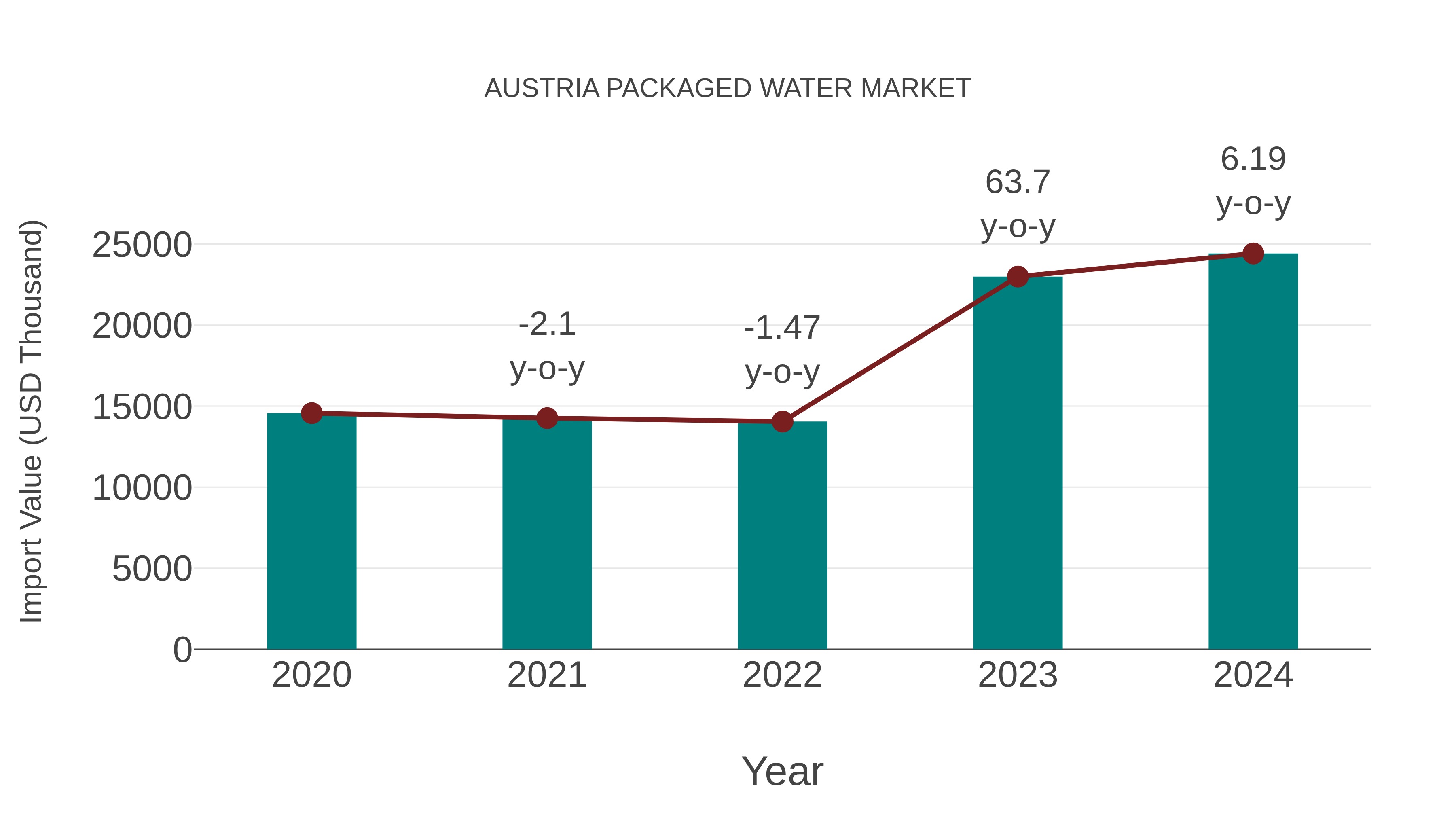
In 2024, Austria`s packaged water market witnessed a notable increase in imports. The trend indicated a growing demand for imported packaged water products within the Austrian market.
Austria Packaged water Market Overview
The packaged water market in Austria is a mature and competitive industry characterized by a high level of consumer awareness regarding the importance of hydration and health. Key players in the market include both domestic and international brands offering a variety of products such as still water, sparkling water, flavored water, and functional water. The market is driven by factors like convenience, health consciousness, and changing consumer preferences towards low-calorie and natural beverages. Sustainability and environmental concerns have also become important considerations for consumers, leading to an increased demand for eco-friendly packaging solutions. The market is expected to continue growing, supported by innovations in packaging, flavors, and functional benefits, as well as marketing strategies emphasizing health and wellness attributes.
Austria Packaged water Market Trends and Opportunities
The Austria Packaged water market is experiencing steady growth driven by increasing health consciousness among consumers, rising disposable incomes, and a shift towards convenient and on-the-go hydration options. Key trends in the market include a growing demand for premium and flavored water products, sustainable packaging solutions, and innovative product offerings such as functional waters and infused waters. Opportunities for market players lie in expanding distribution channels, leveraging digital marketing strategies to reach a wider audience, and focusing on eco-friendly packaging options to cater to the environmentally conscious consumer segment. With the ongoing emphasis on health and wellness, the Packaged water market in Austria is poised for further expansion and innovation in the coming years.
Austria Packaged water Market Challenges
In the Austria Packaged water market, one of the main challenges is the increasing competition among numerous brands, both domestic and international. This competition leads to price wars and aggressive marketing strategies, making it difficult for smaller or newer brands to establish themselves. Additionally, there is a growing concern among consumers about the environmental impact of single-use plastic bottles, prompting a shift towards more sustainable packaging options such as glass or aluminum. Meeting these changing consumer preferences while maintaining cost-effectiveness poses a challenge for companies operating in the packaged water market in Austria. Adapting to stricter regulations on plastic waste and ensuring compliance with quality standards are also key challenges faced by industry players in this market.
Austria Packaged water Market Drivers
The Austria Packaged water market is primarily driven by factors such as increasing health consciousness among consumers, growing concerns over water quality and safety, and the convenience offered by packaged water for on-the-go consumption. Additionally, changing lifestyle patterns, rising disposable incomes, and a shift towards healthier beverage choices are fueling the demand for packaged water in Austria. The emphasis on hydration and the preference for clean and purified water sources are also significant drivers of market growth. Furthermore, the easy availability of packaged water in various formats, such as PET bottles, cartons, and pouches, contributes to the market`s expansion as consumers seek convenient and portable hydration solutions.
Austria Packaged water Market Government Policy
In Austria, the packaged water market is regulated by various government policies aimed at ensuring quality and safety standards. The Austrian Food Safety and Consumer Protection Act sets out requirements for the production, labeling, and marketing of packaged water to protect consumer health. Additionally, the Austrian Mineral Water and Spring Water Ordinance regulates the extraction and bottling of mineral and spring water, ensuring that these products meet specific quality criteria. The Austrian Packaging Ordinance also mandates recycling and waste management practices for packaging materials, including those used for packaged water. These policies work together to uphold high standards of quality, safety, and environmental sustainability in the packaged water market in Austria.
Austria Packaged water Market Future Outlook
The future outlook for the Austria Packaged water market appears positive, driven by increasing health consciousness among consumers, growing concerns about water quality, and the convenience of on-the-go hydration. The market is expected to witness steady growth due to rising disposable incomes, urbanization, and the trend towards sustainable packaging options. Additionally, the demand for functional and flavored waters is anticipated to rise, catering to diverse consumer preferences. Market players are likely to focus on product innovation, such as eco-friendly packaging, infused waters, and enhanced hydration solutions, to stay competitive in this evolving landscape. Overall, the Austria Packaged water market is projected to expand as consumers continue to prioritize hydration and wellness, presenting opportunities for growth and development in the coming years.
Key Highlights of the Report:
- Austria Packaged water Market Outlook
- Market Size of Austria Packaged water Market, 2025
- Forecast of Austria Packaged water Market, 2032
- Historical Data and Forecast of Austria Packaged water Revenues & Volume for the Period 2022 - 2032F
- Austria Packaged water Market Trend Evolution
- Austria Packaged water Market Drivers and Challenges
- Austria Packaged water Price Trends
- Austria Packaged water Porter's Five Forces
- Austria Packaged water Industry Life Cycle
- Historical Data and Forecast of Austria Packaged water Market Revenues & Volume By Product for the Period 2022 - 2032F
- Historical Data and Forecast of Austria Packaged water Market Revenues & Volume By Still for the Period 2022 - 2032F
- Historical Data and Forecast of Austria Packaged water Market Revenues & Volume By Carbonated for the Period 2022 - 2032F
- Historical Data and Forecast of Austria Packaged water Market Revenues & Volume By Flavored for the Period 2022 - 2032F
- Historical Data and Forecast of Austria Packaged water Market Revenues & Volume By Functional for the Period 2022 - 2032F
- Austria Packaged water Import Export Trade Statistics
- Market Opportunity Assessment By Product
- Austria Packaged water Top Companies Market Share
- Austria Packaged water Competitive Benchmarking By Technical and Operational Parameters
- Austria Packaged water Company Profiles
- Austria Packaged water Key Strategic Recommendations






































