Austria Viscose Filament Yarns Market Size (2020-2030)
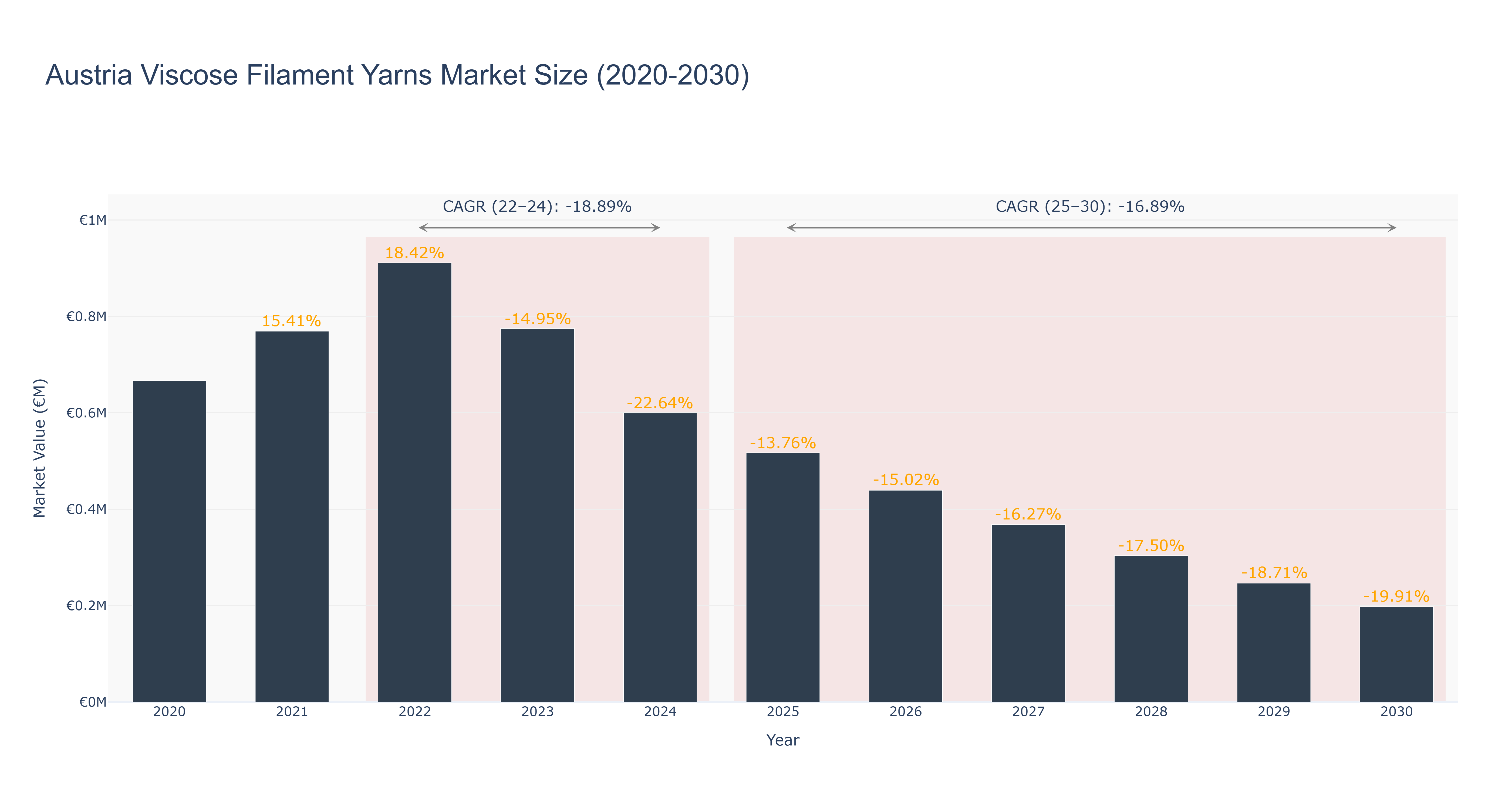
The Austria Viscose Filament Yarns Market experienced a peak market size of €0.91 million in 2022, followed by a decline to €0.44 million in 2026. The market is forecasted to further decrease to €0.20 million by 2030, with a CAGR of -16.89% from 2025 to 2030. The market saw a significant downturn from 2022 to 2024 with a CAGR of -18.89%, attributed to changing consumer preferences towards alternative materials. Industry drivers such as sustainability concerns and technological advancements in textile production are influencing market trends. Looking ahead, upcoming projects in Austria's textile industry include investments in eco-friendly manufacturing processes and the development of innovative yarn blends to cater to evolving market demands. These initiatives aim to revitalize the market and drive future growth despite current challenges.
Austria Viscose Filament Yarns Market: Production & Trade Performance (2019-2025)
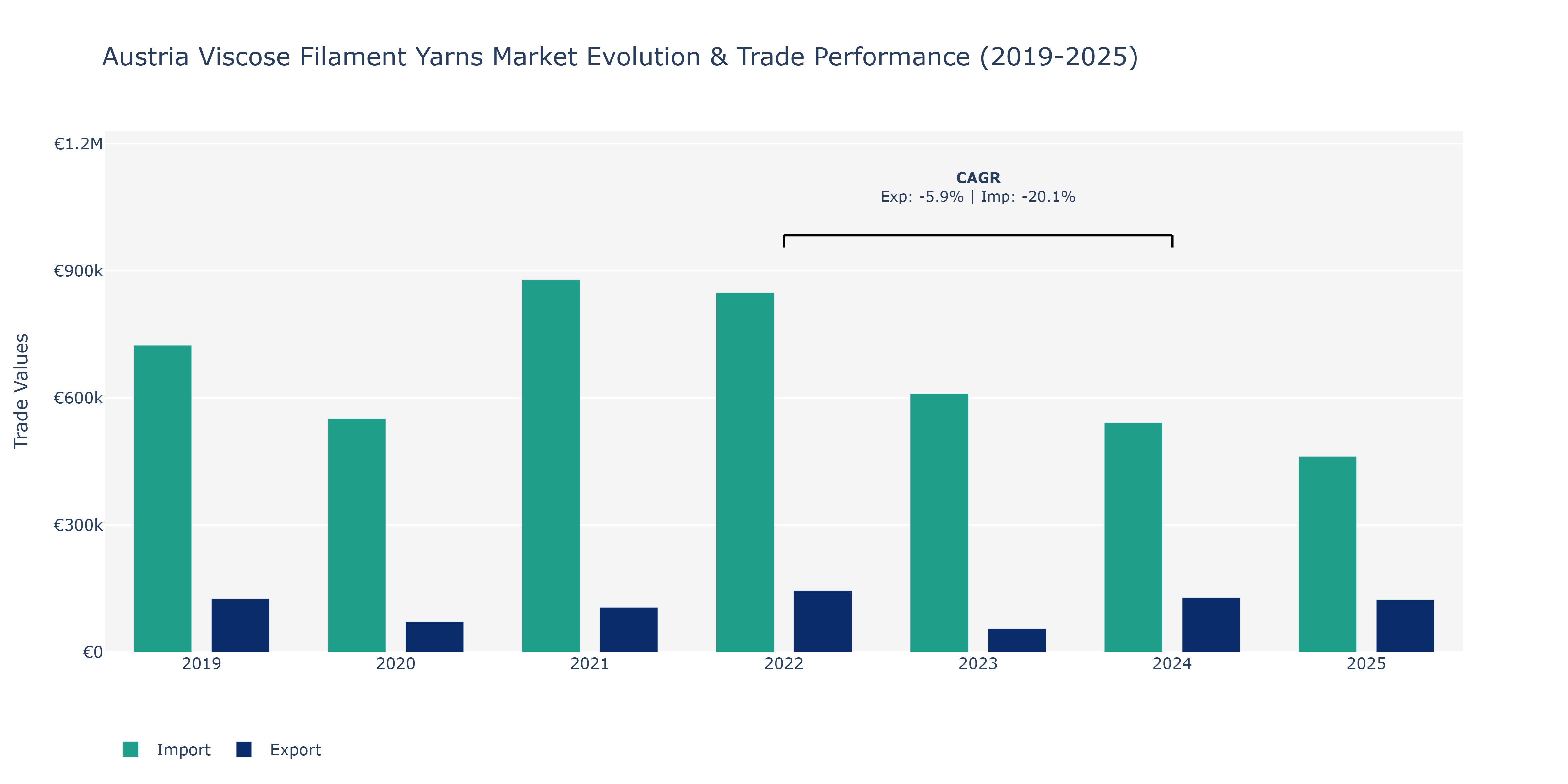
In the Austria Viscose Filament Yarns Market, exports experienced fluctuations over the years, starting at €125.7 thousand in 2019, dropping to €71.52 thousand in 2020, before rebounding to €105.86 thousand in 2021, and reaching a peak of €144.93 thousand in 2022. However, a sharp decline was noted in 2023 to €56.19 thousand, followed by a recovery to €128.31 thousand in 2024, and a slight decrease to €124.28 thousand in 2025. These variations could be attributed to shifts in global demand, changes in pricing strategies, and the impact of trade policies on the textile industry. Conversely, imports followed a different trajectory, starting at €724.62 thousand in 2019, decreasing to €550.91 thousand in 2020, rising to €879.29 thousand in 2021, and then declining to €848.29 thousand in 2022. Import levels continued to decrease in 2023 to €610.83 thousand, followed by a slight recovery to €542.0 thousand in 2024, and further to €462.13 thousand in 2025. These import fluctuations could be due to shifts in global supply chains, currency exchange rates, and geopolitical factors influencing trade volumes within the industry.
Key Highlights of the Report:
- Austria Viscose Filament Yarns Market Outlook
- Market Size of Austria Viscose Filament Yarns Market, 2025
- Forecast of Austria Viscose Filament Yarns Market, 2032
- Historical Data and Forecast of Austria Viscose Filament Yarns Revenues & Volume for the Period 2022-2032F
- Austria Viscose Filament Yarns Market Trend Evolution
- Austria Viscose Filament Yarns Market Drivers and Challenges
- Austria Viscose Filament Yarns Price Trends
- Austria Viscose Filament Yarns Porter`s Five Forces
- Austria Viscose Filament Yarns Industry Life Cycle
- Historical Data and Forecast of Austria Viscose Filament Yarns Market Revenues & Volume By Type for the Period 2022-2032F
- Historical Data and Forecast of Austria Viscose Filament Yarns Market Revenues & Volume By Continuous for the Period 2022-2032F
- Historical Data and Forecast of Austria Viscose Filament Yarns Market Revenues & Volume By Semi-continuous for the Period 2022-2032F
- Historical Data and Forecast of Austria Viscose Filament Yarns Market Revenues & Volume By Application for the Period 2022-2032F
- Historical Data and Forecast of Austria Viscose Filament Yarns Market Revenues & Volume By Garment industry for the Period 2022-2032F
- Historical Data and Forecast of Austria Viscose Filament Yarns Market Revenues & Volume By Auto industry for the Period 2022-2032F
- Historical Data and Forecast of Austria Viscose Filament Yarns Market Revenues & Volume By other for the Period 2022-2032F
- Austria Viscose Filament Yarns Import Export Trade Statistics
- Market Opportunity Assessment By Type
- Market Opportunity Assessment By Application
- Austria Viscose Filament Yarns Top Companies Market Share
- Austria Viscose Filament Yarns Competitive Benchmarking By Technical and Operational Parameters
- Austria Viscose Filament Yarns Company Profiles
- Austria Viscose Filament Yarns Key Strategic Recommendations






































