Azerbaijan 5G Core Market Size, Share & Growth Rate
The Azerbaijan 5G Core Market was estimated at USD 1257 Million in 2025 and is projected to reach USD 2288 Million by 2032, growing at a CAGR of 8.9% from 2026 to 2032. This promising trajectory is fueled by a combination of rising consumer expectations for faster mobile services and a significant commitment from local telecom operators to enhance their network capabilities. Furthermore, the surge in IoT device adoption is setting the stage for expansive 5G applications across various sectors.
Azerbaijan 5G Core Market Year-wise Growth Rate and Key Drivers
This graph highlights how the Azerbaijan 5G Core Market has steadily grown over the years, supported by major growth factors.
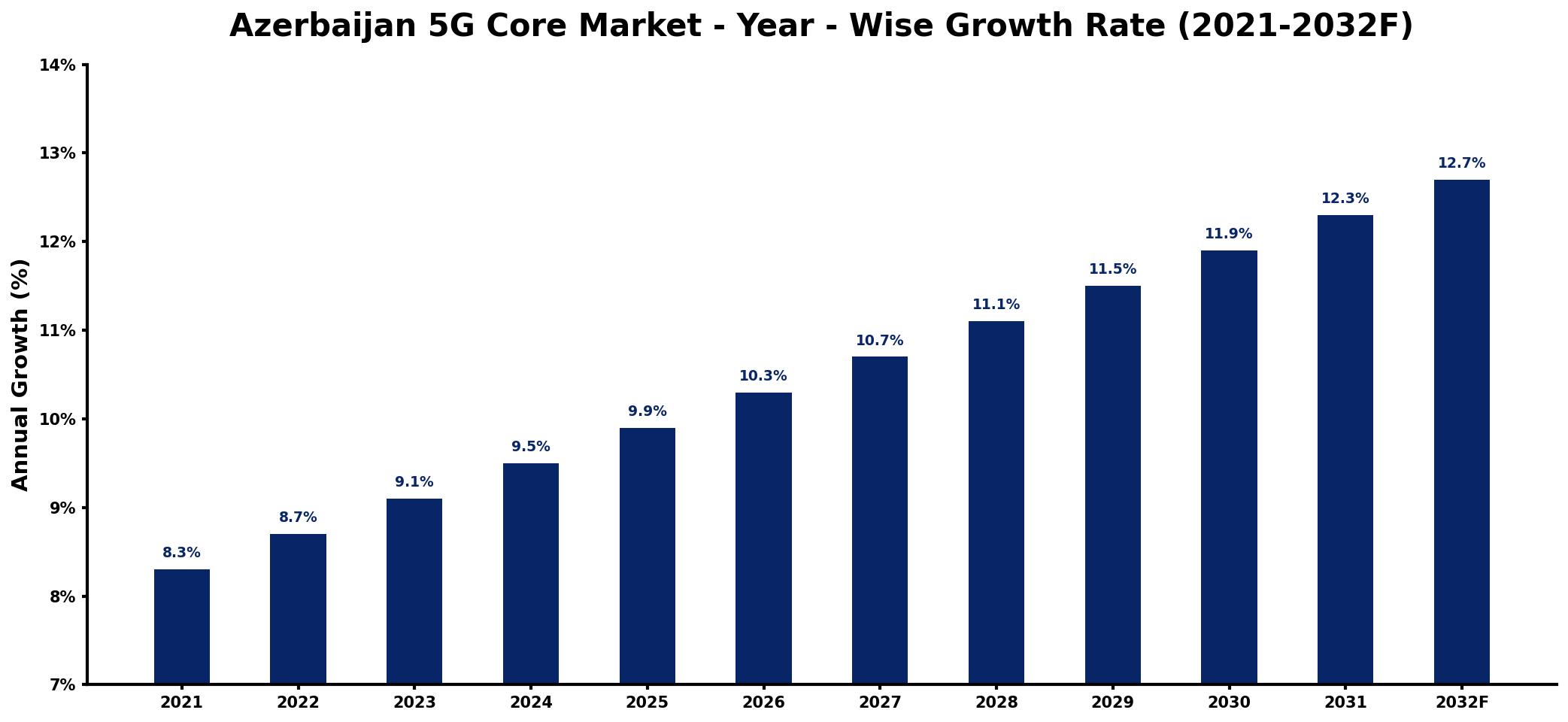
The table below presents the year‑wise growth rates along with the key drivers influencing the market
| Year | Growth Rate | Major Drivers |
| 2021 | 8.3% | increased investment in telecommunications infrastructure |
| 2022 | 8.7% | growing demand for high-speed connectivity |
| 2023 | 9.1% | expansion of mobile broadband services |
| 2024 | 9.5% | rise in smart device adoption |
| 2025 | 9.9% | enhanced focus on IoT applications |
| 2026 | 10.3% | growth in urban digitalization initiatives |
| 2027 | 10.7% | increased government support for technology |
| 2028 | 11.1% | rising procurement volume requirements |
| 2029 | 11.5% | growing commercial sector adoption |
| 2030 | 11.9% | growing downstream application demand |
| 2031 | 12.3% | increased focus on smart cities |
| 2032 | 12.7% | stronger distribution network expansion |
Note: Market size estimations and growth projections presented in this report are based on 6Wresearch's proprietary forecasting methodology, utilizing the latest available industry data, government publications, and primary research inputs.
Azerbaijan 5G Core Market Synopsis
Azerbaijan's push towards a robust 5G infrastructure is rapidly transforming the telecommunications landscape. With a clear emphasis on high-speed connectivity, telecom operators are upgrading their core networks, showcasing their readiness to embrace next-generation technologies. The environment is ripe for the implementation of 5G solutions, with considerable investments being funneled into network enhancements.
The Azerbaijani government is playing an essential role by introducing policies that facilitate the rollout of 5G services. These initiatives aim to bolster digital transformation across the nation, catering to an ever-expanding digital economy. In this context, the market is characterized by innovation, with a range of solutions addressing the diverse needs of users and industries.
Azerbaijan 5G Core Market Key Takeaways
- The market is on a solid growth path, driven by increased demand for mobile connectivity and advanced technologies.
- Key technological trends include cloud-native networks, network slicing, and AI integration for enhanced operational efficiency.
- Cybersecurity remains a focal point as operators enhance their defenses against potential threats in 5G environments.
- Government initiatives are crucial in supporting infrastructure upgrades and encouraging investments in the 5G domain.
- The growing popularity of IoT devices is expected to catalyze further development in the 5G ecosystem.
Evaluation of Restraints in Azerbaijan 5G Core Market
Despite the vibrant growth prospects, several restraints could impede the seamless transition to 5G. Regulatory complexities surrounding spectrum allocation can present significant challenges for telecom operators aiming to expand their services. Additionally, the current infrastructure may require extensive upgrades to fully leverage 5Gs capabilities. Cybersecurity issues also loom large, as the heightened connectivity associated with 5G networks could expose vulnerabilities. Lastly, the shortage of skilled professionals proficient in 5G technologies remains a pressing concern, potentially affecting the deployment timelines and operational efficiency of new networks.
Azerbaijan 5G Core Market Trends
The Azerbaijan 5G Core Market is evolving with notable trends shaping its future. One of the most significant movements is the shift toward cloud-native 5G core networks, allowing for improved scalability and flexibility. Network slicing is increasingly being adopted, enabling operators to tailor services to distinct user segments effectively. Moreover, the integration of artificial intelligence and machine learning is optimizing network management, paving the way for automated operations. In light of rising cybersecurity threats, operators are intensifying their focus on security measures to safeguard their core networks.
Azerbaijan 5G Core Market Opportunities
The market presents a wealth of investment opportunities for stakeholders looking to capitalize on the transition to 5G technology. Investors are encouraged to explore avenues in providing innovative 5G core network solutions and software development tailored for specific applications. Collaborations with local telecom companies could yield successful outcomes in deploying comprehensive 5G networks, offering services designed to meet the unique demands of the Azerbaijani market. Additionally, committing resources to research and development initiatives aimed at enhancing 5G capabilities can ensure sustained growth and a competitive edge.
Government Initiatives in the Azerbaijan 5G Core Market
Azerbaijan's government has taken proactive steps to support the advancement of 5G technology within the country. By allocating necessary spectrum and establishing regulations conducive to rapid deployment, the government aims to foster a stimulating environment for investments in the telecommunications sector. Additionally, various initiatives are in place to encourage collaboration between telecom operators and technology providers, all aimed at facilitating a seamless integration of 5G into the national infrastructure.
Future Insights of the Azerbaijan 5G Core Market
Looking ahead, the Azerbaijan 5G Core Market is poised for substantial growth as infrastructure investments continue and consumer demand for high-speed connectivity escalates. The rollout of 5G networks is expected to enhance overall network performance and introduce new applications such as smart cities and autonomous vehicles. As telecom operators strive to innovate and cater to the evolving needs of consumers, the market holds significant promise for sustained development and new opportunities in the years to come.
Azerbaijan 5G Core Market Latest Developments (2025 - 2026)
Recent industry developments indicate an aggressive push towards the implementation of 5G technology in Azerbaijan. Telecom operators are announcing new partnerships aimed at improving infrastructure and service offerings. Additionally, discussions around enhancing cybersecurity protocols are gaining momentum as the market prepares for broader 5G network deployments. Innovations continue to emerge, suggesting a vibrant and dynamic environment that will further shape the market in the near future.
Azerbaijan 5G Core Market - Key Attractiveness of the Report
- 10 Years of Market Numbers
- Historical Data Starting from 2022 to 2025
- Base Year: 2025
- Forecast Data until 2032
- Key Performance Indicators Impacting the Market
- Major Upcoming Developments and Projects
Key Highlights of the Report:
- Azerbaijan 5G Core Market Outlook
- Market Size of Azerbaijan 5G Core Market, 2025
- Forecast of Azerbaijan 5G Core Market, 2032
- Historical Data and Forecast of Azerbaijan 5G Core Revenues & Volume for the Period 2022-2032F
- Azerbaijan 5G Core Market Trend Evolution
- Azerbaijan 5G Core Market Drivers and Challenges
- Azerbaijan 5G Core Price Trends
- Azerbaijan 5G Core Porter's Five Forces
- Azerbaijan 5G Core Industry Life Cycle
- Historical Data and Forecast of Azerbaijan 5G Core Market Revenues & Volume By Component for the Period 2022-2032F
- Historical Data and Forecast of Azerbaijan 5G Core Market Revenues & Volume By Solutions for the Period 2022-2032F
- Historical Data and Forecast of Azerbaijan 5G Core Market Revenues & Volume By Services for the Period 2022-2032F
- Historical Data and Forecast of Azerbaijan 5G Core Market Revenues & Volume By Network Function for the Period 2022-2032F
- Historical Data and Forecast of Azerbaijan 5G Core Market Revenues & Volume By Access for the Period 2022-2032F
- Historical Data and Forecast of Azerbaijan 5G Core Market Revenues & Volume By Mobility Management Function for the Period 2022-2032F
- Historical Data and Forecast of Azerbaijan 5G Core Market Revenues & Volume By Policy Control Function for the Period 2022-2032F
- Historical Data and Forecast of Azerbaijan 5G Core Market Revenues & Volume By Unified Data Management for the Period 2022-2032F
- Historical Data and Forecast of Azerbaijan 5G Core Market Revenues & Volume By Deployment Model for the Period 2022-2032F
- Historical Data and Forecast of Azerbaijan 5G Core Market Revenues & Volume By Cloud for the Period 2022-2032F
- Historical Data and Forecast of Azerbaijan 5G Core Market Revenues & Volume By On-premises for the Period 2022-2032F
- Historical Data and Forecast of Azerbaijan 5G Core Market Revenues & Volume By End User for the Period 2022-2032F
- Historical Data and Forecast of Azerbaijan 5G Core Market Revenues & Volume By Telecom Operators for the Period 2022-2032F
- Historical Data and Forecast of Azerbaijan 5G Core Market Revenues & Volume By Enterprises for the Period 2022-2032F
- Azerbaijan 5G Core Import Export Trade Statistics
- Market Opportunity Assessment By Component
- Market Opportunity Assessment By Network Function
- Market Opportunity Assessment By Deployment Model
- Market Opportunity Assessment By End User
- Azerbaijan 5G Core Top Companies Market Share
- Azerbaijan 5G Core Competitive Benchmarking By Technical and Operational Parameters
- Azerbaijan 5G Core Company Profiles
- Azerbaijan 5G Core Key Strategic Recommendations






































