Azerbaijan 5G NTN Market Size, Share & Growth Rate
The Azerbaijan 5G NTN Market was estimated at USD 658 Million in 2025 and is projected to reach USD 1115 Million by 2032, growing at a CAGR of 7.8% from 2026 to 2032. This growth is driven by increasing investments in telecommunications infrastructure, alongside a growing emphasis on bridging the digital divide in rural and underserved regions. The unique geographical challenges of Azerbaijan provide a compelling case for the deployment of 5G NTN technologies, which promise to enhance connectivity in these hard-to-reach areas.
Azerbaijan 5G NTN Market Year-wise Growth Rate and Key Drivers
This graph highlights how the Azerbaijan 5G NTN Market has steadily grown over the years, supported by major growth factors.
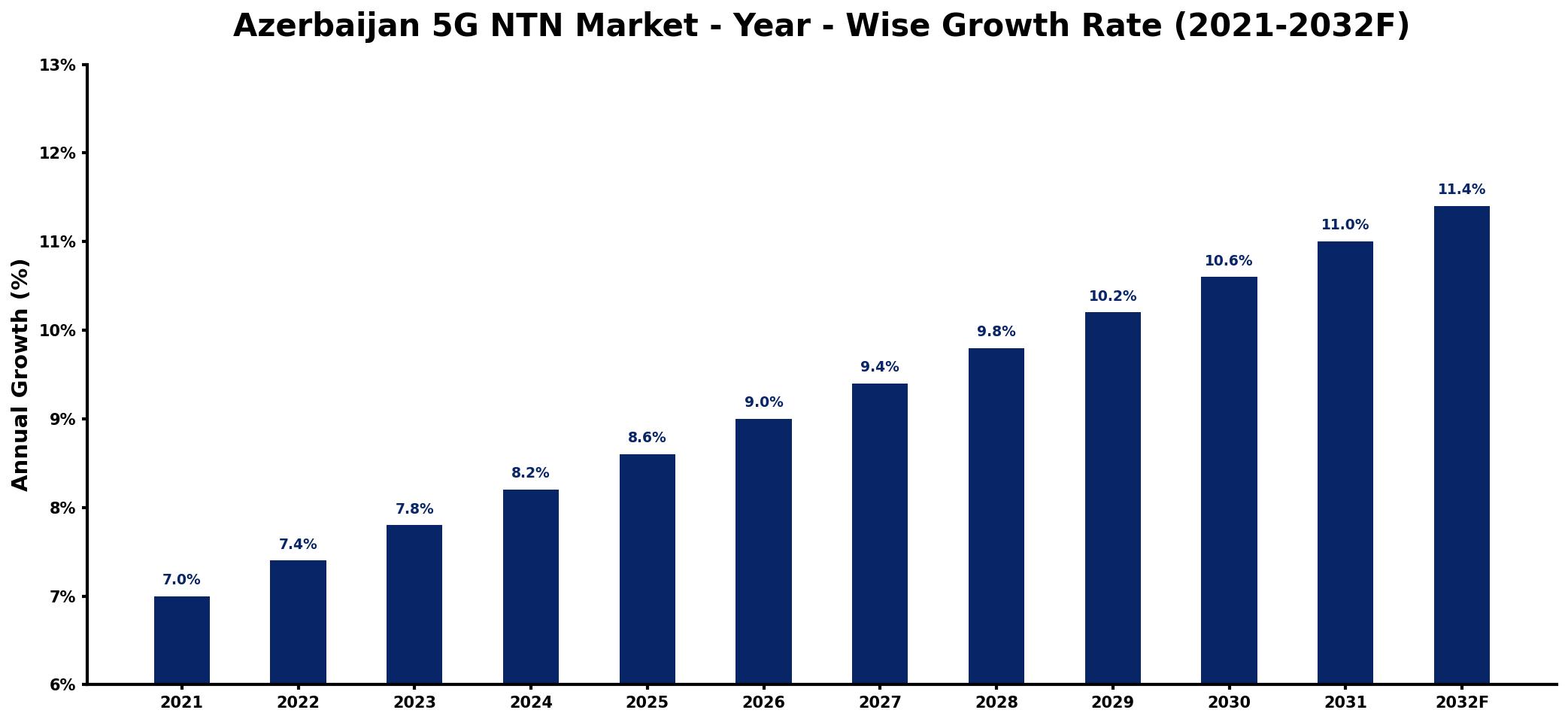
The table below presents the year‑wise growth rates along with the key drivers influencing the market
| Year | Growth Rate | Major Drivers |
| 2021 | 7.0% | increased mobile data consumption |
| 2022 | 7.4% | expansion of broadband infrastructure |
| 2023 | 7.8% | growing demand for IoT solutions |
| 2024 | 8.2% | rise in digital transformation initiatives |
| 2025 | 8.6% | investments in smart city projects |
| 2026 | 9.0% | enhanced network reliability requirements |
| 2027 | 9.4% | adoption of advanced technologies |
| 2028 | 9.8% | surge in connected devices market |
| 2029 | 10.2% | growing interest in autonomous systems |
| 2030 | 10.6% | development of immersive experiences |
| 2031 | 11.0% | increased funding for tech startups |
| 2032 | 11.4% | strengthened partnerships in telecommunications |
Note: Market size estimations and growth projections presented in this report are based on 6Wresearch's proprietary forecasting methodology, utilizing the latest available industry data, government publications, and primary research inputs.
Azerbaijan 5G NTN Market Synopsis
Azerbaijan's 5G NTN market is emerging as a critical component in the nation's broader digital transformation strategy. With a diverse landscape that includes mountains and remote areas, the country presents a unique opportunity for the implementation of non-terrestrial networks, ensuring that urban and rural populations alike can access high-speed connectivity.
Telecommunications companies and governmental institutions are increasingly recognizing the need to modernize infrastructure to support the next generation of network technology. As these stakeholders align their goals with the demands of various sectors such as agriculture, healthcare, and transportation, the potential for innovative solutions and economic development rises significantly.
Azerbaijan 5G NTN Market Key Takeaways
- Azerbaijan's challenging terrain highlights the need for effective 5G NTN solutions, driving demand for satellite and high-altitude network technologies.
- Investment opportunities are growing as local telecommunication firms seek partnerships to enhance their service offerings.
- The government's supportive policies are paving the way for significant advancements in the country's digital infrastructure.
- Emerging applications in sectors like IoT and smart cities are shaping the future of connectivity in Azerbaijan.
- Collaboration between telecom operators and technology providers is expected to be pivotal in advancing the 5G NTN ecosystem.
Evaluation of Restraints in Azerbaijan 5G NTN Market
Despite its promising outlook, the Azerbaijan 5G NTN market faces several challenges that could impede its growth. Limited infrastructure in rural regions presents a significant barrier to widespread adoption. Moreover, the high costs associated with deploying and maintaining advanced network technologies create financial strains for local telecommunications providers. Regulatory hurdles and issues surrounding spectrum allocation add further complexity, complicating the swift rollout of 5G networks. Finally, the shortage of skilled professionals proficient in 5G technology creates a bottleneck in implementation, as companies struggle to recruit the necessary talent to harness these innovations.
Azerbaijan 5G NTN Market Trends
Current trends in the Azerbaijan 5G NTN market indicate a surge in the adoption of 5G technology across various sectors, including healthcare and automotive. Telecom operators are significantly investing in infrastructure upgrades, focusing on boosting the speed and reliability of services. Innovative applications like smart cities and IoT are gaining traction as they promise to improve urban living and increase efficiency across industries. The collaboration between telecom companies and technology providers is also on the rise, leading to enhanced service offerings that meet the evolving needs of the Azerbaijani market.
Azerbaijan 5G NTN Market Opportunities
Investment opportunities in Azerbaijan's 5G NTN market are abundant, primarily due to its strategic location as a bridge between Europe and Asia. This unique positioning presents the potential for Azerbaijan to emerge as a connectivity hub, attracting investments in infrastructure development. Local telecommunications companies are actively seeking collaborations with international partners, which can lead to innovative solutions tailored to the specific needs of the Azerbaijani market. As global demand for high-speed networks increases, early investments in this burgeoning sector could yield substantial long-term returns.
Government Initiatives in the Azerbaijan 5G NTN Market
The Azerbaijani government is playing an active role in fostering the development of the 5G NTN market. The Ministry of Transport, Communications and High Technologies is focused on creating a supportive regulatory environment that encourages the deployment of 5G networks. This includes simplifying the permit process and ensuring that necessary spectrum is allocated efficiently. Additionally, the government has introduced incentives to attract investment, providing subsidies and tax breaks for telecom operators looking to expand their infrastructure. Emphasis on cybersecurity and data protection further underscores the government's commitment to a secure digital landscape.
Future Insights of the Azerbaijan 5G NTN Market
Looking ahead to 2026-2032, the Azerbaijan 5G NTN market is expected to gain substantial traction as the country invests in advanced telecommunications infrastructure. The ongoing demand for reliable and fast connectivity is anticipated to drive the deployment of non-terrestrial networks, particularly in remote areas. As partnerships between telecom operators and technology providers deepen, innovation is likely to flourish, paving the way for enhanced 5G NTN services. With a proactive government committed to digital innovation, Azerbaijan is set to solidify its position as a leader in the next generation of connectivity.
Azerbaijan 5G NTN Market Latest Developments (2025 - 2026)
In recent months, the Azerbaijan 5G NTN market has seen a series of developments aimed at accelerating the rollout of next-generation connectivity solutions. Efforts are underway to enhance collaborations between local and international technology firms, which is expected to bring innovative applications to various sectors. Additionally, the government is actively promoting initiatives that encourage the deployment of digital infrastructure, ensuring that both urban and rural populations benefit from improved connectivity.
Azerbaijan 5G NTN Market - Key Attractiveness of the Report
- 10 Years of Market Numbers
- Historical Data Starting from 2022 to 2025
- Base Year: 2025
- Forecast Data until 2032
- Key Performance Indicators Impacting the Market
- Major Upcoming Developments and Projects
Key Highlights of the Report:
- Azerbaijan 5G NTN Market Outlook
- Market Size of Azerbaijan 5G NTN Market, 2025
- Forecast of Azerbaijan 5G NTN Market, 2032
- Historical Data and Forecast of Azerbaijan 5G NTN Revenues & Volume for the Period 2022-2032F
- Azerbaijan 5G NTN Market Trend Evolution
- Azerbaijan 5G NTN Market Drivers and Challenges
- Azerbaijan 5G NTN Price Trends
- Azerbaijan 5G NTN Porter's Five Forces
- Azerbaijan 5G NTN Industry Life Cycle
- Historical Data and Forecast of Azerbaijan 5G NTN Market Revenues & Volume By Component for the Period 2022-2032F
- Historical Data and Forecast of Azerbaijan 5G NTN Market Revenues & Volume By Hardware for the Period 2022-2032F
- Historical Data and Forecast of Azerbaijan 5G NTN Market Revenues & Volume By Solutions for the Period 2022-2032F
- Historical Data and Forecast of Azerbaijan 5G NTN Market Revenues & Volume By Services for the Period 2022-2032F
- Historical Data and Forecast of Azerbaijan 5G NTN Market Revenues & Volume By End-Use Industry for the Period 2022-2032F
- Historical Data and Forecast of Azerbaijan 5G NTN Market Revenues & Volume By Maritime for the Period 2022-2032F
- Historical Data and Forecast of Azerbaijan 5G NTN Market Revenues & Volume By Aerospace for the Period 2022-2032F
- Historical Data and Forecast of Azerbaijan 5G NTN Market Revenues & Volume By Defense for the Period 2022-2032F
- Historical Data and Forecast of Azerbaijan 5G NTN Market Revenues & Volume By Government for the Period 2022-2032F
- Historical Data and Forecast of Azerbaijan 5G NTN Market Revenues & Volume By Mining for the Period 2022-2032F
- Historical Data and Forecast of Azerbaijan 5G NTN Market Revenues & Volume By Application for the Period 2022-2032F
- Historical Data and Forecast of Azerbaijan 5G NTN Market Revenues & Volume By EMBB for the Period 2022-2032F
- Historical Data and Forecast of Azerbaijan 5G NTN Market Revenues & Volume By URLLC for the Period 2022-2032F
- Historical Data and Forecast of Azerbaijan 5G NTN Market Revenues & Volume By MMTC for the Period 2022-2032F
- Azerbaijan 5G NTN Import Export Trade Statistics
- Market Opportunity Assessment By Component
- Market Opportunity Assessment By End-Use Industry
- Market Opportunity Assessment By Application
- Azerbaijan 5G NTN Top Companies Market Share
- Azerbaijan 5G NTN Competitive Benchmarking By Technical and Operational Parameters
- Azerbaijan 5G NTN Company Profiles
- Azerbaijan 5G NTN Key Strategic Recommendations






































