Azerbaijan AI in IoT Market Size & Growth Rate (2026-2032)
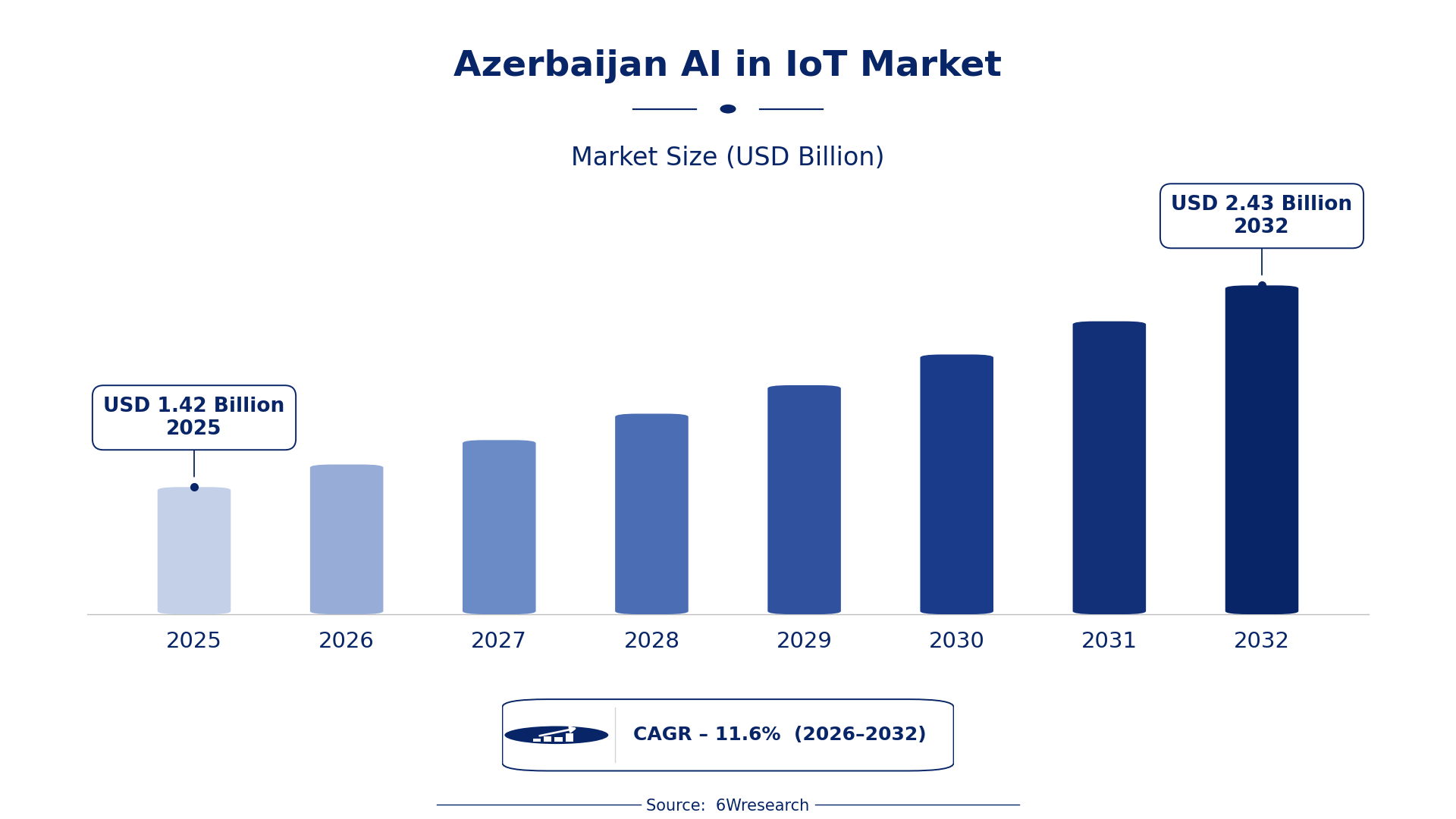
The Azerbaijan AI in IoT Market was estimated at USD 1418 Million in 2025 and is projected to reach USD 2430 Million by 2032, growing at a CAGR of 11.6% from 2026 to 2032.
Azerbaijan AI in IoT Market Synopsis
The Azerbaijan AI in IoT market is currently experiencing a surge, thanks to the rapid adoption of IoT technologies across sectors like manufacturing and healthcare. This momentum is set against a backdrop of increasing demand for AI integration, which is crucial for enhancing operational efficiency and decision-making.
Looking ahead, the market is poised for significant growth as organizations recognize the necessity of AI-enhanced IoT solutions. This shift is not just a trend but a strategic imperative for businesses aiming to maintain competitiveness in an increasingly digital economy.
Azerbaijan AI in IoT Market Year-wise Growth Rate and Key Drivers
This graph illustrates the annual growth rates of the Azerbaijan AI in IoT Market from 2021 to 2032, highlighting a steady upward trajectory and projected expansion over the forecast period.
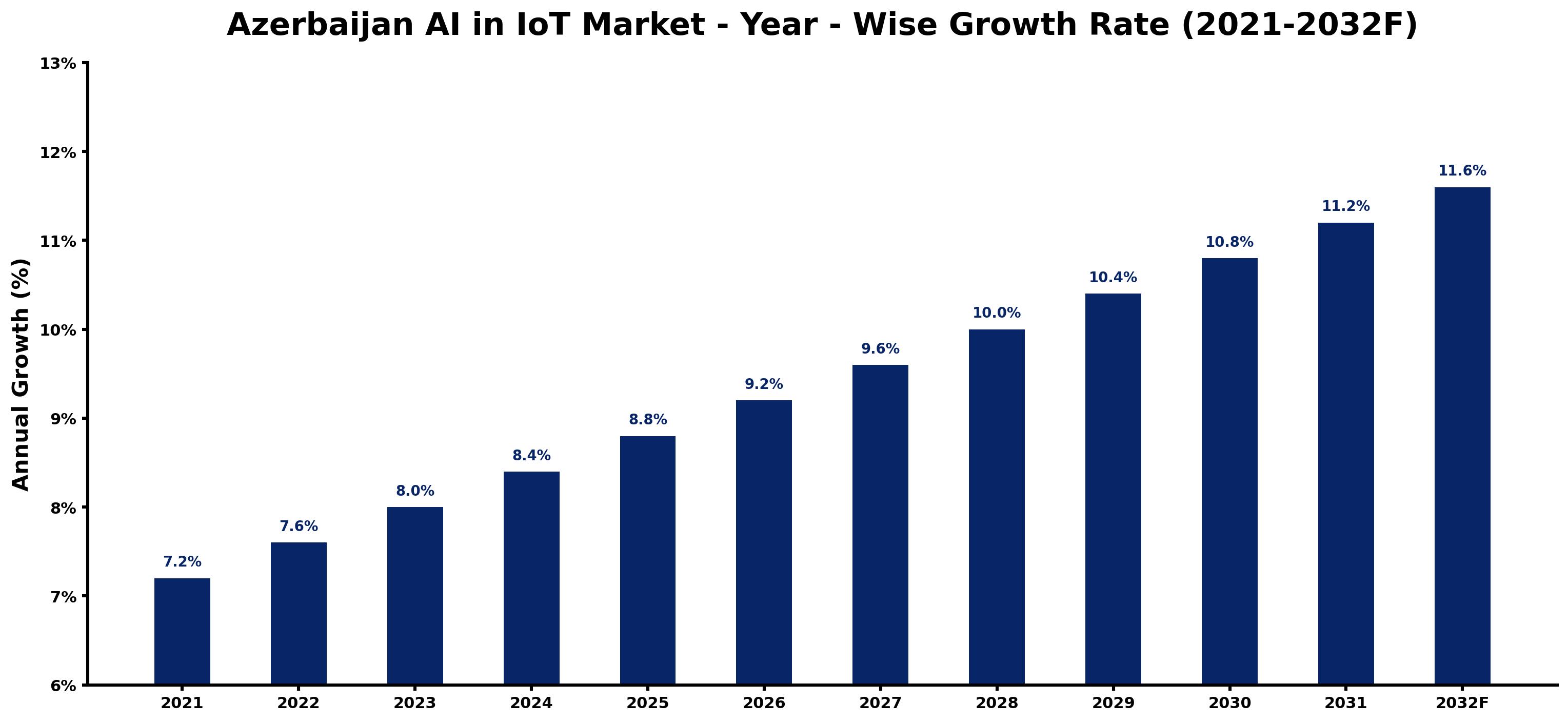
The table below presents the year‑wise growth rates along with the key drivers influencing the market
| Year | Growth Rate | Major Drivers |
| 2021 | 7.2% | Azerbaijan's digitalization strategy promotes IoT integration. |
| 2022 | 7.6% | Government incentives boost AI adoption in smart devices. |
| 2023 | 8.0% | Increasing telecom connectivity enhances IoT device deployment. |
| 2024 | 8.4% | Local startups innovate AI solutions for agriculture monitoring. |
| 2025 | 8.8% | Oil sector investments drive industrial IoT applications. |
| 2026 | 9.2% | Education programs support AI talent development in tech. |
| 2027 | 9.6% | Public sector adopts IoT for smart city initiatives. |
| 2028 | 10.0% | Partnerships with global tech firms enhance local expertise. |
| 2029 | 10.4% | Increased consumer demand for smart home technology products. |
| 2030 | 10.8% | Regulatory support for data privacy fuels AI growth. |
| 2031 | 11.2% | Urbanization drives demand for IoT-based infrastructure solutions. |
| 2032 | 11.6% | Azerbaijan's focus on energy efficiency encourages IoT innovations. |
Note: Market size estimations and growth projections presented in this report are based on 6Wresearch's proprietary forecasting methodology, utilizing the latest available industry data, government publications, and primary research inputs.
Azerbaijan AI in IoT Market Key Takeaways
Below are some of the specific key takeaways from the market, including:
- The market is projected to grow significantly, reaching USD 2430 Million by 2032.
- Government initiatives are crucial in fostering AI and IoT development, establishing regulatory frameworks for data protection.
- The integration of AI into IoT systems is enhancing automation and efficiency across various sectors.
- Investment opportunities are abundant, particularly in smart cities and industrial automation.
- Challenges such as infrastructure limitations and a shortage of skilled professionals remain, impacting growth potential.
Evaluation of Restraints in Azerbaijan AI in IoT Market
The Azerbaijan AI in IoT market faces several constraints that hinder its growth trajectory. A significant barrier is the limited infrastructure necessary for effective IoT deployment, which restricts the scalability of AI applications. Compounding this issue is a shortage of skilled professionals proficient in both AI and IoT technologies, which stifles innovation and slows down project implementation.
Data privacy and security concerns are also prominent, with companies wary of the potential risks associated with vast data generation. Additionally, the regulatory landscape lacks clarity, and the absence of standardized IoT devices complicates interoperability, ultimately impeding the creation of cohesive IoT ecosystems.
Azerbaijan AI in IoT Market Trends
Several key trends are shaping the Azerbaijan AI in IoT market. The integration of AI into IoT devices is not just enhancing efficiency; it's transforming decision-making processes across various sectors. Companies are increasingly investing in advanced AI solutions that can analyze data generated by IoT devices to improve operational performance.
Additionally, there is a notable focus on developing AI algorithms and machine learning techniques that cater specifically to IoT applications. This trend is driving advancements in predictive maintenance and real-time monitoring, further solidifying the relationship between AI and IoT in Azerbaijan.
Azerbaijan AI in IoT Market Opportunities
The Azerbaijan AI in IoT market presents numerous investment opportunities, particularly in sectors like smart cities, industrial automation, healthcare, and agriculture. The government's push for digital transformation is fostering a growing demand for AI-powered IoT solutions, aimed at enhancing productivity and sustainability.
Investors can capitalize on opportunities to develop tailored AI algorithms and connectivity solutions. Collaborating with local enterprises and government entities can also pave the way for market entry and growth, tapping into Azerbaijan's strategic position as a bridge between Europe and Asia.
Government Initiatives in the Azerbaijan AI in IoT Market
The Azerbaijani government is actively shaping the AI in IoT market through a series of strategic policies and initiatives. These efforts aim to cultivate a favorable environment for the growth of AI and IoT technologies, which are vital for the nation’s digital economy. By establishing regulatory frameworks that align with international standards, the government is ensuring a secure pathway for innovation.
- A national digital infrastructure upgrade programme initiated in 2018, aimed at enhancing connectivity for IoT applications.
- Current efforts include the rollout of a regulatory framework to bolster data protection and cybersecurity in AI and IoT solutions.
- A planned public-private initiative focused on advancing research and development in AI technologies, expected to launch in 2025.
- Ongoing partnerships with industry players to foster innovation and create a conducive ecosystem for AI and IoT deployment.
Future Insights of the Azerbaijan AI in IoT Market
The future for the Azerbaijan AI in IoT market looks bright, with substantial growth anticipated through 2032. Continued advancements in AI algorithms and the increasing number of connected devices will drive the market forward. The government's commitment to fostering a digital economy, combined with rising demand for AI-powered IoT solutions, positions Azerbaijan to leverage the convergence of these technologies for business transformation.
Azerbaijan AI in IoT Market Latest Developments
In recent months, the Azerbaijan AI in IoT market has seen notable developments that highlight its growth trajectory. Companies are increasingly focusing on integrating AI capabilities into their IoT solutions, responding to market demands for enhanced functionality and efficiency. This trend is underscored by both private sector initiatives and government support.
- A major technology vendor launched a new AI-powered IoT platform in early 2025, aimed at improving operational efficiency for manufacturing clients.
- An initiative that began in Q3 2025 is underway to establish smart city pilot projects, integrating IoT sensors with AI analytics to enhance urban management.
- In late 2025, a regional operator announced a partnership with local universities to develop AI training programs focused on IoT technologies.
- A rollout of advanced AI algorithms tailored for real-time monitoring is planned for mid-2026, targeting the healthcare sector.
Azerbaijan AI in IoT Market - Key Attractiveness of the Report
- 10 Years of Market Numbers
- Historical Data Starting from 2022 to 2025
- Base Year: 2025
- Forecast Data until 2032
- Key Performance Indicators Impacting the Market
- Major Upcoming Developments and Projects
Key Highlights of the Report:
- Azerbaijan AI in IoT Market Outlook
- Market Size of Azerbaijan AI in IoT Market, 2025
- Forecast of Azerbaijan AI in IoT Market, 2032
- Historical Data and Forecast of Azerbaijan AI in IoT Revenues & Volume for the Period 2022-2032F
- Azerbaijan AI in IoT Market Trend Evolution
- Azerbaijan AI in IoT Market Drivers and Challenges
- Azerbaijan AI in IoT Price Trends
- Azerbaijan AI in IoT Porter's Five Forces
- Azerbaijan AI in IoT Industry Life Cycle
- Historical Data and Forecast of Azerbaijan AI in IoT Market Revenues & Volume By Component for the Period 2022-2032F
- Historical Data and Forecast of Azerbaijan AI in IoT Market Revenues & Volume By Platforms for the Period 2022-2032F
- Historical Data and Forecast of Azerbaijan AI in IoT Market Revenues & Volume By Software Solutions for the Period 2022-2032F
- Historical Data and Forecast of Azerbaijan AI in IoT Market Revenues & Volume By Services for the Period 2022-2032F
- Historical Data and Forecast of Azerbaijan AI in IoT Market Revenues & Volume By Vertical for the Period 2022-2032F
- Historical Data and Forecast of Azerbaijan AI in IoT Market Revenues & Volume By Manufacturing for the Period 2022-2032F
- Historical Data and Forecast of Azerbaijan AI in IoT Market Revenues & Volume By Energy and Utilities for the Period 2022-2032F
- Historical Data and Forecast of Azerbaijan AI in IoT Market Revenues & Volume By Transportation and Mobility for the Period 2022-2032F
- Historical Data and Forecast of Azerbaijan AI in IoT Market Revenues & Volume By BFSI for the Period 2022-2032F
- Historical Data and Forecast of Azerbaijan AI in IoT Market Revenues & Volume By Government and Defense for the Period 2022-2032F
- Historical Data and Forecast of Azerbaijan AI in IoT Market Revenues & Volume By Retail for the Period 2022-2032F
- Historical Data and Forecast of Azerbaijan AI in IoT Market Revenues & Volume By Healthcare and Life Sciences for the Period 2022-2032F
- Historical Data and Forecast of Azerbaijan AI in IoT Market Revenues & Volume By Telecom for the Period 2022-2032F
- Historical Data and Forecast of Azerbaijan AI in IoT Market Revenues & Volume By Technology for the Period 2022-2032F
- Historical Data and Forecast of Azerbaijan AI in IoT Market Revenues & Volume By ML and Deep Learning for the Period 2022-2032F
- Historical Data and Forecast of Azerbaijan AI in IoT Market Revenues & Volume By NLP for the Period 2022-2032F
- Azerbaijan AI in IoT Import Export Trade Statistics
- Market Opportunity Assessment By Component
- Market Opportunity Assessment By Vertical
- Market Opportunity Assessment By Technology
- Azerbaijan AI in IoT Top Companies Market Share
- Azerbaijan AI in IoT Competitive Benchmarking By Technical and Operational Parameters
- Azerbaijan AI in IoT Company Profiles
- Azerbaijan AI in IoT Key Strategic Recommendations






































