Azerbaijan Aircraft Engine Market Size, Share & Growth Rate
The Azerbaijan Aircraft Engine Market was estimated at USD 1384 Million in 2025 and is projected to reach USD 2385 Million by 2032, growing at a CAGR of 8.1% from 2026 to 2032. This robust growth trajectory is fueled by Azerbaijan's expanding aviation sector, which benefits from its strategic geographical position connecting Europe and Asia. Furthermore, the modernization of the country's aviation fleet, supported by both governmental initiatives and foreign partnerships, is driving demand for advanced and efficient aircraft engines.
Azerbaijan Aircraft Engine Market Year-wise Growth Rate and Key Drivers
This graph highlights how the Azerbaijan Aircraft Engine Market has steadily grown over the years, supported by major growth factors.
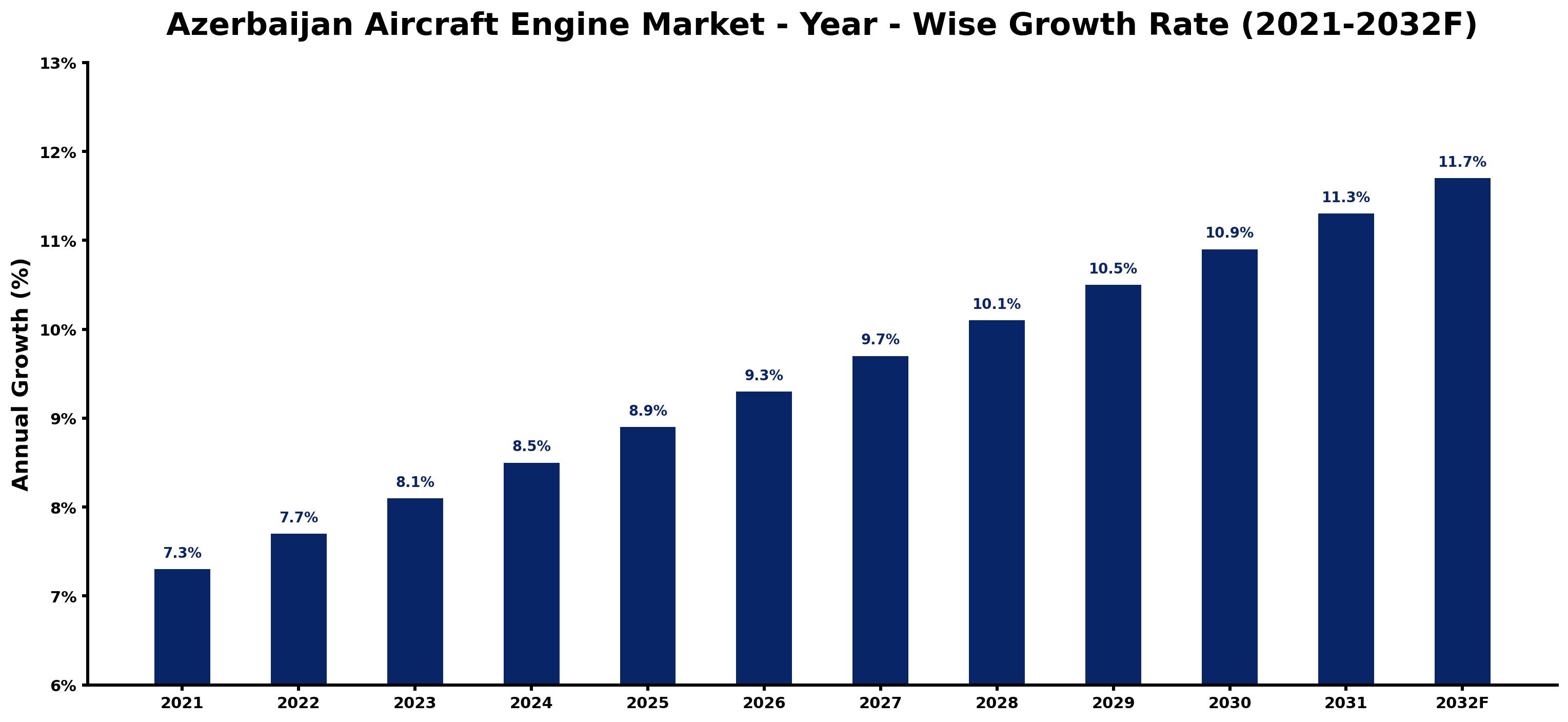
The table below presents the year‑wise growth rates along with the key drivers influencing the market
| Year | Growth Rate | Major Drivers |
| 2021 | 7.3% | Expansion of transportation and logistics networks |
| 2022 | 7.7% | Government infrastructure modernization initiatives |
| 2023 | 8.1% | Increasing smart city development projects |
| 2024 | 8.5% | Expansion of commercial construction activities |
| 2025 | 8.9% | Growing renewable energy integration projects |
| 2026 | 9.3% | Rapid growth in telecom and data center sectors |
| 2027 | 9.7% | Government infrastructure modernization initiatives |
| 2028 | 10.1% | Increasing adoption of advanced technologies |
| 2029 | 10.5% | Rapid growth in telecom and data center sectors |
| 2030 | 10.9% | Increasing smart city development projects |
| 2031 | 11.3% | Increasing industrial infrastructure investments |
| 2032 | 11.7% | Rapid growth in telecom and data center sectors |
Note - Market size estimations and growth projections presented in this report are based on 6Wresearch’s advanced forecasting approach, validated with industry datasets as of June 2026.
Azerbaijan Aircraft Engine Market Synopsis
Recent developments in the Azerbaijan Aircraft Engine Market indicate a vibrant shift towards modernization and sustainability. As local airlines seek to enhance their operational capabilities, there is a rising demand for state-of-the-art aircraft engines that meet international standards of efficiency and reduced emissions.
The influx of foreign investment and technology transfer from prominent international manufacturers is facilitating growth. This not only aids local manufacturers in enhancing their capabilities but also aligns the market with global trends, fostering a competitive landscape that is poised for long-term growth.
Azerbaijan Aircraft Engine Market Key Takeaways
- Strong projected market growth, driven by a modernization push in the aviation sector.
- Increased investment in fuel-efficient and environmentally friendly engine technologies.
- Government policies promoting local manufacturing and international collaborations.
- Emerging interest in alternative fuels, enhancing sustainability in air travel.
- Challenges in domestic manufacturing capabilities necessitating foreign partnerships.
Evaluation of Restraints in Azerbaijan Aircraft Engine Market
Despite its promising growth, the Azerbaijan Aircraft Engine Market faces notable constraints. The limited domestic manufacturing capabilities present a significant barrier, leaving the market heavily reliant on imports for advanced engine technologies and components. Additionally, stringent regulatory standards pose challenges for local manufacturers striving to meet international compliance. Economic fluctuations and geopolitical instability further complicate the landscape, impacting demand for both new aircraft and engine upgrades. Furthermore, the need for skilled workforce training remains critical to support ongoing maintenance and repairs within the sector.
Azerbaijan Aircraft Engine Market Trends
Current trends within the Azerbaijan Aircraft Engine Market are strongly oriented towards sustainability and efficiency. A marked shift towards developing fuel-efficient and low-emission engines aligns with global aviation trends aimed at minimizing environmental impact. Additionally, there is an emerging interest in alternative fuel sources, such as biofuels, indicating a progressive approach to reducing the carbon footprint associated with air travel in Azerbaijan. This trend is expected to continue driving innovation as manufacturers invest in research and development to stay ahead of regulatory demands and consumer expectations.
Azerbaijan Aircraft Engine Market Opportunities
The Azerbaijan Aircraft Engine Market offers substantial investment opportunities due to its burgeoning aviation sector. As the government prioritizes the enhancement of air connectivity and modernization of the aviation fleet, investors have the chance to engage in the manufacturing, maintenance, and distribution of aircraft engines. Collaborations with local airlines can further unlock market potential, enabling access to a growing customer base. Additionally, partnerships with global manufacturers focusing on developing advanced engine technologies tailored to regional needs present lucrative prospects for investors looking to capitalize on Azerbaijan's aviation growth.
Government Initiatives in the Azerbaijan Aircraft Engine Market
The Azerbaijan government has enacted various initiatives to bolster the aircraft engine market, reflecting its commitment to the aviation industry. Policies that offer tax incentives and subsidies to local manufacturers are aimed at fostering domestic production capabilities. Furthermore, public investments in research and development encourage innovation, while strategic partnerships with international aerospace firms facilitate technology transfer and knowledge sharing. Infrastructure enhancements are also being prioritized, aimed at increasing the competitiveness of local manufacturers and attracting foreign investment to the sector.
Future Insights of the Azerbaijan Aircraft Engine Market
Looking ahead to 2026-2032, the Azerbaijan Aircraft Engine Market is positioned for substantial growth. Increasing air travel demand, coupled with ongoing advancements in engine technology, is expected to drive market evolution. As the government continues to focus on developing a robust aerospace ecosystem, opportunities for both domestic and international manufacturers will expand. The emphasis on sustainability will further shape market dynamics, prompting investments in greener technologies and novel fuel sources, ensuring that Azerbaijan remains a pivotal player in the regional aviation landscape.
Azerbaijan Aircraft Engine Market Latest Developments (May 2025 - June 2026)
In recent months, the Azerbaijan Aircraft Engine Market has seen a surge in activity focused on technological upgrades and partnerships aimed at enhancing local manufacturing capabilities. Developments in infrastructure aimed at supporting aircraft maintenance and repair facilities reflect the government's commitment to fostering a competitive aviation sector. Additionally, industry stakeholders are actively participating in global aerospace exhibitions to showcase innovations, signaling a collaborative approach to positioning Azerbaijan as a key player in the international aviation market.
Azerbaijan Aircraft Engine Market - Key Attractiveness of the Report
- 10 Years of Market Numbers
- Historical Data Starting from 2022 to 2025
- Base Year: 2025
- Forecast Data until 2032
- Key Performance Indicators Impacting the Market
- Major Upcoming Developments and Projects
Key Highlights of the Report:
- Azerbaijan Aircraft Engine Market Outlook
- Market Size of Azerbaijan Aircraft Engine Market, 2025
- Forecast of Azerbaijan Aircraft Engine Market, 2032
- Historical Data and Forecast of Azerbaijan Aircraft Engine Revenues & Volume for the Period 2022-2032F
- Azerbaijan Aircraft Engine Market Trend Evolution
- Azerbaijan Aircraft Engine Market Drivers and Challenges
- Azerbaijan Aircraft Engine Price Trends
- Azerbaijan Aircraft Engine Porter's Five Forces
- Azerbaijan Aircraft Engine Industry Life Cycle
- Historical Data and Forecast of Azerbaijan Aircraft Engine Market Revenues & Volume By Type for the Period 2022-2032F
- Historical Data and Forecast of Azerbaijan Aircraft Engine Market Revenues & Volume By Turboprop for the Period 2022-2032F
- Historical Data and Forecast of Azerbaijan Aircraft Engine Market Revenues & Volume By Turbofan for the Period 2022-2032F
- Historical Data and Forecast of Azerbaijan Aircraft Engine Market Revenues & Volume By Turboshaft for the Period 2022-2032F
- Historical Data and Forecast of Azerbaijan Aircraft Engine Market Revenues & Volume By Piston Engine for the Period 2022-2032F
- Historical Data and Forecast of Azerbaijan Aircraft Engine Market Revenues & Volume By Application for the Period 2022-2032F
- Historical Data and Forecast of Azerbaijan Aircraft Engine Market Revenues & Volume By Military Aviation for the Period 2022-2032F
- Historical Data and Forecast of Azerbaijan Aircraft Engine Market Revenues & Volume By Commercial Aviation for the Period 2022-2032F
- Historical Data and Forecast of Azerbaijan Aircraft Engine Market Revenues & Volume By General Aviation for the Period 2022-2032F
- Historical Data and Forecast of Azerbaijan Aircraft Engine Market Revenues & Volume By Platform for the Period 2022-2032F
- Historical Data and Forecast of Azerbaijan Aircraft Engine Market Revenues & Volume By Fixed Wing for the Period 2022-2032F
- Historical Data and Forecast of Azerbaijan Aircraft Engine Market Revenues & Volume By Rotary Wing for the Period 2022-2032F
- Azerbaijan Aircraft Engine Import Export Trade Statistics
- Market Opportunity Assessment By Type
- Market Opportunity Assessment By Application
- Market Opportunity Assessment By Platform
- Azerbaijan Aircraft Engine Top Companies Market Share
- Azerbaijan Aircraft Engine Competitive Benchmarking By Technical and Operational Parameters
- Azerbaijan Aircraft Engine Company Profiles
- Azerbaijan Aircraft Engine Key Strategic Recommendations






































