Azerbaijan Anti Reflective Glass Market Size, Share & Growth Rate
The Azerbaijan Anti Reflective Glass Market was estimated at USD 531 Million in 2025 and is projected to reach USD 895 Million by 2032, growing at a CAGR of 7.7% from 2026 to 2032. This growth trajectory is largely fueled by the expanding construction sector, where the demand for energy-efficient building materials is surging. Additionally, as technological advancements integrate into the automotive and electronics industries, the need for high-performance anti-reflective glass continues to rise.
Azerbaijan Anti Reflective Glass Market Year-wise Growth Rate and Key Drivers
This graph highlights how the Azerbaijan Anti Reflective Glass Market has steadily grown over the years, supported by major growth factors.
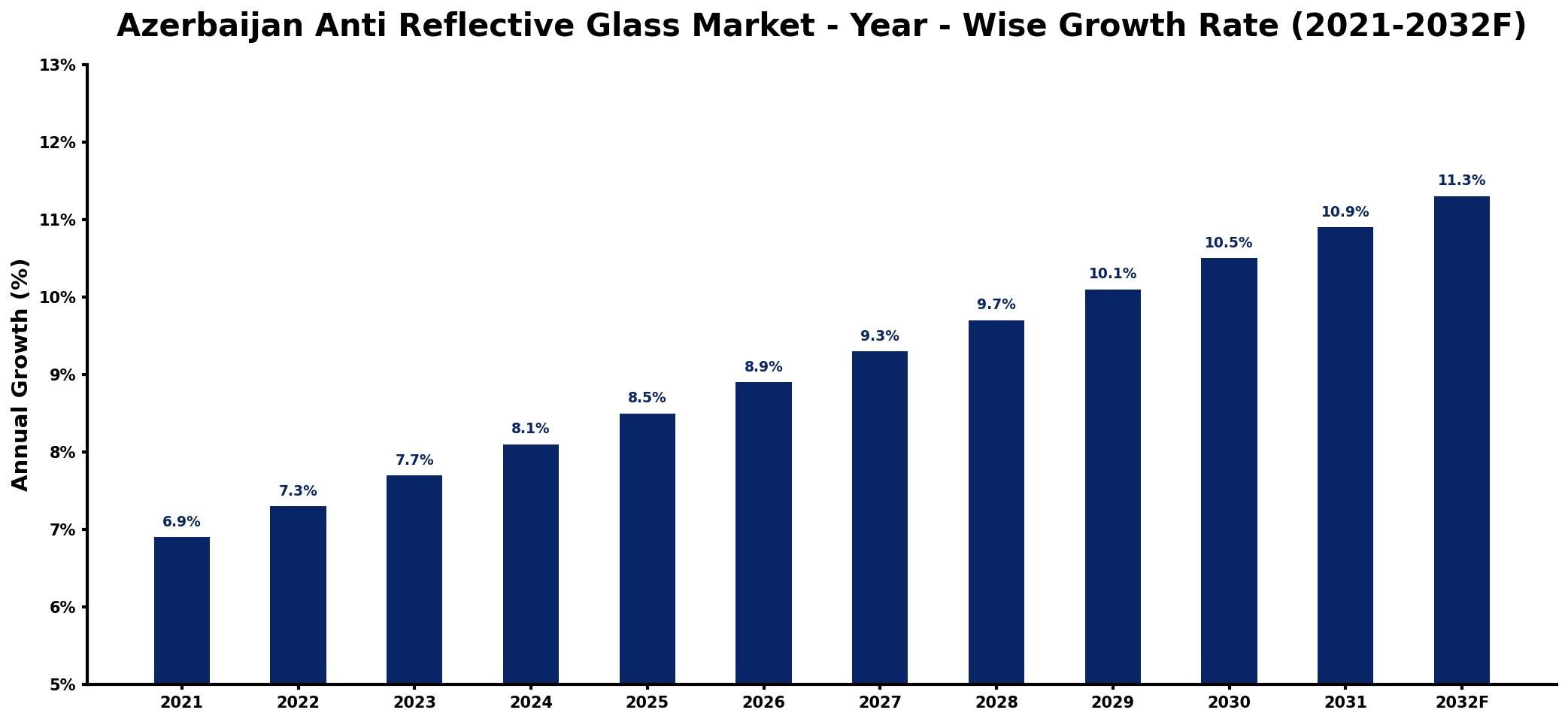
The table below presents the year‑wise growth rates along with the key drivers influencing the market
| Year | Growth Rate | Major Drivers |
| 2021 | 6.9% | Rising demand for energy efficiency |
| 2022 | 7.3% | Growth in construction sector investments |
| 2023 | 7.7% | Increase in architectural design trends |
| 2024 | 8.1% | Expansion of renewable energy projects |
| 2025 | 8.5% | Surge in automotive safety regulations |
| 2026 | 8.9% | Technological advancements in manufacturing |
| 2027 | 9.3% | Growing popularity of smart buildings |
| 2028 | 9.7% | increased overall sector activity |
| 2029 | 10.1% | Demand from electronics industry rising |
| 2030 | 10.5% | Investment in sustainable building materials |
| 2031 | 10.9% | Emergence of new market players |
| 2032 | 11.3% | Focus on luxury interior designs |
Note: Market size estimations and growth projections presented in this report are based on 6Wresearch's proprietary forecasting methodology, utilizing the latest available industry data, government publications, and primary research inputs.
Azerbaijan Anti Reflective Glass Market Synopsis
The adoption of anti-reflective glass in Azerbaijan is predominantly driven by the booming construction market, particularly for high-rise buildings. Developers are increasingly focused on sustainable and aesthetically pleasing materials, making anti-reflective glass a preferred choice for modern architecture.
Furthermore, the automotive sector is also experiencing a notable uptick in demand for anti-reflective glass applications in vehicle windshields and windows. This surge stems from a growing consumer preference for enhanced visibility and safety features in vehicles, aligning with global automotive trends.
Azerbaijan Anti Reflective Glass Market Key Takeaways
- The market is benefiting from increased awareness of energy efficiency and sustainability in construction projects.
- Significant growth in the electronics sector, particularly in displays and touchscreens, is driving demand.
- Investments in advanced technologies are leading to the development of superior anti-reflective glass products.
- Key government policies are fostering local manufacturing and innovation within the market.
- Price sensitivity remains a challenge, potentially slowing down broader market adoption.
Evaluation of Restraints in Azerbaijan Anti Reflective Glass Market
While the market holds significant potential, certain restraints could hinder progress. Limited awareness of the advantages of anti-reflective glass among consumers and businesses may impede adoption rates. Additionally, the higher price point of anti-reflective glass compared to traditional options can deter price-sensitive customers. The competition from alternative specialty glass products necessitates continuous innovation and differentiation, presenting further challenges. Lastly, ensuring a consistent supply of high-quality raw materials at competitive prices is crucial for sustaining growth in this market.
Azerbaijan Anti Reflective Glass Market Trends
Several emerging trends are shaping the Azerbaijan anti-reflective glass market. A notable trend is the increasing focus on integrating energy-efficient solutions in construction, prompting builders to adopt anti-reflective glass to enhance visibility and reduce glare. Moreover, advancements in product durability and thermal performance are being prioritized, addressing the evolving needs of both commercial and residential sectors. The push for innovation in anti-reflective coatings is creating a competitive landscape where differentiation is vital.
Azerbaijan Anti Reflective Glass Market Opportunities
Investment opportunities in the Azerbaijan anti-reflective glass market are promising, particularly as the demand for high-quality glass escalates across various sectors. The construction industry's rapid expansion and the automotive sector's ongoing transition towards innovative safety features present significant avenues for growth. Collaborations with local manufacturers and investments in R&D can lead to product diversification, ensuring alignment with modern consumer preferences and sustainable practices.
Government Initiatives in the Azerbaijan Anti Reflective Glass Market
The Azerbaijani government has introduced a series of initiatives to regulate the anti-reflective glass market effectively. These include the establishment of quality standards mandated by the State Committee for Standardization, Metrology, and Patents. Furthermore, tariffs and import restrictions are imposed to protect domestic manufacturers, while incentives and subsidies are offered to promote innovation and development in the sector. Such initiatives not only enhance product quality but also bolster local production capabilities.
Future Insights of the Azerbaijan Anti Reflective Glass Market
Looking ahead to 2026-2032, the Azerbaijan anti-reflective glass market appears poised for continued expansion. The increasing demand for superior glass products across diverse industries, coupled with growing awareness of their benefits, will further propel market growth. Additionally, technological advancements will lead to innovative solutions that meet evolving consumer expectations. With governmental support aimed at encouraging sustainable practices, the market is set to flourish in the coming years.
Azerbaijan Anti Reflective Glass Market Latest Developments (2025 - 2026)
Recent developments in the Azerbaijan anti-reflective glass market indicate a strong focus on enhancing product capabilities and expanding application areas. Industry players are increasingly prioritizing research and development to innovate new glass solutions that cater to emerging needs. Furthermore, collaborations among manufacturers are fostering advancements in anti-reflective technologies, aimed at meeting the growing demands of both the construction and automotive sectors.
Azerbaijan Anti Reflective Glass Market - Key Attractiveness of the Report
- 10 Years of Market Numbers
- Historical Data Starting from 2022 to 2025
- Base Year: 2025
- Forecast Data until 2032
- Key Performance Indicators Impacting the Market
- Major Upcoming Developments and Projects
Key Highlights of the Report:
- Azerbaijan Anti Reflective Glass Market Outlook
- Market Size of Azerbaijan Anti Reflective Glass Market, 2025
- Forecast of Azerbaijan Anti Reflective Glass Market, 2032
- Historical Data and Forecast of Azerbaijan Anti Reflective Glass Revenues & Volume for the Period 2022-2032F
- Azerbaijan Anti Reflective Glass Market Trend Evolution
- Azerbaijan Anti Reflective Glass Market Drivers and Challenges
- Azerbaijan Anti Reflective Glass Price Trends
- Azerbaijan Anti Reflective Glass Porter's Five Forces
- Azerbaijan Anti Reflective Glass Industry Life Cycle
- Historical Data and Forecast of Azerbaijan Anti Reflective Glass Market Revenues & Volume By Type for the Period 2022-2032F
- Historical Data and Forecast of Azerbaijan Anti Reflective Glass Market Revenues & Volume By Double Layers for the Period 2022-2032F
- Historical Data and Forecast of Azerbaijan Anti Reflective Glass Market Revenues & Volume By Four Layers for the Period 2022-2032F
- Historical Data and Forecast of Azerbaijan Anti Reflective Glass Market Revenues & Volume By Others for the Period 2022-2032F
- Historical Data and Forecast of Azerbaijan Anti Reflective Glass Market Revenues & Volume By Application for the Period 2022-2032F
- Historical Data and Forecast of Azerbaijan Anti Reflective Glass Market Revenues & Volume By Architectural Windows for the Period 2022-2032F
- Historical Data and Forecast of Azerbaijan Anti Reflective Glass Market Revenues & Volume By Instrumentation Windows for the Period 2022-2032F
- Historical Data and Forecast of Azerbaijan Anti Reflective Glass Market Revenues & Volume By Electronic Displays for the Period 2022-2032F
- Historical Data and Forecast of Azerbaijan Anti Reflective Glass Market Revenues & Volume By Picture Framing Glass for the Period 2022-2032F
- Historical Data and Forecast of Azerbaijan Anti Reflective Glass Market Revenues & Volume By Showcase Glass for the Period 2022-2032F
- Historical Data and Forecast of Azerbaijan Anti Reflective Glass Market Revenues & Volume By Cold Storage Displays for the Period 2022-2032F
- Historical Data and Forecast of Azerbaijan Anti Reflective Glass Market Revenues & Volume By Lamps Glass for the Period 2022-2032F
- Historical Data and Forecast of Azerbaijan Anti Reflective Glass Market Revenues & Volume By Others for the Period 2022-2032F
- Azerbaijan Anti Reflective Glass Import Export Trade Statistics
- Market Opportunity Assessment By Type
- Market Opportunity Assessment By Application
- Azerbaijan Anti Reflective Glass Top Companies Market Share
- Azerbaijan Anti Reflective Glass Competitive Benchmarking By Technical and Operational Parameters
- Azerbaijan Anti Reflective Glass Company Profiles
- Azerbaijan Anti Reflective Glass Key Strategic Recommendations






































