Azerbaijan Apiculture Market Size, Share & Growth Rate
The Azerbaijan Apiculture Market was estimated at USD 404 Million in 2025 and is projected to reach USD 673 Million by 2032, growing at a CAGR of 7.6% from 2026 to 2032. This positive trajectory is primarily driven by the increasing consumer demand for natural and organic honey products, both locally and in international markets. The government's initiatives aimed at enhancing production capabilities further bolster this growth, establishing a robust foundation for sustainable apiculture practices.
Azerbaijan Apiculture Market Year-wise Growth Rate and Key Drivers
This graph highlights how the Azerbaijan Apiculture Market has steadily grown over the years, supported by major growth factors.
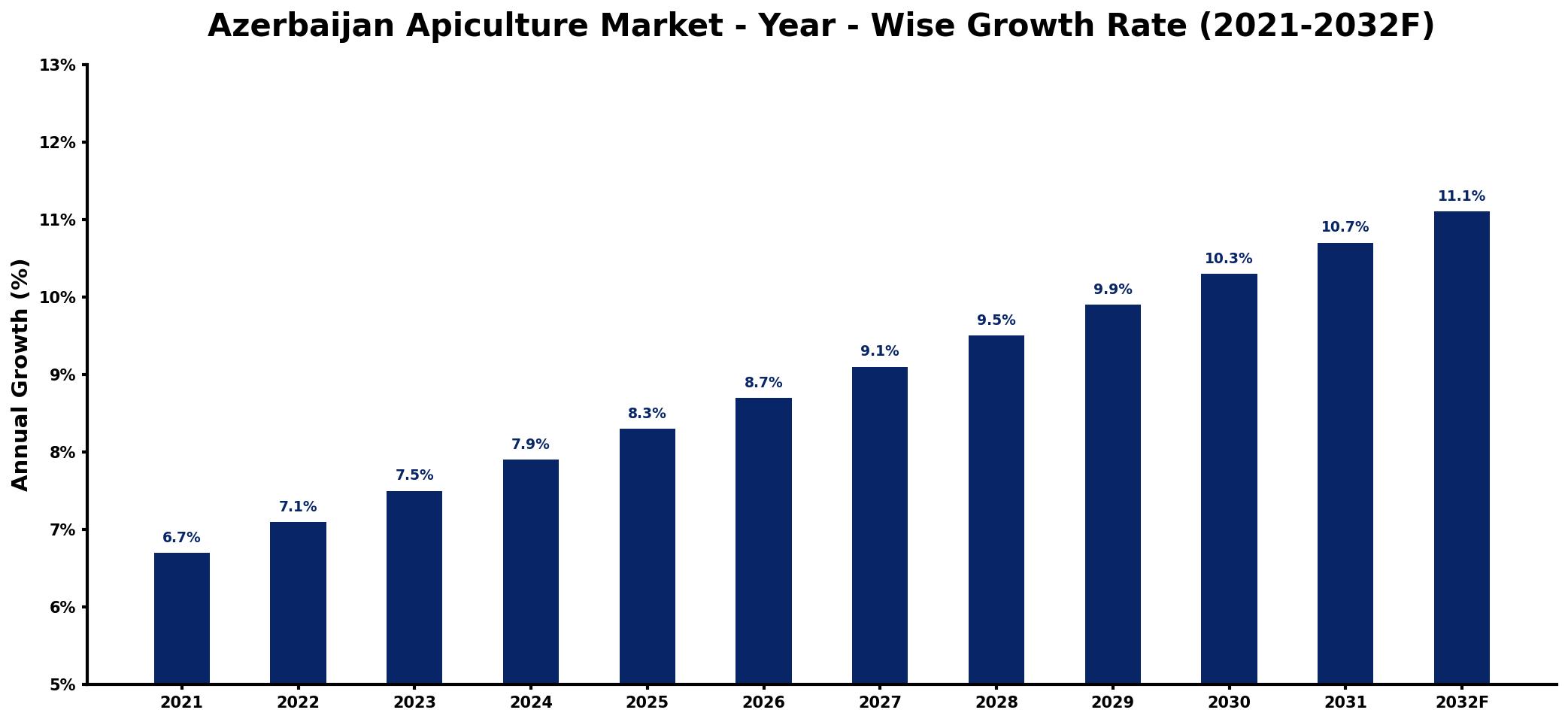
The table below presents the year‑wise growth rates along with the key drivers influencing the market
| Year | Growth Rate | Major Drivers |
| 2021 | 6.7% | increased consumer interest in honey |
| 2022 | 7.1% | growing organic food market demand |
| 2023 | 7.5% | expanding health and wellness trends |
| 2024 | 7.9% | rising investment in local agriculture |
| 2025 | 8.3% | enhanced distribution network efficiency |
| 2026 | 8.7% | increased export opportunities for products |
| 2027 | 9.1% | growing popularity of natural sweeteners |
| 2028 | 9.5% | increased awareness of pollinator importance |
| 2029 | 9.9% | expanding e-commerce sales channels |
| 2030 | 10.3% | rising demand for bee products |
| 2031 | 10.7% | increased government support initiatives |
| 2032 | 11.1% | growing educational programs on sustainability |
Note: Market size estimations and growth projections presented in this report are based on 6Wresearch's proprietary forecasting methodology, utilizing the latest available industry data, government publications, and primary research inputs.
Azerbaijan Apiculture Market Synopsis
The Azerbaijan apiculture market is currently shaped by a significant emphasis on high-quality honey production. This emphasis is supported by the country's rich biodiversity and favorable climatic conditions, which are ideal for various honeybee species and the cultivation of diverse floral sources. Additionally, there is a notable rise in consumer preferences for organic and natural honey, prompting beekeepers to adapt their practices.
The government plays a critical role in promoting beekeeping through supportive policies and programs aimed at improving honey quality and production levels. Furthermore, with ongoing technological advancements in beekeeping practices, there is a concerted effort among local producers to modernize operations, thereby enhancing overall market competitiveness.
Azerbaijan Apiculture Market Key Takeaways
- The market is projected to grow significantly, reaching USD 673 Million by 2032.
- Consumer trends are shifting towards organic and sustainable honey products.
- Government support is pivotal in boosting production and quality standards.
- Emerging technologies are being integrated into beekeeping practices for optimization.
- Investment opportunities in value-added bee products are on the rise.
Evaluation of Restraints in Azerbaijan Apiculture Market
Despite the promising outlook, the Azerbaijan apiculture market faces several challenges that inhibit its growth. Limited access to modern beekeeping technologies hampers productivity and efficiency, while inadequate training for beekeepers contributes to inconsistent honey quality. Furthermore, the absence of stringent regulations affects market confidence, and the environmental threats posed by climate change and pesticide use endanger bee populations. Addressing these constraints is essential for the long-term sustainability of the apiculture industry in Azerbaijan.
Azerbaijan Apiculture Market Trends
The Azerbaijan apiculture market is witnessing several noteworthy trends that are reshaping its landscape. A pronounced movement towards organic honey production is evident as consumers become more health-conscious and seek natural products. Additionally, technology is increasingly being utilized in beekeeping, with innovations such as hive monitoring systems enhancing productivity and ensuring the health of bee populations. There is also a growing interest in diverse honey varieties, with beekeepers exploring unique floral sources and processing methods to cater to specialty markets.
Azerbaijan Apiculture Market Opportunities
Investment opportunities in the Azerbaijan apiculture market are abundant, particularly in areas such as high-quality honey production, which remains in high demand. The integration of modern technologies in beekeeping practices offers a pathway to improve efficiency and yield. Furthermore, the potential for developing value-added products like beeswax, royal jelly, and propolis is significant, appealing to both health and cosmetic markets. Collaborations with local beekeepers to enhance their operational practices and facilitate market access can also yield lucrative returns for investors.
Government Initiatives in the Azerbaijan Apiculture Market
The government of Azerbaijan has been proactive in fostering the development of the apiculture market. Key initiatives include the provision of subsidies and financial support to beekeepers, alongside training programs aimed at improving skills and knowledge within the sector. Additionally, the government promotes research and development efforts focused on enhancing honey production standards. Regulatory frameworks have also been established to ensure product safety and quality, which are critical for both domestic and international market competitiveness.
Future Insights of the Azerbaijan Apiculture Market
Looking forward to the period between 2026 and 2032, the Azerbaijan apiculture market is set to thrive, propelled by increasing demand for honey and bee products. The countrys favorable environmental conditions, coupled with a supportive governmental framework and growing consumer awareness regarding health benefits, are likely to drive market growth. Nevertheless, it will be essential for stakeholders to address ongoing challenges such as climate change and competition from imported honey to fully capitalize on these opportunities.
Azerbaijan Apiculture Market Latest Developments (2025 - 2026)
Recent developments in the Azerbaijan apiculture market have shown a notable increase in technological adoption among beekeepers, with many starting to implement data-driven approaches to hive management. Additionally, there has been a concerted effort to enhance honey quality through improved processing techniques. The government continues to play a pivotal role, announcing new initiatives aimed at sustainability and environmental protection, ensuring that the apiculture sector remains resilient in the face of challenges.
Azerbaijan Apiculture Market - Key Attractiveness of the Report
- 10 Years of Market Numbers
- Historical Data Starting from 2022 to 2025
- Base Year: 2025
- Forecast Data until 2032
- Key Performance Indicators Impacting the Market
- Major Upcoming Developments and Projects
Key Highlights of the Report:
- Azerbaijan Apiculture Market Outlook
- Market Size of Azerbaijan Apiculture Market, 2025
- Forecast of Azerbaijan Apiculture Market, 2032
- Historical Data and Forecast of Azerbaijan Apiculture Revenues & Volume for the Period 2022-2032F
- Azerbaijan Apiculture Market Trend Evolution
- Azerbaijan Apiculture Market Drivers and Challenges
- Azerbaijan Apiculture Price Trends
- Azerbaijan Apiculture Porter's Five Forces
- Azerbaijan Apiculture Industry Life Cycle
- Historical Data and Forecast of Azerbaijan Apiculture Market Revenues & Volume By Product Type for the Period 2022-2032F
- Historical Data and Forecast of Azerbaijan Apiculture Market Revenues & Volume By Honey for the Period 2022-2032F
- Historical Data and Forecast of Azerbaijan Apiculture Market Revenues & Volume By Beeswax for the Period 2022-2032F
- Historical Data and Forecast of Azerbaijan Apiculture Market Revenues & Volume By Live-bees for the Period 2022-2032F
- Historical Data and Forecast of Azerbaijan Apiculture Market Revenues & Volume By Others for the Period 2022-2032F
- Historical Data and Forecast of Azerbaijan Apiculture Market Revenues & Volume By Application for the Period 2022-2032F
- Historical Data and Forecast of Azerbaijan Apiculture Market Revenues & Volume By Medical for the Period 2022-2032F
- Historical Data and Forecast of Azerbaijan Apiculture Market Revenues & Volume By Food Beverages for the Period 2022-2032F
- Historical Data and Forecast of Azerbaijan Apiculture Market Revenues & Volume By Cosmetics for the Period 2022-2032F
- Historical Data and Forecast of Azerbaijan Apiculture Market Revenues & Volume By Others for the Period 2022-2032F
- Azerbaijan Apiculture Import Export Trade Statistics
- Market Opportunity Assessment By Product Type
- Market Opportunity Assessment By Application
- Azerbaijan Apiculture Top Companies Market Share
- Azerbaijan Apiculture Competitive Benchmarking By Technical and Operational Parameters
- Azerbaijan Apiculture Company Profiles
- Azerbaijan Apiculture Key Strategic Recommendations






































