Azerbaijan Architectural Hardware Market Summary
The azerbaijan architectural hardware market was estimated at USD 1269 Million in 2025 and is projected to reach USD 2104 Million by 2032, growing at a CAGR of 8.6% from 2026 to 2032.
Azerbaijan Architectural Hardware Market Year-wise Growth Rate and Key Drivers
This graph highlights how the Azerbaijan Architectural Hardware Market has steadily grown over the past five years, supported by major growth factors.
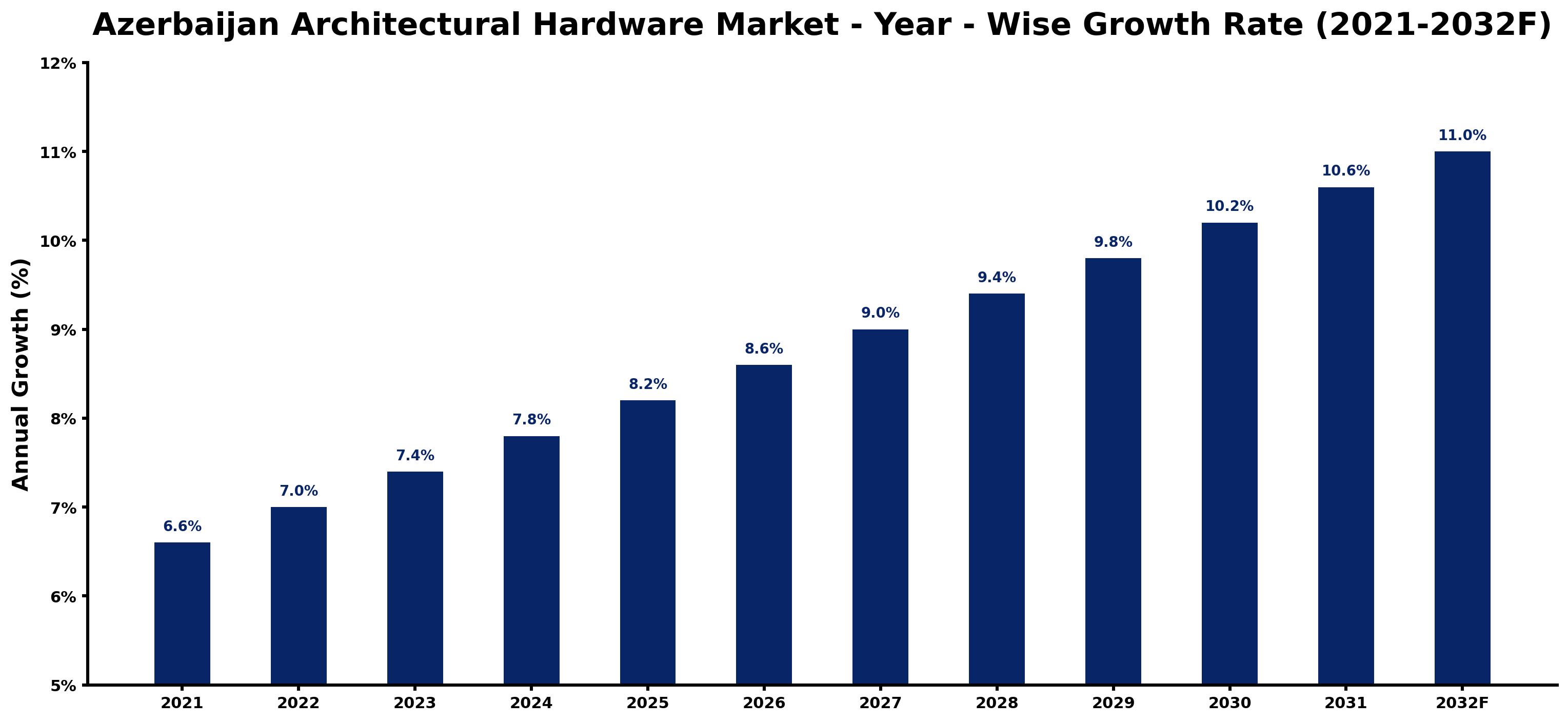
The table below presents the year wise growth rates along with the key drivers influencing the market
| Year | Growth Rate | Major Drivers |
| 2021 | 6.6% | Post-pandemic recovery fueled increased investments in residential and commercial construction. |
| 2022 | 7.0% | Emerging real estate projects highlighted the need for modern architectural hardware solutions. |
| 2023 | 7.4% | Construction sector growth emphasized the importance of quality materials in building design. |
| 2024 | 7.8% | Urbanization trends created greater demand for innovative hardware in Azerbaijan's cities. |
| 2025 | 8.2% | Local manufacturers began collaborating with global firms to enhance product offerings. |
| 2026 | 8.6% | Government policies supporting infrastructure projects encouraged architectural hardware innovations. |
| 2027 | 9.0% | Technological advancements in production improved product durability and design complexity. |
| 2028 | 9.4% | Sustainability concerns drove interest in eco-friendly architectural hardware options. |
| 2029 | 9.8% | Consumer preferences shifted towards customizable solutions for unique architectural needs. |
| 2030 | 10.2% | Regional competitors prompted local firms to enhance service quality and product range. |
| 2031 | 10.6% | Increased foreign investments supported technological upgrades in local manufacturing plants. |
| 2032 | 11.0% | The thriving tourism sector required sophisticated designs for hospitality and leisure buildings. |
Note - Market size estimations and growth projections presented in this report are based on 6Wresearch's advanced forecasting approach, validated with industry datasets as of June 2026.
Azerbaijan Architectural Hardware Market Synopsis
The Azerbaijan Architectural Hardware Market is projected to reach 8.6% and witness significant growth during the forecast period (2026-2032). This expansion is primarily fueled by robust construction activities across various sectors, including residential, commercial, and industrial. The increasing urbanization coupled with infrastructural development significantly drives demand for architectural hardware products such as door handles, locks, hinges, and window fittings. Furthermore, there is a growing emphasis on aesthetic appeal and security features in building designs, propelling the market toward innovative and durable hardware solutions.
Azerbaijan Architectural Hardware Market Growth Drivers
The growth of the Azerbaijan Architectural Hardware Market can be attributed to several key drivers:
- The escalation of urbanization trends creates a higher demand for residential and commercial projects, thereby increasing the consumption of architectural hardware.
- Government initiatives aimed at boosting the construction sector encourage investment in infrastructure, positively impacting the market for architectural hardware.
- Consumer preferences are shifting towards high-quality, energy-efficient, and aesthetically pleasing hardware products that align with modern architectural designs.
- Technological advancements in security solutions, including smart locks and automated systems, are opening new avenues for product development in the hardware sector.
- The rise of sustainability as a priority in building practices is generating demand for eco-friendly hardware alternatives, further driving market growth.
Azerbaijan Architectural Hardware Market Trends and Opportunities
The Azerbaijan Architectural Hardware Market is characterized by several emerging trends that present numerous opportunities:
- There is a noticeable shift towards smart architectural hardware solutions, including digital locks and app-controlled access systems, reflecting consumer interest in integrating technology into their environments.
- The trend toward minimalistic design is gaining traction, with architects and designers favoring sleek, unobtrusive hardware that enhances overall aesthetics.
- Customization is increasingly preferred; consumers are showing interest in personalized hardware solutions that cater to their specific needs and design preferences.
- Collaboration with designers and builders is becoming common, allowing for the innovation of bespoke hardware products that fit unique architectural requirements.
- The focus on sustainable practices is encouraging the adoption of materials and designs that prioritize longevity and environmental responsibility.
Azerbaijan Architectural Hardware Market Challenges and Restraints
Despite its growth potential, the Azerbaijan Architectural Hardware Market faces several challenges:
- The reliance on imported architectural hardware can lead to supply chain vulnerabilities, impacting availability and potentially resulting in delays in project timelines.
- Intense competition among local and international suppliers complicates the market landscape, often forcing companies to lower prices, which can affect profitability.
- There is a pervasive issue with counterfeit products in the market, undermining the credibility of legitimate manufacturers and eroding consumer trust.
- Fluctuating raw material prices and unstable currency exchange rates can adversely affect production costs, complicating pricing strategies for suppliers.
- Regulatory compliance and barriers can hinder innovation and market entry for new players, thereby restricting competition.
Azerbaijan Architectural Hardware Market Investment Opportunities
The Azerbaijan Architectural Hardware Market presents several compelling investment opportunities:
- Investing in the production and distribution of modern architectural hardware products aligns well with the ongoing growth in the construction sector.
- The rising demand for sustainable building practices offers a niche for eco-friendly hardware solutions, appealing to environmentally-conscious consumers and builders.
- Opportunities exist for partnerships with local construction firms and architects to provide tailored hardware solutions that enhance the functionality and aesthetics of their projects.
- Investing in research and development can lead to the creation of innovative products that cater to the evolving preferences of consumers focused on smart technology.
- The growing trend of customization presents a high potential market segment for businesses that can offer bespoke hardware solutions tailored to specific project needs.
Azerbaijan Architectural Hardware Market Government Investment and Initiatives
Government policies significantly influence the Azerbaijan Architectural Hardware Market, centering on construction standards and safety regulations. Recent initiatives have focused on enhancing quality control for architectural hardware, particularly in high-rise and public infrastructure projects. These regulations aim to ensure that all products meet stringent safety standards, fostering consumer confidence in the market. Additionally, policies promoting local manufacturing have emerged, aiming to boost domestic production capabilities and reduce reliance on imports. Public spending on infrastructure development is also expected to create a favorable environment for market growth, encouraging investment in local architectural hardware manufacturing and innovation.
Azerbaijan Architectural Hardware Market Latest Developments (May 2025 - June 2026)
Between May 2025 and June 2026, the Azerbaijan Architectural Hardware Market has witnessed several notable developments. The trend toward smart technology in architectural hardware accelerated as manufacturers introduced new products enhancing security and convenience. Additionally, collaborations between hardware suppliers and construction firms increased, resulting in customized hardware solutions that address specific project requirements. Efforts to combat counterfeit products gained momentum, with industry stakeholders advocating for stricter regulations and consumer awareness initiatives. Furthermore, the push for sustainability resulted in more manufacturers investing in eco-friendly production practices, aligning with the broader trends in global construction and design.
Azerbaijan Architectural Hardware Market - Key Attractiveness of the Report
- 10 Years of Market Numbers
- Historical Data Starting from 2022 to 2025
- Base Year: 2025
- Forecast Data until 2032
- Key Performance Indicators Impacting the Market
- Major Upcoming Developments and Projects
Key Highlights of the Report:
- Azerbaijan Architectural Hardware Market Outlook
- Market Size of Azerbaijan Architectural Hardware Market, 2025
- Forecast of Azerbaijan Architectural Hardware Market, 2032F
- Historical Data and Forecast of Azerbaijan Architectural Hardware Revenues & Volume for the Period 2022-2032F
- Azerbaijan Architectural Hardware Market Trend Evolution
- Azerbaijan Architectural Hardware Market Drivers and Challenges
- Azerbaijan Architectural Hardware Price Trends
- Azerbaijan Architectural Hardware Porter's Five Forces
- Azerbaijan Architectural Hardware Industry Life Cycle
- Historical Data and Forecast of Azerbaijan Architectural Hardware Market Revenues & Volume By Application for the Period 2022-2032F
- Historical Data and Forecast of Azerbaijan Architectural Hardware Market Revenues & Volume By Doors for the Period 2022-2032F
- Historical Data and Forecast of Azerbaijan Architectural Hardware Market Revenues & Volume By Windows for the Period 2022-2032F
- Historical Data and Forecast of Azerbaijan Architectural Hardware Market Revenues & Volume By Furniture for the Period 2022-2032F
- Historical Data and Forecast of Azerbaijan Architectural Hardware Market Revenues & Volume By Shower for the Period 2022-2032F
- Historical Data and Forecast of Azerbaijan Architectural Hardware Market Revenues & Volume By End-user for the Period 2022-2032F
- Historical Data and Forecast of Azerbaijan Architectural Hardware Market Revenues & Volume By Commercial for the Period 2022-2032F
- Historical Data and Forecast of Azerbaijan Architectural Hardware Market Revenues & Volume By Industrial for the Period 2022-2032F
- Historical Data and Forecast of Azerbaijan Architectural Hardware Market Revenues & Volume By Residential for the Period 2022-2032F
- Azerbaijan Architectural Hardware Import Export Trade Statistics
- Market Opportunity Assessment By Application
- Market Opportunity Assessment By End-user
- Azerbaijan Architectural Hardware Top Companies Market Share
- Azerbaijan Architectural Hardware Competitive Benchmarking By Technical and Operational Parameters
- Azerbaijan Architectural Hardware Company Profiles
- Azerbaijan Architectural Hardware Key Strategic Recommendations






































