Azerbaijan Artichokes Market Size, Share & Growth Rate
The Azerbaijan Artichokes Market was estimated at USD 1248 Million in 2025 and is projected to reach USD 2235 Million by 2032, growing at a CAGR of 8.7% from 2026 to 2032. This robust growth trajectory is fueled by a surge in consumer awareness surrounding the health benefits of artichokes, alongside increasing culinary applications. Farmers are responding to this demand, ramping up production efforts, while the government's supportive policies further enhance market viability.
Azerbaijan Artichokes Market Year-wise Growth Rate and Key Drivers
This graph highlights how the Azerbaijan Artichokes Market has steadily grown over the years, supported by major growth factors.
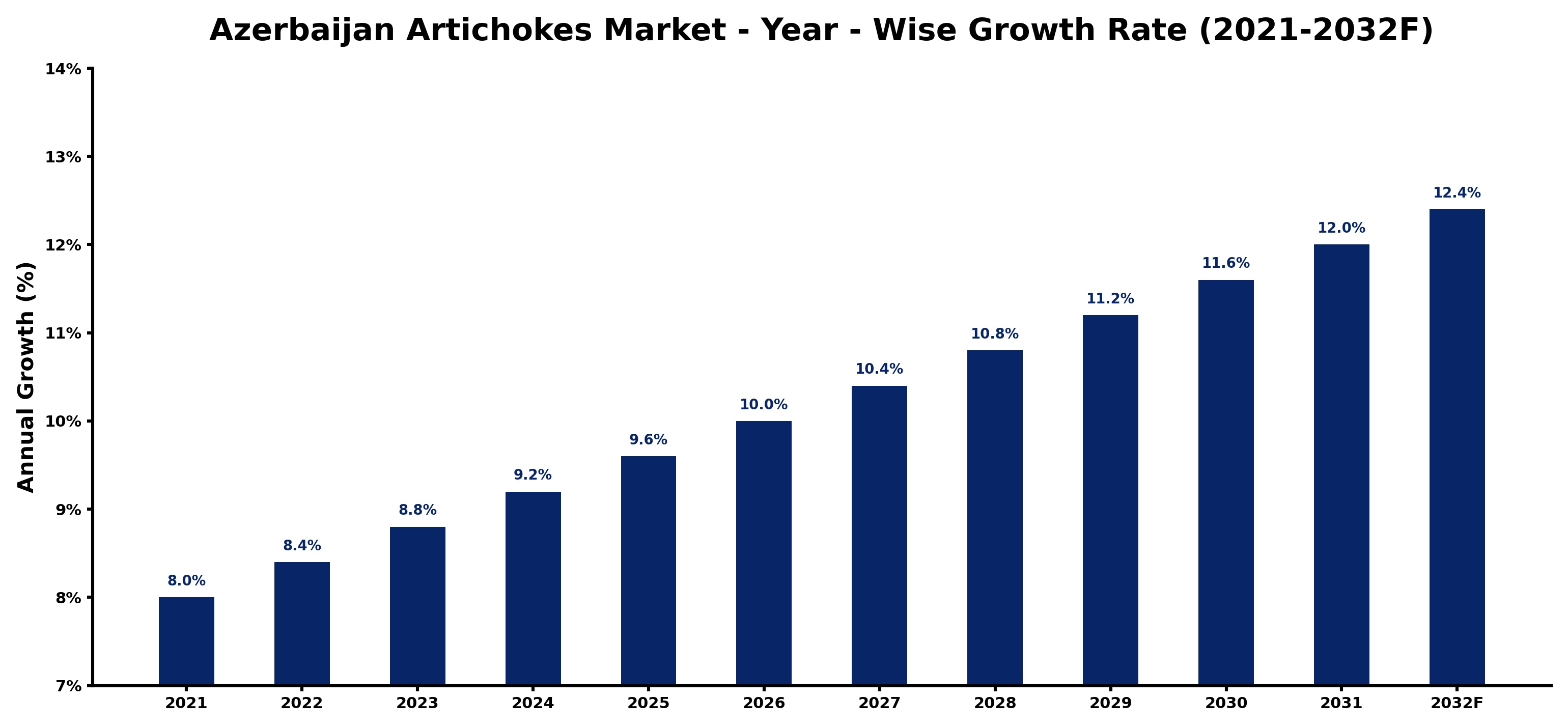
The table below presents the year‑wise growth rates along with the key drivers influencing the market
| Year | Growth Rate | Major Drivers |
| 2021 | 8.0% | Increased consumer health awareness |
| 2022 | 8.4% | Culinary trends embraced artichokes |
| 2023 | 8.8% | Local farming initiatives expanded supply |
| 2024 | 9.2% | Export opportunities enhanced market reach |
| 2025 | 9.6% | Artichoke-based products gained popularity |
| 2026 | 10.0% | Sustainable farming practices attracted interest |
| 2027 | 10.4% | Nutritional benefits promoted widely |
| 2028 | 10.8% | Culinary education programs increased demand |
| 2029 | 11.2% | Artichoke festivals boosted consumer interest |
| 2030 | 11.6% | Innovative recipes encouraged usage growth |
| 2031 | 12.0% | Food bloggers highlighted artichoke versatility |
| 2032 | 12.4% | Artichoke cultivation technology advanced significantly |
Note - Market size estimations and growth projections presented in this report are based on 6Wresearch’s advanced forecasting approach, validated with industry datasets as of June 2026.
Azerbaijan Artichokes Market Synopsis
Recently, the Azerbaijan artichokes market has experienced notable momentum, driven by shifting consumer preferences towards healthier eating. As artichokes gain traction as a superfood, the outlook is increasingly optimistic, with expectations for continued growth in both local consumption and exports. The convergence of health trends and culinary innovation positions the market for substantial expansion.
Looking ahead, the market is set to benefit from heightened awareness and the push for sustainable agricultural practices. With local farmers embracing modern farming technologies and the rise of organic products, the artichoke sector in Azerbaijan is becoming more competitive and resilient. This ensures that consumers have access to high-quality produce while supporting economic growth.
Azerbaijan Artichokes Market Key Takeaways
- Increasing demand for health-oriented and organic food options is driving market growth.
- Local production is on the rise, with a focus on sustainability and quality improvement.
- Value-added products, such as dips and marinated artichokes, are gaining popularity.
- Online retail platforms are expanding access to a diverse range of artichoke products.
- Government initiatives are fostering agricultural development and protecting local producers.
Evaluation of Restraints in Azerbaijan Artichokes Market
Despite the positive outlook, several restraints hinder the full potential of the Azerbaijan artichokes market. Seasonality in production creates supply inconsistencies, leading to price fluctuations that challenge both producers and consumers. Furthermore, there exists a notable gap in consumer awareness regarding artichokes, which may limit overall market penetration. Infrastructure limitations in storage and transportation further complicate distribution, impacting market efficiency. Such constraints underscore the necessity for strategic initiatives to bolster market growth.
Azerbaijan Artichokes Market Trends
Current trends in the Azerbaijan artichokes market emphasize a growing preference for fresh and locally sourced produce. This shift is accompanied by rising interest in convenience, spurring demand for ready-to-eat artichoke-based products. Moreover, e-commerce is rapidly transforming the landscape, enabling consumers to explore a wider variety of artichoke offerings. These trends signal a shift towards a more health-conscious, convenience-driven consumer base, shaping the future of the market.
Azerbaijan Artichokes Market Opportunities
Investment opportunities abound in the Azerbaijan artichokes market. As domestic and international demand escalates, there is significant potential in cultivating artichokes, particularly organic varieties. Innovations in farming practices, coupled with advancements in storage and distribution, can yield increased efficiencies and better-quality products. Additionally, venturing into the production of value-added artichoke products aligns with consumer preferences for convenience foods, presenting lucrative avenues for growth.
Government Initiatives in the Azerbaijan Artichokes Market
The Azerbaijan government is actively promoting agricultural development through various policies and initiatives aimed at enhancing food security. Support mechanisms, including subsidies for local farmers, are designed to bolster artichoke production while ensuring quality. Furthermore, regulations governing imports help protect domestic producers, creating a favorable environment for market growth. These government efforts are pivotal in cultivating a thriving artichoke industry.
Future Insights of the Azerbaijan Artichokes Market
The future of the Azerbaijan artichokes market appears bright, driven by health trends and consumer interest in organic produce. Advancements in agricultural techniques are set to enhance crop yields and quality, further solidifying Azerbaijan's competitive stance. As local cultivation gains momentum and sustainability becomes a priority, the market is poised for expansion, potentially opening up new avenues for export as well.
Azerbaijan Artichokes Market Latest Developments (May 2025 - June 2026)
In recent months, the Azerbaijan artichokes market has witnessed several developments that indicate a shift towards modernization and sustainability. Farmers are increasingly adopting innovative agricultural practices to enhance production efficiency. Meanwhile, new online platforms are emerging, providing consumers with greater access to artichoke products. Retailers are also expanding their offerings, introducing more value-added products that cater to evolving consumer preferences.
Azerbaijan Artichokes Market - Key Attractiveness of the Report
- 10 Years of Market Numbers
- Historical Data Starting from 2022 to 2025
- Base Year: 2025
- Forecast Data until 2032
- Key Performance Indicators Impacting the Market
- Major Upcoming Developments and Projects
Key Highlights of the Report:
- Azerbaijan Artichokes Market Outlook
- Market Size of Azerbaijan Artichokes Market, 2025
- Forecast of Azerbaijan Artichokes Market, 2032
- Historical Data and Forecast of Azerbaijan Artichokes Revenues & Volume for the Period 2022-2032F
- Azerbaijan Artichokes Market Trend Evolution
- Azerbaijan Artichokes Market Drivers and Challenges
- Azerbaijan Artichokes Price Trends
- Azerbaijan Artichokes Porter's Five Forces
- Azerbaijan Artichokes Industry Life Cycle
- Historical Data and Forecast of Azerbaijan Artichokes Market Revenues & Volume By Category for the Period 2022-2032F
- Historical Data and Forecast of Azerbaijan Artichokes Market Revenues & Volume By Organic for the Period 2022-2032F
- Historical Data and Forecast of Azerbaijan Artichokes Market Revenues & Volume By Conventional for the Period 2022-2032F
- Historical Data and Forecast of Azerbaijan Artichokes Market Revenues & Volume By Product Type for the Period 2022-2032F
- Historical Data and Forecast of Azerbaijan Artichokes Market Revenues & Volume By Globe Artichokes for the Period 2022-2032F
- Historical Data and Forecast of Azerbaijan Artichokes Market Revenues & Volume By Elongated Artichokes for the Period 2022-2032F
- Historical Data and Forecast of Azerbaijan Artichokes Market Revenues & Volume By End Use for the Period 2022-2032F
- Historical Data and Forecast of Azerbaijan Artichokes Market Revenues & Volume By Direct Consumption for the Period 2022-2032F
- Historical Data and Forecast of Azerbaijan Artichokes Market Revenues & Volume By Food Processing for the Period 2022-2032F
- Historical Data and Forecast of Azerbaijan Artichokes Market Revenues & Volume By Beverage Processing for the Period 2022-2032F
- Historical Data and Forecast of Azerbaijan Artichokes Market Revenues & Volume By Others for the Period 2022-2032F
- Azerbaijan Artichokes Import Export Trade Statistics
- Market Opportunity Assessment By Category
- Market Opportunity Assessment By Product Type
- Market Opportunity Assessment By End Use
- Azerbaijan Artichokes Top Companies Market Share
- Azerbaijan Artichokes Competitive Benchmarking By Technical and Operational Parameters
- Azerbaijan Artichokes Company Profiles
- Azerbaijan Artichokes Key Strategic Recommendations






































