Azerbaijan Artificial Organs Market Size, Share & Growth Rate
The Azerbaijan Artificial Organs Market was estimated at USD 513 Million in 2025 and is projected to reach USD 884 Million by 2032, growing at a CAGR of 8.1% from 2026 to 2032. This robust growth is primarily driven by the increasing prevalence of chronic diseases, particularly kidney and heart ailments, alongside an aging population that necessitates innovative healthcare solutions. As advancements in medical technology continue to emerge, the market is becoming more receptive to artificial organs, providing promising pathways for patient care and rehabilitation.
Azerbaijan Artificial Organs Market Year-wise Growth Rate and Key Drivers
This graph highlights how the Azerbaijan Artificial Organs Market has steadily grown over the years, supported by major growth factors.
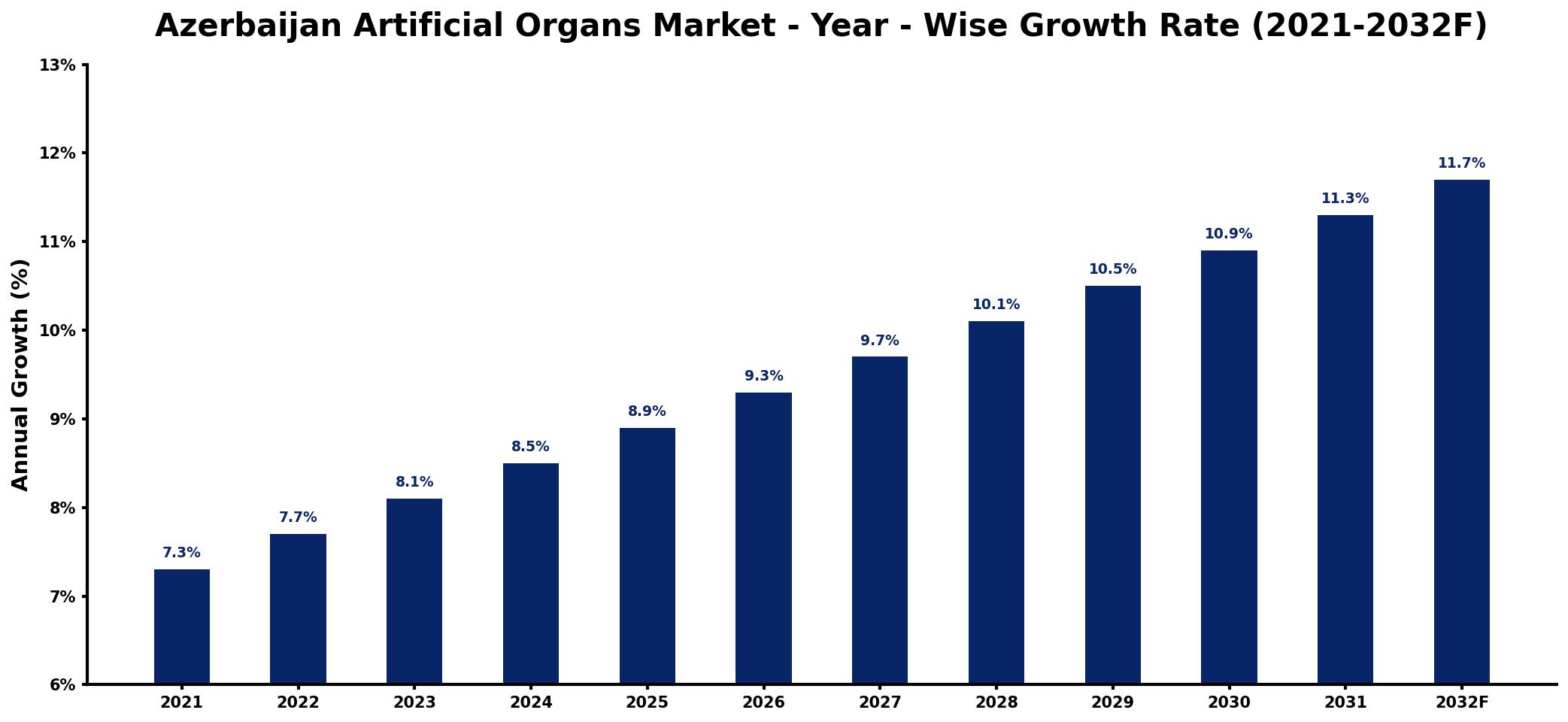
The table below presents the year‑wise growth rates along with the key drivers influencing the market
| Year | Growth Rate | Major Drivers |
| 2021 | 7.3% | Rising healthcare investment initiatives |
| 2022 | 7.7% | Increased patient population demand |
| 2023 | 8.1% | Advancements in medical technology |
| 2024 | 8.5% | Growing awareness of alternatives |
| 2025 | 8.9% | Expansion of healthcare infrastructure |
| 2026 | 9.3% | Surge in research funding allocations |
| 2027 | 9.7% | Enhanced regulatory support frameworks |
| 2028 | 10.1% | Collaboration between industry stakeholders |
| 2029 | 10.5% | Emergence of innovative startups |
| 2030 | 10.9% | Improved reimbursement policies implemented |
| 2031 | 11.3% | Increase in global market partnerships |
| 2032 | 11.7% | Strengthened education and training programs |
Note: Market size estimations and growth projections presented in this report are based on 6Wresearch's proprietary forecasting methodology, utilizing the latest available industry data, government publications, and primary research inputs.
Azerbaijan Artificial Organs Market Synopsis
The Azerbaijan Artificial Organs Market is rapidly evolving, reflecting significant changes in healthcare demands and technological innovations. The rising incidence of organ failure, along with the inadequacy of donor organs, is steering patients and healthcare providers towards artificial solutions that can enhance life quality and functional independence.
Currently, the market is characterized by a growing focus on cutting-edge technologies such as 3D bioprinting and bioengineering. These advances not only promise improved artificial organs but also foster collaborations between research institutions and healthcare providers, driving a culture of innovation essential for market expansion.
Azerbaijan Artificial Organs Market Key Takeaways
- The market is driven by increased chronic disease rates and a demand for organ transplants.
- Technological advancements are enhancing the functionality and lifespan of artificial organs.
- Collaborations between healthcare and research sectors are essential for innovation.
- Government initiatives aim to improve accessibility and affordability of artificial organs.
- The market is expected to grow significantly due to rising healthcare spending and infrastructural development.
Evaluation of Restraints in Azerbaijan Artificial Organs Market
Despite the promising growth potential, several factors are currently restraining the Azerbaijan Artificial Organs Market. One major concern is the limited availability of advanced technology and infrastructure necessary for the production and development of artificial organs. This gap complicates the ability of manufacturers to meet rising demand efficiently. Furthermore, regulatory challenges and a lack of established industry standards can slow down the approval processes for new products, thus affecting market entry timelines. Lastly, the high costs associated with these innovative solutions often render them inaccessible to a significant portion of the population, further hindering market penetration and growth.
Azerbaijan Artificial Organs Market Trends
Key trends shaping the Azerbaijan Artificial Organs Market include the integration of 3D bioprinting technologies, which are revolutionizing the production of customized artificial organs. This approach not only allows for personalized patient care but also boosts the efficiency of organ creation. Moreover, the increasing collaboration between private companies and government entities is leading to a more robust research and development framework. With a focus on enhancing both the longevity and functionality of artificial organs, we can expect to see accelerated growth in product offerings that cater to specific health needs, driving further demand.
Azerbaijan Artificial Organs Market Opportunities
Investment opportunities in the Azerbaijan Artificial Organs Market are substantial, fueled by the rising incidence of organ failure and a growing acceptance of artificial organs among patients. As healthcare technologies advance, there is a notable demand for products such as prosthetic limbs, artificial hearts, and other innovative solutions. Furthermore, opportunities exist in forming partnerships with local healthcare providers to enhance market outreach and accessibility. These investments not only promise lucrative returns but also contribute to advancing healthcare standards across the nation.
Government Initiatives in the Azerbaijan Artificial Organs Market
The Azerbaijani government has enacted several policies aimed at regulating the artificial organs market, prioritizing safety, efficacy, and quality. The State Agency on Mandatory Health Insurance is a key player in overseeing the procurement and utilization of artificial organs, ensuring they meet strict regulatory standards. Additionally, the government actively encourages collaboration between healthcare providers and medical device manufacturers, promoting research and development efforts to enhance the availability and affordability of artificial organs for patients.
Future Insights of the Azerbaijan Artificial Organs Market
Looking ahead to 2026-2032, the Azerbaijan Artificial Organs Market is set to experience transformative growth, fueled by an increasing geriatric population and a higher prevalence of chronic diseases. The persistent shortage of donor organs, combined with technological advancements in organ development, will create a favorable environment for artificial organ adoption. Government initiatives aimed at improving healthcare infrastructure and increasing public health expenditure further contribute to the optimistic market outlook, paving the way for enhanced patient care solutions.
Azerbaijan Artificial Organs Market Latest Developments (2025 - 2026)
Recent developments in the Azerbaijan Artificial Organs Market indicate a heightened focus on technological advancements, particularly in bioengineering and regenerative medicine. Industry stakeholders are increasingly pursuing collaborative partnerships to expedite the research and development of innovative artificial organ solutions. Moreover, public and private sectors are aligning efforts to enhance healthcare infrastructure, addressing current limitations in technology availability and market accessibility.
Azerbaijan Artificial Organs Market - Key Attractiveness of the Report
- 10 Years of Market Numbers
- Historical Data Starting from 2022 to 2025
- Base Year: 2025
- Forecast Data until 2032
- Key Performance Indicators Impacting the Market
- Major Upcoming Developments and Projects
Key Highlights of the Report:
- Azerbaijan Artificial Organs Market Outlook
- Market Size of Azerbaijan Artificial Organs Market, 2025
- Forecast of Azerbaijan Artificial Organs Market, 2032
- Historical Data and Forecast of Azerbaijan Artificial Organs Revenues & Volume for the Period 2022-2032F
- Azerbaijan Artificial Organs Market Trend Evolution
- Azerbaijan Artificial Organs Market Drivers and Challenges
- Azerbaijan Artificial Organs Price Trends
- Azerbaijan Artificial Organs Porter's Five Forces
- Azerbaijan Artificial Organs Industry Life Cycle
- Historical Data and Forecast of Azerbaijan Artificial Organs Market Revenues & Volume By Product Type for the Period 2022-2032F
- Historical Data and Forecast of Azerbaijan Artificial Organs Market Revenues & Volume By Artificial Kidney for the Period 2022-2032F
- Historical Data and Forecast of Azerbaijan Artificial Organs Market Revenues & Volume By Artificial Heart for the Period 2022-2032F
- Historical Data and Forecast of Azerbaijan Artificial Organs Market Revenues & Volume By Artificial Pancreas for the Period 2022-2032F
- Historical Data and Forecast of Azerbaijan Artificial Organs Market Revenues & Volume By Cochlear Implants for the Period 2022-2032F
- Historical Data and Forecast of Azerbaijan Artificial Organs Market Revenues & Volume By Others for the Period 2022-2032F
- Azerbaijan Artificial Organs Import Export Trade Statistics
- Market Opportunity Assessment By Product Type
- Azerbaijan Artificial Organs Top Companies Market Share
- Azerbaijan Artificial Organs Competitive Benchmarking By Technical and Operational Parameters
- Azerbaijan Artificial Organs Company Profiles
- Azerbaijan Artificial Organs Key Strategic Recommendations






































