Azerbaijan Asphalt Market Summary
The azerbaijan asphalt market was estimated at USD 949 Million in 2025 and is projected to reach USD 1635 Million by 2032, growing at a CAGR of 9.3% from 2026 to 2032.
Azerbaijan Asphalt Market Year-wise Growth Rate and Key Drivers
This graph highlights how the Azerbaijan Asphalt Market has steadily grown over the past five years, supported by major growth factors.
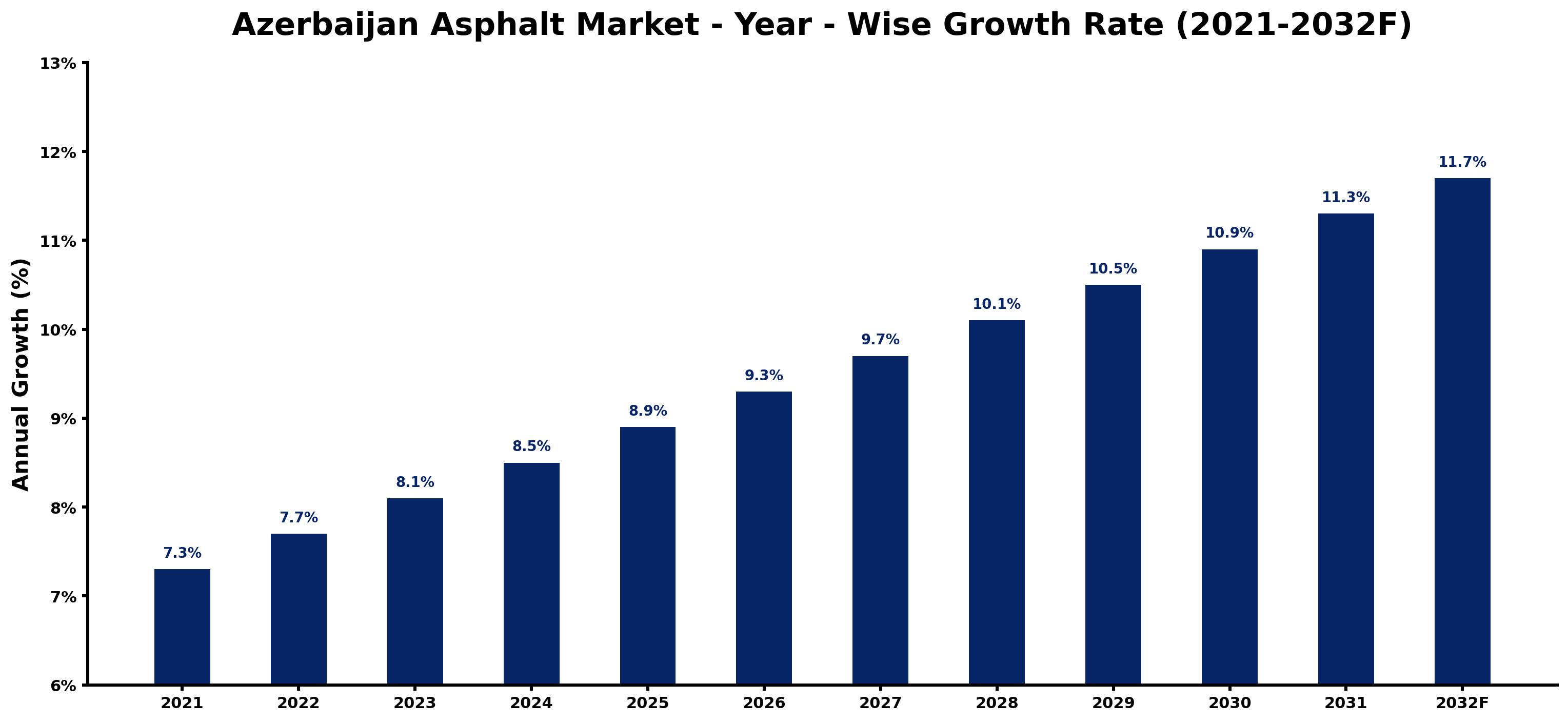
The table below presents the year wise growth rates along with the key drivers influencing the market
| Year | Growth Rate | Major Drivers |
| 2021 | 7.3% | Infrastructure projects commenced, highlighting a need for improved road quality and durability. |
| 2022 | 7.7% | Local asphalt production facilities opened, boosting employment and reducing import dependence significantly. |
| 2023 | 8.1% | Economic recovery plans prioritized construction, leading to more asphalt usage in urban areas. |
| 2024 | 8.5% | With tourism increasing, road expansions became crucial for enhancing transportation networks. |
| 2025 | 8.9% | New highway projects launched, aimed at connecting major cities and reducing travel times. |
| 2026 | 9.3% | Investment in smart city initiatives encouraged the use of high-performance asphalt products. |
| 2027 | 9.7% | Local construction firms collaborated with international entities for innovative asphalt solutions. |
| 2028 | 10.1% | Public-private partnerships emerged, focusing on sustainable infrastructure development across regions. |
| 2029 | 10.5% | Emerging technologies in asphalt recycling gained traction, appealing to environmental concerns. |
| 2030 | 10.9% | Regional trade agreements facilitated easier access to advanced asphalt materials and technology. |
| 2031 | 11.3% | Market analysis indicated higher standards for road safety, influencing asphalt quality requirements. |
| 2032 | 11.7% | Urbanization trends prompted consistent demand for durable asphalt in residential development projects. |
Note - Market size estimations and growth projections presented in this report are based on 6Wresearch's advanced forecasting approach, validated with industry datasets as of June 2026.
Azerbaijan Asphalt Market Synopsis
The Azerbaijan Asphalt Market is projected to reach 9.3% and witness significant growth during the forecast period (2026-2032). This expansion is primarily driven by extensive infrastructure development initiatives across Azerbaijan, emphasizing road construction and maintenance. The growing demand is indicative of an overall increase in residential and industrial construction activities, reflecting the government's commitment to enhancing transportation infrastructure.
Azerbaijan Asphalt Market Growth Drivers
The Azerbaijan asphalt market's growth is fueled by several key factors:
- The government's substantial investment in infrastructure projects, which includes the improvement of existing roads and the construction of new highways, is a principal driver of asphalt demand.
- Increasing urbanization in Azerbaijan prompts greater need for residential and commercial road networks, thereby elevating the asphalt consumption rate.
- Government initiatives aimed at enhancing the quality and durability of road surfaces compel the use of advanced asphalt technologies, including warm and cold mix asphalt solutions.
- The implementation of development policies that promote foreign investments in the construction sector allows for the infusion of innovative technologies and practices.
- Growing environmental concerns lead to a shift towards sustainable asphalt production methods, which further broaden the market's attractiveness.
Azerbaijan Asphalt Market Trends and Opportunities
The Azerbaijan Asphalt Market is poised to embrace trends that focus on innovation and sustainable development. The following trends exemplify the dynamic nature of this market:
- There is a clear shift towards technologies that prioritize the reduction of environmental impact, such as the adoption of warm-mix asphalt.
- Investments in high-quality raw materials and production processes are on the rise, ensuring that asphalt products meet increasingly stringent regulatory standards.
- The market is embracing digitalization, with advancements in project management software improving efficiency in asphalt-related projects.
- Partnerships between local firms and international construction entities are becoming more prevalent, enhancing capabilities and fostering knowledge transfer.
- Demand for smart road technology, which integrates integrated traffic management systems, presents new opportunities for asphalt applications in modern road projects.
Azerbaijan Asphalt Market Challenges and Restraints
Despite the promising growth trajectory, the Azerbaijan asphalt market faces several challenges that could hinder its progress:
- Dependence on imported raw materials compromises the consistency of supply and can lead to fluctuations in asphalt prices, influenced by global oil market volatility.
- Limited local production capacity necessitates future investments in domestic manufacturing capabilities to cater to growing demand effectively.
- Logistical challenges resulting from inadequate infrastructure complicate transportation and distribution processes, affecting project timelines.
- Regulatory complexities in securing construction permits can delay project execution, thereby stifling market growth opportunities.
- The urgent need for continuous technological advancements and adherence to quality standards demands consistent investment, placing financial strain on smaller enterprises.
Azerbaijan Asphalt Market Government Investment and Initiatives
The Azerbaijani government has initiated various policies and programs to stimulate the asphalt market as part of its broader infrastructure development strategy. The State Program on Socio-Economic Development of the Regions significantly targets road infrastructure improvement, leading to a surge in asphalt product demand.
Furthermore, the government actively seeks to attract foreign investment into the construction sector, thereby creating an environment conducive to business growth and technological advancement. Financial support from the State Oil Fund of Azerbaijan plays a crucial role in funding infrastructure projects, ensuring that adequate financial resources are accessible for asphalt-related ventures. This government commitment to elevating national infrastructure is anticipated to further solidify the asphalt market's foundation.
Azerbaijan Asphalt Market Latest Developments (May 2025 - June 2026)
Recent developments in the Azerbaijan asphalt market between May 2025 and June 2026 highlight the industry's response to evolving needs. The increased adoption of sustainable asphalt technologies has been observed, with local construction projects integrating environmentally friendly practices into their operations. Additionally, partnerships between domestic and foreign firms are strengthening market capabilities and enhancing production efficiency, enabling the introduction of innovative asphalt solutions.
Regulatory bodies have also worked to streamline the permitting processes for construction projects, making it easier for companies to initiate asphalt-related projects. This is a critical step toward addressing logistical challenges faced by the industry. Overall, these developments reflect a growing emphasis on modernization and sustainability, reinforcing the positive outlook for Azerbaijan's asphalt market.
Azerbaijan Asphalt Market - Key Attractiveness of the Report
- 10 Years of Market Numbers
- Historical Data Starting from 2022 to 2025
- Base Year: 2025
- Forecast Data until 2032
- Key Performance Indicators Impacting the Market
- Major Upcoming Developments and Projects
Key Highlights of the Report:
- Azerbaijan Asphalt Market Outlook
- Market Size of Azerbaijan Asphalt Market, 2025
- Forecast of Azerbaijan Asphalt Market, 2032F
- Historical Data and Forecast of Azerbaijan Asphalt Revenues & Volume for the Period 2022-2032F
- Azerbaijan Asphalt Market Trend Evolution
- Azerbaijan Asphalt Market Drivers and Challenges
- Azerbaijan Asphalt Price Trends
- Azerbaijan Asphalt Porter's Five Forces
- Azerbaijan Asphalt Industry Life Cycle
- Historical Data and Forecast of Azerbaijan Asphalt Market Revenues & Volume By Type for the Period 2022-2032F
- Historical Data and Forecast of Azerbaijan Asphalt Market Revenues & Volume By Paving Petroleum Asphalt for the Period 2022-2032F
- Historical Data and Forecast of Azerbaijan Asphalt Market Revenues & Volume By Industrial Petroleum Asphalt for the Period 2022-2032F
- Historical Data and Forecast of Azerbaijan Asphalt Market Revenues & Volume By Others for the Period 2022-2032F
- Historical Data and Forecast of Azerbaijan Asphalt Market Revenues & Volume By Application for the Period 2022-2032F
- Historical Data and Forecast of Azerbaijan Asphalt Market Revenues & Volume By Paving for the Period 2022-2032F
- Historical Data and Forecast of Azerbaijan Asphalt Market Revenues & Volume By Roofing for the Period 2022-2032F
- Historical Data and Forecast of Azerbaijan Asphalt Market Revenues & Volume By Others for the Period 2022-2032F
- Azerbaijan Asphalt Import Export Trade Statistics
- Market Opportunity Assessment By Type
- Market Opportunity Assessment By Application
- Azerbaijan Asphalt Top Companies Market Share
- Azerbaijan Asphalt Competitive Benchmarking By Technical and Operational Parameters
- Azerbaijan Asphalt Company Profiles
- Azerbaijan Asphalt Key Strategic Recommendations






































