Azerbaijan Automotive Drive Shaft Market Size, Share & Growth Rate
The Azerbaijan Automotive Drive Shaft Market was estimated at USD 745 Million in 2025 and is projected to reach USD 1348 Million by 2032, growing at a CAGR of 8.8% from 2026 to 2032. This growth trajectory is propelled by an increasing demand for personal and commercial vehicles, spurred by rising disposable incomes and expanding urban infrastructure. Furthermore, the burgeoning popularity of SUVs and LCVs in Azerbaijan is creating a significant demand for high-quality drive shafts, underscoring the market's robust potential.
Azerbaijan Automotive Drive Shaft Market Year-wise Growth Rate and Key Drivers
This graph highlights how the Azerbaijan Automotive Drive Shaft Market has steadily grown over the years, supported by major growth factors.
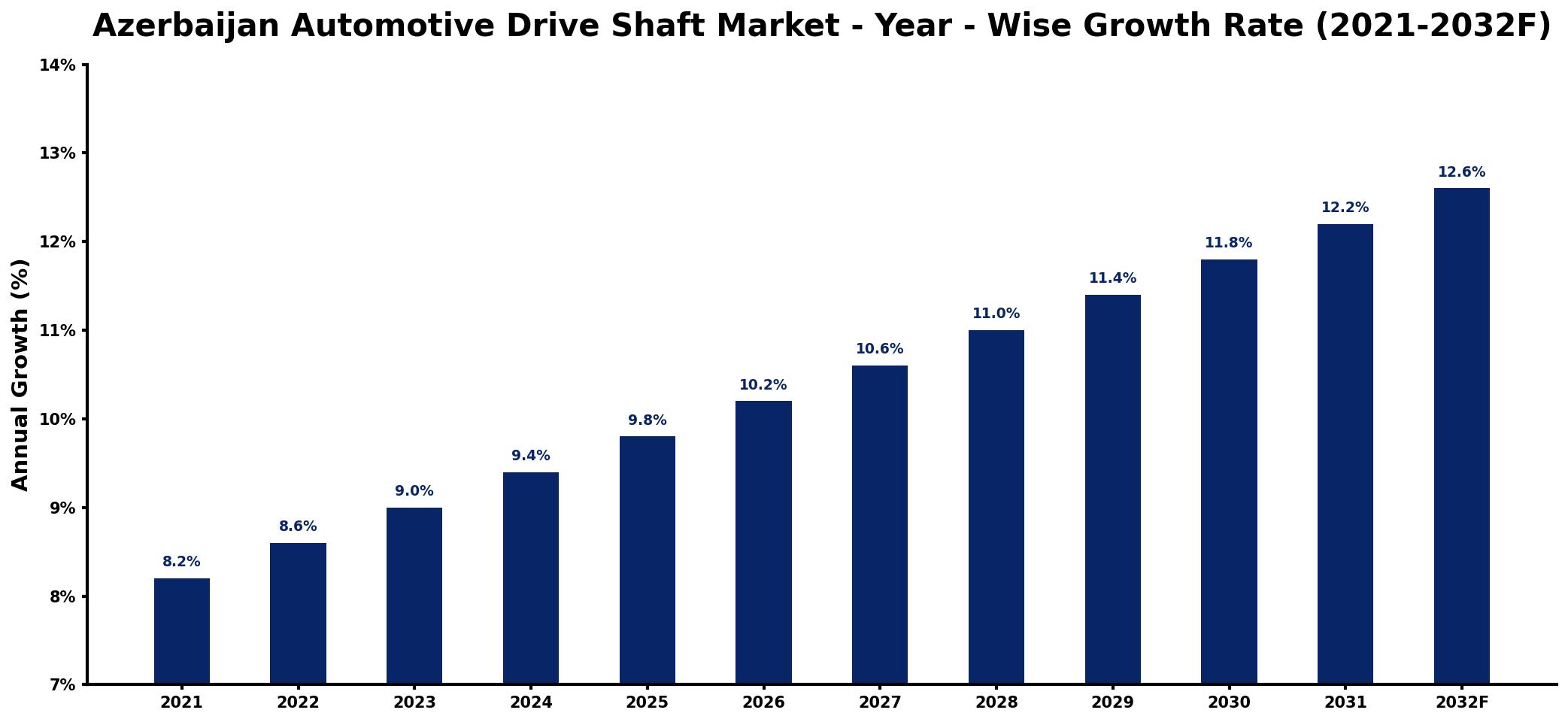
The table below presents the year‑wise growth rates along with the key drivers influencing the market
| Year | Growth Rate | Major Drivers |
| 2021 | 8.2% | Rising consumer vehicle ownership |
| 2022 | 8.6% | Expansion of local manufacturing facilities |
| 2023 | 9.0% | Increased foreign investment influx |
| 2024 | 9.4% | Growing electric vehicle adoption |
| 2025 | 9.8% | Strengthening regional trade agreements |
| 2026 | 10.2% | Surge in infrastructure development projects |
| 2027 | 10.6% | Enhanced vehicle safety regulations |
| 2028 | 11.0% | Growing demand for performance upgrades |
| 2029 | 11.4% | Increase in logistics sector activities |
| 2030 | 11.8% | increased domestic production output |
| 2031 | 12.2% | Rising popularity of ride-sharing services |
| 2032 | 12.6% | Innovations in mobility solutions |
Note: Market size estimations and growth projections presented in this report are based on 6Wresearch's proprietary forecasting methodology, utilizing the latest available industry data, government publications, and primary research inputs.
Azerbaijan Automotive Drive Shaft Market Synopsis
Azerbaijan's automotive sector is increasingly embracing the need for reliable drive shaft components, as vehicle ownership steadily climbs. This rise is particularly notable among light commercial vehicles, which are vital for local businesses and logistics.
The aftermarket for automotive parts, including drive shafts, is also experiencing significant growth. Consumers are more inclined to replace worn-out parts to maintain vehicle performance, which drives innovation and competition in this sector.
Azerbaijan Automotive Drive Shaft Market Key Takeaways
- The market is benefiting from rising disposable incomes and infrastructure development.
- Technological advancements are pushing the demand for lightweight and durable drive shaft materials.
- The automotive aftermarket is a critical growth driver as consumers prioritize vehicle maintenance and upgrades.
- Government policies favoring local production are shaping market dynamics positively.
- The increasing popularity of SUVs and hybrid vehicles is influencing product innovations in the drive shaft segment.
Evaluation of Restraints in Azerbaijan Automotive Drive Shaft Market
Despite the promising growth, the Azerbaijan Automotive Drive Shaft Market faces several significant challenges. Limited domestic manufacturing capabilities have led to a heavy dependence on imports, which poses risks regarding supply chain stability. The fluctuating costs of raw materials add another layer of complexity, often impacting production budgets. Additionally, the market is plagued by counterfeit products, which can damage brand credibility and consumer trust. Navigating these challenges requires strategic investment in local manufacturing and stringent quality control to ensure that the market can sustain its growth trajectory.
Azerbaijan Automotive Drive Shaft Market Trends
Emerging trends in the Azerbaijan Automotive Drive Shaft Market emphasize the shift toward lightweight materials such as carbon fiber and advanced aluminum alloys. These materials are favored for their ability to enhance fuel efficiency and vehicle performance. Furthermore, there is an increasing trend towards the adoption of electric and hybrid vehicles, which necessitate specialized drive shafts designed to accommodate unique powertrain configurations. Sustainability is also becoming a focal point, with manufacturers exploring recycled materials for production to align with global environmental initiatives.
Azerbaijan Automotive Drive Shaft Market Opportunities
The market offers significant investment opportunities, particularly in manufacturing and distribution of drive shafts. With Azerbaijan's automotive industry on the rise, there is a growing demand for high-quality automotive components. Investors may find strategic benefits in partnering with local manufacturers to enhance market presence and capitalize on the burgeoning need for reliable automotive parts. As urbanization continues, the potential for aftermarket services related to drive shafts is also increasing, providing another avenue for revenue generation.
Government Initiatives in the Azerbaijan Automotive Drive Shaft Market
Government initiatives play a crucial role in shaping the Azerbaijan Automotive Drive Shaft Market. Policies aimed at protecting domestic manufacturers through import tariffs promote local production while ensuring compliance with quality and safety standards. Furthermore, the government is actively working on infrastructure development, which enhances transportation networks and indirectly boosts vehicle sales, thereby benefiting the drive shaft market. Emission standards are also being implemented to encourage environmentally sustainable practices within the automotive sector.
Future Insights of the Azerbaijan Automotive Drive Shaft Market
Looking ahead to the years 2026-2032, the Azerbaijan Automotive Drive Shaft Market is poised for continued growth. The combination of increasing vehicle demand, improving economic conditions, and ongoing investments in infrastructure is expected to drive market expansion. Technological innovations in manufacturing processes and materials will likely dominate the landscape, addressing the evolving needs of consumers and automotive manufacturers alike. As the market matures, the focus will shift towards more sustainable and high-performance drive shaft solutions, aligning with global automotive trends.
Azerbaijan Automotive Drive Shaft Market Latest Developments (2025 - 2026)
Recent developments in the Azerbaijan Automotive Drive Shaft Market have seen a push towards technological upgrades in manufacturing facilities to enhance production efficiency. Additionally, local manufacturers are forging partnerships with international suppliers to diversify their product offerings and increase competitiveness. The emphasis on sustainability has led to innovative approaches in drive shaft design, incorporating eco-friendly materials. Overall, these trends indicate a proactive approach within the market to adapt to both domestic and global automotive demands.
Azerbaijan Automotive Drive Shaft Market - Key Attractiveness of the Report
- 10 Years of Market Numbers
- Historical Data Starting from 2022 to 2025
- Base Year: 2025
- Forecast Data until 2032
- Key Performance Indicators Impacting the Market
- Major Upcoming Developments and Projects
Key Highlights of the Report:
- Azerbaijan Automotive Drive Shaft Market Outlook
- Market Size of Azerbaijan Automotive Drive Shaft Market, 2025
- Forecast of Azerbaijan Automotive Drive Shaft Market, 2032
- Historical Data and Forecast of Azerbaijan Automotive Drive Shaft Revenues & Volume for the Period 2022-2032F
- Azerbaijan Automotive Drive Shaft Market Trend Evolution
- Azerbaijan Automotive Drive Shaft Market Drivers and Challenges
- Azerbaijan Automotive Drive Shaft Price Trends
- Azerbaijan Automotive Drive Shaft Porter's Five Forces
- Azerbaijan Automotive Drive Shaft Industry Life Cycle
- Historical Data and Forecast of Azerbaijan Automotive Drive Shaft Market Revenues & Volume By Design Type for the Period 2022-2032F
- Historical Data and Forecast of Azerbaijan Automotive Drive Shaft Market Revenues & Volume By Hollow Shaft for the Period 2022-2032F
- Historical Data and Forecast of Azerbaijan Automotive Drive Shaft Market Revenues & Volume By Solid Shaft for the Period 2022-2032F
- Historical Data and Forecast of Azerbaijan Automotive Drive Shaft Market Revenues & Volume By Position Type for the Period 2022-2032F
- Historical Data and Forecast of Azerbaijan Automotive Drive Shaft Market Revenues & Volume By Rear Axle for the Period 2022-2032F
- Historical Data and Forecast of Azerbaijan Automotive Drive Shaft Market Revenues & Volume By Front Axle for the Period 2022-2032F
- Historical Data and Forecast of Azerbaijan Automotive Drive Shaft Market Revenues & Volume By Vehicle Type for the Period 2022-2032F
- Historical Data and Forecast of Azerbaijan Automotive Drive Shaft Market Revenues & Volume By Passenger Cars for the Period 2022-2032F
- Historical Data and Forecast of Azerbaijan Automotive Drive Shaft Market Revenues & Volume By Commercial Vehicles for the Period 2022-2032F
- Azerbaijan Automotive Drive Shaft Import Export Trade Statistics
- Market Opportunity Assessment By Design Type
- Market Opportunity Assessment By Position Type
- Market Opportunity Assessment By Vehicle Type
- Azerbaijan Automotive Drive Shaft Top Companies Market Share
- Azerbaijan Automotive Drive Shaft Competitive Benchmarking By Technical and Operational Parameters
- Azerbaijan Automotive Drive Shaft Company Profiles
- Azerbaijan Automotive Drive Shaft Key Strategic Recommendations






































