Azerbaijan Calcium Silicate Market Size, Share & Growth Rate
The Azerbaijan Calcium Silicate Market was estimated at USD 389 Million in 2025 and is projected to reach USD 645 Million by 2032, growing at a CAGR of 7.5% from 2026 to 2032. This promising trajectory is primarily driven by the robust expansion of the construction sector, which is increasingly adopting calcium silicate products for their thermal insulation properties. Moreover, a growing commitment to sustainability and energy efficiency is catalyzing the demand for these eco-friendly materials, positioning the market for significant growth in the coming years.
Azerbaijan Calcium Silicate Market Year-wise Growth Rate and Key Drivers
This graph highlights how the Azerbaijan Calcium Silicate Market has steadily grown over the years, supported by major growth factors.
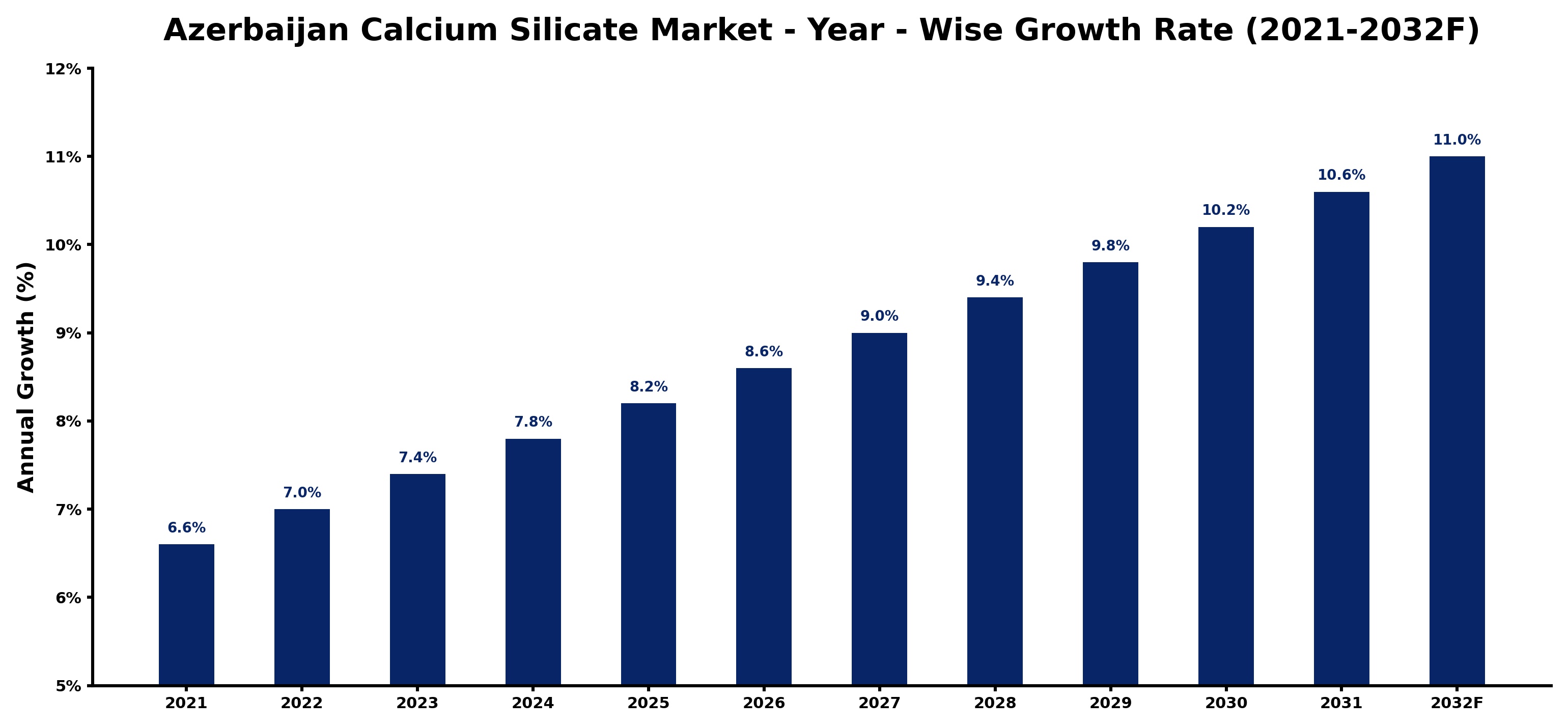
The table below presents the year‑wise growth rates along with the key drivers influencing the market
| Year | Growth Rate | Major Drivers |
| 2021 | 6.6% | Construction sector demand increased |
| 2022 | 7.0% | Industrial applications expanded significantly |
| 2023 | 7.4% | Energy efficiency regulations strengthened |
| 2024 | 7.8% | Infrastructure projects drove consumption |
| 2025 | 8.2% | Sustainable building materials trend emerged |
| 2026 | 8.6% | Technological advancements improved production |
| 2027 | 9.0% | Export opportunities expanded internationally |
| 2028 | 9.4% | Market awareness of benefits increased |
| 2029 | 9.8% | Partnerships with manufacturers strengthened |
| 2030 | 10.2% | Product innovation attracted new clients |
| 2031 | 10.6% | Regulatory support enhanced market growth |
| 2032 | 11.0% | Consumer preferences shifted positively |
Note - Market size estimations and growth projections presented in this report are based on 6Wresearch's advanced forecasting approach, validated with industry datasets as of June 2026.
Azerbaijan Calcium Silicate Market Synopsis
Recently, the Azerbaijan calcium silicate market has witnessed notable momentum due to rising construction activities and an increasing emphasis on sustainable building materials. As the market evolves, it is on track to embrace innovative solutions that not only meet industry requirements but also align with environmental standards.
Looking ahead, the market is poised for growth as manufacturers focus on expanding their product offerings, particularly in the realms of fire resistance and thermal efficiency. This shift is indicative of the market's adaptability and readiness to meet the diverse needs of both the construction and industrial sectors in Azerbaijan.
Azerbaijan Calcium Silicate Market Key Takeaways
- The market is projected to experience a CAGR of 7.5% from 2026 to 2032.
- Growing awareness of energy-efficient building practices is propelling demand for calcium silicate products.
- Government initiatives are promoting domestic production and reducing reliance on imports.
- Challenges such as limited consumer awareness and logistics must be addressed to unlock market potential.
- Investment opportunities are abundant due to the rising focus on eco-friendly construction materials.
Evaluation of Restraints in Azerbaijan Calcium Silicate Market
Despite the positive outlook for the Azerbaijan calcium silicate market, several restraints impede its full potential. A critical challenge is the limited awareness of calcium silicate products among both consumers and industry professionals, which often leads to a preference for traditional materials. Additionally, logistical hurdles—such as transportation costs and the limitations of the distribution network—create barriers to product accessibility and affordability. Regulatory compliance associated with building codes can also slow the adoption rate of calcium silicate materials, necessitating targeted education and infrastructure improvements to foster market growth.
Azerbaijan Calcium Silicate Market Trends
The Azerbaijan calcium silicate market is currently witnessing a prominent trend towards the utilization of calcium silicate boards, recognized for their sustainability and fire-resistant attributes. This trend is complemented by a notable shift towards incorporating calcium silicate insulation products in industrial applications, as these materials demonstrate superior high-temperature resistance and energy efficiency. Manufacturers are increasingly channeling efforts into product innovation, ensuring that offerings align with the evolving demands of construction and industrial sectors.
Azerbaijan Calcium Silicate Market Opportunities
The landscape of the Azerbaijan calcium silicate market is ripe with investment opportunities, particularly driven by the burgeoning construction industry. Demand for calcium silicate products, such as insulation boards and acoustic ceiling tiles, continues to rise as stakeholders prioritize sustainability and energy efficiency. Furthermore, government initiatives aimed at infrastructure development and urbanization are creating a favorable environment for investment, making it an opportune time for stakeholders to collaborate with local manufacturers and distributors to capitalize on market potential.
Government Initiatives in the Azerbaijan Calcium Silicate Market
The Azerbaijani government is actively promoting policies to support the calcium silicate market by fostering domestic production and reducing reliance on imports. Measures such as subsidies, tax incentives, and funding for research and development are being implemented to aid local manufacturers. Moreover, regulations ensuring the safety and environmental sustainability of calcium silicate products are in place, contributing to the development of a competitive market environment that encourages technological advancements and innovation within the industry.
Future Insights of the Azerbaijan Calcium Silicate Market
The future of the Azerbaijan calcium silicate market is optimistic, with forecasts indicating continued growth driven by increasing demands from various sectors, including construction, automotive, and food and beverage industries. With infrastructure development projects on the rise and an urbanization push, the need for thermal insulation applications is set to expand significantly. As more sectors recognize calcium silicate's benefits as a green building material, the market is expected to see a surge in adoption and innovation, promising a vibrant future from 2026 to 2032.
Azerbaijan Calcium Silicate Market Latest Developments (May 2025 - June 2026)
Recent industry developments indicate a shift towards innovative applications of calcium silicate in construction projects. Companies are increasingly exploring collaborative ventures to enhance product quality and diversify offerings, aiming to meet the growing consumer demand for sustainable materials. Additionally, ongoing government support is paving the way for improvements in manufacturing practices, which are expected to elevate product standards and reinforce market growth in the near future.
Azerbaijan Calcium Silicate Market - Key Attractiveness of the Report
- 10 Years of Market Numbers
- Historical Data Starting from 2022 to 2025
- Base Year: 2025
- Forecast Data until 2032
- Key Performance Indicators Impacting the Market
- Major Upcoming Developments and Projects
Key Highlights of the Report:
- Azerbaijan Calcium Silicate Market Outlook
- Market Size of Azerbaijan Calcium Silicate Market, 2025
- Forecast of Azerbaijan Calcium Silicate Market, 2032
- Historical Data and Forecast of Azerbaijan Calcium Silicate Revenues & Volume for the Period 2022-2032F
- Azerbaijan Calcium Silicate Market Trend Evolution
- Azerbaijan Calcium Silicate Market Drivers and Challenges
- Azerbaijan Calcium Silicate Price Trends
- Azerbaijan Calcium Silicate Porter's Five Forces
- Azerbaijan Calcium Silicate Industry Life Cycle
- Historical Data and Forecast of Azerbaijan Calcium Silicate Market Revenues & Volume By Application for the Period 2022-2032F
- Historical Data and Forecast of Azerbaijan Calcium Silicate Market Revenues & Volume By Insulation for the Period 2022-2032F
- Historical Data and Forecast of Azerbaijan Calcium Silicate Market Revenues & Volume By Paints & Coatings for the Period 2022-2032F
- Historical Data and Forecast of Azerbaijan Calcium Silicate Market Revenues & Volume By Fire Protection for the Period 2022-2032F
- Historical Data and Forecast of Azerbaijan Calcium Silicate Market Revenues & Volume By Cement for the Period 2022-2032F
- Historical Data and Forecast of Azerbaijan Calcium Silicate Market Revenues & Volume By Ceramics for the Period 2022-2032F
- Historical Data and Forecast of Azerbaijan Calcium Silicate Market Revenues & Volume By Others for the Period 2022-2032F
- Azerbaijan Calcium Silicate Import Export Trade Statistics
- Market Opportunity Assessment By Application
- Azerbaijan Calcium Silicate Top Companies Market Share
- Azerbaijan Calcium Silicate Competitive Benchmarking By Technical and Operational Parameters
- Azerbaijan Calcium Silicate Company Profiles
- Azerbaijan Calcium Silicate Key Strategic Recommendations






































