Azerbaijan Cameras Market Summary
The azerbaijan cameras market was estimated at USD 1474 Million in 2025 and is projected to reach USD 2625 Million by 2032, growing at a CAGR of 9.9% from 2026 to 2032.
Azerbaijan Cameras Market Year-wise Growth Rate and Key Drivers
This graph highlights how the Azerbaijan Cameras Market has steadily grown over the past five years, supported by major growth factors.
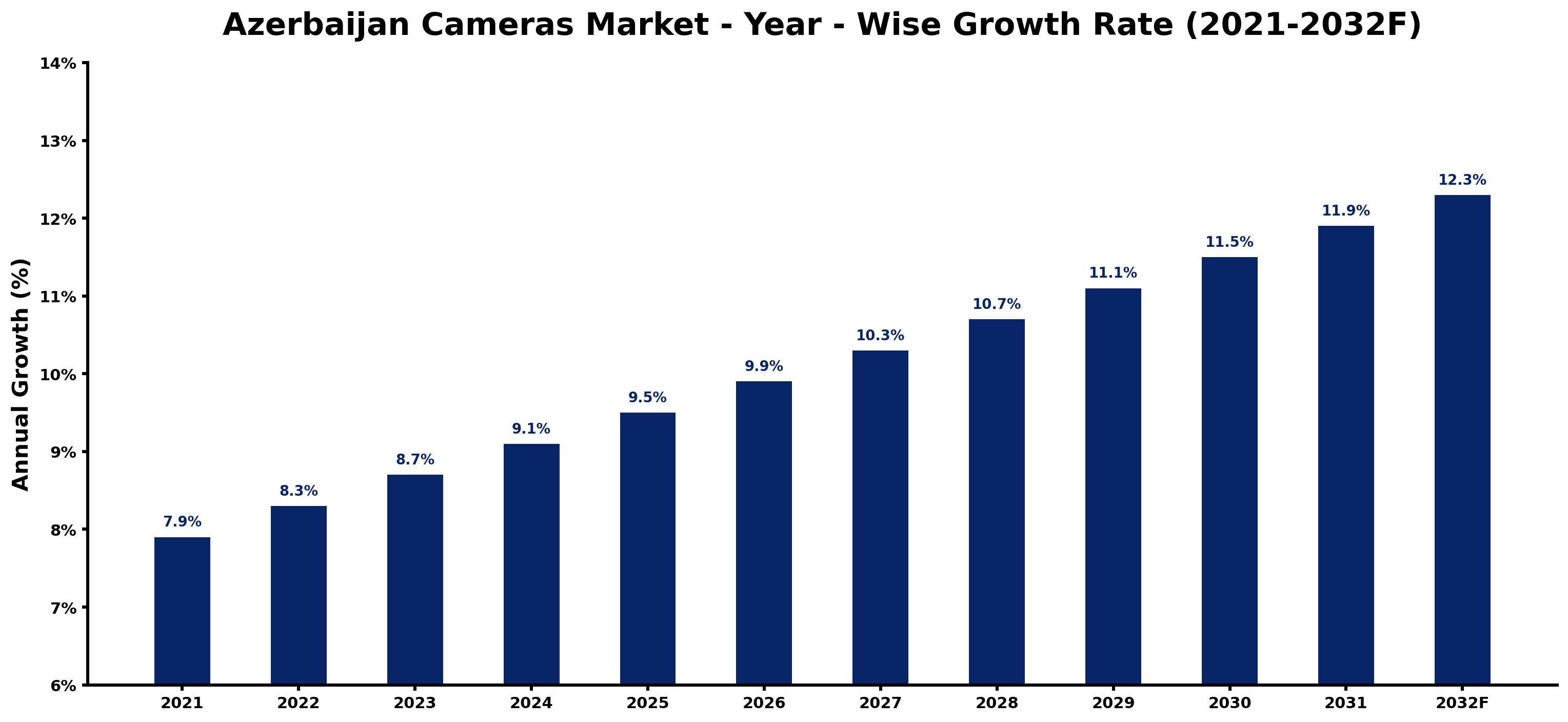
The table below presents the year wise growth rates along with the key drivers influencing the market
| Year | Growth Rate | Major Drivers |
| 2021 | 7.9% | Post-pandemic consumer interest in photography stimulated camera purchases and usage. |
| 2022 | 8.3% | Local retailers increased digital marketing efforts to capture younger audiences' attention. |
| 2023 | 8.7% | Affordable smartphone cameras compelled traditional manufacturers to innovate and diversify products. |
| 2024 | 9.1% | Rising tourism industry encouraged investments in high-quality camera equipment by travelers. |
| 2025 | 9.5% | Educational programs in photography emerged, fostering interest and creating new camera users. |
| 2026 | 9.9% | Social media platforms became essential for showcasing photographic talent, boosting camera sales. |
| 2027 | 10.3% | Launch of local photography contests incentivized community engagement and camera utilization. |
| 2028 | 10.7% | Event photography demand surged as local festivals and events resumed post-pandemic. |
| 2029 | 11.1% | Emergence of influencer marketing showcased the appeal of professional cameras to consumers. |
| 2030 | 11.5% | Online marketplaces expanded access to diverse camera models, enhancing market competition. |
| 2031 | 11.9% | Sustainable practices in manufacturing drew eco-conscious consumers towards specific brands. |
| 2032 | 12.3% | Technological integration in cameras attracted tech enthusiasts focused on cutting-edge features. |
Note - Market size estimations and growth projections presented in this report are based on 6Wresearch's advanced forecasting approach, validated with industry datasets as of June 2026.
Azerbaijan Cameras Market Synopsis
The Azerbaijan Cameras Market is projected to reach 9.9% and witness significant growth during the forecast period (2026-2032). This growth is fueled by increasing consumer enthusiasm for photography and videography, technological advancements in camera devices, and the rising popularity of social media platforms. Cameras are becoming essential tools for both personal use and professional content creation, further driving demand in the market.
Azerbaijan Cameras Market Growth Drivers
Several key factors are contributing to the growth of the Azerbaijan Cameras Market. Firstly, the proliferation of social media has led to an upsurge in demand for high-quality imaging devices, as individuals seek to share visually appealing content. Additionally, the growing trend of vlogging and content creation has heightened interest in advanced camera technologies. The increasing adoption of mirrorless cameras, which are favored for their compactness and superior image quality, further strengthens market growth.
- The rapid escalation of social media usage influences purchasing decisions, as users aim to enhance their visual storytelling capabilities.
- Technological improvements in camera design and performance are attracting consumers who prioritize high-quality images and user-friendly interfaces.
- With rising disposable incomes, more consumers are willing to invest in premium photography equipment, impacting overall market dynamics positively.
- Online retail has emerged as a significant distribution channel, providing consumers with easy access to a diverse array of camera products and accessories.
- The tourism industry's growth in Azerbaijan presents additional opportunities for camera sales, catering to both local and international travelers seeking to document their experiences.
Azerbaijan Cameras Market Trends and Opportunities
The Azerbaijani market is characterized by evolving consumer preferences, particularly the shift towards mirrorless cameras, which are increasingly replacing traditional DSLRs. Additionally, the popularity of action cameras is on the rise, driven by adventure tourism and the demand for high-quality video content among vloggers. Furthermore, smartphone cameras continue to compete effectively with standalone cameras, prompting manufacturers to innovate and enhance features such as AI capabilities and connectivity options.
- Consumers are gravitating towards compact and lightweight camera options, making mirrorless cameras particularly appealing for travel enthusiasts.
- The trend of integrating advanced technology into camera equipment, such as enhanced autofocus systems and high-resolution sensors, is becoming increasingly common.
- With the rise of content creators, there is a burgeoning demand for professional-grade cameras that cater to a wider range of creative applications.
- The evolution of online shopping is influencing purchasing behavior, as consumers appreciate the convenience and variety offered by digital platforms.
- Educational initiatives focused on photography are likely to stimulate market growth by increasing consumer knowledge and appreciation for quality imaging.
Azerbaijan Cameras Market Challenges and Restraints
Despite the positive growth outlook, the Azerbaijan Cameras Market faces several challenges that could impact its trajectory. Intense competition from international brands often puts local manufacturers at a disadvantage, affecting market shares. Rapid technological changes lead to shorter product lifecycles, posing difficulties in sustaining competitive advantage. Additionally, economic fluctuations can alter discretionary spending patterns, affecting consumer purchases.
- Strict competition may hinder market penetration efforts for new entrants and smaller players.
- Technological advances can result in rapid obsolescence of existing products, creating pressure to continuously innovate.
- Economic downturns can limit consumer spending power, impacting overall sales of premium camera products.
- Issues surrounding intellectual property rights and counterfeiting may undermine brand integrity and consumer trust.
- The lack of adequate after-sales support and distribution channels can adversely affect customer satisfaction and loyalty.
Azerbaijan Cameras Market Government Investment and Initiatives
The government of Azerbaijan has established stringent regulations to enhance the quality and safety of cameras sold within the country. Standards for imports ensure that all camera devices meet specific safety criteria, protecting both consumers and local manufacturers. To further bolster the local industry, there are policies in place that impose import tariffs on cameras, aimed at promoting domestic production. Additionally, government incentives for research and development in the camera sector are designed to encourage innovation and bolster competitive capabilities among local firms.
These initiatives not only aim to enhance consumer protection but also foster overall economic growth within the camera market. By supporting local manufacturers and encouraging technological advancements, the government aims to position Azerbaijan as a competitive player in the global cameras market.
Azerbaijan Cameras Market Latest Developments (May 2025 - June 2026)
Recent developments in the Azerbaijan Cameras Market have highlighted a shift towards more innovative imaging technologies. Manufacturers are increasingly focusing on feature-rich products that cater to the growing demand for social media content creation. Additionally, collaborations between technology firms and photography enthusiasts have emerged, fostering a community that promotes the importance of high-quality imaging.
Moreover, the trend towards e-commerce has accelerated, with more online retailers entering the market to meet consumer demands for convenience and variety. This period has also seen an emphasis on the use of social media platforms for marketing strategies, as companies aim to tap into the influencer culture prevalent in Azerbaijan.
Azerbaijan Cameras Market - Key Attractiveness of the Report
- 10 Years of Market Numbers
- Historical Data Starting from 2022 to 2025
- Base Year: 2025
- Forecast Data until 2032
- Key Performance Indicators Impacting the Market
- Major Upcoming Developments and Projects
Key Highlights of the Report:
- Azerbaijan Cameras Market Outlook
- Market Size of Azerbaijan Cameras Market, 2025
- Forecast of Azerbaijan Cameras Market, 2032F
- Historical Data and Forecast of Azerbaijan Cameras Revenues & Volume for the Period 2022-2032F
- Azerbaijan Cameras Market Trend Evolution
- Azerbaijan Cameras Market Drivers and Challenges
- Azerbaijan Cameras Price Trends
- Azerbaijan Cameras Porter's Five Forces
- Azerbaijan Cameras Industry Life Cycle
- Historical Data and Forecast of Azerbaijan Cameras Market Revenues & Volume By Product Type for the Period 2022-2032F
- Historical Data and Forecast of Azerbaijan Cameras Market Revenues & Volume By Built-in Lens Camera for the Period 2022-2032F
- Historical Data and Forecast of Azerbaijan Cameras Market Revenues & Volume By Interchangeable Lens Camera for the Period 2022-2032F
- Historical Data and Forecast of Azerbaijan Cameras Market Revenues & Volume By DSLR for the Period 2022-2032F
- Historical Data and Forecast of Azerbaijan Cameras Market Revenues & Volume By Non-reflex for the Period 2022-2032F
- Historical Data and Forecast of Azerbaijan Cameras Market Revenues & Volume By Application for the Period 2022-2032F
- Historical Data and Forecast of Azerbaijan Cameras Market Revenues & Volume By Commercial for the Period 2022-2032F
- Historical Data and Forecast of Azerbaijan Cameras Market Revenues & Volume By Residential for the Period 2022-2032F
- Historical Data and Forecast of Azerbaijan Cameras Market Revenues & Volume By Distribution Channel for the Period 2022-2032F
- Historical Data and Forecast of Azerbaijan Cameras Market Revenues & Volume By Online for the Period 2022-2032F
- Historical Data and Forecast of Azerbaijan Cameras Market Revenues & Volume By Offline for the Period 2022-2032F
- Azerbaijan Cameras Import Export Trade Statistics
- Market Opportunity Assessment By Product Type
- Market Opportunity Assessment By Application
- Market Opportunity Assessment By Distribution Channel
- Azerbaijan Cameras Top Companies Market Share
- Azerbaijan Cameras Competitive Benchmarking By Technical and Operational Parameters
- Azerbaijan Cameras Company Profiles
- Azerbaijan Cameras Key Strategic Recommendations






































