Azerbaijan Canvas Market Size, Share & Growth Rate
The Azerbaijan Canvas Market was estimated at USD 304 Million in 2025 and is projected to reach USD 562 Million by 2032, growing at a CAGR of 9.2% from 2026 to 2032. This robust growth trajectory is supported by the country's active infrastructure development and an increasing appetite for durable textiles across multiple sectors, including construction and outdoor recreation. As demand for versatile applications like tents, awnings, and upholstery surges, the canvas market is poised for significant advancements.
Azerbaijan Canvas Market Year-wise Growth Rate and Key Drivers
This graph highlights how the Azerbaijan Canvas Market has steadily grown over the years, supported by major growth factors.
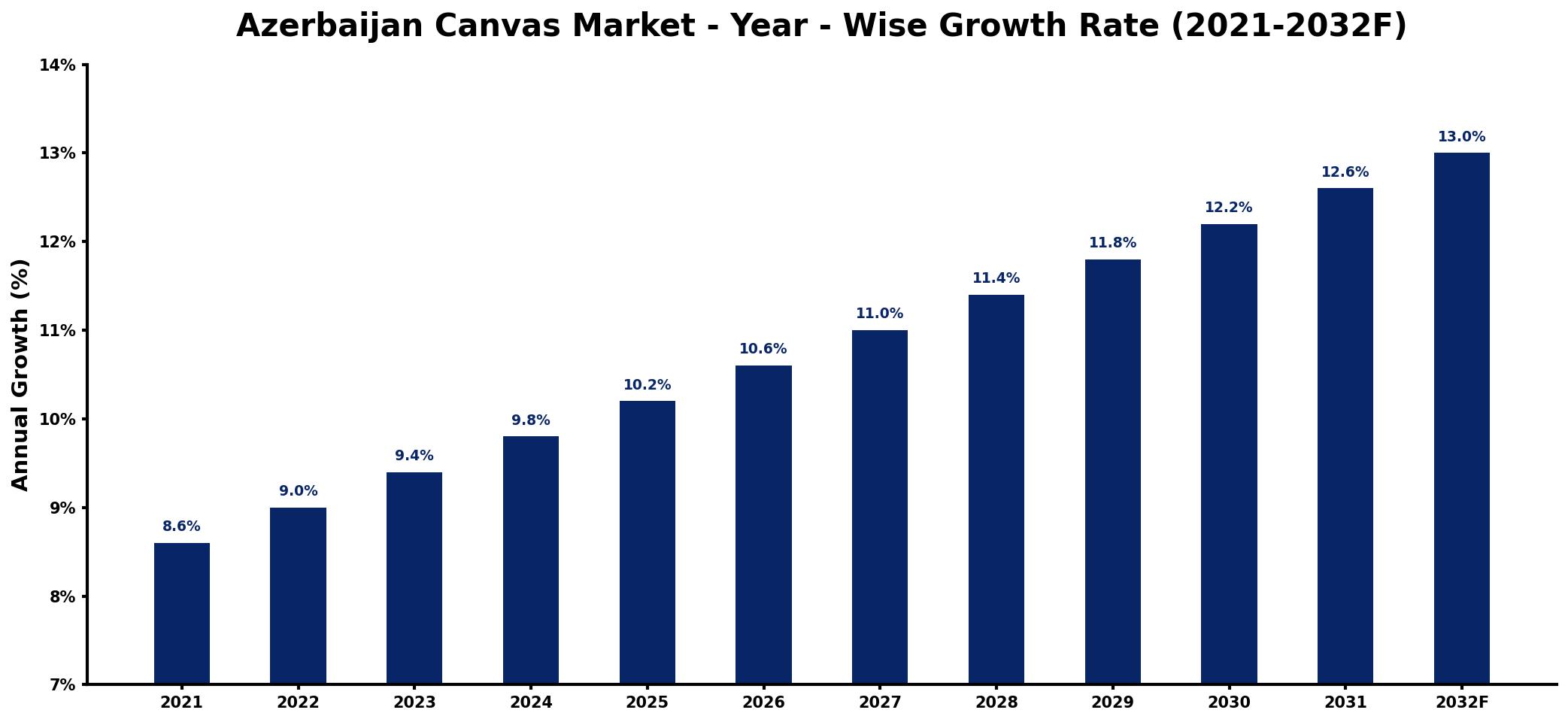
The table below presents the year‑wise growth rates along with the key drivers influencing the market
| Year | Growth Rate | Major Drivers |
| 2021 | 8.6% | increased demand for art supplies |
| 2022 | 9.0% | growth in decorative interior design |
| 2023 | 9.4% | rising interest in DIY projects |
| 2024 | 9.8% | expansion of educational art programs |
| 2025 | 10.2% | increased investment in creative industries |
| 2026 | 10.6% | growing popularity of home decor |
| 2027 | 11.0% | surge in online art sales |
| 2028 | 11.4% | boost in cultural art events |
| 2029 | 11.8% | growing commercial sector adoption |
| 2030 | 12.2% | increased collaboration with artists |
| 2031 | 12.6% | expanding healthcare application demand |
| 2032 | 13.0% | rising global art market influence |
Note: Market size estimations and growth projections presented in this report are based on 6Wresearch's proprietary forecasting methodology, utilizing the latest available industry data, government publications, and primary research inputs.
Azerbaijan Canvas Market Synopsis
The canvas market in Azerbaijan has gained significant momentum in recent years, fueled by a strong construction sector and rising outdoor activities that necessitate durable fabric solutions. Moving forward, this market is expected to evolve further, offering innovative products that cater to the diverse needs of consumers.
While the current focus is on traditional applications, such as tarpaulins and bags, future developments may lead to the integration of advanced materials and technologies, enhancing the functional attributes of canvas products. This shift indicates a promising horizon for manufacturers seeking to capitalize on emerging market demands.
Azerbaijan Canvas Market Key Takeaways
- The Azerbaijan Canvas Market is projected to experience a CAGR of 9.2% from 2026 to 2032.
- Infrastructure projects are a significant growth driver, with rising demand for durable textiles across multiple industries.
- Canvas products have a wide range of applications, including construction, automotive, and outdoor recreation.
- Competition from alternative materials and fluctuating raw material prices pose challenges for market players.
- Government regulations related to manufacturing and quality standards will shape market dynamics.
Evaluation of Restraints in Azerbaijan Canvas Market
While the Azerbaijan Canvas Market shows promising growth potential, several restraints could hinder its advancement. Chief among these are the competition posed by synthetic materials, which often offer lower costs and varying performance qualities. Additionally, fluctuations in raw material prices can create uncertainty for manufacturers, impacting their ability to deliver consistent, high-quality products. In response, companies must adapt by focusing on product durability, weather resistance, and overall versatility to meet the evolving demands of consumers across diverse applications.
Azerbaijan Canvas Market Trends
Several key trends are currently shaping the Azerbaijan Canvas Market. The shift towards sustainability has prompted manufacturers to explore eco-friendly materials and production practices. Additionally, innovations in textile technology are enabling the development of lighter, more durable canvases, appealing to both consumers and industry professionals. The rise of outdoor recreational activities has further amplified demand for canvas-based products, creating a vibrant market for items like tents and backpacks. As consumer preferences evolve, there is also a growing focus on customization and niche applications, which are influencing product development strategies.
Azerbaijan Canvas Market Opportunities
The Azerbaijan Canvas Market presents a multitude of growth and investment opportunities. As infrastructure projects continue to expand, manufacturers can leverage increased demand for high-quality canvas materials in construction applications. Furthermore, the rising popularity of outdoor activities suggests a lucrative market for recreational canvas products. Additionally, advancements in technology provide avenues for innovation in product offerings, allowing manufacturers to meet specific customer needs and expand into new market segments. Those poised to invest in research and development stand to gain a competitive edge in this evolving landscape.
Government Initiatives in the Azerbaijan Canvas Market
The Azerbaijani government has begun implementing policies aimed at supporting the manufacturing sector, including the canvas market. These initiatives encompass quality standards to ensure the reliability of canvas products, alongside potential import tariffs or restrictions designed to foster local production. Moreover, regulations governing the use of canvas in construction and other industries may impact market dynamics, pushing manufacturers to align their offerings with government guidelines. As public spending on infrastructure projects increases, these initiatives could play a pivotal role in shaping the canvas market's landscape.
Future Insights of the Azerbaijan Canvas Market
Looking ahead to 2026-2032, the Azerbaijan Canvas Market is set to undergo transformative changes, driven by sustained growth in construction and outdoor recreation sectors. Anticipated technological advancements and increased emphasis on sustainability will further shape product offerings, catering to discerning consumers. As the demand for versatile and durable textiles continues to rise, the market will likely expand its focus on innovation and customization. Companies that remain agile and responsive to market trends will be well-positioned to thrive in this evolving environment.
Azerbaijan Canvas Market Latest Developments (2025 - 2026)
In recent months, the Azerbaijan Canvas Market has seen a growing emphasis on sustainability and eco-friendly practices, with several manufacturers exploring environmentally conscious materials and production methods. As the country ramps up its infrastructure projects, interest in durable canvas products has surged, leading to potential collaborations between manufacturers and construction firms. Additionally, outdoor recreational brands are increasingly looking to incorporate innovative canvas materials into their products, reflecting changing consumer preferences and driving new product developments.
Azerbaijan Canvas Market - Key Attractiveness of the Report
- 10 Years of Market Numbers
- Historical Data Starting from 2022 to 2025
- Base Year: 2025
- Forecast Data until 2032
- Key Performance Indicators Impacting the Market
- Major Upcoming Developments and Projects
Key Highlights of the Report:
- Azerbaijan Canvas Market Outlook
- Market Size of Azerbaijan Canvas Market, 2025
- Forecast of Azerbaijan Canvas Market, 2032
- Historical Data and Forecast of Azerbaijan Canvas Revenues & Volume for the Period 2022-2032F
- Azerbaijan Canvas Market Trend Evolution
- Azerbaijan Canvas Market Drivers and Challenges
- Azerbaijan Canvas Price Trends
- Azerbaijan Canvas Porter's Five Forces
- Azerbaijan Canvas Industry Life Cycle
- Historical Data and Forecast of Azerbaijan Canvas Market Revenues & Volume By Types for the Period 2022-2032F
- Historical Data and Forecast of Azerbaijan Canvas Market Revenues & Volume By Plane Canvas for the Period 2022-2032F
- Historical Data and Forecast of Azerbaijan Canvas Market Revenues & Volume By Duck Canvas for the Period 2022-2032F
- Historical Data and Forecast of Azerbaijan Canvas Market Revenues & Volume By Application for the Period 2022-2032F
- Historical Data and Forecast of Azerbaijan Canvas Market Revenues & Volume By Tent for the Period 2022-2032F
- Historical Data and Forecast of Azerbaijan Canvas Market Revenues & Volume By Luggage Fabric for the Period 2022-2032F
- Historical Data and Forecast of Azerbaijan Canvas Market Revenues & Volume By Automotive Fabric for the Period 2022-2032F
- Historical Data and Forecast of Azerbaijan Canvas Market Revenues & Volume By Apparel for the Period 2022-2032F
- Historical Data and Forecast of Azerbaijan Canvas Market Revenues & Volume By Others for the Period 2022-2032F
- Azerbaijan Canvas Import Export Trade Statistics
- Market Opportunity Assessment By Types
- Market Opportunity Assessment By Application
- Azerbaijan Canvas Top Companies Market Share
- Azerbaijan Canvas Competitive Benchmarking By Technical and Operational Parameters
- Azerbaijan Canvas Company Profiles
- Azerbaijan Canvas Key Strategic Recommendations






































