Azerbaijan Carbon Credit Market Size, Share & Growth Rate
The Azerbaijan Carbon Credit Market was estimated at USD 531 Million in 2025 and is projected to reach USD 890 Million by 2032, growing at a CAGR of 7.7% from 2026 to 2032. This robust trajectory is fueled by increasing investments in renewable energy and afforestation projects, coupled with the government's commitment to international climate agreements. As businesses seek to align with global sustainability goals, the demand for carbon credits as a viable offset mechanism is expected to intensify.
Azerbaijan Carbon Credit Market Year-wise Growth Rate and Key Drivers
This graph highlights how the Azerbaijan Carbon Credit Market has steadily grown over the years, supported by major growth factors.
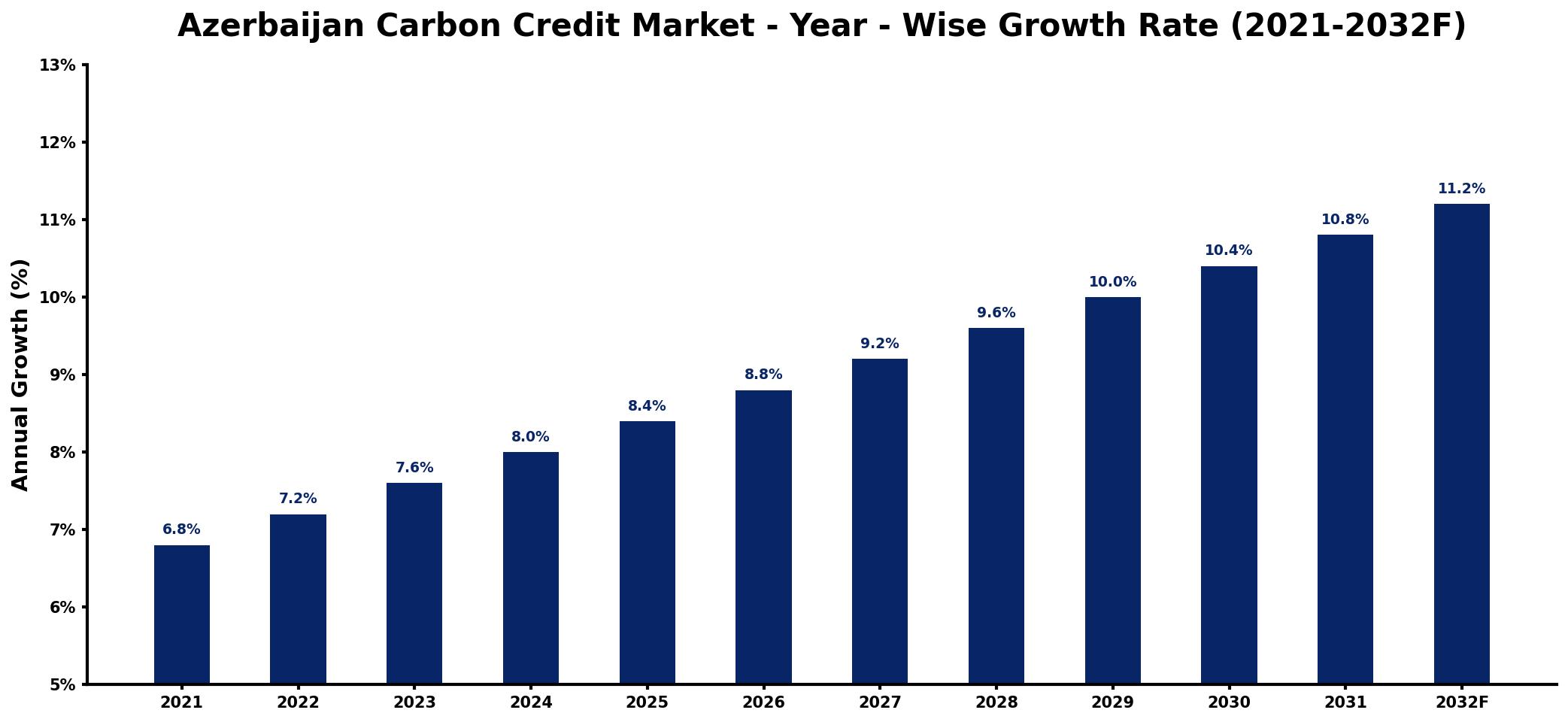
The table below presents the year‑wise growth rates along with the key drivers influencing the market
| Year | Growth Rate | Major Drivers |
| 2021 | 6.8% | increased investments in renewable energy |
| 2022 | 7.2% | growing awareness of climate change |
| 2023 | 7.6% | expansion of regulatory frameworks |
| 2024 | 8.0% | rising corporate sustainability initiatives |
| 2025 | 8.4% | enhanced technological innovations adoption |
| 2026 | 8.8% | increased public environmental consciousness |
| 2027 | 9.2% | increased capital investment inflows |
| 2028 | 9.6% | increased overall sector activity |
| 2029 | 10.0% | increased participation in global markets |
| 2030 | 10.4% | growing demand for sustainable practices |
| 2031 | 10.8% | development of new environmental standards |
| 2032 | 11.2% | enhanced collaboration among stakeholders |
Note: Market size estimations and growth projections presented in this report are based on 6Wresearch's proprietary forecasting methodology, utilizing the latest available industry data, government publications, and primary research inputs.
Azerbaijan Carbon Credit Market Synopsis
The Azerbaijan Carbon Credit Market has been gaining significant traction, bolstered by a growing awareness of the need for sustainable practices and a commitment to reduce greenhouse gas emissions. Recent initiatives have sparked interest among both domestic and international investors, heralding a new era of carbon trading.
Looking forward, the market is poised for expansion, with a diverse array of projects spanning renewable energy, energy efficiency, and forestry. These developments not only promise economic viability but also underline Azerbaijan's commitment to sustainable growth in accordance with its climate goals.
Azerbaijan Carbon Credit Market Key Takeaways
- The market is on a growth trajectory, anticipated to reach USD 890 Million by 2032.
- Government policies are increasingly supportive of carbon trading initiatives and sustainable practices.
- Investors are actively engaged in projects focusing on renewable energy and afforestation, enhancing market liquidity.
- Standardization in carbon credit trading is fostering transparency and encouraging wider participation.
- The increasing demand for carbon credits positions Azerbaijan as a strategic player in the global carbon market.
Evaluation of Restraints in Azerbaijan Carbon Credit Market
Despite the positive outlook, the Azerbaijan Carbon Credit Market faces several constraints. A significant challenge lies in the lack of robust regulatory frameworks, which can create uncertainty for potential investors. This unpredictability may impede the growth of new projects, as stakeholders seek clarity on carbon credit processes. Additionally, the complexities of monitoring and verification can present hurdles, demanding higher costs that may deter smaller businesses from entering the market. Furthermore, limited awareness of carbon credits among the general population hinders broader participation, necessitating targeted educational initiatives to overcome these barriers.
Azerbaijan Carbon Credit Market Trends
Several key trends are shaping the Azerbaijan Carbon Credit Market. Firstly, there is a marked increase in projects aimed at renewable energy, with an emphasis on solar and wind initiatives. Energy efficiency measures are also gaining traction, demonstrating a concerted effort to reduce overall emissions. Furthermore, the trend towards transparency and standardization is helping to build trust within the market, making carbon credit trading more accessible to various stakeholders. These developments highlight the evolving landscape as Azerbaijan positions itself to meet both domestic and global sustainability targets.
Azerbaijan Carbon Credit Market Opportunities
The opportunities within the Azerbaijan Carbon Credit Market are vast and varied. Investors can tap into a growing portfolio of projects focused on renewable energy, energy efficiency, and reforestation. The governments commitment to fostering a green economy provides fertile ground for innovative ventures. Additionally, as awareness of climate change and sustainability grows, the market is likely to attract a broader range of participants, paving the way for investment in emerging technologies and practices that support carbon offsetting initiatives. By engaging early, investors can secure a competitive advantage in this evolving market.
Government Initiatives in the Azerbaijan Carbon Credit Market
The Azerbaijani government has implemented a series of initiatives to bolster the carbon credit market, signaling its dedication to environmental sustainability. Notable among these is the establishment of the State Agency for Alternative and Renewable Energy Sources, which plays a crucial role in overseeing emissions trading and facilitating renewable projects. Moreover, the government has ratified the Kyoto Protocol, aligning its policies with international standards to ensure a robust carbon trading framework. Various tax incentives and subsidies for clean energy technologies further illustrate the government's commitment to fostering a conducive environment for carbon credit generation and trading.
Future Insights of the Azerbaijan Carbon Credit Market
Looking ahead to 2026-2032, the Azerbaijan Carbon Credit Market is set for transformative growth. The government's steadfast dedication to reducing greenhouse gas emissions, coupled with its strategic geographic positioning between Europe and Asia, enhances Azerbaijan's potential as a significant player in the global carbon marketplace. Demand for carbon credits is anticipated to rise significantly, driven by both local initiatives and international requirements for emissions reduction. With ongoing investments in infrastructure and policy enhancements, the market is likely to evolve into a competitive hub for carbon trading.
Azerbaijan Carbon Credit Market Latest Developments (2025 - 2026)
In recent months, the Azerbaijan Carbon Credit Market has seen notable activity, particularly in the realm of renewable energy projects and carbon credit trading platforms. Initiatives aimed at improving transparency and standardization have gained momentum, fostering trust among investors and stakeholders. Additionally, workshops and seminars focusing on carbon trading practices have been organized to enhance knowledge and engagement within the market. This educational push is expected to encourage broader participation and investment, setting the stage for a more vibrant carbon credit landscape.
Azerbaijan Carbon Credit Market - Key Attractiveness of the Report
- 10 Years of Market Numbers
- Historical Data Starting from 2022 to 2025
- Base Year: 2025
- Forecast Data until 2032
- Key Performance Indicators Impacting the Market
- Major Upcoming Developments and Projects
Key Highlights of the Report:
- Azerbaijan Carbon Credit Market Outlook
- Market Size of Azerbaijan Carbon Credit Market, 2025
- Forecast of Azerbaijan Carbon Credit Market, 2032
- Historical Data and Forecast of Azerbaijan Carbon Credit Revenues & Volume for the Period 2022-2032F
- Azerbaijan Carbon Credit Market Trend Evolution
- Azerbaijan Carbon Credit Market Drivers and Challenges
- Azerbaijan Carbon Credit Price Trends
- Azerbaijan Carbon Credit Porter's Five Forces
- Azerbaijan Carbon Credit Industry Life Cycle
- Historical Data and Forecast of Azerbaijan Carbon Credit Market Revenues & Volume By Sector for the Period 2022-2032F
- Historical Data and Forecast of Azerbaijan Carbon Credit Market Revenues & Volume By Energy for the Period 2022-2032F
- Historical Data and Forecast of Azerbaijan Carbon Credit Market Revenues & Volume By Transportation for the Period 2022-2032F
- Historical Data and Forecast of Azerbaijan Carbon Credit Market Revenues & Volume By Residential And Commercial Buildings for the Period 2022-2032F
- Historical Data and Forecast of Azerbaijan Carbon Credit Market Revenues & Volume By Industry for the Period 2022-2032F
- Historical Data and Forecast of Azerbaijan Carbon Credit Market Revenues & Volume By Agriculture for the Period 2022-2032F
- Historical Data and Forecast of Azerbaijan Carbon Credit Market Revenues & Volume By Forestry for the Period 2022-2032F
- Historical Data and Forecast of Azerbaijan Carbon Credit Market Revenues & Volume By Water And Wastewater for the Period 2022-2032F
- Azerbaijan Carbon Credit Import Export Trade Statistics
- Market Opportunity Assessment By Sector
- Azerbaijan Carbon Credit Top Companies Market Share
- Azerbaijan Carbon Credit Competitive Benchmarking By Technical and Operational Parameters
- Azerbaijan Carbon Credit Company Profiles
- Azerbaijan Carbon Credit Key Strategic Recommendations






































