Azerbaijan Cellulose Acetate Fiber Market Size, Share & Growth Rate
The Azerbaijan Cellulose Acetate Fiber Market was estimated at USD 931 Million in 2025 and is projected to reach USD 1741 Million by 2032, growing at a CAGR of 9.4% from 2026 to 2032. This trajectory is propelled by a significant pivot toward sustainable and eco-friendly textile materials, as both consumers and manufacturers increasingly recognize the benefits of biodegradable fibers. Furthermore, supportive government initiatives aiming to foster sustainable manufacturing practices underscore the potential for continued market expansion.
Azerbaijan Cellulose Acetate Fiber Market Year-wise Growth Rate and Key Drivers
This graph highlights how the Azerbaijan Cellulose Acetate Fiber Market has steadily grown over the years, supported by major growth factors.
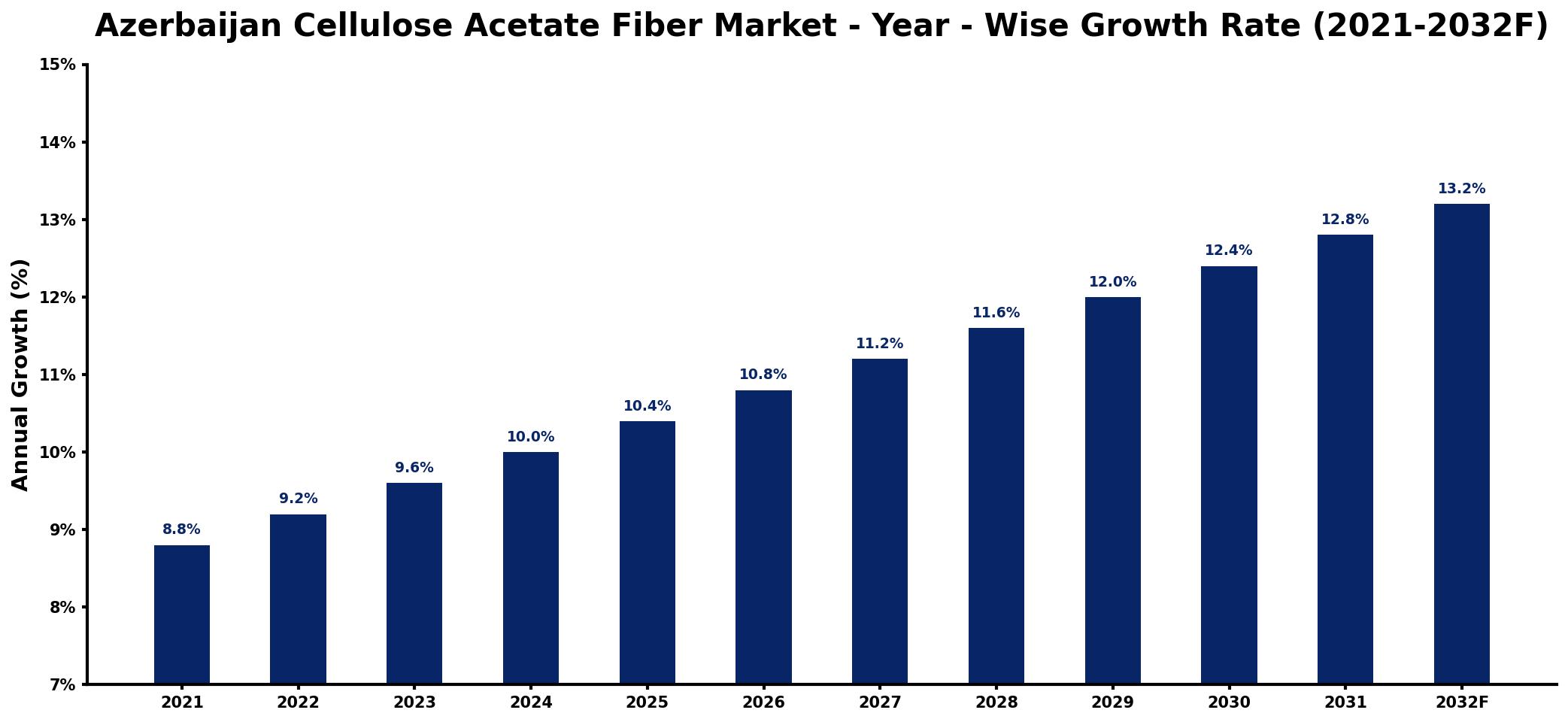
The table below presents the year‑wise growth rates along with the key drivers influencing the market
| Year | Growth Rate | Major Drivers |
| 2021 | 8.8% | Rising demand in textile industry |
| 2022 | 9.2% | Increased investments in manufacturing |
| 2023 | 9.6% | Expansion of sustainable product lines |
| 2024 | 10.0% | Growing consumer awareness sustainability |
| 2025 | 10.4% | Technological advancements in production |
| 2026 | 10.8% | Emerging market opportunities abroad |
| 2027 | 11.2% | Strengthening global supply chains |
| 2028 | 11.6% | Enhanced product performance standards |
| 2029 | 12.0% | Diversification of end-use applications |
| 2030 | 12.4% | Collaboration with fashion designers |
| 2031 | 12.8% | Growing emphasis on eco-friendly materials |
| 2032 | 13.2% | Increased regulatory support initiatives |
Note: Market size estimations and growth projections presented in this report are based on 6Wresearch's proprietary forecasting methodology, utilizing the latest available industry data, government publications, and primary research inputs.
Azerbaijan Cellulose Acetate Fiber Market Synopsis
Recent growth in the Azerbaijan Cellulose Acetate Fiber Market reflects a robust shift towards environmental consciousness within the textile sector. However, as the market matures, there remains considerable opportunity for innovation and development to meet rising consumer expectations for quality and sustainability.
Looking ahead, the demand for cellulose acetate fibers is poised to surge, driven by increasing awareness of environmental issues and the push for sustainable practices across various industries. As manufacturers prioritize eco-friendly production methods, this market is expected to solidify its position as a leading alternative to synthetic fibers.
Azerbaijan Cellulose Acetate Fiber Market Key Takeaways
- The market is projected to maintain a strong growth trajectory through 2032, supported by sustainability trends.
- Key drivers include increasing consumer awareness and government support for eco-friendly materials.
- Technological advancements are enhancing the quality and performance of cellulose acetate fibers.
- Challenges from synthetic fibers remain, but innovation is shifting market dynamics positively.
- Investment opportunities abound in production and distribution, particularly targeting eco-conscious consumers.
Evaluation of Restraints in Azerbaijan Cellulose Acetate Fiber Market
Despite the positive outlook, the Azerbaijan Cellulose Acetate Fiber Market faces notable restraints. The competition from alternative synthetic fibers such as polyester and nylon poses significant challenges, as these materials often present lower costs and performance advantages. Additionally, fluctuations in raw material prices for cellulose acetate can directly affect manufacturers' profitability. Limited consumer awareness regarding the benefits of cellulose acetate fibers further restrains market growth, as many consumers still gravitate towards more familiar synthetic options. Addressing these hurdles will be critical for market stakeholders aiming to capitalize on the growing demand for sustainable fibers.
Azerbaijan Cellulose Acetate Fiber Market Trends
The Azerbaijan Cellulose Acetate Fiber Market is witnessing significant trends that reflect broader shifts within the textile industry. There is a marked emphasis on sustainability and eco-friendliness, prompting manufacturers to innovate with production processes that prioritize renewable resources. Additionally, the textiles and apparel sector is increasingly adopting cellulose acetate fibers for their desirable attributes, such as breathability and biodegradability. Technological advancements in production methods are enabling improved quality and expanded applications, thereby fueling demand across various sectors.
Azerbaijan Cellulose Acetate Fiber Market Opportunities
The landscape of investment opportunities within the Azerbaijan Cellulose Acetate Fiber Market appears promising, spurred by a burgeoning textile industry and rising consumer inclination towards eco-friendly materials. There is significant potential to develop cellulose acetate fiber production facilities catering to both domestic and international markets. Moreover, as awareness of environmental concerns continues to grow, the market is ripe for new entrants focusing on innovative cellulose acetate fiber products. Collaborations with local manufacturers and leveraging Azerbaijan's strategic location can further enhance investment prospects in this sector.
Government Initiatives in the Azerbaijan Cellulose Acetate Fiber Market
The Azerbaijani government is actively promoting the growth of the cellulose acetate fiber market through regulations aimed at ensuring environmental sustainability in production processes. Policies that encourage the development of local manufacturing capabilities, along with potential incentives for eco-friendly initiatives, form part of the governments strategic approach to bolster this sector. By fostering an environment conducive to sustainable practices, these initiatives are expected to play a crucial role in shaping the future dynamics of the market.
Future Insights of the Azerbaijan Cellulose Acetate Fiber Market
The future of the Azerbaijan Cellulose Acetate Fiber Market appears promising, driven by an escalating demand for sustainable materials across a variety of industries, including textiles, automotive, and packaging. The natural attributes of cellulose acetate fibers—such as biodegradability and comfort—position them as preferred choices for manufacturers aiming to meet eco-conscious consumer demands. As awareness regarding environmental issues continues to grow, coupled with advancements in production techniques, the market is likely to witness significant expansion through 2032, potentially creating avenues for export growth as well.
Azerbaijan Cellulose Acetate Fiber Market Latest Developments (2025 - 2026)
In recent months, the Azerbaijan Cellulose Acetate Fiber Market has shown a dynamic shift towards sustainable practices, with several manufacturers initiating partnerships aimed at optimizing production processes. Research and development efforts are intensifying, focusing on enhancing the properties of cellulose acetate fibers to meet diverse consumer needs. Additionally, there is growing attention to consumer education campaigns that highlight the advantages of cellulose acetate over traditional synthetic fibers, further supporting market momentum.
Azerbaijan Cellulose Acetate Fiber Market - Key Attractiveness of the Report
- 10 Years of Market Numbers
- Historical Data Starting from 2022 to 2025
- Base Year: 2025
- Forecast Data until 2032
- Key Performance Indicators Impacting the Market
- Major Upcoming Developments and Projects
Key Highlights of the Report:
- Azerbaijan Cellulose Acetate Fiber Market Outlook
- Market Size of Azerbaijan Cellulose Acetate Fiber Market, 2025
- Forecast of Azerbaijan Cellulose Acetate Fiber Market, 2032
- Historical Data and Forecast of Azerbaijan Cellulose Acetate Fiber Revenues & Volume for the Period 2022-2032F
- Azerbaijan Cellulose Acetate Fiber Market Trend Evolution
- Azerbaijan Cellulose Acetate Fiber Market Drivers and Challenges
- Azerbaijan Cellulose Acetate Fiber Price Trends
- Azerbaijan Cellulose Acetate Fiber Porter's Five Forces
- Azerbaijan Cellulose Acetate Fiber Industry Life Cycle
- Historical Data and Forecast of Azerbaijan Cellulose Acetate Fiber Market Revenues & Volume By Type for the Period 2022-2032F
- Historical Data and Forecast of Azerbaijan Cellulose Acetate Fiber Market Revenues & Volume By Plastic for the Period 2022-2032F
- Historical Data and Forecast of Azerbaijan Cellulose Acetate Fiber Market Revenues & Volume By Fiber for the Period 2022-2032F
- Historical Data and Forecast of Azerbaijan Cellulose Acetate Fiber Market Revenues & Volume By Application for the Period 2022-2032F
- Historical Data and Forecast of Azerbaijan Cellulose Acetate Fiber Market Revenues & Volume By Photographic Films for the Period 2022-2032F
- Historical Data and Forecast of Azerbaijan Cellulose Acetate Fiber Market Revenues & Volume By Cigarette Filters for the Period 2022-2032F
- Historical Data and Forecast of Azerbaijan Cellulose Acetate Fiber Market Revenues & Volume By Tapes & Labels for the Period 2022-2032F
- Historical Data and Forecast of Azerbaijan Cellulose Acetate Fiber Market Revenues & Volume By Textiles & Apparel for the Period 2022-2032F
- Azerbaijan Cellulose Acetate Fiber Import Export Trade Statistics
- Market Opportunity Assessment By Type
- Market Opportunity Assessment By Application
- Azerbaijan Cellulose Acetate Fiber Top Companies Market Share
- Azerbaijan Cellulose Acetate Fiber Competitive Benchmarking By Technical and Operational Parameters
- Azerbaijan Cellulose Acetate Fiber Company Profiles
- Azerbaijan Cellulose Acetate Fiber Key Strategic Recommendations






































