Azerbaijan Cloud Analytics Market Size & Growth Rate (2026-2032)
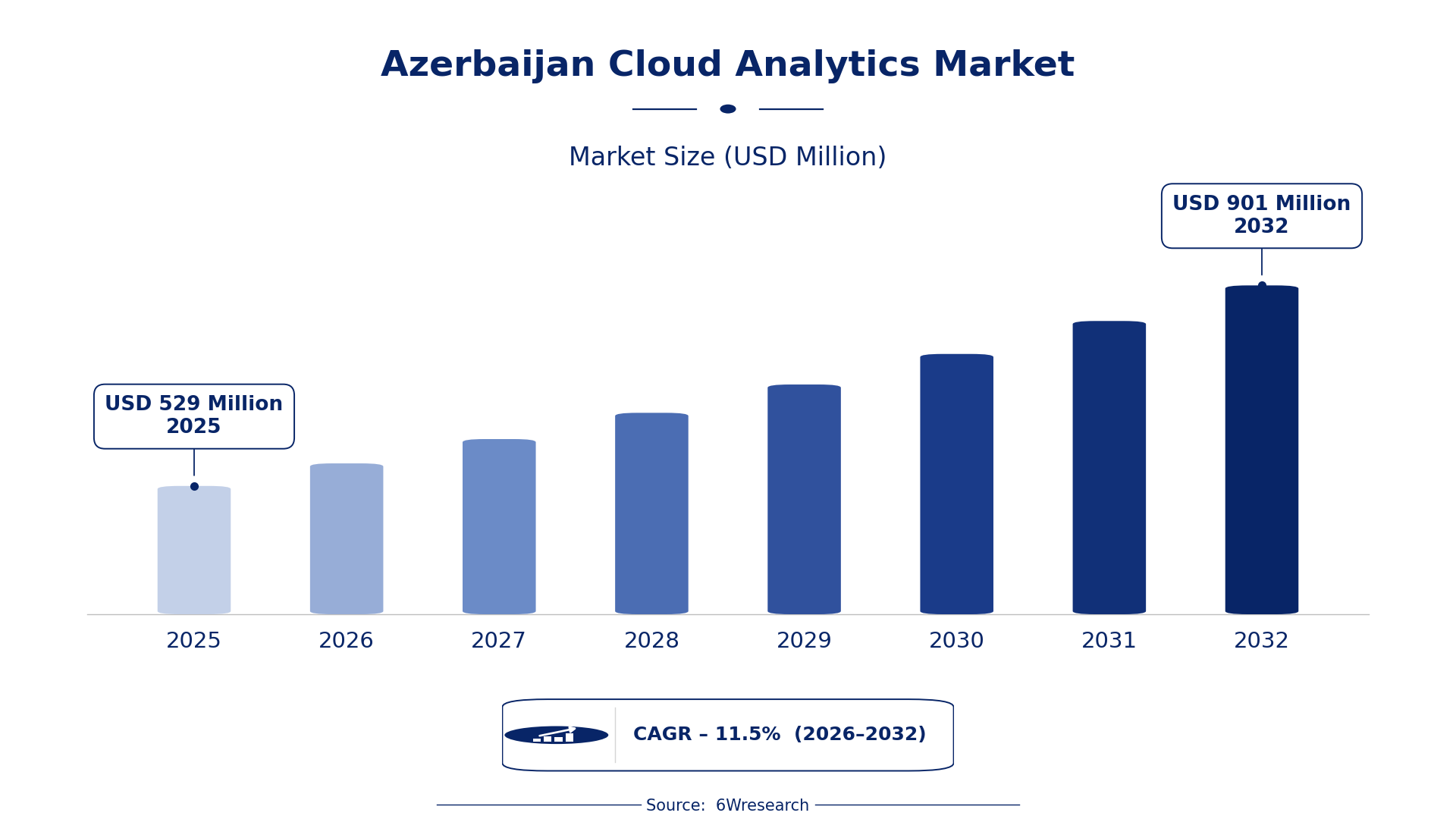
The Azerbaijan Cloud Analytics Market was estimated at USD 529 Million in 2025 and is projected to reach USD 901 Million by 2032, growing at a CAGR of 11.5% from 2026 to 2032.
Azerbaijan Cloud Analytics Market Synopsis
The driving force behind the Azerbaijan Cloud Analytics Market is the insatiable demand for data-driven insights across various sectors. Organizations are increasingly recognizing the advantages of cloud-based analytics solutions, which offer not only scalability but also the agility required to respond to fast-changing market conditions.
In Azerbaijan, businesses are actively adopting cloud analytics to process vast amounts of data, leading to improved operational efficiency and customer engagement. This shift is not merely a trend; it reflects a fundamental change in how companies approach decision-making and competitive advantage in an increasingly data-centric world.
Azerbaijan Cloud Analytics Market Year-wise Growth Rate and Key Drivers
This graph illustrates the annual growth rates of the Azerbaijan Cloud Analytics Market from 2021 to 2032, highlighting a steady upward trajectory and projected expansion over the forecast period.
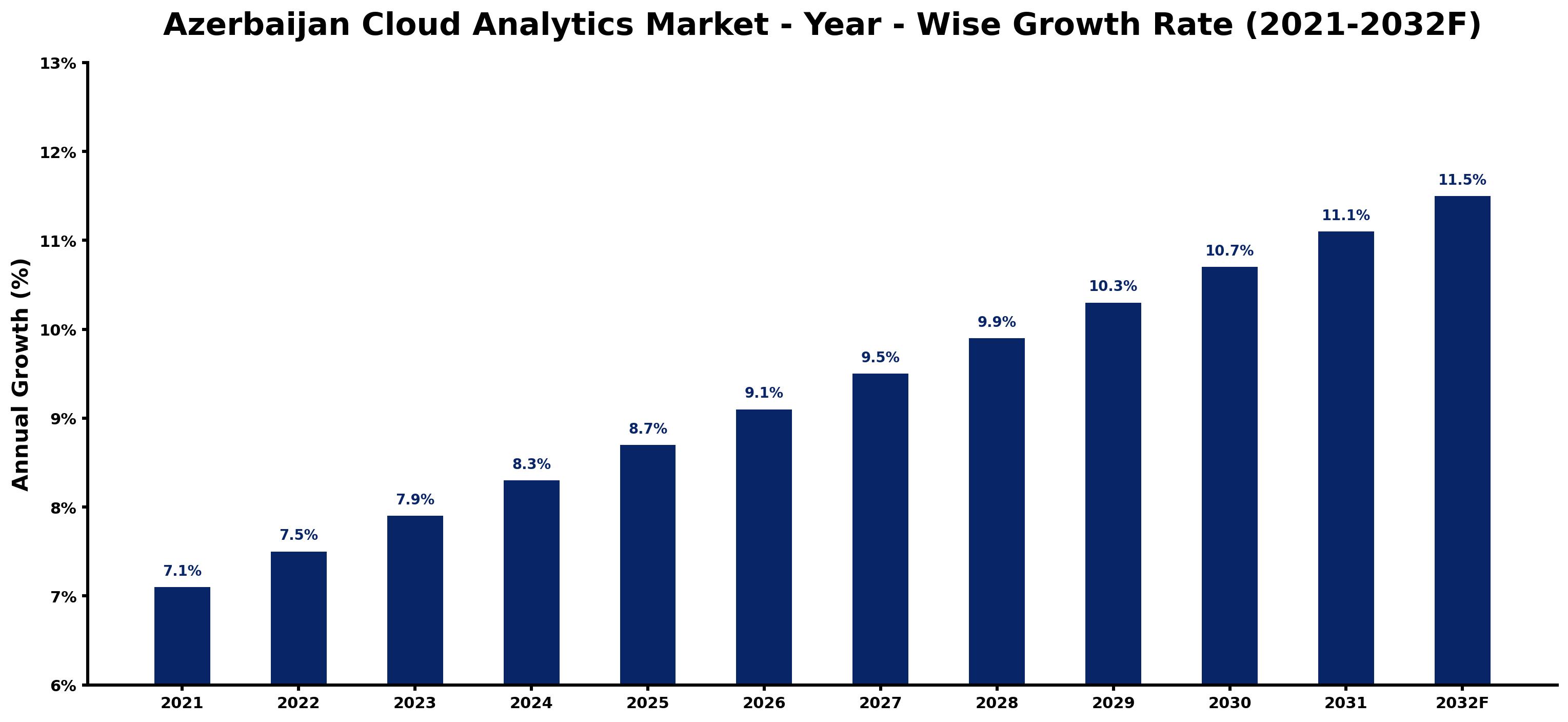
The table below presents the year‑wise growth rates along with the key drivers influencing the market
| Year | Growth Rate | Major Drivers |
| 2021 | 7.1% | Baku-based companies adopting cloud solutions for efficiency. |
| 2022 | 7.5% | Growing youth population driving tech adoption and analytics. |
| 2023 | 7.9% | Аzerbaijan Economic Ministry promoting cloud data analytics. |
| 2024 | 8.3% | Local universities enhancing cloud computing curriculum effectiveness. |
| 2025 | 8.7% | Increased cybersecurity laws boosting cloud service trust. |
| 2026 | 9.1% | Government fostering public-private partnerships in tech sectors. |
| 2027 | 9.5% | Expanding e-commerce sector needing advanced analytics capabilities. |
| 2028 | 9.9% | Investment in smart city projects using IoT analytics. |
| 2029 | 10.3% | Oil industry digitization driving demand for cloud analytics. |
| 2030 | 10.7% | Rise of startups seeking scalable cloud-based solutions. |
| 2031 | 11.1% | Local fintech companies leveraging analytics for customer insights. |
| 2032 | 11.5% | Increased mobile penetration enhancing cloud service accessibility. |
Note: Market size estimations and growth projections presented in this report are based on 6Wresearch's proprietary forecasting methodology, utilizing the latest available industry data, government publications, and primary research inputs.
Azerbaijan Cloud Analytics Market Key Takeaways
Below are some of the specific key takeaways from the market, including:
- The market is experiencing a surge in demand for real-time data analytics solutions.
- Organizations are prioritizing investments in cloud-based platforms for enhanced data processing capabilities.
- Government initiatives are promoting the growth and adoption of cloud analytics technologies.
- Businesses are increasingly focusing on predictive analytics to stay ahead of the competition.
- Challenges related to data security and the availability of skilled professionals remain significant.
Evaluation of Restraints in Azerbaijan Cloud Analytics Market
Despite the promising growth trajectory, the Azerbaijan Cloud Analytics Market faces several restraints. A primary issue is the limited awareness and understanding of cloud analytics solutions among local enterprises. Many organizations still operate under traditional data management paradigms, hindering their ability to transition to cloud-based analytics.
on top of that, the lack of skilled professionals proficient in data analytics poses a barrier to effective implementation. Companies struggle to find talent capable of harnessing the full potential of cloud analytics, resulting in underutilization of these powerful tools. Additionally, concerns regarding data security and compliance with regulations like GDPR complicate the landscape, necessitating a strategic approach to overcome these challenges.
Azerbaijan Cloud Analytics Market Trends
Several trends are emerging in the Azerbaijan Cloud Analytics Market that will shape its future. The rapid growth of big data analytics is at the forefront, with companies seeking to extract actionable insights from large data sets. This trend is complemented by an increased focus on predictive analytics, allowing organizations to forecast trends and make informed decisions.
Additionally, the rise of artificial intelligence and machine learning technologies is further driving the demand for cloud analytics. Businesses are exploring how these technologies can be integrated into their analytics processes to enhance accuracy and efficiency. As organizations prioritize digital transformation, the shift towards cloud-based solutions will likely accelerate.
Azerbaijan Cloud Analytics Market Opportunities
The Azerbaijan Cloud Analytics Market presents numerous growth opportunities, particularly in sectors like finance, healthcare, and retail. As organizations within these industries strive to optimize operations and enhance customer experiences, the need for advanced analytics becomes critical.
Investment in training and development programs can address the skills gap, enabling a workforce capable of leveraging cloud analytics effectively. on top of that, partnerships between private and public sectors can facilitate knowledge transfer and promote best practices, further driving market growth.
Government Initiatives in the Azerbaijan Cloud Analytics Market
The government of Azerbaijan is actively fostering an environment conducive to the growth of the cloud analytics market. With a clear vision for digital transformation, public policy is focused on enhancing data infrastructure and promoting the adoption of cloud technologies across various industries. This proactive approach is crucial as it lays the groundwork for a data-driven economy.
- A national digital infrastructure upgrade programme now in its rollout phase aims to improve access to cloud computing resources.
- A training initiative targeting workforce development in data analytics is currently underway, focusing on equipping professionals with essential skills.
- A regulatory framework introduced in 2025 mandating transparency in data usage aims to bolster trust in cloud analytics solutions.
- A planned public-private initiative is expected to enhance the collaboration between government and industry leaders by 2028.
- A new policy encouraging innovation in cloud-based solutions is anticipated to be launched in late 2026, aimed at facilitating research and development.
Future Insights of the Azerbaijan Cloud Analytics Market
Looking ahead to 2026-2032, the Azerbaijan Cloud Analytics Market is set to experience continued growth driven by technological advancements and evolving business needs. As organizations increasingly recognize the importance of data-driven decision-making, the demand for cloud analytics solutions will rise.
Companies that invest in cloud analytics capabilities will likely gain a competitive edge, especially in sectors that rely heavily on data insights. With government support and a growing emphasis on digital transformation, the market is well-positioned to thrive in the coming years.
Azerbaijan Cloud Analytics Market Latest Developments
Recent activity in the Azerbaijan Cloud Analytics Market has been marked by significant advancements and initiatives. Over the past year, businesses and government entities have intensified their efforts to adopt cloud analytics solutions, reflecting a broader commitment to leveraging data for strategic advantage.
- A major technology vendor announced a partnership with local businesses in early 2025 to enhance cloud analytics capabilities, focusing on tailored solutions.
- An initiative that began in mid-2025 and remains underway aims to establish a center for excellence in data analytics, promoting best practices and innovation.
- A rollout of new cloud-based analytics tools is expected to begin in the second half of 2026, enhancing data processing for multiple sectors.
- A recent collaboration between educational institutions and private companies aims to create specialized training programs for data analytics, enhancing skill development.
- A government-backed project to improve data security protocols in cloud analytics is planned for 2027, addressing compliance and trust issues.
Azerbaijan Cloud Analytics Market - Key Attractiveness of the Report
- 10 Years of Market Numbers
- Historical Data Starting from 2022 to 2025
- Base Year: 2025
- Forecast Data until 2032
- Key Performance Indicators Impacting the Market
- Major Upcoming Developments and Projects
Key Highlights of the Report:
- Azerbaijan Cloud Analytics Market Outlook
- Market Size of Azerbaijan Cloud Analytics Market, 2025
- Forecast of Azerbaijan Cloud Analytics Market, 2032
- Historical Data and Forecast of Azerbaijan Cloud Analytics Revenues & Volume for the Period 2022-2032F
- Azerbaijan Cloud Analytics Market Trend Evolution
- Azerbaijan Cloud Analytics Market Drivers and Challenges
- Azerbaijan Cloud Analytics Price Trends
- Azerbaijan Cloud Analytics Porter's Five Forces
- Azerbaijan Cloud Analytics Industry Life Cycle
- Historical Data and Forecast of Azerbaijan Cloud Analytics Market Revenues & Volume By Solution for the Period 2022-2032F
- Historical Data and Forecast of Azerbaijan Cloud Analytics Market Revenues & Volume By Hosted Data Warehouse Solutions for the Period 2022-2032F
- Historical Data and Forecast of Azerbaijan Cloud Analytics Market Revenues & Volume By Complex Event Processing for the Period 2022-2032F
- Historical Data and Forecast of Azerbaijan Cloud Analytics Market Revenues & Volume By Enterprise Information Management for the Period 2022-2032F
- Historical Data and Forecast of Azerbaijan Cloud Analytics Market Revenues & Volume By Enterprise Performance Management for the Period 2022-2032F
- Historical Data and Forecast of Azerbaijan Cloud Analytics Market Revenues & Volume By Governance, Risk, and Compliance for the Period 2022-2032F
- Historical Data and Forecast of Azerbaijan Cloud Analytics Market Revenues & Volume By Analytics Solutions for the Period 2022-2032F
- Historical Data and Forecast of Azerbaijan Cloud Analytics Market Revenues & Volume By Deployment Mode for the Period 2022-2032F
- Historical Data and Forecast of Azerbaijan Cloud Analytics Market Revenues & Volume By Public Cloud for the Period 2022-2032F
- Historical Data and Forecast of Azerbaijan Cloud Analytics Market Revenues & Volume By Private Cloud for the Period 2022-2032F
- Historical Data and Forecast of Azerbaijan Cloud Analytics Market Revenues & Volume By Hybrid Cloud for the Period 2022-2032F
- Historical Data and Forecast of Azerbaijan Cloud Analytics Market Revenues & Volume By Industry Vertical for the Period 2022-2032F
- Historical Data and Forecast of Azerbaijan Cloud Analytics Market Revenues & Volume By BFSI for the Period 2022-2032F
- Historical Data and Forecast of Azerbaijan Cloud Analytics Market Revenues & Volume By Retail and Consumer Goods for the Period 2022-2032F
- Historical Data and Forecast of Azerbaijan Cloud Analytics Market Revenues & Volume By Healthcare and Life Sciences for the Period 2022-2032F
- Historical Data and Forecast of Azerbaijan Cloud Analytics Market Revenues & Volume By Media and Entertainment for the Period 2022-2032F
- Historical Data and Forecast of Azerbaijan Cloud Analytics Market Revenues & Volume By Government for the Period 2022-2032F
- Historical Data and Forecast of Azerbaijan Cloud Analytics Market Revenues & Volume By Telecom and IT for the Period 2022-2032F
- Historical Data and Forecast of Azerbaijan Cloud Analytics Market Revenues & Volume By Research and Education for the Period 2022-2032F
- Historical Data and Forecast of Azerbaijan Cloud Analytics Market Revenues & Volume By Energy for the Period 2022-2032F
- Historical Data and Forecast of Azerbaijan Cloud Analytics Market Revenues & Volume By Organization Size for the Period 2022-2032F
- Historical Data and Forecast of Azerbaijan Cloud Analytics Market Revenues & Volume By SMEs for the Period 2022-2032F
- Historical Data and Forecast of Azerbaijan Cloud Analytics Market Revenues & Volume By Large Enterprises for the Period 2022-2032F
- Azerbaijan Cloud Analytics Import Export Trade Statistics
- Market Opportunity Assessment By Solution
- Market Opportunity Assessment By Deployment Mode
- Market Opportunity Assessment By Industry Vertical
- Market Opportunity Assessment By Organization Size
- Azerbaijan Cloud Analytics Top Companies Market Share
- Azerbaijan Cloud Analytics Competitive Benchmarking By Technical and Operational Parameters
- Azerbaijan Cloud Analytics Company Profiles
- Azerbaijan Cloud Analytics Key Strategic Recommendations






































