Azerbaijan Cloud Professional Services Market Size & Growth Rate (2026-2032)
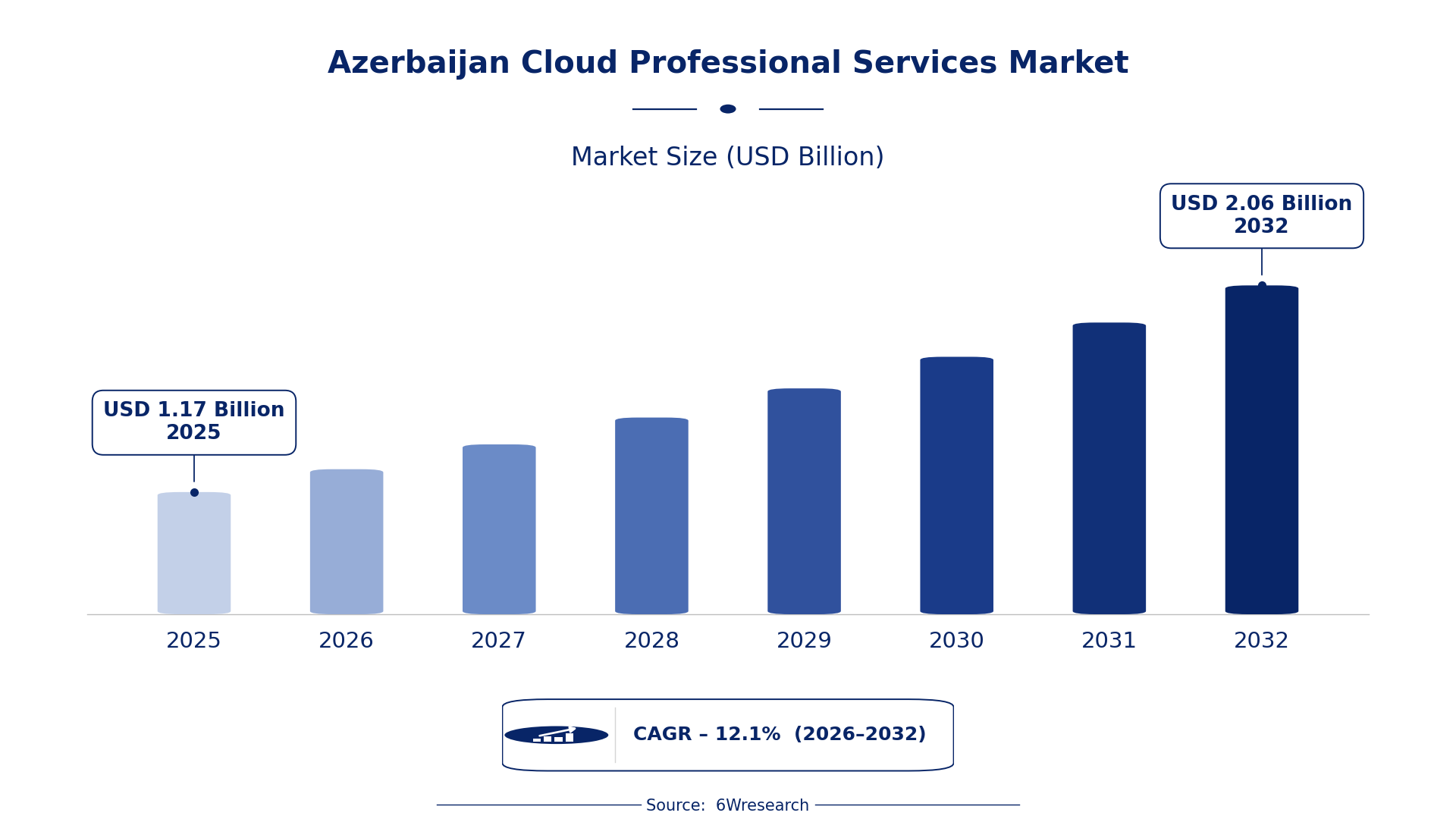
The Azerbaijan Cloud Professional Services Market was estimated at USD 1168 Million in 2025 and is projected to reach USD 2057 Million by 2032, growing at a CAGR of 12.1% from 2026 to 2032.
Azerbaijan Cloud Professional Services Market Synopsis
In Azerbaijan, the surge in cloud adoption is the primary force shaping the cloud professional services market. Businesses are increasingly recognizing the necessity of expert guidance to navigate the complexities of cloud technologies, particularly as they undergo digital transformation initiatives and adopt hybrid cloud models.
As organizations strive to optimize their cloud environments, the demand for specialized consulting, implementation, and ongoing support services is expected to rise sharply. This trend is further fueled by a skills gap in the IT workforce, making it critical for companies to partner with proficient service providers who can deliver tailored solutions.
Azerbaijan Cloud Professional Services Market Year-wise Growth Rate and Key Drivers
This graph illustrates the annual growth rates of the Azerbaijan Cloud Professional Services Market from 2021 to 2032, highlighting a steady upward trajectory and projected expansion over the forecast period.
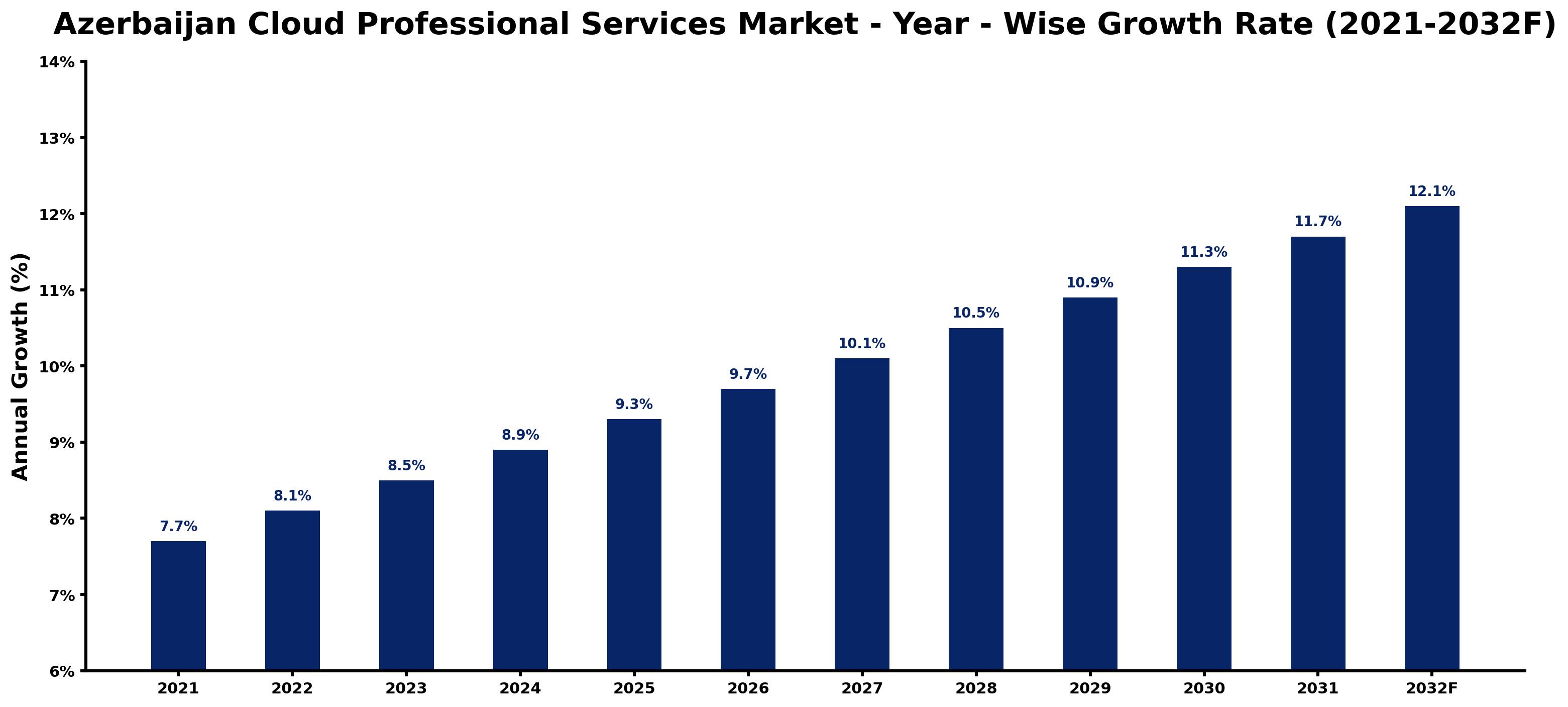
The table below presents the year‑wise growth rates along with the key drivers influencing the market
| Year | Growth Rate | Major Drivers |
| 2021 | 7.7% | Azerbaijan's IT Development Strategy promoting cloud adoption. |
| 2022 | 8.1% | Local startups accelerating digital service transformations. |
| 2023 | 8.5% | Regulations favoring cloud data storage for enterprises. |
| 2024 | 8.9% | Increase in remote work driving cloud-based solutions. |
| 2025 | 9.3% | Petroleum sector adopting cloud for data management. |
| 2026 | 9.7% | Government grants available for cloud service providers. |
| 2027 | 10.1% | Rising cyber security awareness boosting cloud services demand. |
| 2028 | 10.5% | Strategic partnerships forming between local firms and cloud vendors. |
| 2029 | 10.9% | Increased smartphone penetration promoting cloud access. |
| 2030 | 11.3% | Local enterprises migrating legacy systems to cloud solutions. |
| 2031 | 11.7% | Cloud gaming popularity driving infrastructure investments. |
| 2032 | 12.1% | Education sector’s shift to cloud-based learning platforms. |
Note: Market size estimations and growth projections presented in this report are based on 6Wresearch's proprietary forecasting methodology, utilizing the latest available industry data, government publications, and primary research inputs.
Azerbaijan Cloud Professional Services Market Key Takeaways
Below are some of the specific key takeaways from the market, including:
- Cloud adoption is accelerating as businesses seek to enhance operational efficiency and reduce costs.
- The shortage of skilled professionals in cloud technologies is a significant challenge for organizations.
- Government initiatives are actively promoting the growth of local expertise in cloud services.
- Hybrid cloud deployments are becoming a standard strategy among Azerbaijani enterprises.
- Consulting and implementation services are critical for successful cloud transformation projects.
Evaluation of Restraints in Azerbaijan Cloud Professional Services Market
The market faces notable constraints, particularly the limited pool of qualified cloud professionals. As businesses increasingly turn to cloud solutions, the lack of specialized training and certification programs has become apparent. This skills gap hampers organizations’ ability to effectively migrate to and manage cloud environments. on top of that, aligning cloud strategies with business goals and ensuring compliance with regulatory frameworks, such as GDPR, adds layers of complexity that challenge both service providers and clients.
Azerbaijan Cloud Professional Services Market Trends
Emerging trends indicate a shift towards more integrated cloud solutions, with organizations adopting multi-cloud strategies to avoid vendor lock-in. There's also a growing emphasis on security and compliance, as businesses recognize the importance of safeguarding their data in cloud environments. Additionally, the rise of artificial intelligence and machine learning is prompting companies to seek cloud services that can support advanced analytics and automation capabilities.
Azerbaijan Cloud Professional Services Market Opportunities
The market presents numerous opportunities for growth, particularly in sectors such as finance, healthcare, and telecommunications, where cloud solutions can enhance operational efficiency. Companies that focus on developing training programs and certification courses will be well-positioned to bridge the skills gap. on top of that, businesses that can offer innovative solutions tailored to hybrid cloud environments will find a receptive market eager for expertise.
Government Initiatives in the Azerbaijan Cloud Professional Services Market
Government policy is playing a crucial role in shaping the Azerbaijan Cloud Professional Services Market. By implementing supportive policies aimed at nurturing local talent and fostering investment, the government is laying the groundwork for a thriving cloud ecosystem. These initiatives not only aim to enhance the quality of services offered but also to encourage collaborations with international firms.
- A national digital skills development program launched in early 2023 aims to train IT professionals in cloud technologies.
- Currently ongoing is a public-private partnership initiative designed to facilitate knowledge sharing and resource allocation in cloud services.
- Plans are in place for a regulatory framework expected to be introduced by 2025, focusing on data security standards for cloud services.
- The government is promoting incentives for businesses that adopt cloud solutions, set to roll out in mid-2024.
- A recently completed investment initiative has attracted several international firms to establish cloud service centers in Azerbaijan.
Future Insights of the Azerbaijan Cloud Professional Services Market
Looking ahead to 2026-2032, the Azerbaijan Cloud Professional Services Market is set to expand significantly. The ongoing digital transformation across various industries will continue to drive demand for cloud expertise. As hybrid and multi-cloud strategies become standard practice, businesses will increasingly seek specialized consulting and support services to optimize their cloud environments. The government's proactive policies will further stimulate growth, making Azerbaijan a competitive player in the regional cloud services arena.
Azerbaijan Cloud Professional Services Market Latest Developments
In the past year, the Azerbaijan Cloud Professional Services Market has seen dynamic activity, with several initiatives aimed at enhancing cloud capabilities across various sectors. The focus has been on strengthening local expertise while fostering partnerships with international firms to elevate service quality.
- An initiative that began in early 2023 and remains underway focuses on enhancing cybersecurity measures for cloud services across the country.
- A major technology vendor announced a partnership in Q2 2023 to deliver cloud solutions tailored to the Azerbaijani market.
- A successful pilot program was completed in late 2023, aimed at integrating AI capabilities into local cloud services.
- Plans for a comprehensive cloud migration service were revealed in Q1 2024, set to be launched by mid-2024.
- An ongoing collaboration with educational institutions aims to develop a certification program for cloud professionals, expected to be fully operational by early 2025.
Azerbaijan Cloud Professional Services Market - Key Attractiveness of the Report
- 10 Years of Market Numbers
- Historical Data Starting from 2022 to 2025
- Base Year: 2025
- Forecast Data until 2032
- Key Performance Indicators Impacting the Market
- Major Upcoming Developments and Projects
Key Highlights of the Report:
- Azerbaijan Cloud Professional Services Market Outlook
- Market Size of Azerbaijan Cloud Professional Services Market, 2025
- Forecast of Azerbaijan Cloud Professional Services Market, 2032
- Historical Data and Forecast of Azerbaijan Cloud Professional Services Revenues & Volume for the Period 2022-2032F
- Azerbaijan Cloud Professional Services Market Trend Evolution
- Azerbaijan Cloud Professional Services Market Drivers and Challenges
- Azerbaijan Cloud Professional Services Price Trends
- Azerbaijan Cloud Professional Services Porter's Five Forces
- Azerbaijan Cloud Professional Services Industry Life Cycle
- Historical Data and Forecast of Azerbaijan Cloud Professional Services Market Revenues & Volume By Service Type for the Period 2022-2032F
- Historical Data and Forecast of Azerbaijan Cloud Professional Services Market Revenues & Volume By Consulting for the Period 2022-2032F
- Historical Data and Forecast of Azerbaijan Cloud Professional Services Market Revenues & Volume By Integration & Optimization for the Period 2022-2032F
- Historical Data and Forecast of Azerbaijan Cloud Professional Services Market Revenues & Volume By Implementation & Migration for the Period 2022-2032F
- Historical Data and Forecast of Azerbaijan Cloud Professional Services Market Revenues & Volume By Application Development & Modernization for the Period 2022-2032F
- Historical Data and Forecast of Azerbaijan Cloud Professional Services Market Revenues & Volume By Service Model for the Period 2022-2032F
- Historical Data and Forecast of Azerbaijan Cloud Professional Services Market Revenues & Volume By Platform as a Service (PaaS) for the Period 2022-2032F
- Historical Data and Forecast of Azerbaijan Cloud Professional Services Market Revenues & Volume By Software as a Service (SaaS) for the Period 2022-2032F
- Historical Data and Forecast of Azerbaijan Cloud Professional Services Market Revenues & Volume By Infrastructure as a Service (IaaS) for the Period 2022-2032F
- Historical Data and Forecast of Azerbaijan Cloud Professional Services Market Revenues & Volume By Deployment Model for the Period 2022-2032F
- Historical Data and Forecast of Azerbaijan Cloud Professional Services Market Revenues & Volume By Public Cloud for the Period 2022-2032F
- Historical Data and Forecast of Azerbaijan Cloud Professional Services Market Revenues & Volume By Private Cloud for the Period 2022-2032F
- Historical Data and Forecast of Azerbaijan Cloud Professional Services Market Revenues & Volume By Organization Size for the Period 2022-2032F
- Historical Data and Forecast of Azerbaijan Cloud Professional Services Market Revenues & Volume By Small and Medium-Sized Enterprises (SMEs) for the Period 2022-2032F
- Historical Data and Forecast of Azerbaijan Cloud Professional Services Market Revenues & Volume By Large Enterprises for the Period 2022-2032F
- Historical Data and Forecast of Azerbaijan Cloud Professional Services Market Revenues & Volume By Vertical for the Period 2022-2032F
- Historical Data and Forecast of Azerbaijan Cloud Professional Services Market Revenues & Volume By Baanking, Financial Services, and insurance (BFSI) for the Period 2022-2032F
- Historical Data and Forecast of Azerbaijan Cloud Professional Services Market Revenues & Volume By Retail & Consumer Goods for the Period 2022-2032F
- Historical Data and Forecast of Azerbaijan Cloud Professional Services Market Revenues & Volume By IT & ITeS for the Period 2022-2032F
- Historical Data and Forecast of Azerbaijan Cloud Professional Services Market Revenues & Volume By Telecommunications for the Period 2022-2032F
- Historical Data and Forecast of Azerbaijan Cloud Professional Services Market Revenues & Volume By Healthcare & Life Sciences for the Period 2022-2032F
- Historical Data and Forecast of Azerbaijan Cloud Professional Services Market Revenues & Volume By Manufacturing for the Period 2022-2032F
- Historical Data and Forecast of Azerbaijan Cloud Professional Services Market Revenues & Volume By Energy & Utilities for the Period 2022-2032F
- Historical Data and Forecast of Azerbaijan Cloud Professional Services Market Revenues & Volume By Government & Defense for the Period 2022-2032F
- Azerbaijan Cloud Professional Services Import Export Trade Statistics
- Market Opportunity Assessment By Service Type
- Market Opportunity Assessment By Service Model
- Market Opportunity Assessment By Deployment Model
- Market Opportunity Assessment By Organization Size
- Market Opportunity Assessment By Vertical
- Azerbaijan Cloud Professional Services Top Companies Market Share
- Azerbaijan Cloud Professional Services Competitive Benchmarking By Technical and Operational Parameters
- Azerbaijan Cloud Professional Services Company Profiles
- Azerbaijan Cloud Professional Services Key Strategic Recommendations






































