Azerbaijan Coated Fabric Market Size, Share & Growth Rate
The Azerbaijan Coated Fabric Market was estimated at USD 1147 Million in 2025 and is projected to reach USD 2009 Million by 2032, growing at a CAGR of 8.3% from 2026 to 2032. This promising growth trajectory is largely driven by escalating demand from key industries like automotive and construction, which are increasingly favoring coated fabrics for their enhanced durability and resistance to various environmental factors. Additionally, a shift in consumer preferences towards functional textiles is set to further bolster market growth.
Azerbaijan Coated Fabric Market Year-wise Growth Rate and Key Drivers
This graph highlights how the Azerbaijan Coated Fabric Market has steadily grown over the years, supported by major growth factors.
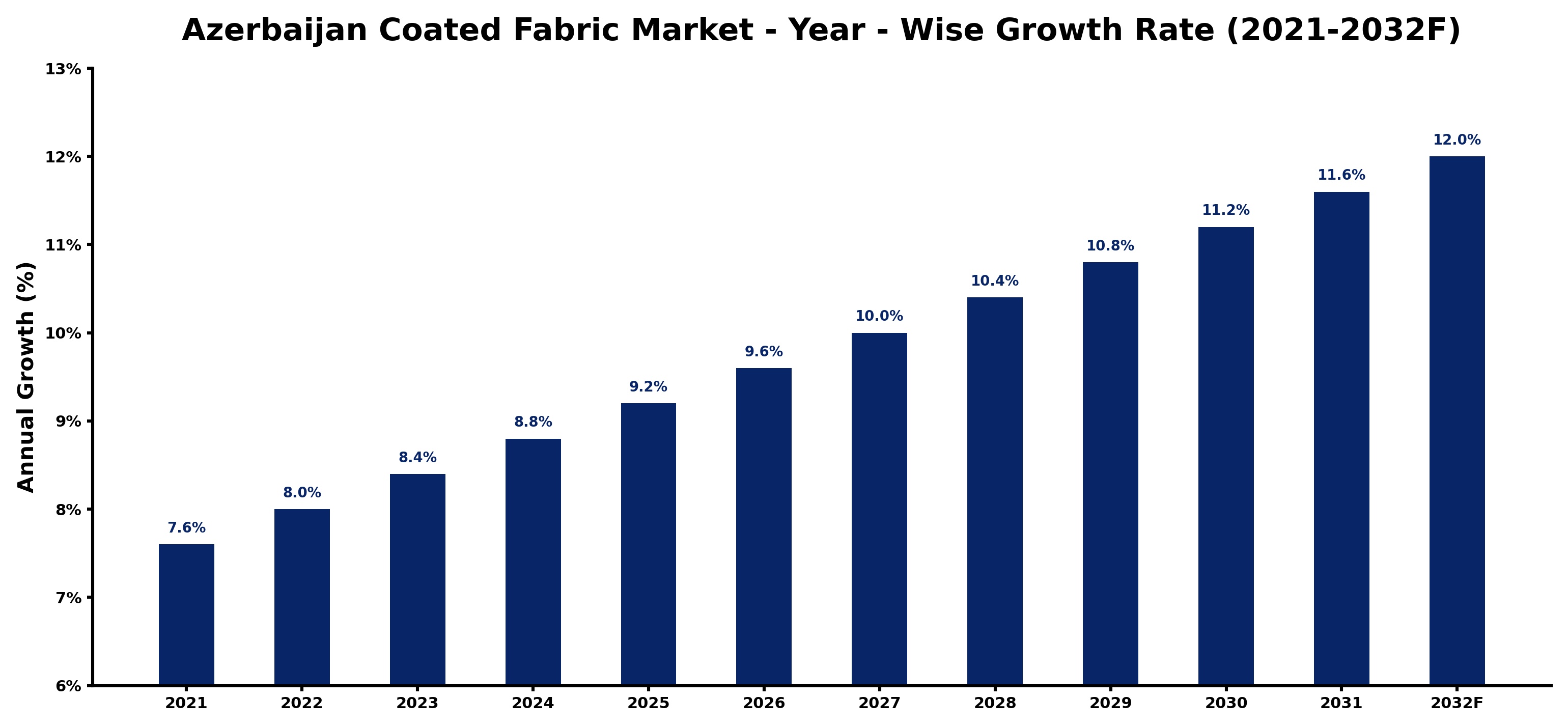
The table below presents the year‑wise growth rates along with the key drivers influencing the market
| Year | Growth Rate | Major Drivers |
| 2021 | 7.6% | Expansion of commercial construction activities |
| 2022 | 8.0% | Expansion of manufacturing activities |
| 2023 | 8.4% | Increasing industrial infrastructure investments |
| 2024 | 8.8% | Increasing adoption of advanced technologies |
| 2025 | 9.2% | Expansion of commercial construction activities |
| 2026 | 9.6% | Increasing adoption of advanced technologies |
| 2027 | 10.0% | Rapid growth in telecom and data center sectors |
| 2028 | 10.4% | Increasing adoption of advanced technologies |
| 2029 | 10.8% | Increasing smart city development projects |
| 2030 | 11.2% | Expansion of commercial construction activities |
| 2031 | 11.6% | Rapid growth in telecom and data center sectors |
| 2032 | 12.0% | Increasing industrial infrastructure investments |
Note - Market size estimations and growth projections presented in this report are based on 6Wresearch’s advanced forecasting approach, validated with industry datasets as of June 2026.
Azerbaijan Coated Fabric Market Synopsis
The Azerbaijan coated fabric market is experiencing a noteworthy transformation, propelled by increasing urbanization and infrastructure development projects. Coated fabrics are gaining traction in various sectors, including automotive, healthcare, and outdoor recreation, where their performance attributes are highly sought after.
A growing awareness of the benefits of durable and weather-resistant materials among consumers is further accentuating this trend. As technological advancements in coating methods continue to evolve, the market is positioned for substantial growth, reflecting a dynamic interplay between consumer needs and industrial applications.
Azerbaijan Coated Fabric Market Key Takeaways
- The market is set to grow significantly, with projected revenues reaching USD 2009 Million by 2032.
- Urbanization and infrastructure projects are key drivers of demand for coated fabrics.
- Technological advancements are enhancing the properties of coated fabrics, making them more appealing across various industries.
- Government policies aimed at industrial development are expected to support market growth.
- The automotive and construction sectors are leading the demand for high-performance coated fabrics.
Evaluation of Restraints in Azerbaijan Coated Fabric Market
Despite its growth potential, the Azerbaijan coated fabric market faces specific constraints that could impact its trajectory. The limited availability of high-quality coated fabrics with particular performance characteristics is a significant hurdle. Manufacturers often encounter difficulties in sourcing materials that meet diverse end-use requirements due to the variability in coating technologies and substrate materials. Moreover, compliance with regulatory standards like REACH remains a crucial concern, as adherence to environmental sustainability and product safety regulations is essential in building consumer trust and market resilience.
Azerbaijan Coated Fabric Market Trends
The current trends in the Azerbaijan coated fabric market indicate a shift towards multifunctional textiles that offer enhanced durability and specialized properties such as flame resistance and UV protection. As industries emphasize environmental sustainability, there is a growing push for eco-friendly coating materials that align with global sustainability goals. Additionally, digital innovations and smart textiles are emerging, enabling the development of coated fabrics with integrated functionalities that cater to niche markets, thereby driving consumer interest.
Azerbaijan Coated Fabric Market Opportunities
Genuine growth opportunities in the Azerbaijan coated fabric market lie within sectors such as automotive and healthcare, which are undergoing rapid transformation. The increasing investment in infrastructure, driven by both governmental and private sector initiatives, presents a fertile ground for coated fabric suppliers. Furthermore, the rising demand for outdoor recreation products reflects consumer trends favoring durable and weather-resistant materials, suggesting a substantial market expansion potential for innovative coated fabric solutions.
Government Initiatives in the Azerbaijan Coated Fabric Market
Government policies play a crucial role in shaping the dynamics of the coated fabric market in Azerbaijan. Initiatives aimed at promoting industrial development through tax incentives and grants are encouraging investments in manufacturing and technology upgrades. Trade regulations and environmental policies also have significant implications, as they govern the import/export dynamics and ensure product safety. Additionally, public procurement policies are increasingly favoring domestically produced coated fabrics, providing further stimulus to local manufacturers.
Future Insights of the Azerbaijan Coated Fabric Market
Looking ahead, the Azerbaijan coated fabric market is set to continue its upward trajectory from 2026 to 2032, driven by increased urbanization and infrastructure spending. The evolving consumer landscape, characterized by a demand for innovative, sustainable materials, will necessitate ongoing advancements in coating technologies. As industries increasingly seek out tailored solutions, market players who can adapt to these shifting demands will be best positioned to thrive in this dynamic environment.
Azerbaijan Coated Fabric Market Latest Developments (May 2025 - June 2026)
Recent trends indicate a marked increase in collaborations between coated fabric manufacturers and research institutions, focusing on developing eco-friendly materials and advanced coating technologies. The industry is witnessing a surge in innovation, with new product lines emerging that cater to specialized applications in sectors such as healthcare and sportswear. As regulatory frameworks continue to evolve, players are actively seeking compliance strategies that align with sustainability goals, driving further investment and growth.
Azerbaijan Coated Fabric Market - Key Attractiveness of the Report
- 10 Years of Market Numbers
- Historical Data Starting from 2022 to 2025
- Base Year: 2025
- Forecast Data until 2032
- Key Performance Indicators Impacting the Market
- Major Upcoming Developments and Projects
Key Highlights of the Report:
- Azerbaijan Coated Fabric Market Outlook
- Market Size of Azerbaijan Coated Fabric Market, 2025
- Forecast of Azerbaijan Coated Fabric Market, 2032
- Historical Data and Forecast of Azerbaijan Coated Fabric Revenues & Volume for the Period 2022-2032F
- Azerbaijan Coated Fabric Market Trend Evolution
- Azerbaijan Coated Fabric Market Drivers and Challenges
- Azerbaijan Coated Fabric Price Trends
- Azerbaijan Coated Fabric Porter's Five Forces
- Azerbaijan Coated Fabric Industry Life Cycle
- Historical Data and Forecast of Azerbaijan Coated Fabric Market Revenues & Volume By Product for the Period 2022-2032F
- Historical Data and Forecast of Azerbaijan Coated Fabric Market Revenues & Volume By Polymer-coated Fabric for the Period 2022-2032F
- Historical Data and Forecast of Azerbaijan Coated Fabric Market Revenues & Volume By Rubber-coated Fabric for the Period 2022-2032F
- Historical Data and Forecast of Azerbaijan Coated Fabric Market Revenues & Volume By Fabric-backed Wall Coverings for the Period 2022-2032F
- Historical Data and Forecast of Azerbaijan Coated Fabric Market Revenues & Volume By Application for the Period 2022-2032F
- Historical Data and Forecast of Azerbaijan Coated Fabric Market Revenues & Volume By Transportation for the Period 2022-2032F
- Historical Data and Forecast of Azerbaijan Coated Fabric Market Revenues & Volume By Protective Clothing for the Period 2022-2032F
- Historical Data and Forecast of Azerbaijan Coated Fabric Market Revenues & Volume By Industrial for the Period 2022-2032F
- Historical Data and Forecast of Azerbaijan Coated Fabric Market Revenues & Volume By Roofing, Awnings & Canopies for the Period 2022-2032F
- Historical Data and Forecast of Azerbaijan Coated Fabric Market Revenues & Volume By Furniture & Seating for the Period 2022-2032F
- Historical Data and Forecast of Azerbaijan Coated Fabric Market Revenues & Volume By Others for the Period 2022-2032F
- Azerbaijan Coated Fabric Import Export Trade Statistics
- Market Opportunity Assessment By Product
- Market Opportunity Assessment By Application
- Azerbaijan Coated Fabric Top Companies Market Share
- Azerbaijan Coated Fabric Competitive Benchmarking By Technical and Operational Parameters
- Azerbaijan Coated Fabric Company Profiles
- Azerbaijan Coated Fabric Key Strategic Recommendations






































