Azerbaijan Commercial Boiler Market Size, Share & Growth Rate
The Azerbaijan Commercial Boiler Market was estimated at USD 665 Million in 2025 and is projected to reach USD 1230 Million by 2032, growing at a CAGR of 9.2% from 2026 to 2032. This robust growth is primarily fueled by the countrys industrialization efforts, the rapid urbanization of its cities, and increasing investments in commercial infrastructure such as hotels and hospitals. As businesses and public institutions strive for enhanced energy efficiency, the demand for modern, efficient boiler systems is set to rise significantly.
Azerbaijan Commercial Boiler Market Year-wise Growth Rate and Key Drivers
This graph highlights how the Azerbaijan Commercial Boiler Market has steadily grown over the years, supported by major growth factors.
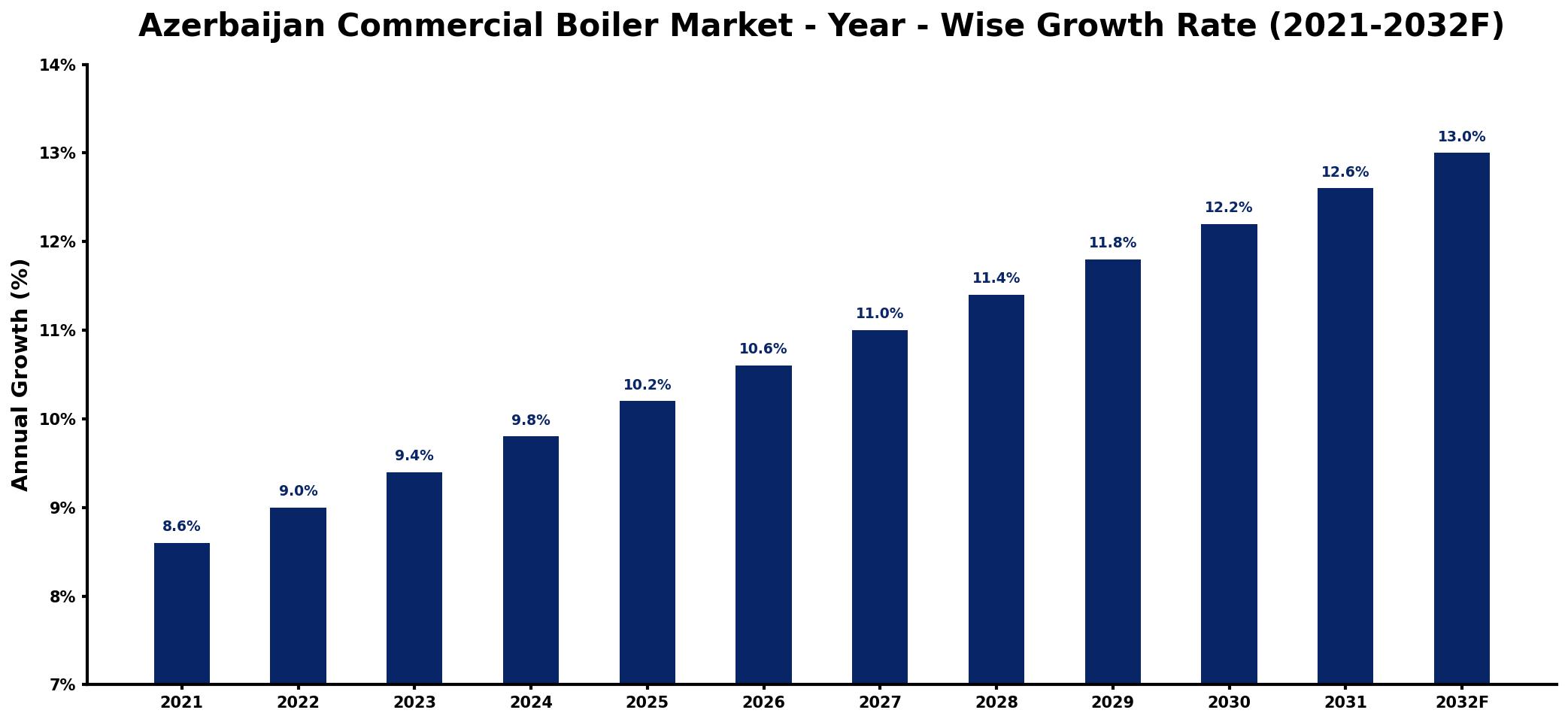
The table below presents the year‑wise growth rates along with the key drivers influencing the market
| Year | Growth Rate | Major Drivers |
| 2021 | 8.6% | Rising industrial sector investments |
| 2022 | 9.0% | Increased energy efficiency regulations |
| 2023 | 9.4% | Growing demand for sustainable solutions |
| 2024 | 9.8% | Expansion of construction projects |
| 2025 | 10.2% | Technological advancements in energy |
| 2026 | 10.6% | Enhanced focus on environmental standards |
| 2027 | 11.0% | Increasing urbanization and infrastructure |
| 2028 | 11.4% | Higher adoption of renewable energy |
| 2029 | 11.8% | rising demand from electronics |
| 2030 | 12.2% | Growing awareness of energy conservation |
| 2031 | 12.6% | Investments in energy modernization |
| 2032 | 13.0% | Rising focus on energy independence |
Note: Market size estimations and growth projections presented in this report are based on 6Wresearch's proprietary forecasting methodology, utilizing the latest available industry data, government publications, and primary research inputs.
Azerbaijan Commercial Boiler Market Synopsis
Currently, the Azerbaijan Commercial Boiler Market serves as a cornerstone for heating and hot water supply across various sectors, crucially supporting the comfort of commercial and industrial facilities. The transition toward cleaner technologies and energy-efficient systems is gaining traction, driven by environmental concerns and regulatory mandates.
As urban areas expand and the demand for reliable heating solutions grows, the market is poised for transformative changes. However, this evolution hinges on overcoming regulatory hurdles and ensuring the adoption of innovative technologies that align with national sustainability goals.
Azerbaijan Commercial Boiler Market Key Takeaways
- The market is experiencing robust growth due to industrialization and urbanization trends.
- Energy efficiency and regulatory compliance are central themes driving market evolution.
- Integration of advanced technologies is essential for modernizing existing boiler systems.
- Fuel diversity is increasingly critical as reliance on natural gas persists.
- Collaboration among stakeholders is crucial for fostering innovation and addressing market challenges.
Evaluation of Restraints in Azerbaijan Commercial Boiler Market
Despite the market's potential, several restraints threaten its growth trajectory. The tightening of energy efficiency regulations places manufacturers in a challenging position, necessitating significant investment in technology upgrades to meet compliance. Additionally, the reliance on a narrow range of fuel options constrains operational flexibility and may hinder competitiveness against more diverse energy markets. The rapid pace of technological advancement also demands ongoing investments in training and infrastructure, which can be a barrier for smaller operators in the market.
Azerbaijan Commercial Boiler Market Trends
A shift towards smart boiler technologies is emerging, with an emphasis on automation and remote monitoring capabilities that enhance efficiency and performance. Additionally, there is a growing demand for systems that can accommodate alternative fuels as businesses seek to diversify their energy sources. Furthermore, the trend towards sustainability is prompting an interest in eco-friendly technologies, including those that reduce carbon emissions and improve overall energy use.
Azerbaijan Commercial Boiler Market Opportunities
The ongoing construction of commercial infrastructures, along with government incentives for modernizing heating systems, presents significant growth opportunities. There is potential for innovative boiler solutions that cater to varying fuel types, including renewable energy options. Furthermore, the integration of digital technologies in boiler management systems offers avenues for efficiency improvements and operational cost reductions, encouraging businesses to invest in upgrades.
Government Initiatives in the Azerbaijan Commercial Boiler Market
The Azerbaijani government has recognized the importance of efficient heating systems in maintaining energy security and environmental sustainability. As part of its strategy, policies are being implemented to incentivize businesses to transition to energy-efficient boiler technologies. These initiatives include financing options and regulatory frameworks designed to facilitate compliance with energy standards, alongside research and development support to foster innovation in the sector.
Future Insights of the Azerbaijan Commercial Boiler Market
Looking ahead to 2026-2032, the Azerbaijan Commercial Boiler Market is likely to witness substantial transformation. The growing emphasis on sustainability will drive the adoption of cleaner technologies, while energy security concerns will encourage diversification of energy sources. Moreover, as urbanization continues, there will be increasing demand for advanced heating solutions that meet the needs of modern commercial facilities. The collaboration between stakeholders will be crucial in navigating the challenges and capitalizing on growth opportunities, positioning the market for sustained expansion.
Azerbaijan Commercial Boiler Market Latest Developments (2025 - 2026)
Recent industry developments indicate a shift towards more energy-efficient boiler solutions, as numerous stakeholders are actively pursuing partnerships focused on technological innovation. The emphasis on research and development has intensified, with several pilot projects aimed at integrating renewable energy sources into commercial heating systems. Additionally, governmental support is being reflected through increased public spending on energy efficiency initiatives, providing a favorable environment for market growth.
Azerbaijan Commercial Boiler Market - Key Attractiveness of the Report
- 10 Years of Market Numbers
- Historical Data Starting from 2022 to 2025
- Base Year: 2025
- Forecast Data until 2032
- Key Performance Indicators Impacting the Market
- Major Upcoming Developments and Projects
Key Highlights of the Report:
- Azerbaijan Commercial Boiler Market Outlook
- Market Size of Azerbaijan Commercial Boiler Market, 2025
- Forecast of Azerbaijan Commercial Boiler Market, 2032
- Historical Data and Forecast of Azerbaijan Commercial Boiler Revenues & Volume for the Period 2022-2032F
- Azerbaijan Commercial Boiler Market Trend Evolution
- Azerbaijan Commercial Boiler Market Drivers and Challenges
- Azerbaijan Commercial Boiler Price Trends
- Azerbaijan Commercial Boiler Porter's Five Forces
- Azerbaijan Commercial Boiler Industry Life Cycle
- Historical Data and Forecast of Azerbaijan Commercial Boiler Market Revenues & Volume By Fuel Type for the Period 2022-2032F
- Historical Data and Forecast of Azerbaijan Commercial Boiler Market Revenues & Volume By Natural Gas for the Period 2022-2032F
- Historical Data and Forecast of Azerbaijan Commercial Boiler Market Revenues & Volume By Oil for the Period 2022-2032F
- Historical Data and Forecast of Azerbaijan Commercial Boiler Market Revenues & Volume By Coal for the Period 2022-2032F
- Historical Data and Forecast of Azerbaijan Commercial Boiler Market Revenues & Volume By Others for the Period 2022-2032F
- Historical Data and Forecast of Azerbaijan Commercial Boiler Market Revenues & Volume By Technology for the Period 2022-2032F
- Historical Data and Forecast of Azerbaijan Commercial Boiler Market Revenues & Volume By Condensing for the Period 2022-2032F
- Historical Data and Forecast of Azerbaijan Commercial Boiler Market Revenues & Volume By Non-Condensing for the Period 2022-2032F
- Historical Data and Forecast of Azerbaijan Commercial Boiler Market Revenues & Volume By Capacity for the Period 2022-2032F
- Historical Data and Forecast of Azerbaijan Commercial Boiler Market Revenues & Volume By Less than 10 MMBtu/hr for the Period 2022-2032F
- Historical Data and Forecast of Azerbaijan Commercial Boiler Market Revenues & Volume By 10-50 MMBtu/hr for the Period 2022-2032F
- Historical Data and Forecast of Azerbaijan Commercial Boiler Market Revenues & Volume By Others for the Period 2022-2032F
- Historical Data and Forecast of Azerbaijan Commercial Boiler Market Revenues & Volume By End User for the Period 2022-2032F
- Historical Data and Forecast of Azerbaijan Commercial Boiler Market Revenues & Volume By Offices for the Period 2022-2032F
- Historical Data and Forecast of Azerbaijan Commercial Boiler Market Revenues & Volume By Hospitals for the Period 2022-2032F
- Historical Data and Forecast of Azerbaijan Commercial Boiler Market Revenues & Volume By Educational Institutions for the Period 2022-2032F
- Historical Data and Forecast of Azerbaijan Commercial Boiler Market Revenues & Volume By Lodging for the Period 2022-2032F
- Historical Data and Forecast of Azerbaijan Commercial Boiler Market Revenues & Volume By Others for the Period 2022-2032F
- Azerbaijan Commercial Boiler Import Export Trade Statistics
- Market Opportunity Assessment By Fuel Type
- Market Opportunity Assessment By Technology
- Market Opportunity Assessment By Capacity
- Market Opportunity Assessment By End User
- Azerbaijan Commercial Boiler Top Companies Market Share
- Azerbaijan Commercial Boiler Competitive Benchmarking By Technical and Operational Parameters
- Azerbaijan Commercial Boiler Company Profiles
- Azerbaijan Commercial Boiler Key Strategic Recommendations






































