Azerbaijan Conveyor Belt Market Size Growth Rate
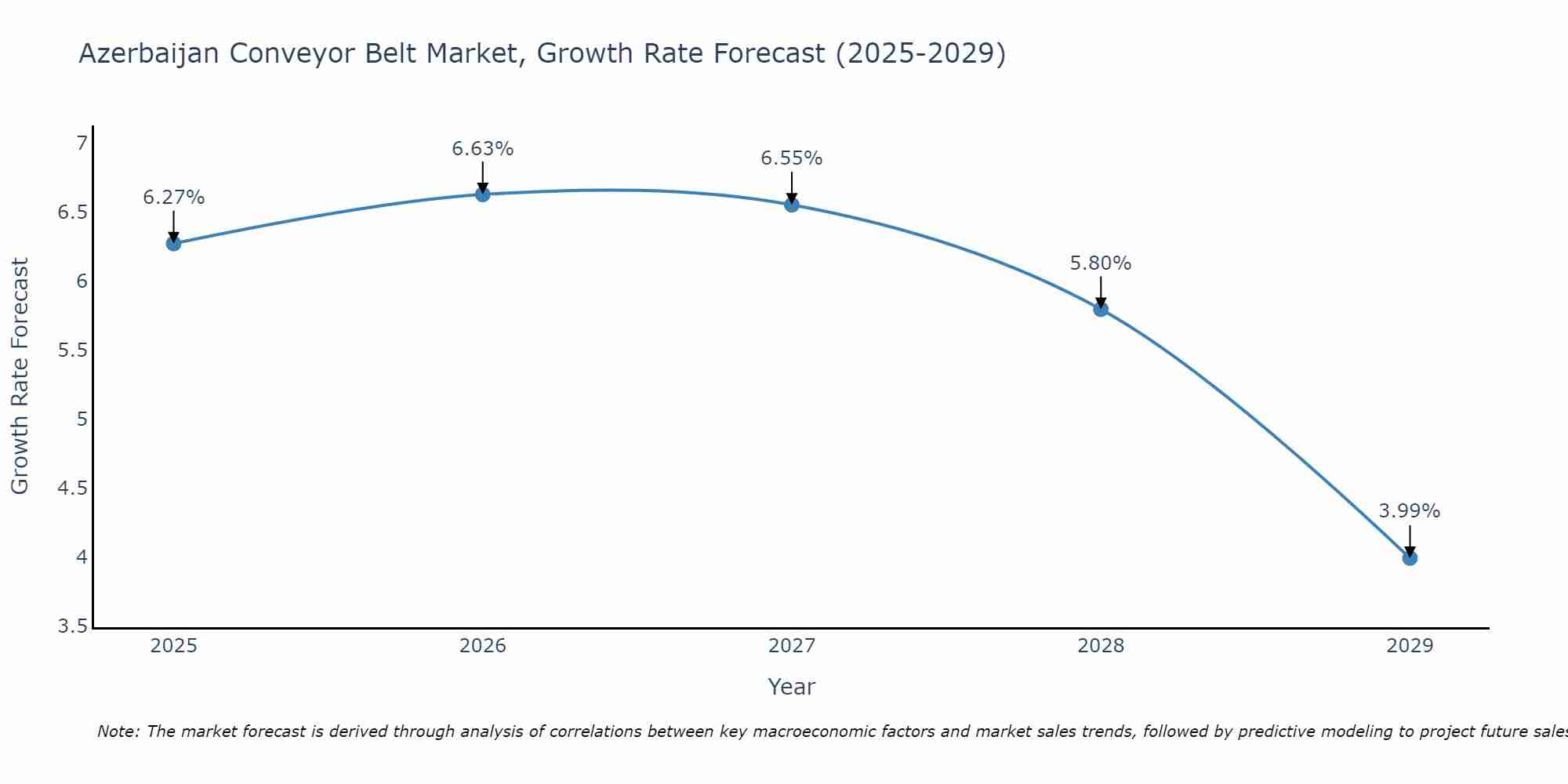
The Azerbaijan Conveyor Belt Market is projected to witness mixed growth rate patterns during 2025 to 2029. The growth rate begins at 6.27% in 2025, climbs to a high of 6.63% in 2026, and moderates to 3.99% by 2029.
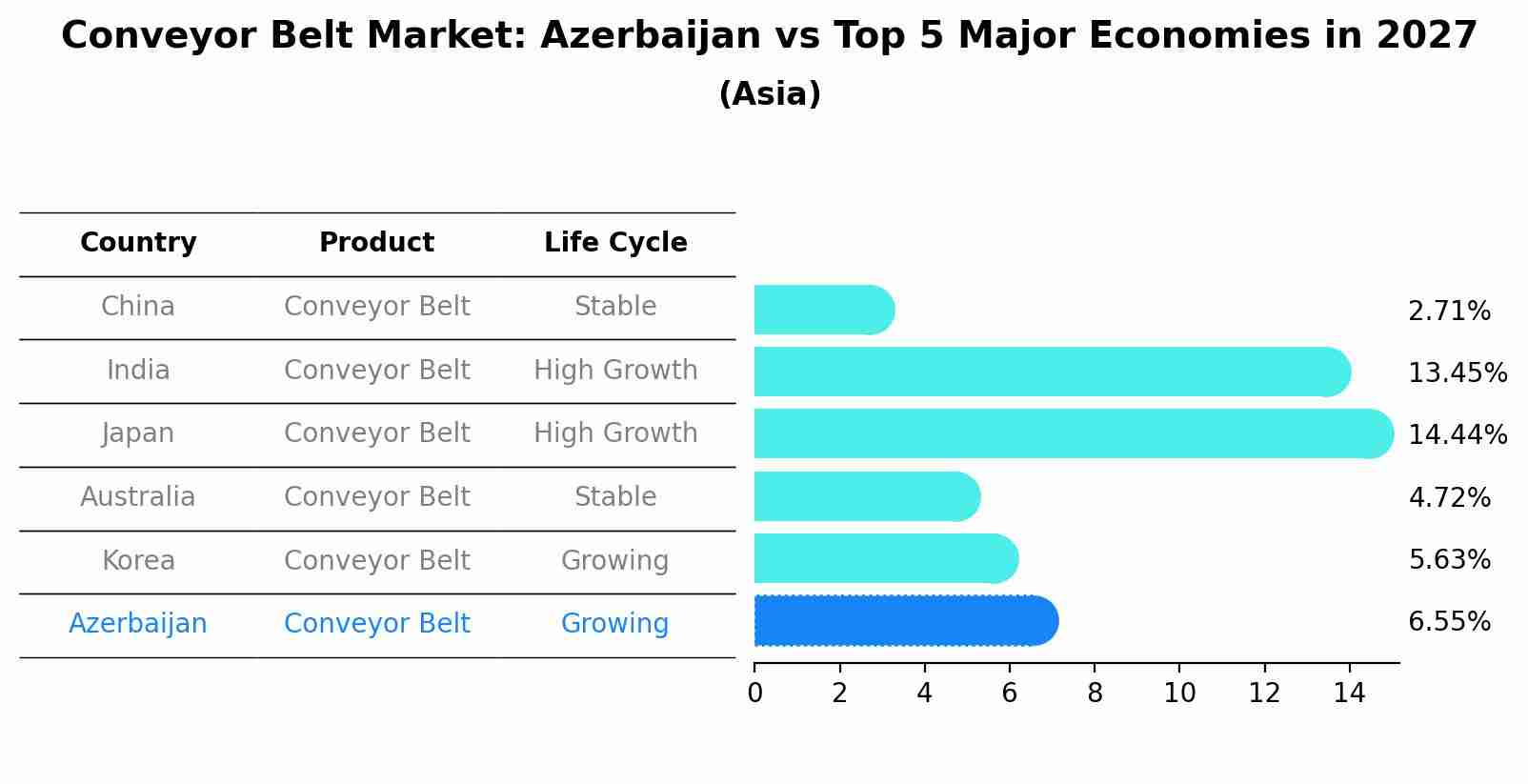
Conveyor Belt Market: Azerbaijan vs Top 5 Major Economies in 2027 (Asia)
The Conveyor Belt market in Azerbaijan is projected to grow at a growing growth rate of 6.55% by 2027, within the Asia region led by China, along with other countries like India, Japan, Australia and South Korea, collectively shaping a dynamic and evolving market environment driven by innovation and increasing adoption of emerging technologies.
Azerbaijan Conveyor Belt Market Synopsis
The conveyor belt market in Azerbaijan offers conveyor systems and components used for transporting goods and materials in industries such as mining, manufacturing, logistics, and agriculture. These conveyor belts come in various types such as flat belts, modular belts, and roller belts, serving diverse material handling needs. With the country`s industrial growth and infrastructure projects, the demand for conveyor belts is rising. Policies supporting industrial safety regulations, logistics efficiency, and automation technologies are driving the growth of this market.
Drivers of the market
The drivers of the conveyor belt market in Azerbaijan include the growth of manufacturing and logistics sectors, increasing automation in material handling processes, and advancements in conveyor belt technologies. Conveyor belts are essential components of material handling systems used in industries such as mining, food processing, automotive, and logistics, facilitating the efficient movement of goods and materials along production lines and distribution channels. Factors such as industrial expansion, e-commerce growth, and the need for efficient supply chain management drive market demand for conveyor belts as businesses seek to improve operational efficiency, productivity, and safety in material handling operations.
Challenges of the market
In the conveyor belt market in Azerbaijan, challenges include ensuring conveyor systems meet the demands of diverse industries while minimizing maintenance and downtime. Conveyor belts are essential for material handling and transportation across industries such as mining, manufacturing, and logistics. However, challenges such as abrasive materials, heavy loads, and harsh environments can lead to premature wear and failure, requiring innovative solutions for belt design, maintenance, and repair.
Government Policy of the market
In the Azerbaijan Conveyor Belt Market, government policies are essential for promoting industrial efficiency, ensuring workplace safety, and fostering innovation in conveyor belt technologies. The government typically enforces regulations and standards to govern the design, manufacturing, and usage of conveyor belts to ensure reliability, durability, and performance in material handling applications. Additionally, the government may introduce incentives or support programs to encourage investment in advanced conveyor belt technologies, aiming to improve productivity, reduce maintenance costs, and enhance worker safety. Moreover, policies aimed at promoting standards adoption and quality assurance may be implemented to facilitate the adoption of standardized conveyor belt solutions across different industries and sectors. Furthermore, regulations governing importation and distribution may be established to ensure compliance with safety standards and prevent the use of unauthorized or substandard conveyor belt products in Azerbaijan.
Key Highlights of the Report:
- Azerbaijan Conveyor Belt Market Outlook
- Market Size of Azerbaijan Conveyor Belt Market, 2024
- Forecast of Azerbaijan Conveyor Belt Market, 2031
- Historical Data and Forecast of Azerbaijan Conveyor Belt Revenues & Volume for the Period 2021-2031
- Azerbaijan Conveyor Belt Market Trend Evolution
- Azerbaijan Conveyor Belt Market Drivers and Challenges
- Azerbaijan Conveyor Belt Price Trends
- Azerbaijan Conveyor Belt Porter's Five Forces
- Azerbaijan Conveyor Belt Industry Life Cycle
- Historical Data and Forecast of Azerbaijan Conveyor Belt Market Revenues & Volume By Material for the Period 2021-2031
- Historical Data and Forecast of Azerbaijan Conveyor Belt Market Revenues & Volume By Metal for the Period 2021-2031
- Historical Data and Forecast of Azerbaijan Conveyor Belt Market Revenues & Volume By Polymer for the Period 2021-2031
- Historical Data and Forecast of Azerbaijan Conveyor Belt Market Revenues & Volume By Others for the Period 2021-2031
- Historical Data and Forecast of Azerbaijan Conveyor Belt Market Revenues & Volume By Product for the Period 2021-2031
- Historical Data and Forecast of Azerbaijan Conveyor Belt Market Revenues & Volume By Flat Belt for the Period 2021-2031
- Historical Data and Forecast of Azerbaijan Conveyor Belt Market Revenues & Volume By Modular Belt for the Period 2021-2031
- Historical Data and Forecast of Azerbaijan Conveyor Belt Market Revenues & Volume By Cleated Belt for the Period 2021-2031
- Historical Data and Forecast of Azerbaijan Conveyor Belt Market Revenues & Volume By Installation for the Period 2021-2031
- Historical Data and Forecast of Azerbaijan Conveyor Belt Market Revenues & Volume By Portable for the Period 2021-2031
- Historical Data and Forecast of Azerbaijan Conveyor Belt Market Revenues & Volume By Stationary for the Period 2021-2031
- Historical Data and Forecast of Azerbaijan Conveyor Belt Market Revenues & Volume By Application for the Period 2021-2031
- Historical Data and Forecast of Azerbaijan Conveyor Belt Market Revenues & Volume By Light Weight for the Period 2021-2031
- Historical Data and Forecast of Azerbaijan Conveyor Belt Market Revenues & Volume By Medium Weight for the Period 2021-2031
- Historical Data and Forecast of Azerbaijan Conveyor Belt Market Revenues & Volume By Heavy Weight for the Period 2021-2031
- Historical Data and Forecast of Azerbaijan Conveyor Belt Market Revenues & Volume By End-user for the Period 2021-2031
- Historical Data and Forecast of Azerbaijan Conveyor Belt Market Revenues & Volume By Mining for the Period 2021-2031
- Historical Data and Forecast of Azerbaijan Conveyor Belt Market Revenues & Volume By Food & Beverage for the Period 2021-2031
- Historical Data and Forecast of Azerbaijan Conveyor Belt Market Revenues & Volume By Power Generation for the Period 2021-2031
- Historical Data and Forecast of Azerbaijan Conveyor Belt Market Revenues & Volume By Recycling for the Period 2021-2031
- Historical Data and Forecast of Azerbaijan Conveyor Belt Market Revenues & Volume By Supply Chain for the Period 2021-2031
- Historical Data and Forecast of Azerbaijan Conveyor Belt Market Revenues & Volume By General Manufacturing for the Period 2021-2031
- Historical Data and Forecast of Azerbaijan Conveyor Belt Market Revenues & Volume By Others for the Period 2021-2031
- Azerbaijan Conveyor Belt Import Export Trade Statistics
- Market Opportunity Assessment By Material
- Market Opportunity Assessment By Product
- Market Opportunity Assessment By Installation
- Market Opportunity Assessment By Application
- Market Opportunity Assessment By End-user
- Azerbaijan Conveyor Belt Top Companies Market Share
- Azerbaijan Conveyor Belt Competitive Benchmarking By Technical and Operational Parameters
- Azerbaijan Conveyor Belt Company Profiles
- Azerbaijan Conveyor Belt Key Strategic Recommendations






































