Azerbaijan Cultured Meat Market Size, Share & Growth Rate
The Azerbaijan Cultured Meat Market was estimated at USD 775 Million in 2025 and is projected to reach USD 1328 Million by 2032, growing at a CAGR of 8.0% from 2026 to 2032. This anticipated growth is propelled by increasing consumer demand for sustainable food sources and heightened awareness of animal welfare issues. Additionally, advancements in cellular agriculture technology are enabling more efficient production methods, which are vital for capturing mainstream market acceptance.
Azerbaijan Cultured Meat Market Year-wise Growth Rate and Key Drivers
This graph highlights how the Azerbaijan Cultured Meat Market has steadily grown over the years, supported by major growth factors.
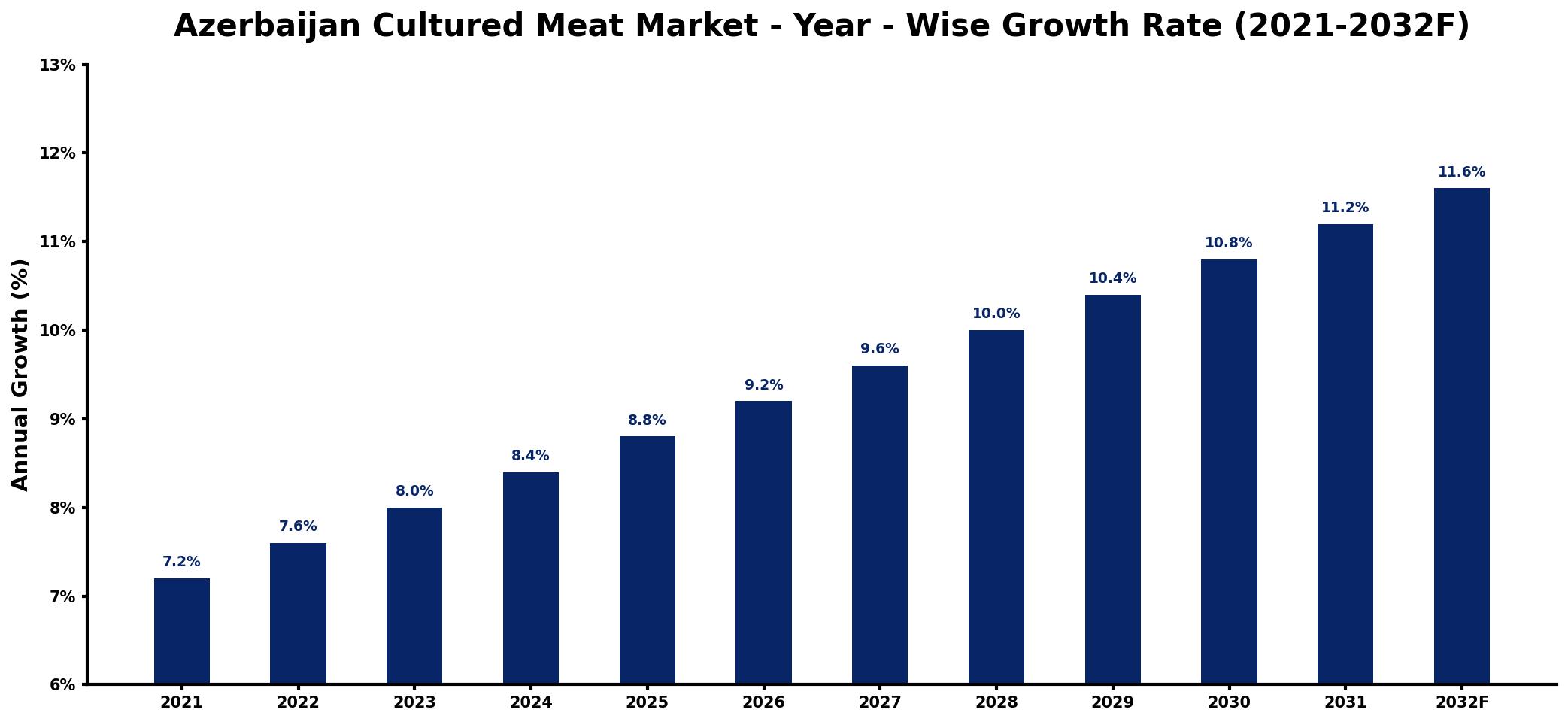
The table below presents the year‑wise growth rates along with the key drivers influencing the market
| Year | Growth Rate | Major Drivers |
| 2021 | 7.2% | increased consumer health awareness |
| 2022 | 7.6% | growing sustainability initiatives worldwide |
| 2023 | 8.0% | rising investment in biotechnology |
| 2024 | 8.4% | expansion of alternative protein markets |
| 2025 | 8.8% | enhanced regulatory support frameworks |
| 2026 | 9.2% | advancements in production technologies |
| 2027 | 9.6% | increased market accessibility options |
| 2028 | 10.0% | growing environmental consciousness trends |
| 2029 | 10.4% | wider culinary applications emerging |
| 2030 | 10.8% | strengthened global trade partnerships |
| 2031 | 11.2% | increased collaboration with startups |
| 2032 | 11.6% | evolving consumer preferences shifting |
Note: Market size estimations and growth projections presented in this report are based on 6Wresearch's proprietary forecasting methodology, utilizing the latest available industry data, government publications, and primary research inputs.
Azerbaijan Cultured Meat Market Synopsis
The Azerbaijan cultured meat market is witnessing a significant transformation as innovators explore lab-grown alternatives to conventional meat products. This shift aligns with the nations commitment to enhancing food security and pursuing sustainable agricultural practices. Recent developments indicate growing investment in research and development, signaling a robust interest in the commercialization of cultured meat products.
Azerbaijan's evolving consumer preferences, driven by health consciousness and environmental concerns, are increasingly steering them towards ethical protein sources. This burgeoning market is poised to thrive as stakeholders address regulatory frameworks and consumer perceptions, ensuring that cultured meat can meet evolving dietary needs while fostering a sustainable food ecosystem.
Azerbaijan Cultured Meat Market Key Takeaways
- The market is primed for growth due to rising consumer awareness of sustainability and animal welfare.
- Advancements in biotechnology are critical for enhancing production efficiency and scaling operations.
- Regulatory frameworks are being established to ensure safety and promote consumer confidence in lab-grown meat.
- Government initiatives are focusing on fostering innovation and supporting local startups in cellular agriculture.
- Investments in research and development are crucial for driving future market growth and product diversification.
Evaluation of Restraints in Azerbaijan Cultured Meat Market
Despite its promising potential, the Azerbaijan cultured meat market faces notable restraints that could hinder growth. Regulatory hurdles pose significant challenges, with companies needing to navigate complex approval processes for novel food products. Additionally, consumer acceptance remains a critical barrier; many consumers still prefer traditional meat sources and may be wary of lab-grown options due to misinformation or lack of familiarity. Educational initiatives aimed at informing the public about the safety, benefits, and ethical implications of cultured meat will be essential for overcoming these perceptions.
Azerbaijan Cultured Meat Market Trends
Current trends in the Azerbaijan cultured meat market highlight an increasing focus on local sourcing and sustainability. Consumers are not only seeking healthier options but are also expressing preference for products that minimize environmental impact. This trend is complemented by technological advancements in cellular agriculture, which facilitate more efficient production methods. Moreover, partnerships between startups and research institutions are emerging, fostering collaborative innovation that could accelerate the development and commercialization of cultured meat products.
Azerbaijan Cultured Meat Market Opportunities
The prospects for investment and growth within the Azerbaijan cultured meat market are promising. Opportunities lie in the development of unique regional products that cater to local tastes and preferences. Furthermore, as awareness around sustainability intensifies, partnerships with governmental bodies and NGOs could facilitate the adoption of cultured meat in public health initiatives. Expanding distribution channels through e-commerce and retail partnerships will also enhance market reach, positioning cultured meat as a viable alternative in the consumer protein landscape.
Government Initiatives in the Azerbaijan Cultured Meat Market
The Azerbaijani government plays a crucial role in shaping the cultured meat market landscape through policy formulation and funding opportunities. Initiatives focused on sustainable agriculture and food security guide regulatory frameworks that ensure safety and promote innovative practices in cell-based meat production. Additionally, government support for research and development, including grants and collaborations with international partners, helps advance local technological capabilities in this burgeoning field. The engagement with industry stakeholders further reinforces the commitment to fostering a conducive environment for cultured meat adoption.
Future Insights of the Azerbaijan Cultured Meat Market
Looking ahead, the Azerbaijan cultured meat market is expected to see substantial evolution from 2026 to 2032. As regulatory frameworks mature and public awareness increases, the integration of cultured meat into mainstream diets will likely accelerate. Innovation in production techniques is poised to enhance efficiency, making cultured meat more accessible and affordable for consumers. Furthermore, as global trends influence local markets, Azerbaijan's position as a pioneer in alternative protein sources may attract international attention and investment, ultimately contributing to the countrys economic growth and food sustainability.
Azerbaijan Cultured Meat Market Latest Developments (2025 - 2026)
Recent developments in the Azerbaijan cultured meat market indicate a growing emphasis on regulatory frameworks that ensure food safety and consumer acceptance. Initiatives are underway to enhance public awareness through educational campaigns that highlight the benefits of cultured meat. Additionally, several collaborations between private enterprises and research institutions have emerged, aiming to innovate production methodologies and improve the market viability of lab-grown meat products. These strategic movements demonstrate a clear trajectory towards market stabilization and acceptance in the coming years.
Azerbaijan Cultured Meat Market - Key Attractiveness of the Report
- 10 Years of Market Numbers
- Historical Data Starting from 2022 to 2025
- Base Year: 2025
- Forecast Data until 2032
- Key Performance Indicators Impacting the Market
- Major Upcoming Developments and Projects
Key Highlights of the Report:
- Azerbaijan Cultured Meat Market Outlook
- Market Size of Azerbaijan Cultured Meat Market, 2025
- Forecast of Azerbaijan Cultured Meat Market, 2032
- Historical Data and Forecast of Azerbaijan Cultured Meat Revenues & Volume for the Period 2022-2032F
- Azerbaijan Cultured Meat Market Trend Evolution
- Azerbaijan Cultured Meat Market Drivers and Challenges
- Azerbaijan Cultured Meat Price Trends
- Azerbaijan Cultured Meat Porter's Five Forces
- Azerbaijan Cultured Meat Industry Life Cycle
- Historical Data and Forecast of Azerbaijan Cultured Meat Market Revenues & Volume By Product Type for the Period 2022-2032F
- Historical Data and Forecast of Azerbaijan Cultured Meat Market Revenues & Volume By Poultry for the Period 2022-2032F
- Historical Data and Forecast of Azerbaijan Cultured Meat Market Revenues & Volume By Beef for the Period 2022-2032F
- Historical Data and Forecast of Azerbaijan Cultured Meat Market Revenues & Volume By Seafood for the Period 2022-2032F
- Historical Data and Forecast of Azerbaijan Cultured Meat Market Revenues & Volume By Pork for the Period 2022-2032F
- Historical Data and Forecast of Azerbaijan Cultured Meat Market Revenues & Volume By Duck for the Period 2022-2032F
- Historical Data and Forecast of Azerbaijan Cultured Meat Market Revenues & Volume By End-Use for the Period 2022-2032F
- Historical Data and Forecast of Azerbaijan Cultured Meat Market Revenues & Volume By Nuggets for the Period 2022-2032F
- Historical Data and Forecast of Azerbaijan Cultured Meat Market Revenues & Volume By Burgers for the Period 2022-2032F
- Historical Data and Forecast of Azerbaijan Cultured Meat Market Revenues & Volume By Meatballs for the Period 2022-2032F
- Historical Data and Forecast of Azerbaijan Cultured Meat Market Revenues & Volume By Sausage for the Period 2022-2032F
- Historical Data and Forecast of Azerbaijan Cultured Meat Market Revenues & Volume By Hot dogs for the Period 2022-2032F
- Historical Data and Forecast of Azerbaijan Cultured Meat Market Revenues & Volume By Others for the Period 2022-2032F
- Azerbaijan Cultured Meat Import Export Trade Statistics
- Market Opportunity Assessment By Product Type
- Market Opportunity Assessment By End-Use
- Azerbaijan Cultured Meat Top Companies Market Share
- Azerbaijan Cultured Meat Competitive Benchmarking By Technical and Operational Parameters
- Azerbaijan Cultured Meat Company Profiles
- Azerbaijan Cultured Meat Key Strategic Recommendations






































