Azerbaijan Cyber Security Market Size, Share & Growth Rate
The Azerbaijan Cyber Security Market was estimated at USD 1406 Million in 2025 and is projected to reach USD 2410 Million by 2032, growing at a CAGR of 8.0% from 2026 to 2032. This remarkable growth trajectory is driven by an increasing recognition of the critical importance of robust cyber security measures in both public and private sectors. As Azerbaijan continues to advance its digital transformation initiatives, the rising threat of cyber attacks, such as phishing and data breaches, necessitates enhanced security solutions to protect sensitive information and maintain consumer trust.
Azerbaijan Cyber Security Market Year-wise Growth Rate and Key Drivers
This graph highlights how the Azerbaijan Cyber Security Market has steadily grown over the years, supported by major growth factors.
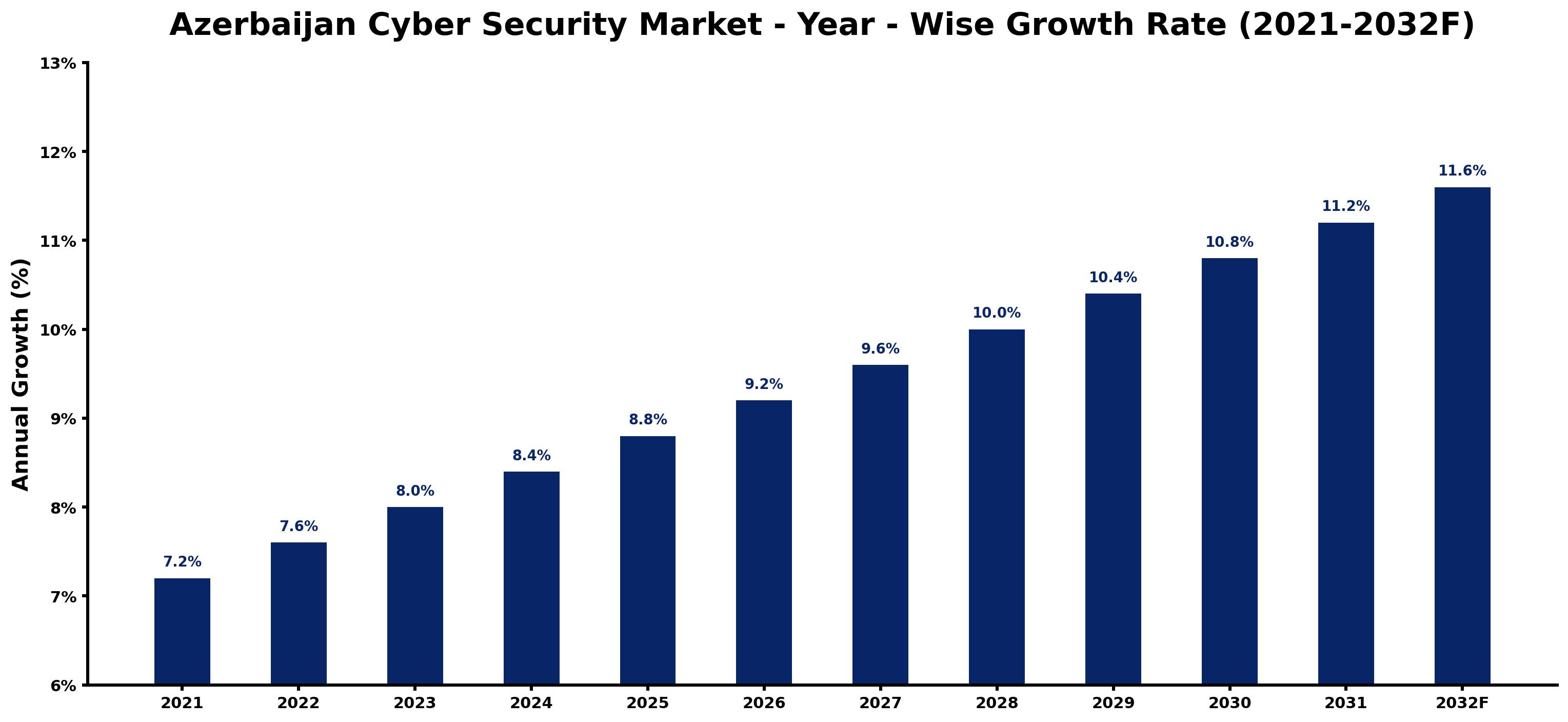
The table below presents the year‑wise growth rates along with the key drivers influencing the market
| Year | Growth Rate | Major Drivers |
| 2021 | 7.2% | Expansion of transportation and logistics networks |
| 2022 | 7.6% | Increasing industrial infrastructure investments |
| 2023 | 8.0% | Rapid growth in telecom and data center sectors |
| 2024 | 8.4% | Increasing industrial automation investments |
| 2025 | 8.8% | Increasing adoption of advanced technologies |
| 2026 | 9.2% | Government infrastructure modernization initiatives |
| 2027 | 9.6% | Increasing smart city development projects |
| 2028 | 10.0% | Expansion of transportation and logistics networks |
| 2029 | 10.4% | Increasing smart city development projects |
| 2030 | 10.8% | Government infrastructure modernization initiatives |
| 2031 | 11.2% | Increasing industrial automation investments |
| 2032 | 11.6% | Increasing smart city development projects |
Note - Market size estimations and growth projections presented in this report are based on 6Wresearch’s advanced forecasting approach, validated with industry datasets as of June 2026.
Azerbaijan Cyber Security Market Synopsis
In recent years, Azerbaijan has seen a surge in the deployment of cyber security products, driven by both the increased digitization of services and the emergence of sophisticated cyber threats. The government and enterprises alike are recognizing that implementing comprehensive security protocols is no longer optional but essential to safeguard operations and foster digital commerce.
Moreover, the demand for web-based security solutions is gaining traction as businesses look to enhance their online presence. With an acceleration in the adoption of cloud-based applications, the need for reliable security measures is paramount to mitigate risks associated with data breaches and unauthorized access, thereby fueling market growth.
Azerbaijan Cyber Security Market Key Takeaways
- The Azerbaijan Cyber Security Market is on track for substantial growth driven by increased digitalization and a rise in cyber threats.
- Adoption of advanced cyber security measures is critical for protecting sensitive data within various industries.
- Government initiatives play a pivotal role in promoting cyber security awareness and implementation across sectors.
- Investment in innovative security technologies is expected to surge, aligning with global market trends.
- The transition to digital platforms is accelerating demand for sophisticated and scalable security solutions.
Evaluation of Restraints in Azerbaijan Cyber Security Market
Despite its promising growth potential, the Azerbaijan cyber security market faces notable restraints. One primary challenge is the shortage of skilled professionals equipped to handle complex security threats and implement advanced solutions effectively. Additionally, the awareness of cyber security's importance is still in the nascent stages for many small and medium-sized enterprises, limiting the market's overall potential. Furthermore, budget constraints, particularly in public sectors, can hinder investment in essential cyber security infrastructure. These factors could impede the rapid scalability needed to tackle evolving digital threats.
Azerbaijan Cyber Security Market Trends
A significant trend in the Azerbaijan cyber security market is the shift towards cloud-based security solutions. Businesses are increasingly migrating their operations to the cloud, necessitating adaptable security frameworks that can protect data across multiple environments. Another emerging trend is the integration of artificial intelligence and machine learning within security systems to enhance threat detection and response capabilities. The growing focus on regulatory compliance is also shaping the market, as organizations prioritize solutions that ensure adherence to local and international standards.
Azerbaijan Cyber Security Market Opportunities
As digital transformation accelerates in Azerbaijan, there exist substantial opportunities for growth in the cyber security market. The rising need for secure online transactions in e-commerce creates a demand for advanced payment security solutions. Additionally, sectors such as finance, healthcare, and government are increasingly investing in cyber security to protect sensitive data, presenting avenues for specialized service providers. With a global spotlight on cyber resilience, Azerbaijani firms can leverage international partnerships to enhance their offerings and expertise in this critical area.
Government Initiatives in the Azerbaijan Cyber Security Market
The Azerbaijani government has initiated several programs aimed at bolstering the nation's cyber security landscape. These initiatives include policy frameworks designed to enhance the cyber security posture of both public institutions and private enterprises. Furthermore, government-led campaigns are focused on increasing awareness and educating stakeholders about the importance of cyber security measures, which aims to foster a more secure digital environment across the country.
Future Insights of the Azerbaijan Cyber Security Market
Looking ahead to 2026-2032, the Azerbaijan cyber security market is poised for substantial evolution driven by ongoing technological advancements and an increasing focus on digital security. As businesses become more interconnected, the demand for innovative cyber security solutions will intensify. Additionally, the emergence of new technologies such as the Internet of Things (IoT) and 5G networks will further complicate the threat landscape, necessitating adaptive security strategies. Therefore, market participants will need to stay ahead of trends and threats to capitalize on the opportunities that lie ahead.
Azerbaijan Cyber Security Market Latest Developments (May 2025 - June 2026)
Recent developments in the Azerbaijan cyber security market indicate a growing alignment between businesses and government initiatives aimed at enhancing cyber resilience. There has been an increase in collaborative efforts between sectors to address the evolving cyber threats, with numerous workshops and training programs taking place to build a skilled workforce. Additionally, several companies are ramping up investments in state-of-the-art cyber security technologies to better protect their digital assets, reflecting a proactive stance towards securing their operations against potential threats.
Azerbaijan Cyber Security Market - Key Attractiveness of the Report
- 10 Years of Market Numbers
- Historical Data Starting from 2022 to 2025
- Base Year: 2025
- Forecast Data until 2032
- Key Performance Indicators Impacting the Market
- Major Upcoming Developments and Projects
Key Highlights of the Report:
- Azerbaijan Cyber security Market Overview
- Azerbaijan Cyber security Market Outlook
- Azerbaijan Cyber security Market Forecast
- Historical Data of Azerbaijan Cyber security Market Revenues for the Period 2022-2032F
- Azerbaijan Cyber security Market Size and Azerbaijan Cyber security Market Forecast of Revenues, Until 2032F
- Historical Data of Azerbaijan Cyber security Market Revenues, by Product, for the Period 2022-2032F
- Market Size & Forecast of Azerbaijan Cyber security Market Revenues, by Product, Until 2032F
- Historical Data of Azerbaijan Cyber security Market Revenues, by Deployment Mode, for the Period 2022-2032F
- Market Size & Forecast of Azerbaijan Cyber security Market Revenues, by Deployment Mode, Until 2032F
- Historical Data of Azerbaijan Cyber security Market Revenues, by Regions, for the Period 2022-2032F
- Market Size & Forecast of Azerbaijan Cyber security Market Revenues, by Regions, Until 2032F
- Market Drivers and Restraints
- Azerbaijan Cyber security Market Trends and Industry Life Cycle
- Porter’s Five Force Analysis
- Market Opportunity Assessment
- Azerbaijan Cyber security Market Share, By Players
- Azerbaijan Cyber security Market Share, By Regions
- Azerbaijan Cyber security Market Overview on Competitive Benchmarking
Markets Covered
The Azerbaijan Cyber security Market report provides a detailed analysis of the following market segments:
- By Product type:
- Solutions
- Identity & Access Management
- Threat Detection & Prevention
- DDoS & Mitigation
- IDS
- Security Information & Event Management
- Others
- Services
- Solutions
- By End-user industry:
- Manufacturing
- Retail
- IT & Telecom
- Aerospace & Defense
- Healthcare
- Utility
- Others
- By Deployment Mode:
- On-premises
- Cloud






































