Azerbaijan Data Classification Market Size & Growth Rate (2026-2032)
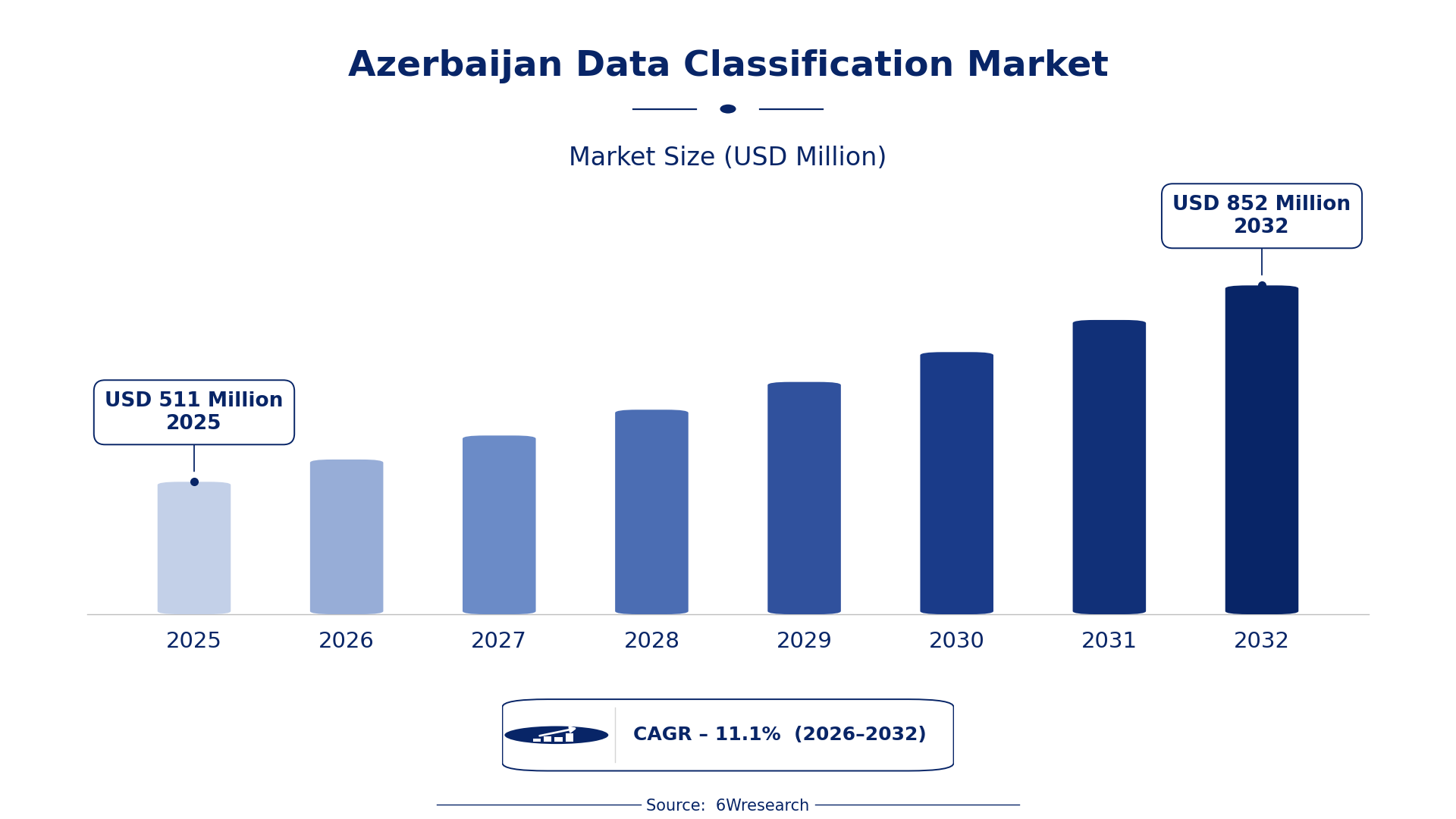
The Azerbaijan Data Classification Market was estimated at USD 511 Million in 2025 and is projected to reach USD 852 Million by 2032, growing at a CAGR of 11.1% from 2026 to 2032.
Azerbaijan Data Classification Market Synopsis
In Azerbaijan, the demand for data classification is rapidly escalating as organizations recognize the importance of managing sensitive information. With increasing regulatory scrutiny and a focus on data privacy, businesses are compelled to adopt classification solutions that align with compliance frameworks.
This market primarily revolves around categorizing data assets based on sensitivity and importance. Local businesses are increasingly turning to automated tools and policies to streamline data management, security, and compliance efforts, thereby enhancing operational effectiveness.
Azerbaijan Data Classification Market Year-wise Growth Rate and Key Drivers
This graph illustrates the annual growth rates of the Azerbaijan Data Classification Market from 2021 to 2032, highlighting a steady upward trajectory and projected expansion over the forecast period.
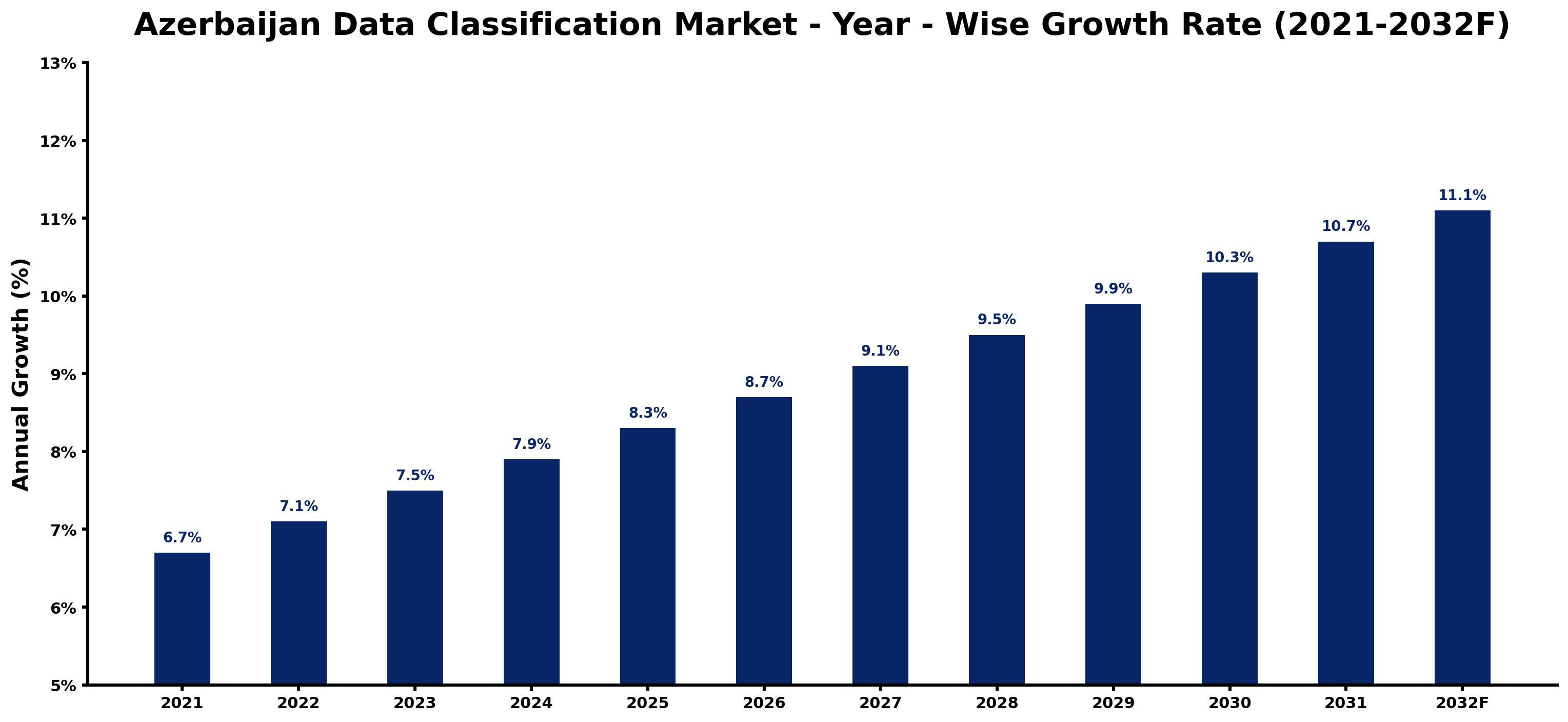
The table below presents the year‑wise growth rates along with the key drivers influencing the market
| Year | Growth Rate | Major Drivers |
| 2021 | 6.7% | New cybersecurity standards from Azerbaijan's Ministry of Digital Development |
| 2022 | 7.1% | Increased investments in data protection by local enterprises |
| 2023 | 7.5% | Growth of local startups focusing on data privacy solutions |
| 2024 | 7.9% | Implementation of stricter data compliance regulations in Azerbaijan |
| 2025 | 8.3% | Rising awareness of data classification among SMEs in Azerbaijan |
| 2026 | 8.7% | Government grants for businesses adopting data classification technologies |
| 2027 | 9.1% | Boost from regional cooperation on data security initiatives |
| 2028 | 9.5% | Azerbaijan's participation in global data protection conferences |
| 2029 | 9.9% | Emergence of local data protection consultancies boosting demand |
| 2030 | 10.3% | Increased cross-border data flow agreements with neighboring countries |
| 2031 | 10.7% | Investment in technology education enhancing skilled workforce availability |
| 2032 | 11.1% | Growing public sector focus on digital transformation projects |
Note: Market size estimations and growth projections presented in this report are based on 6Wresearch's proprietary forecasting methodology, utilizing the latest available industry data, government publications, and primary research inputs.
Azerbaijan Data Classification Market Key Takeaways
Below are some of the specific key takeaways from the market, including:
- The market is growing due to rising data volumes and privacy concerns.
- Organizations are prioritizing data classification to ensure compliance with local and international regulations.
- Automated tools are gaining traction to simplify the classification of complex data environments.
- Cloud-based storage solutions are a key driver for adopting classification technologies.
- Emerging data protection laws are influencing market dynamics significantly.
Evaluation of Restraints in Azerbaijan Data Classification Market
Despite the promising outlook, several restraints hold back the Azerbaijan Data Classification Market. One major limitation is the complexity of classifying vast amounts of data, especially with the coexistence of structured and unstructured formats. Organizations often struggle to develop effective frameworks for data governance and compliance. on top of that, the potential for misclassification poses significant risks, leading to inadequate data protection and compliance failures, which can have severe legal and financial implications.
Azerbaijan Data Classification Market Trends
Recent trends indicate a significant shift towards adopting machine learning and artificial intelligence in data classification processes. Organizations are keen to harness these technologies to automate the identification and categorization of sensitive data more accurately. Additionally, the growing inclination towards hybrid cloud environments is prompting businesses to seek solutions that can operate seamlessly across on-premises and cloud infrastructures.
Azerbaijan Data Classification Market Opportunities
As the market matures, several growth avenues are emerging. Companies that offer tailored classification solutions that cater specifically to local regulatory needs are well-positioned for success. on top of that, the increased focus on data analytics presents a unique opportunity to develop classification tools that integrate with business intelligence platforms, thus enabling organizations to derive actionable insights while ensuring compliance.
Government Initiatives in the Azerbaijan Data Classification Market
Government policy plays a crucial role in shaping the data classification market in Azerbaijan. The administration is actively promoting the responsible management and protection of data through regulatory frameworks that dictate classification standards. This regulatory focus not only ensures compliance with existing laws but also fosters an environment conducive to technological adoption.
- A regulatory framework introduced in early 2024 mandates organizations to classify sensitive data according to established standards.
- A national training initiative launched in late 2023 aims to enhance data handling practices among businesses across sectors.
- A public-private collaboration expected to commence in 2026 will focus on developing industry-specific data classification certifications.
- An ongoing digital literacy campaign is raising awareness about data privacy and the importance of classification among the public and private sectors.
Future Insights of the Azerbaijan Data Classification Market
Looking ahead to the years 2026-2032, the Azerbaijan Data Classification Market is set to evolve significantly. As regulations tighten and data breaches become more prevalent, the emphasis on data security will drive further investment in classification technologies. The integration of advanced analytics and automation tools will also revolutionize how organizations manage their data, ensuring not just compliance but also operational efficiency. New innovations tailored to the needs of local businesses will likely emerge, further propelling the market forward.
Azerbaijan Data Classification Market Latest Developments
In the past year, the Azerbaijan Data Classification Market has witnessed a flurry of activity, signaling a growing recognition of the need for enhanced data management practices. Organizations are increasingly rolling out innovative classification tools and solutions to tackle compliance challenges head-on.
- A new classification software solution designed to automate data tagging was launched in early 2023, receiving positive feedback for its accuracy and efficiency.
- Mid-2023 saw a partnership formed between local tech firms to develop a comprehensive training program focused on data classification best practices.
- In Q4 2023, a government-led initiative aimed at refining data protection regulations began its implementation phase, signaling a stronger regulatory environment.
- A project scheduled for 2026 will introduce cloud-based classification tools intended to enhance accessibility and scalability for SMEs.
Azerbaijan Data Classification Market - Key Attractiveness of the Report
- 10 Years of Market Numbers
- Historical Data Starting from 2022 to 2025
- Base Year: 2025
- Forecast Data until 2032
- Key Performance Indicators Impacting the Market
- Major Upcoming Developments and Projects
Key Highlights of the Report:
- Azerbaijan Data Classification Market Outlook
- Market Size of Azerbaijan Data Classification Market, 2025
- Forecast of Azerbaijan Data Classification Market, 2032
- Historical Data and Forecast of Azerbaijan Data Classification Revenues & Volume for the Period 2022-2032F
- Azerbaijan Data Classification Market Trend Evolution
- Azerbaijan Data Classification Market Drivers and Challenges
- Azerbaijan Data Classification Price Trends
- Azerbaijan Data Classification Porter's Five Forces
- Azerbaijan Data Classification Industry Life Cycle
- Historical Data and Forecast of Azerbaijan Data Classification Market Revenues & Volume By Component for the Period 2022-2032F
- Historical Data and Forecast of Azerbaijan Data Classification Market Revenues & Volume By Solutions (Standalone and Integrated) for the Period 2022-2032F
- Historical Data and Forecast of Azerbaijan Data Classification Market Revenues & Volume By Services for the Period 2022-2032F
- Historical Data and Forecast of Azerbaijan Data Classification Market Revenues & Volume By Application for the Period 2022-2032F
- Historical Data and Forecast of Azerbaijan Data Classification Market Revenues & Volume By Access Control for the Period 2022-2032F
- Historical Data and Forecast of Azerbaijan Data Classification Market Revenues & Volume By GRC for the Period 2022-2032F
- Historical Data and Forecast of Azerbaijan Data Classification Market Revenues & Volume By Web for the Period 2022-2032F
- Historical Data and Forecast of Azerbaijan Data Classification Market Revenues & Volume By Mobile & Email Protection for the Period 2022-2032F
- Historical Data and Forecast of Azerbaijan Data Classification Market Revenues & Volume By Centralized Management for the Period 2022-2032F
- Historical Data and Forecast of Azerbaijan Data Classification Market Revenues & Volume By Methodology for the Period 2022-2032F
- Historical Data and Forecast of Azerbaijan Data Classification Market Revenues & Volume By Content-based Classification for the Period 2022-2032F
- Historical Data and Forecast of Azerbaijan Data Classification Market Revenues & Volume By Context-based Classification for the Period 2022-2032F
- Historical Data and Forecast of Azerbaijan Data Classification Market Revenues & Volume By User-based Classification for the Period 2022-2032F
- Historical Data and Forecast of Azerbaijan Data Classification Market Revenues & Volume By Vertical for the Period 2022-2032F
- Historical Data and Forecast of Azerbaijan Data Classification Market Revenues & Volume By BFSI for the Period 2022-2032F
- Historical Data and Forecast of Azerbaijan Data Classification Market Revenues & Volume By Healthcare and Lifesciences for the Period 2022-2032F
- Historical Data and Forecast of Azerbaijan Data Classification Market Revenues & Volume By Government and Defense for the Period 2022-2032F
- Historical Data and Forecast of Azerbaijan Data Classification Market Revenues & Volume By Education for the Period 2022-2032F
- Historical Data and Forecast of Azerbaijan Data Classification Market Revenues & Volume By Telecom for the Period 2022-2032F
- Historical Data and Forecast of Azerbaijan Data Classification Market Revenues & Volume By Media and Entertainment for the Period 2022-2032F
- Historical Data and Forecast of Azerbaijan Data Classification Market Revenues & Volume By Others (Retail and Ecommerce, Manufacturing, and Energy and Utilities) for the Period 2022-2032F
- Azerbaijan Data Classification Import Export Trade Statistics
- Market Opportunity Assessment By Component
- Market Opportunity Assessment By Application
- Market Opportunity Assessment By Methodology
- Market Opportunity Assessment By Vertical
- Azerbaijan Data Classification Top Companies Market Share
- Azerbaijan Data Classification Competitive Benchmarking By Technical and Operational Parameters
- Azerbaijan Data Classification Company Profiles
- Azerbaijan Data Classification Key Strategic Recommendations






































