Azerbaijan Data Masking Market Size & Growth Rate (2026-2032)
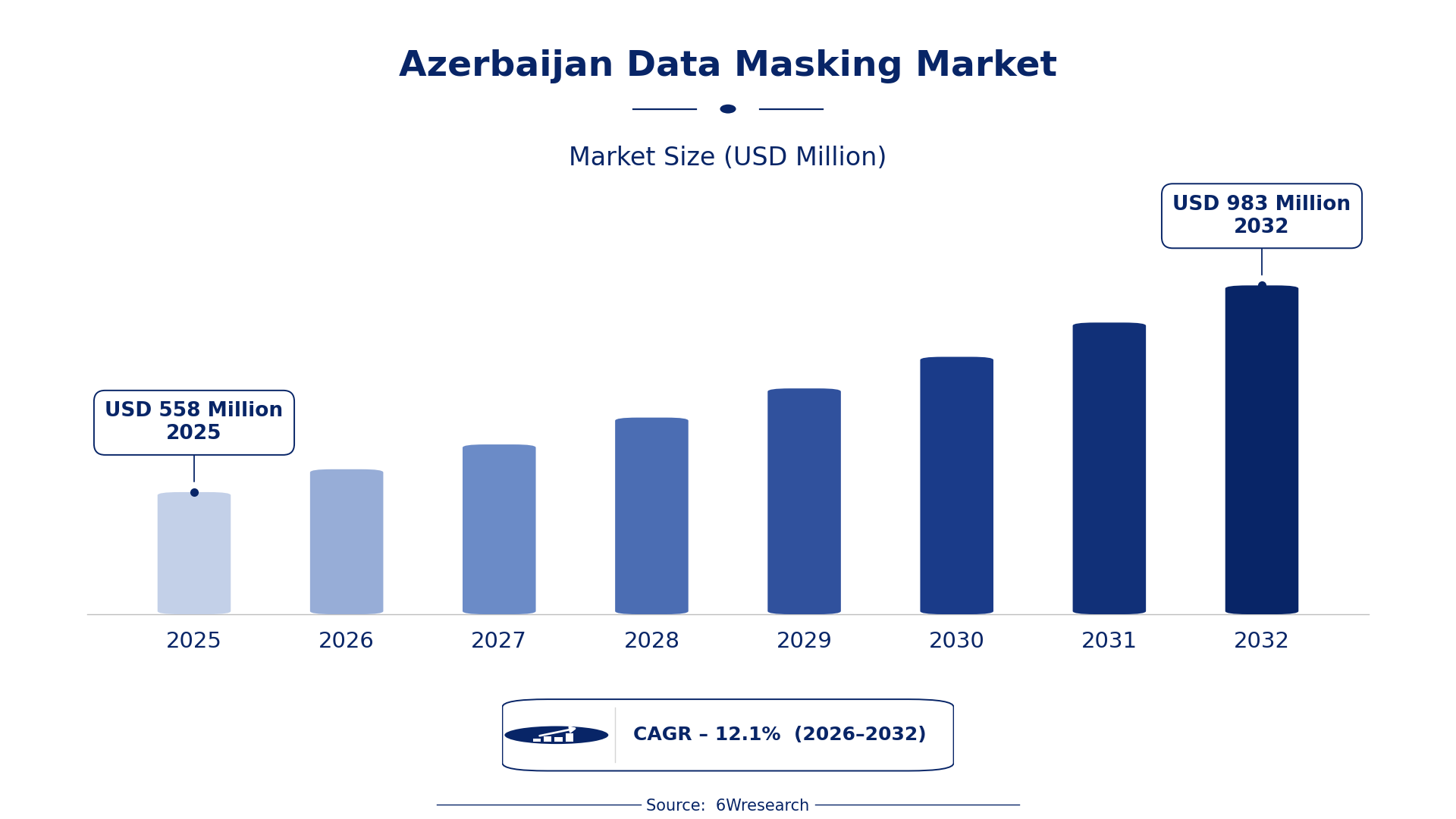
The Azerbaijan Data Masking Market was estimated at USD 558 Million in 2025 and is projected to reach USD 983 Million by 2032, growing at a CAGR of 12.1% from 2026 to 2032.
Azerbaijan Data Masking Market Synopsis
In Azerbaijan, increasing regulatory pressures related to data protection are the most influential factor driving the demand for data masking solutions. As organizations look to comply with stringent data privacy laws, they are turning to effective tools that allow them to safeguard sensitive information while still using data for operational needs.
The market has seen a noticeable uptick in the adoption of sophisticated data masking techniques, such as tokenization and dynamic data masking. This trend reflects a broader commitment to cybersecurity and a proactive stance against potential data breaches that could jeopardize public trust and organizational integrity.
Azerbaijan Data Masking Market Year-wise Growth Rate and Key Drivers
This graph illustrates the annual growth rates of the Azerbaijan Data Masking Market from 2021 to 2032, highlighting a steady upward trajectory and projected expansion over the forecast period.

The table below presents the year‑wise growth rates along with the key drivers influencing the market
| Year | Growth Rate | Major Drivers |
| 2021 | 7.7% | Azerbaijan's National Cyber Security Strategy implementation. |
| 2022 | 8.1% | Growing adoption of cloud services amidst data privacy concerns. |
| 2023 | 8.5% | Regulatory mandates for personal data protection compliance. |
| 2024 | 8.9% | Increased use of mobile banking requiring robust data masking. |
| 2025 | 9.3% | Healthcare sector digital transformation enhancing patient data protection. |
| 2026 | 9.7% | Rising adoption of AI technologies needing enhanced data privacy. |
| 2027 | 10.1% | New data privacy laws stimulating enterprise data security investments. |
| 2028 | 10.5% | Local fintech startups driving demand for secure data solutions. |
| 2029 | 10.9% | Public sector initiatives prioritizing citizen data protection strategies. |
| 2030 | 11.3% | Increased cross-border data transfer regulations boosting security needs. |
| 2031 | 11.7% | Growing concerns over identity theft encouraging data masking adoption. |
| 2032 | 12.1% | Emergence of big data analytics requiring effective data governance. |
Note: Market size estimations and growth projections presented in this report are based on 6Wresearch's proprietary forecasting methodology, utilizing the latest available industry data, government publications, and primary research inputs.
Azerbaijan Data Masking Market Key Takeaways
Below are some of the specific key takeaways from the market, including:
- The market's rapid growth is driven by heightened awareness of data privacy and compliance challenges.
- Organizations are increasingly using data masking to mitigate risks associated with insider threats and cyberattacks.
- Dynamic data masking solutions are gaining traction for their ability to protect sensitive data without sacrificing usability.
- The complexity of data structures presents challenges for implementation but also opportunities for innovation in masking technologies.
- Government initiatives are actively promoting data protection standards and best practices across sectors.
Evaluation of Restraints in Azerbaijan Data Masking Market
Several factors are creating hurdles for the advancement of data masking solutions in Azerbaijan. The intricate nature of data formats—structured, unstructured, and semi-structured—poses a significant challenge for organizations striving to implement effective masking techniques. Compliance with international data protection regulations, such as GDPR and HIPAA, adds another layer of complexity that organizations must navigate. Striking a balance between robust data security and practical data usability complicates the decision-making process for many organizations, leading to hesitation in investing in data masking technologies.
Azerbaijan Data Masking Market Trends
A few noteworthy trends are emerging within the Azerbaijan Data Masking Market. Firstly, the shift towards remote working arrangements has intensified the need for secure data sharing practices among organizations. Companies are increasingly recognizing the essential role that data masking plays in allowing safe collaboration without exposing sensitive information.
Additionally, an increase in partnerships among technology providers is facilitating the development of advanced solutions that can better address the diverse needs of various sectors. The focus on integrating AI and machine learning with data masking solutions is also gaining momentum, promising enhanced capabilities in safeguarding data.
Azerbaijan Data Masking Market Opportunities
The Azerbaijan Data Masking Market presents several lucrative opportunities for growth and investment. Organizations are looking to expand their data security frameworks, which can lead to increased demand for innovative data masking technologies. Industries such as finance, healthcare, and e-commerce, which handle vast amounts of sensitive information, are particularly ripe for investment.
on top of that, the growing recognition of data privacy as a competitive advantage means that organizations are more willing to invest in comprehensive data protection strategies, including data masking. As the regulatory environment continues to evolve, businesses that adopt advanced data masking solutions early stand to benefit significantly.
Government Initiatives in the Azerbaijan Data Masking Market
Government policies in Azerbaijan are increasingly focused on data privacy and protection, establishing a framework that facilitates the growth of the data masking market. Regulatory bodies are working to create standards for data anonymization and encryption, which are essential for enhancing the security posture of organizations across the country. Such initiatives matter greatly, as they provide the necessary guidelines and support for organizations to adopt data masking technologies effectively.
- A regulatory framework established in 2025 emphasizes stringent data anonymization standards for public and private sectors.
- Currently underway is a national initiative aimed at providing training and capacity building for organizations on best practices in data privacy.
- A planned public-private partnership expected to enhance infrastructure for data protection technologies, including data masking solutions, by 2026.
- A 2024 launched program focused on developing national cybersecurity capabilities includes specific guidelines for data masking technologies.
- An ongoing assessment of existing data protection regulations aims to align local laws with international standards like GDPR.
Future Insights of the Azerbaijan Data Masking Market
The future of the Azerbaijan Data Masking Market appears bright, with expectations for sustained growth driven by regulatory compliance and an increased focus on cybersecurity. As organizations continue to adopt digital transformation strategies, the need for effective data protection measures will only escalate.
Emerging technologies, like AI-driven data masking solutions, are expected to provide significant enhancements, allowing for better data security without hindering usability. The collaborative efforts between the government and private sector to create a comprehensive regulatory framework will also bolster market confidence and stimulate investment.
Azerbaijan Data Masking Market Latest Developments
Recent months have seen significant activity within the Azerbaijan Data Masking Market, highlighting the urgency with which organizations are adopting data protection solutions. A noticeable trend is the increasing collaboration between technology vendors and local firms to develop customized solutions that address specific regional challenges.
- A technology vendor launched a new data masking solution designed specifically for the financial sector, completed in Q1 2025.
- Ongoing collaborations between cybersecurity firms and educational institutions aim to enhance data privacy education, started in late 2024.
- A planned rollout of an upgraded dynamic data masking software is expected to begin by early 2026, aiming to improve user experience and security.
- A major service provider has been enhancing its data analytics capabilities with integrated masking features, a project initiated in mid-2025.
- A national data privacy awareness campaign launched in late 2024 focuses on promoting the importance of data masking among businesses.
Azerbaijan Data Masking Market - Key Attractiveness of the Report
- 10 Years of Market Numbers
- Historical Data Starting from 2022 to 2025
- Base Year: 2025
- Forecast Data until 2032
- Key Performance Indicators Impacting the Market
- Major Upcoming Developments and Projects
Key Highlights of the Report:
- Azerbaijan Data Masking Market Outlook
- Market Size of Azerbaijan Data Masking Market, 2025
- Forecast of Azerbaijan Data Masking Market, 2032
- Historical Data and Forecast of Azerbaijan Data Masking Revenues & Volume for the Period 2022-2032F
- Azerbaijan Data Masking Market Trend Evolution
- Azerbaijan Data Masking Market Drivers and Challenges
- Azerbaijan Data Masking Price Trends
- Azerbaijan Data Masking Porter's Five Forces
- Azerbaijan Data Masking Industry Life Cycle
- Historical Data and Forecast of Azerbaijan Data Masking Market Revenues & Volume By Data Masking Type for the Period 2022-2032F
- Historical Data and Forecast of Azerbaijan Data Masking Market Revenues & Volume By Static for the Period 2022-2032F
- Historical Data and Forecast of Azerbaijan Data Masking Market Revenues & Volume By Dynamic for the Period 2022-2032F
- Historical Data and Forecast of Azerbaijan Data Masking Market Revenues & Volume By Component for the Period 2022-2032F
- Historical Data and Forecast of Azerbaijan Data Masking Market Revenues & Volume By Software for the Period 2022-2032F
- Historical Data and Forecast of Azerbaijan Data Masking Market Revenues & Volume By Services for the Period 2022-2032F
- Historical Data and Forecast of Azerbaijan Data Masking Market Revenues & Volume By Business Function for the Period 2022-2032F
- Historical Data and Forecast of Azerbaijan Data Masking Market Revenues & Volume By Finance for the Period 2022-2032F
- Historical Data and Forecast of Azerbaijan Data Masking Market Revenues & Volume By Marketing & Sales for the Period 2022-2032F
- Historical Data and Forecast of Azerbaijan Data Masking Market Revenues & Volume By Operations for the Period 2022-2032F
- Historical Data and Forecast of Azerbaijan Data Masking Market Revenues & Volume By Legal for the Period 2022-2032F
- Historical Data and Forecast of Azerbaijan Data Masking Market Revenues & Volume By Organization Size for the Period 2022-2032F
- Historical Data and Forecast of Azerbaijan Data Masking Market Revenues & Volume By Small and Medium-sized Enterprises (SMEs) for the Period 2022-2032F
- Historical Data and Forecast of Azerbaijan Data Masking Market Revenues & Volume By Large enterprises for the Period 2022-2032F
- Historical Data and Forecast of Azerbaijan Data Masking Market Revenues & Volume By Deployment Type for the Period 2022-2032F
- Historical Data and Forecast of Azerbaijan Data Masking Market Revenues & Volume By On-premises for the Period 2022-2032F
- Historical Data and Forecast of Azerbaijan Data Masking Market Revenues & Volume By Cloud for the Period 2022-2032F
- Historical Data and Forecast of Azerbaijan Data Masking Market Revenues & Volume By Vertical for the Period 2022-2032F
- Historical Data and Forecast of Azerbaijan Data Masking Market Revenues & Volume By BFSI for the Period 2022-2032F
- Historical Data and Forecast of Azerbaijan Data Masking Market Revenues & Volume By Healthcare and life sciences for the Period 2022-2032F
- Historical Data and Forecast of Azerbaijan Data Masking Market Revenues & Volume By Retail and eCommerce for the Period 2022-2032F
- Historical Data and Forecast of Azerbaijan Data Masking Market Revenues & Volume By Telecommunications and IT for the Period 2022-2032F
- Historical Data and Forecast of Azerbaijan Data Masking Market Revenues & Volume By Government and defense for the Period 2022-2032F
- Historical Data and Forecast of Azerbaijan Data Masking Market Revenues & Volume By Media and entertainment for the Period 2022-2032F
- Historical Data and Forecast of Azerbaijan Data Masking Market Revenues & Volume By Manufacturing for the Period 2022-2032F
- Azerbaijan Data Masking Import Export Trade Statistics
- Market Opportunity Assessment By Data Masking Type
- Market Opportunity Assessment By Component
- Market Opportunity Assessment By Business Function
- Market Opportunity Assessment By Organization Size
- Market Opportunity Assessment By Deployment Type
- Market Opportunity Assessment By Vertical
- Azerbaijan Data Masking Top Companies Market Share
- Azerbaijan Data Masking Competitive Benchmarking By Technical and Operational Parameters
- Azerbaijan Data Masking Company Profiles
- Azerbaijan Data Masking Key Strategic Recommendations






































