Azerbaijan Database Security Market Size & Growth Rate (2026-2032)
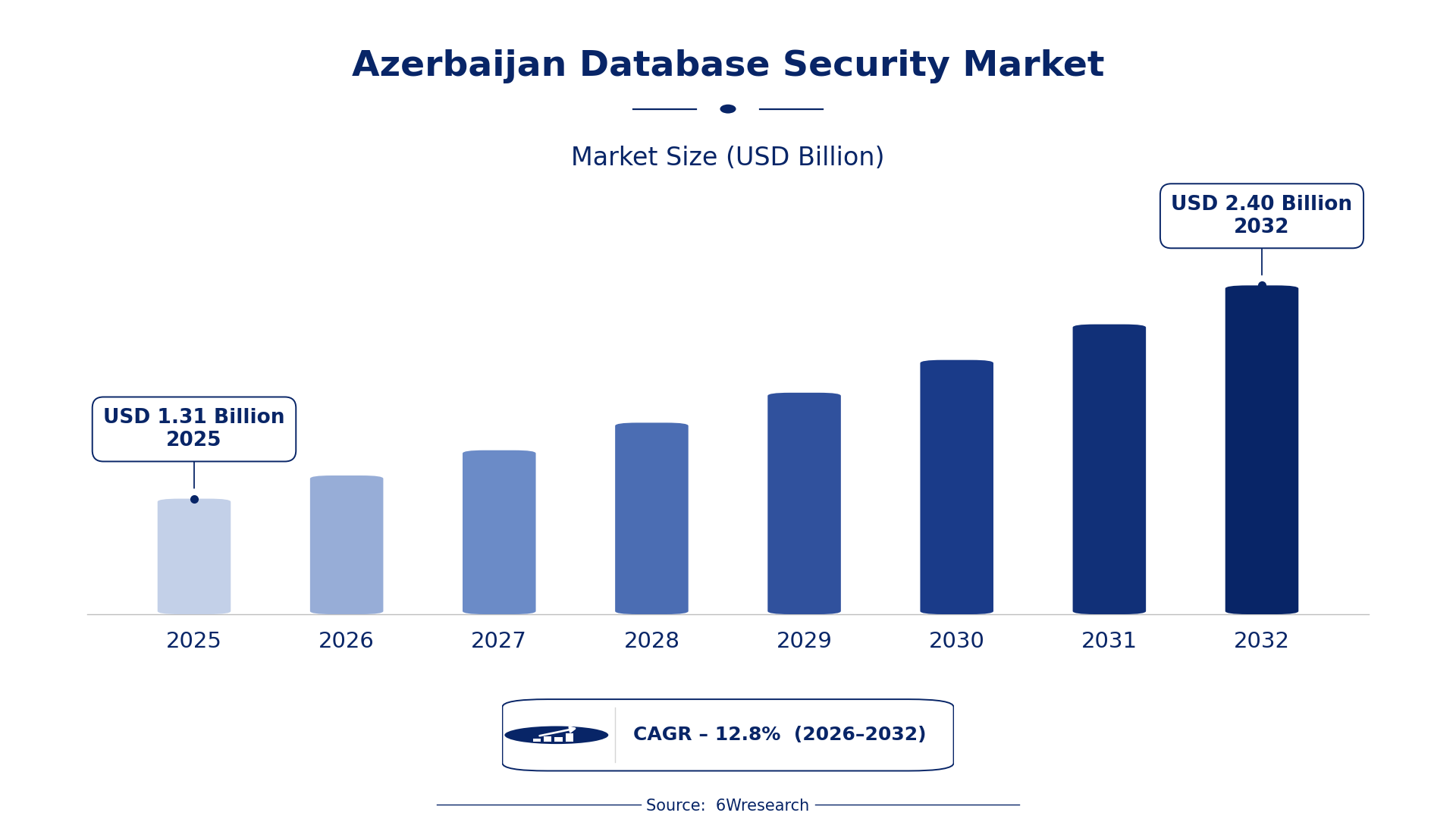
The Azerbaijan Database Security Market was estimated at USD 1314 Million in 2025 and is projected to reach USD 2405 Million by 2032, growing at a CAGR of 12.8% from 2026 to 2032.
Azerbaijan Database Security Market Synopsis
The growing dependence on data-driven applications in Azerbaijan is pushing organizations to prioritize database security. As cyber threats become increasingly sophisticated, there is a pressing need for robust solutions to safeguard sensitive information from breaches and unauthorized access.
In this market, companies are focusing on comprehensive security measures, including encryption, authentication, and monitoring tools. Such solutions are critical not only for maintaining data integrity but also for ensuring compliance with emerging regulations around data privacy and protection.
Azerbaijan Database Security Market Year-wise Growth Rate and Key Drivers
This graph illustrates the annual growth rates of the Azerbaijan Database Security Market from 2021 to 2032, highlighting a steady upward trajectory and projected expansion over the forecast period.
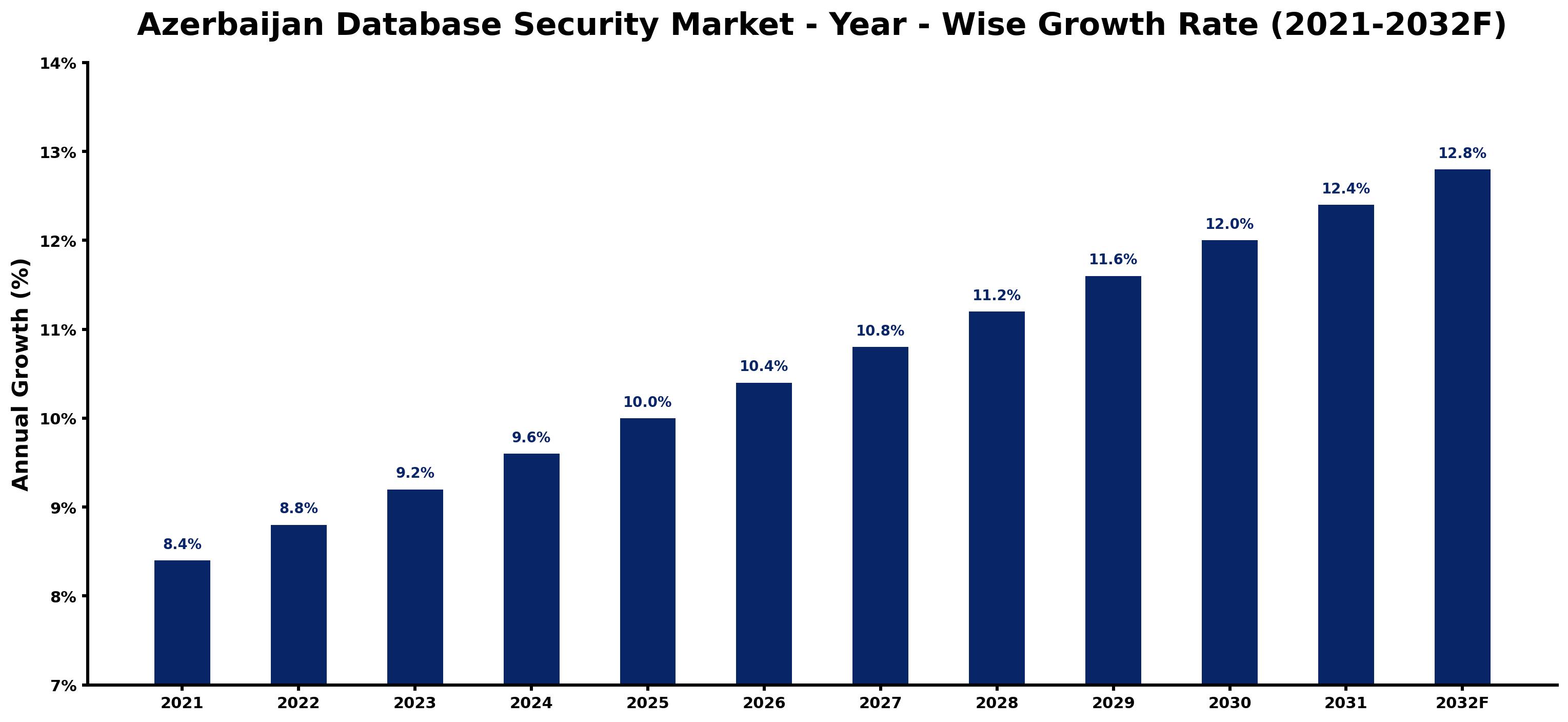
The table below presents the year‑wise growth rates along with the key drivers influencing the market
| Year | Growth Rate | Major Drivers |
| 2021 | 8.4% | Implementation of Data Protection Law enhancing cybersecurity mandates. |
| 2022 | 8.8% | Increase in digital banking services driving security requirements. |
| 2023 | 9.2% | Government push for e-Government services amplifying data security needs. |
| 2024 | 9.6% | Rising cyber threats prompting investment in database protection. |
| 2025 | 10.0% | Local tech startups emphasizing robust database security solutions. |
| 2026 | 10.4% | Growing adoption of cloud services requiring enhanced security measures. |
| 2027 | 10.8% | Expanding telecommunications sector increasing the need for data security. |
| 2028 | 11.2% | Rising awareness of data breaches leading to stronger security investments. |
| 2029 | 11.6% | Increased foreign investments necessitating compliance with international security standards. |
| 2030 | 12.0% | Cybersecurity awareness campaigns boosting demand for database protection. |
| 2031 | 12.4% | Workforce digitalization driving demand for secure database systems. |
| 2032 | 12.8% | Emergence of AI technologies prompting advanced database security solutions. |
Note: Market size estimations and growth projections presented in this report are based on 6Wresearch's proprietary forecasting methodology, utilizing the latest available industry data, government publications, and primary research inputs.
Azerbaijan Database Security Market Key Takeaways
Below are some of the specific key takeaways from the market, including:
- The Azerbaijani government is taking significant steps to improve database security policies and frameworks.
- Growing cyber threats are driving demand for sophisticated database security technologies.
- The market is witnessing increased investments in encryption and access control solutions.
- Organizations are focusing on compliance with both local and international data protection regulations.
- Cloud-based database services are prompting new security challenges and opportunities.
Evaluation of Restraints in Azerbaijan Database Security Market
Despite the optimistic outlook, the Azerbaijan Database Security Market faces several obstacles that hinder growth. A prominent challenge lies in the rapidly evolving nature of cyber threats, which often outpace existing security measures. Organizations struggle to stay ahead of tactics like SQL injection attacks and other malicious activities. Additionally, the complexity of managing diverse data types within databases complicates security protocols, often leading to gaps that can be exploited by attackers. Lastly, the need for granular access controls adds another layer of difficulty as companies strive to enforce data protection principles without hampering operational efficiency.
Azerbaijan Database Security Market Trends
Current trends show an accelerated adoption of cloud computing, driving the demand for cloud-specific database security solutions. Companies are also increasingly favoring multi-factor authentication and advanced encryption methods as standard practices. The rise of remote work has further catalyzed investments in database activity monitoring tools to track and mitigate insider threats. Additionally, there is a growing focus on integrating artificial intelligence and machine learning into security protocols to enhance threat detection and response times.
Azerbaijan Database Security Market Opportunities
The Azerbaijan Database Security Market is ripe for innovation and investment. Companies should look toward developing tailored solutions for sectors heavily reliant on sensitive data, such as finance and healthcare. The increasing regulatory landscape presents an opportunity for providers to position their products as essential for compliance. on top of that, partnerships with local authorities could open new avenues for public-sector contracts focused on national cybersecurity initiatives. As businesses transition to cloud environments, offering hybrid solutions that encompass both on-premises and cloud security will be critical for meeting customer needs.
Government Initiatives in the Azerbaijan Database Security Market
Government policy in Azerbaijan is heavily influencing the direction of the Database Security Market. Initiatives aim to bolster cybersecurity across various sectors, ensuring that organizations adopt stringent protective measures. By introducing regulations and guidelines, the government seeks to establish a framework that supports both security and compliance, which is crucial for fostering trust in digital transactions.
- A national cybersecurity strategy launched in early 2025 emphasizes database protection standards across all sectors.
- Current initiatives focus on enhancing public awareness about cybersecurity threats and best practices through nationwide training programs.
- A planned regulatory framework is expected to be introduced in 2027 to mandate advanced encryption and access control measures.
- Ongoing partnerships with industry stakeholders aim to develop new certification schemes for database security practices.
- Government grants are currently available for organizations investing in new database security technologies to improve their cybersecurity posture.
Future Insights of the Azerbaijan Database Security Market
Looking ahead, the Azerbaijan Database Security Market is set for dynamic growth. The increasing interconnectivity and digital transformation across industries will necessitate stronger security frameworks. As more organizations adopt digital solutions, the focus on data protection will become paramount. Vendors that can offer adaptive, scalable security solutions will likely capture significant market share. The integration of advanced technologies like AI-driven analytics is expected to redefine how organizations approach database security, ultimately leading to improved resilience against cyber threats.
Azerbaijan Database Security Market Latest Developments
In the past year, the Azerbaijan Database Security Market has seen numerous developments that reflect the growing focus on cybersecurity. Organizations are increasingly prioritizing database protection, leading to innovative product launches and collaborations aimed at enhancing security measures.
- A major technology vendor announced a new database encryption solution that began rollout in Q1 2025, offering enhanced security features tailored to the Azerbaijani market.
- A collaborative initiative between local universities and tech firms is currently underway to advance research in cybersecurity methodologies focused on database protection.
- In mid-2025, an industry consortium was formed to share best practices and develop a unified approach towards database security standards.
- A public-sector project is planned for late 2026 to update infrastructure across government databases, emphasizing robust security protocols.
- A key regional operator is enhancing its database monitoring tools with new AI functionalities expected to launch in early 2026.
Azerbaijan Database Security Market - Key Attractiveness of the Report
- 10 Years of Market Numbers
- Historical Data Starting from 2022 to 2025
- Base Year: 2025
- Forecast Data until 2032
- Key Performance Indicators Impacting the Market
- Major Upcoming Developments and Projects
Key Highlights of the Report:
- Azerbaijan Database Security Market Outlook
- Market Size of Azerbaijan Database Security Market, 2025
- Forecast of Azerbaijan Database Security Market, 2032
- Historical Data and Forecast of Azerbaijan Database Security Revenues & Volume for the Period 2022-2032F
- Azerbaijan Database Security Market Trend Evolution
- Azerbaijan Database Security Market Drivers and Challenges
- Azerbaijan Database Security Price Trends
- Azerbaijan Database Security Porter's Five Forces
- Azerbaijan Database Security Industry Life Cycle
- Historical Data and Forecast of Azerbaijan Database Security Market Revenues & Volume By Component for the Period 2022-2032F
- Historical Data and Forecast of Azerbaijan Database Security Market Revenues & Volume By Solution for the Period 2022-2032F
- Historical Data and Forecast of Azerbaijan Database Security Market Revenues & Volume By Services for the Period 2022-2032F
- Historical Data and Forecast of Azerbaijan Database Security Market Revenues & Volume By Business function for the Period 2022-2032F
- Historical Data and Forecast of Azerbaijan Database Security Market Revenues & Volume By Marketing for the Period 2022-2032F
- Historical Data and Forecast of Azerbaijan Database Security Market Revenues & Volume By sales for the Period 2022-2032F
- Historical Data and Forecast of Azerbaijan Database Security Market Revenues & Volume By finance for the Period 2022-2032F
- Historical Data and Forecast of Azerbaijan Database Security Market Revenues & Volume By operations for the Period 2022-2032F
- Historical Data and Forecast of Azerbaijan Database Security Market Revenues & Volume By Organization Size for the Period 2022-2032F
- Historical Data and Forecast of Azerbaijan Database Security Market Revenues & Volume By Large Enterprises for the Period 2022-2032F
- Historical Data and Forecast of Azerbaijan Database Security Market Revenues & Volume By SMEs for the Period 2022-2032F
- Historical Data and Forecast of Azerbaijan Database Security Market Revenues & Volume By Deployment Mode for the Period 2022-2032F
- Historical Data and Forecast of Azerbaijan Database Security Market Revenues & Volume By Cloud for the Period 2022-2032F
- Historical Data and Forecast of Azerbaijan Database Security Market Revenues & Volume By On-premises for the Period 2022-2032F
- Historical Data and Forecast of Azerbaijan Database Security Market Revenues & Volume By Vertical for the Period 2022-2032F
- Historical Data and Forecast of Azerbaijan Database Security Market Revenues & Volume By Banking, Financial Services, And Insurance for the Period 2022-2032F
- Historical Data and Forecast of Azerbaijan Database Security Market Revenues & Volume By Telecommunication and IT for the Period 2022-2032F
- Historical Data and Forecast of Azerbaijan Database Security Market Revenues & Volume By Government and Defense for the Period 2022-2032F
- Historical Data and Forecast of Azerbaijan Database Security Market Revenues & Volume By Manufacturing for the Period 2022-2032F
- Historical Data and Forecast of Azerbaijan Database Security Market Revenues & Volume By Healthcare and life sciences for the Period 2022-2032F
- Historical Data and Forecast of Azerbaijan Database Security Market Revenues & Volume By Retail and Ecommerce for the Period 2022-2032F
- Historical Data and Forecast of Azerbaijan Database Security Market Revenues & Volume By Energy and Utilities for the Period 2022-2032F
- Azerbaijan Database Security Import Export Trade Statistics
- Market Opportunity Assessment By Component
- Market Opportunity Assessment By Business function
- Market Opportunity Assessment By Organization Size
- Market Opportunity Assessment By Deployment Mode
- Market Opportunity Assessment By Vertical
- Azerbaijan Database Security Top Companies Market Share
- Azerbaijan Database Security Competitive Benchmarking By Technical and Operational Parameters
- Azerbaijan Database Security Company Profiles
- Azerbaijan Database Security Key Strategic Recommendations






































