Azerbaijan Decorative tile Market Summary
The azerbaijan decorative tile market was estimated at USD 1411 Million in 2025 and is projected to reach USD 2327 Million by 2032, growing at a CAGR of 8.5% from 2026 to 2032.
Azerbaijan Decorative tile Market Year-wise Growth Rate and Key Drivers
This graph highlights how the Azerbaijan Decorative tile Market has steadily grown over the past five years, supported by major growth factors.
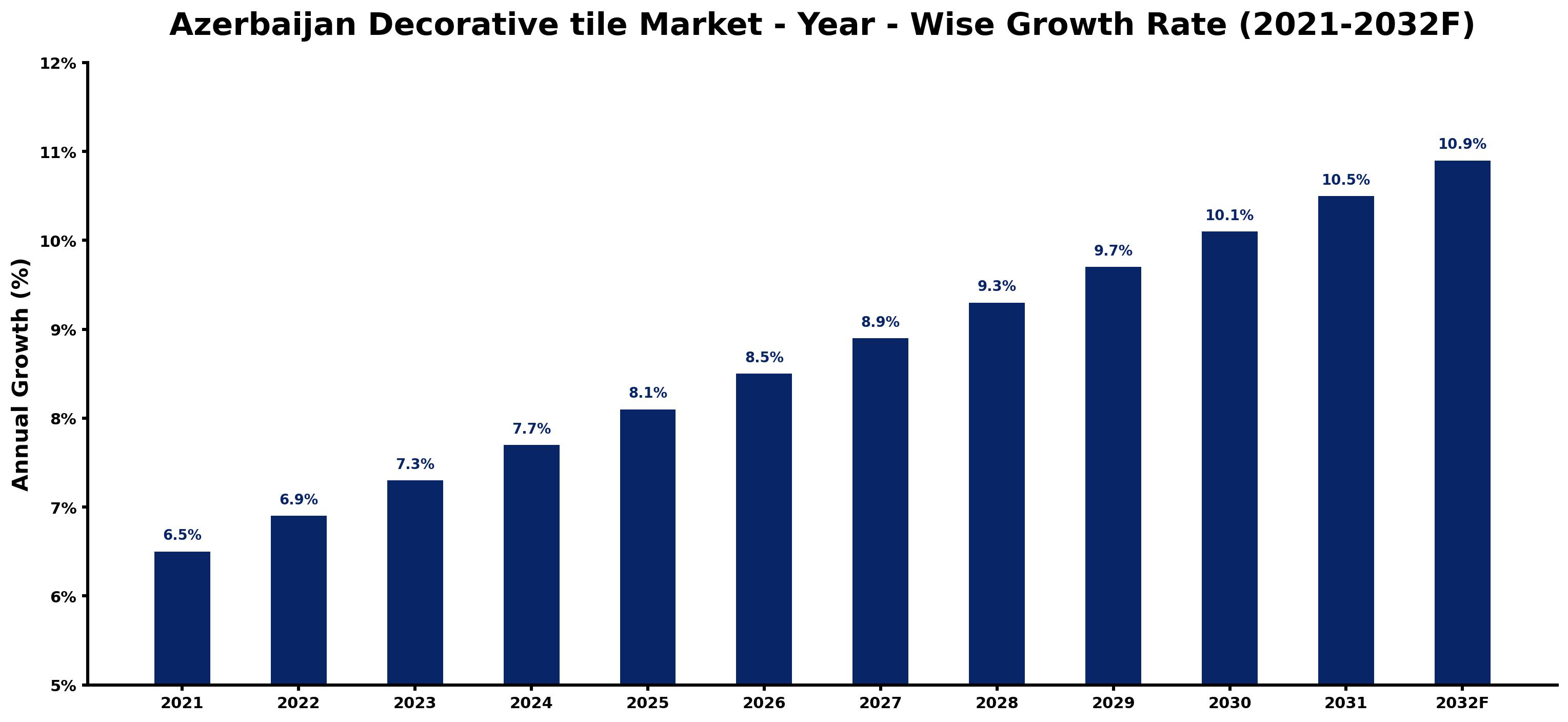
The table below presents the year wise growth rates along with the key drivers influencing the market
| Year | Growth Rate | Major Drivers |
| 2021 | 6.5% | Post-pandemic housing recovery efforts sparked renewed interest in home renovations. |
| 2022 | 6.9% | Local artisans increasingly emphasized traditional designs, enhancing cultural relevance and appeal. |
| 2023 | 7.3% | Urbanization trends created a surge in residential construction projects across major cities. |
| 2024 | 7.7% | Influence of social media showcased diverse tile applications, inspiring consumer creativity. |
| 2025 | 8.1% | Corporate investments in local manufacturing facilities reduced dependency on imports significantly. |
| 2026 | 8.5% | Eco-friendly materials gained popularity, aligning with global sustainability movements and consumer preferences. |
| 2027 | 8.9% | Architectural firms embraced decorative tiles as essential design elements in new builds. |
| 2028 | 9.3% | Regional tourism growth spurred demand for decorative tiles in hotels and public spaces. |
| 2029 | 9.7% | Expansion of distribution networks improved access to a variety of decorative tiles. |
| 2030 | 10.1% | Increased disposable income allowed consumers to invest more in home aesthetics and renovations. |
| 2031 | 10.5% | Government initiatives focused on urban renewal highlighted the importance of vibrant public spaces. |
| 2032 | 10.9% | Collaboration between designers and manufacturers led to innovative tile solutions tailored for local needs. |
Note - Market size estimations and growth projections presented in this report are based on 6Wresearch's advanced forecasting approach, validated with industry datasets as of June 2026.
Azerbaijan Decorative tile Market Synopsis
The Azerbaijan Decorative tile Market is projected to reach 8.5% and witness significant growth during the forecast period (2026-2032). This growth is primarily driven by increasing investments in construction, along with a heightened demand for aesthetically pleasing interior design solutions. As disposable incomes rise and consumer preferences evolve, decorative tiles have become a significant choice for enhancing both residential and commercial spaces.
Azerbaijan Decorative tile Market Growth Drivers
Several key factors are contributing to the growth of the Azerbaijan Decorative tile Market. The foremost among these are:
- Increasing Construction Activities: The boost in urban development and infrastructure projects across Azerbaijan is driving demand for decorative tiles.
- Rising Disposable Incomes: As the economy grows, consumers are willing to invest in home and business decor, leading to an increased preference for decorative tiles.
- Focus on Aesthetics: Both homeowners and businesses are placing greater emphasis on interior aesthetics, which in turn increases demand for stylish tile options.
- Technological Advancements: Innovations in tile manufacturing are leading to the introduction of unique designs and sustainable materials.
- Customization Trends: A growing appetite for personalized home decor is driving consumers to seek out decorative tiles that reflect their individual style.
Azerbaijan Decorative tile Market Trends and Opportunities
The Azerbaijan Decorative tile Market is currently witnessing evolving trends that present numerous opportunities for growth:
- Shift Towards Minimalism: Modern designs featuring clean lines and minimalistic patterns are becoming popular among consumers seeking contemporary decor.
- Geometric Patterns and Bold Colors: There is a notable trend toward tiles that incorporate striking geometric designs and vibrant color schemes, enhancing the luxury appeal of interior spaces.
- Sustainable Materials: An increasing awareness of environmental sustainability is prompting consumers to favor eco-friendly tile options, fostering innovation within the market.
- Digital Printing Technology: This technology is allowing for intricate and customizable designs on tiles, catering to consumer desires for unique home decor.
- Growth in Commercial Spaces: As businesses continue to leverage interior design to attract customers, the demand for decorative tiles in commercial environments is on the rise.
Azerbaijan Decorative tile Market Challenges and Restraints
Despite its promising outlook, the Azerbaijan Decorative tile Market faces several challenges that could impact its trajectory:
- Competition from Imports: The influx of imported tiles presents a competitive challenge to local manufacturers, necessitating differentiation in products.
- Raw Material Price Fluctuations: Volatility in the prices of raw materials can affect the cost structure of tile production.
- Labor Skill Gaps: A shortage of skilled labor for intricate tile designs limits the production capabilities of local manufacturers.
- Technological Limitations: Limited access to advanced production technology can hinder innovation in tile manufacturing.
- Logistical Challenges: Transportation and logistics issues can lead to delays in delivering products, affecting customer satisfaction and market reach.
Azerbaijan Decorative tile Market Investment Opportunities
The Azerbaijan Decorative tile Market offers numerous investment opportunities, particularly in the context of the country's expanding construction and real estate sectors. Key prospects include:
- Manufacturing Investments: Investing in local tile manufacturing facilities can help tap into the growing domestic demand and reduce reliance on imports.
- Retail Expansion: Setting up distribution networks or retail outlets can make decorative tiles more accessible to a broader customer base.
- Import Opportunities: There is potential for importing innovative tile designs that meet the evolving preferences of consumers.
- Sustainable Practices: Companies that focus on eco-friendly production methods may attract environmentally conscious consumers.
- Technological Investments: Investing in modernizing production equipment can enhance the quality and variety of tile offerings.
Azerbaijan Decorative tile Market Government Investment and Initiatives
Government initiatives in Azerbaijan aimed at enhancing the decorative tile market are comprehensive and supportive of local industry growth. Key initiatives include:
- Support for Local Production: The government has introduced various financial incentives for domestic manufacturers to encourage local production and reduce dependency on imports.
- Quality Regulation: Regulations are being enforced to ensure that decorative tiles conform to established quality standards and safety requirements.
- Promotion of Exports: Initiatives are in place to market Azerbaijani decorative tiles internationally, enhancing the global recognition of local brands.
- Skills Development: The government is investing in training programs to improve the skills of workers in tile design and production.
- Public Infrastructure Spending: Investments in public infrastructure also contribute to heightened demand for decorative tiles in newly built or renovated public spaces.
Azerbaijan Decorative tile Market Latest Developments (May 2025 - June 2026)
Recent developments within the Azerbaijan Decorative tile Market reflect a dynamic landscape marked by innovation and evolving consumer preferences. During this period, manufacturers have increasingly adopted advanced production techniques, particularly digital printing technologies, to create more intricate and customizable tile designs. Furthermore, the market has seen an uptick in the availability of eco-friendly tiles, catering to a growing cohort of environmentally conscious consumers. The government has also intensified its support for local production, which is expected to result in higher-quality offerings on the domestic market. Concurrently, the trend towards modern and minimalist aesthetics remains strong, compelling companies to adapt their product lines accordingly.
Azerbaijan Decorative tile Market - Key Attractiveness of the Report
- 10 Years of Market Numbers
- Historical Data Starting from 2022 to 2025
- Base Year: 2025
- Forecast Data until 2032
- Key Performance Indicators Impacting the Market
- Major Upcoming Developments and Projects
Key Highlights of the Report:
- Azerbaijan Decorative tile Market Outlook
- Market Size of Azerbaijan Decorative tile Market, 2025
- Forecast of Azerbaijan Decorative tile Market, 2032F
- Historical Data and Forecast of Azerbaijan Decorative tile Revenues & Volume for the Period 2022-2032F
- Azerbaijan Decorative tile Market Trend Evolution
- Azerbaijan Decorative tile Market Drivers and Challenges
- Azerbaijan Decorative tile Price Trends
- Azerbaijan Decorative tile Porter's Five Forces
- Azerbaijan Decorative tile Industry Life Cycle
- Historical Data and Forecast of Azerbaijan Decorative tile Market Revenues & Volume By Type for the Period 2022-2032F
- Historical Data and Forecast of Azerbaijan Decorative tile Market Revenues & Volume By Ceramic Wall Tiles for the Period 2022-2032F
- Historical Data and Forecast of Azerbaijan Decorative tile Market Revenues & Volume By Vinyl Wall Tiles for the Period 2022-2032F
- Historical Data and Forecast of Azerbaijan Decorative tile Market Revenues & Volume By Stone Wall Tiles for the Period 2022-2032F
- Historical Data and Forecast of Azerbaijan Decorative tile Market Revenues & Volume By Other Types for the Period 2022-2032F
- Historical Data and Forecast of Azerbaijan Decorative tile Market Revenues & Volume By End-users for the Period 2022-2032F
- Historical Data and Forecast of Azerbaijan Decorative tile Market Revenues & Volume By Residential for the Period 2022-2032F
- Historical Data and Forecast of Azerbaijan Decorative tile Market Revenues & Volume By Commercial for the Period 2022-2032F
- Historical Data and Forecast of Azerbaijan Decorative tile Market Revenues & Volume By Application for the Period 2022-2032F
- Historical Data and Forecast of Azerbaijan Decorative tile Market Revenues & Volume By Flooring for the Period 2022-2032F
- Historical Data and Forecast of Azerbaijan Decorative tile Market Revenues & Volume By Wall Coverings for the Period 2022-2032F
- Historical Data and Forecast of Azerbaijan Decorative tile Market Revenues & Volume By Other Applications for the Period 2022-2032F
- Azerbaijan Decorative tile Import Export Trade Statistics
- Market Opportunity Assessment By Type
- Market Opportunity Assessment By End-users
- Market Opportunity Assessment By Application
- Azerbaijan Decorative tile Top Companies Market Share
- Azerbaijan Decorative tile Competitive Benchmarking By Technical and Operational Parameters
- Azerbaijan Decorative tile Company Profiles
- Azerbaijan Decorative tile Key Strategic Recommendations






































