Azerbaijan Digital Remittance Market Size Growth Rate
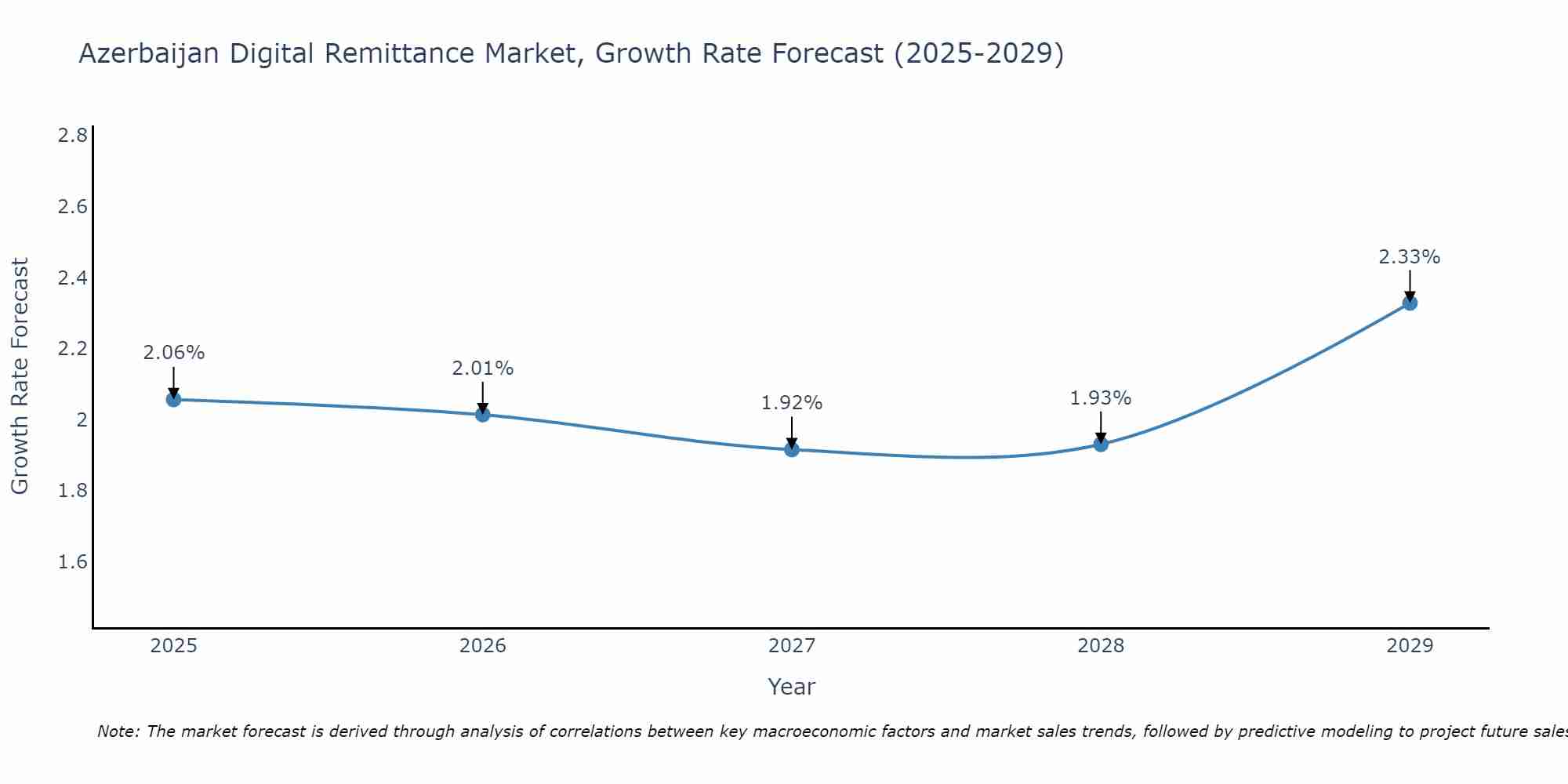
The Azerbaijan Digital Remittance Market is projected to witness mixed growth rate patterns during 2025 to 2029. From 2.06% in 2025, the growth rate steadily ascends to 2.33% in 2029.
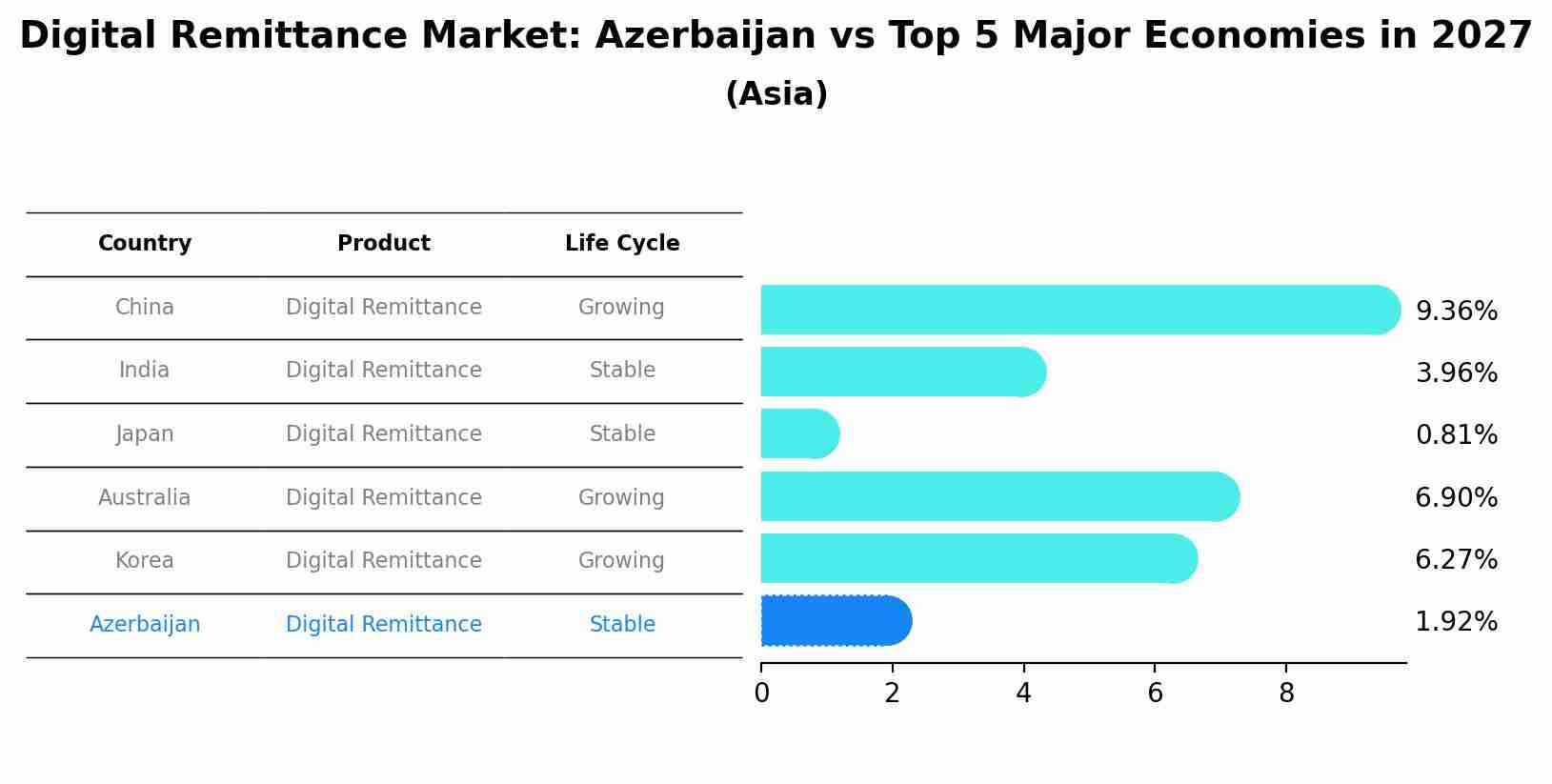
Digital Remittance Market: Azerbaijan vs Top 5 Major Economies in 2027 (Asia)
By 2027, Azerbaijan's Digital Remittance market is forecasted to achieve a stable growth rate of 1.92%, with China leading the Asia region, followed by India, Japan, Australia and South Korea.
Azerbaijan Digital Remittance Market Synopsis
The digital remittance market in Azerbaijan comprises the provision of electronic money transfer services facilitated by digital platforms and mobile applications. Digital remittance services enable individuals to send money domestically or internationally to recipients using online banking, mobile wallets, or specialized remittance platforms. These digital solutions offer advantages such as speed, convenience, and cost-effectiveness compared to traditional remittance methods, contributing to the digitization of financial transactions and the expansion of financial inclusion in Azerbaijan.
Drivers of the market
The drivers of the digital remittance market in Azerbaijan include the increasing adoption of digital payment and money transfer solutions, growing demand for convenient and cost-effective remittance services, rising international migration and cross-border transactions, and advancements in mobile and online banking technologies. Digital remittance refers to the transfer of money using digital channels such as mobile wallets, online platforms, and blockchain-based systems. Factors such as the globalization of labor markets, the need for financial inclusion, and the rise of digital banking drive the growth of the digital remittance market in Azerbaijan as individuals and businesses seek secure, fast, and affordable ways to send and receive money domestically and internationally.
Challenges of the market
In the Azerbaijan Digital Remittance Market, financial institutions and remittance service providers face challenges in delivering fast, secure, and cost-effective cross-border money transfer services while complying with regulatory requirements and addressing customer needs. One significant hurdle is the complexity of regulatory compliance and anti-money laundering (AML) regulations governing cross-border remittance transactions. Ensuring the transparency and traceability of funds transfers while minimizing compliance risks requires robust Know Your Customer (KYC) and AML procedures. Moreover, addressing concerns about data privacy and security in digital remittance platforms and complying with data protection regulations pose legal and compliance challenges for service providers. Additionally, competing with traditional remittance channels and informal money transfer networks requires innovative pricing strategies and value-added services to attract customers. Furthermore, enhancing financial inclusion and expanding access to digital remittance services for underserved populations, including migrants and unbanked individuals, present accessibility and adoption challenges for the industry.
Government Policy of the market
In the Azerbaijan Digital Remittance Market, government policies focus on regulating cross-border financial transactions, ensuring transparency and security, and promoting financial inclusion and innovation in digital remittance services for migrant workers, expatriates, and other individuals sending money abroad. The government may establish regulations and standards for digital remittance platforms, including licensing requirements, transaction limits, and anti-money laundering (AML) and counter-terrorism financing (CFT) measures to prevent fraud, illicit activities, and financial abuse. These policies may also include measures to support the development of digital payment infrastructure and interoperability, provide incentives for technology adoption and digital literacy, and foster partnerships between financial institutions, mobile operators, and fintech companies to expand access to affordable, convenient, and secure remittance services in the Azerbaijan Digital Remittance Market.
Key Highlights of the Report:
- Azerbaijan Digital Remittance Market Outlook
- Market Size of Azerbaijan Digital Remittance Market, 2024
- Forecast of Azerbaijan Digital Remittance Market, 2031
- Historical Data and Forecast of Azerbaijan Digital Remittance Revenues & Volume for the Period 2018 - 2031
- Azerbaijan Digital Remittance Market Trend Evolution
- Azerbaijan Digital Remittance Market Drivers and Challenges
- Azerbaijan Digital Remittance Price Trends
- Azerbaijan Digital Remittance Porter's Five Forces
- Azerbaijan Digital Remittance Industry Life Cycle
- Historical Data and Forecast of Azerbaijan Digital Remittance Market Revenues & Volume By Type for the Period 2018 - 2031
- Historical Data and Forecast of Azerbaijan Digital Remittance Market Revenues & Volume By Inward Digital Remittance for the Period 2018 - 2031
- Historical Data and Forecast of Azerbaijan Digital Remittance Market Revenues & Volume By Outward Digital Remittance for the Period 2018 - 2031
- Historical Data and Forecast of Azerbaijan Digital Remittance Market Revenues & Volume By Channel for the Period 2018 - 2031
- Historical Data and Forecast of Azerbaijan Digital Remittance Market Revenues & Volume By Banks for the Period 2018 - 2031
- Historical Data and Forecast of Azerbaijan Digital Remittance Market Revenues & Volume By Money Transfer Operators for the Period 2018 - 2031
- Historical Data and Forecast of Azerbaijan Digital Remittance Market Revenues & Volume By Online Platforms for the Period 2018 - 2031
- Historical Data and Forecast of Azerbaijan Digital Remittance Market Revenues & Volume By Others for the Period 2018 - 2031
- Historical Data and Forecast of Azerbaijan Digital Remittance Market Revenues & Volume By End-use for the Period 2018 - 2031
- Historical Data and Forecast of Azerbaijan Digital Remittance Market Revenues & Volume By Migrant Labor Workforce for the Period 2018 - 2031
- Historical Data and Forecast of Azerbaijan Digital Remittance Market Revenues & Volume By Personal for the Period 2018 - 2031
- Historical Data and Forecast of Azerbaijan Digital Remittance Market Revenues & Volume By Small Businesses for the Period 2018 - 2031
- Historical Data and Forecast of Azerbaijan Digital Remittance Market Revenues & Volume By Others for the Period 2018 - 2031
- Azerbaijan Digital Remittance Import Export Trade Statistics
- Market Opportunity Assessment By Type
- Market Opportunity Assessment By Channel
- Market Opportunity Assessment By End-use
- Azerbaijan Digital Remittance Top Companies Market Share
- Azerbaijan Digital Remittance Competitive Benchmarking By Technical and Operational Parameters
- Azerbaijan Digital Remittance Company Profiles
- Azerbaijan Digital Remittance Key Strategic Recommendations






































