Azerbaijan Dill Seed Oil Market Size, Share & Growth Rate
The Azerbaijan Dill Seed Oil Market was estimated at USD 322 Million in 2025 and is projected to reach USD 537 Million by 2032, growing at a CAGR of 7.6% from 2026 to 2032. This growth trajectory is largely fueled by the increasing demand for natural and organic ingredients across various industries, notably cosmetics and pharmaceuticals. Additionally, the surge in consumer awareness regarding the numerous health benefits of dill seed oil, including its anti-inflammatory and digestive properties, is contributing to its market expansion.
Azerbaijan Dill Seed Oil Market Year-wise Growth Rate and Key Drivers
This graph highlights how the Azerbaijan Dill Seed Oil Market has steadily grown over the years, supported by major growth factors.
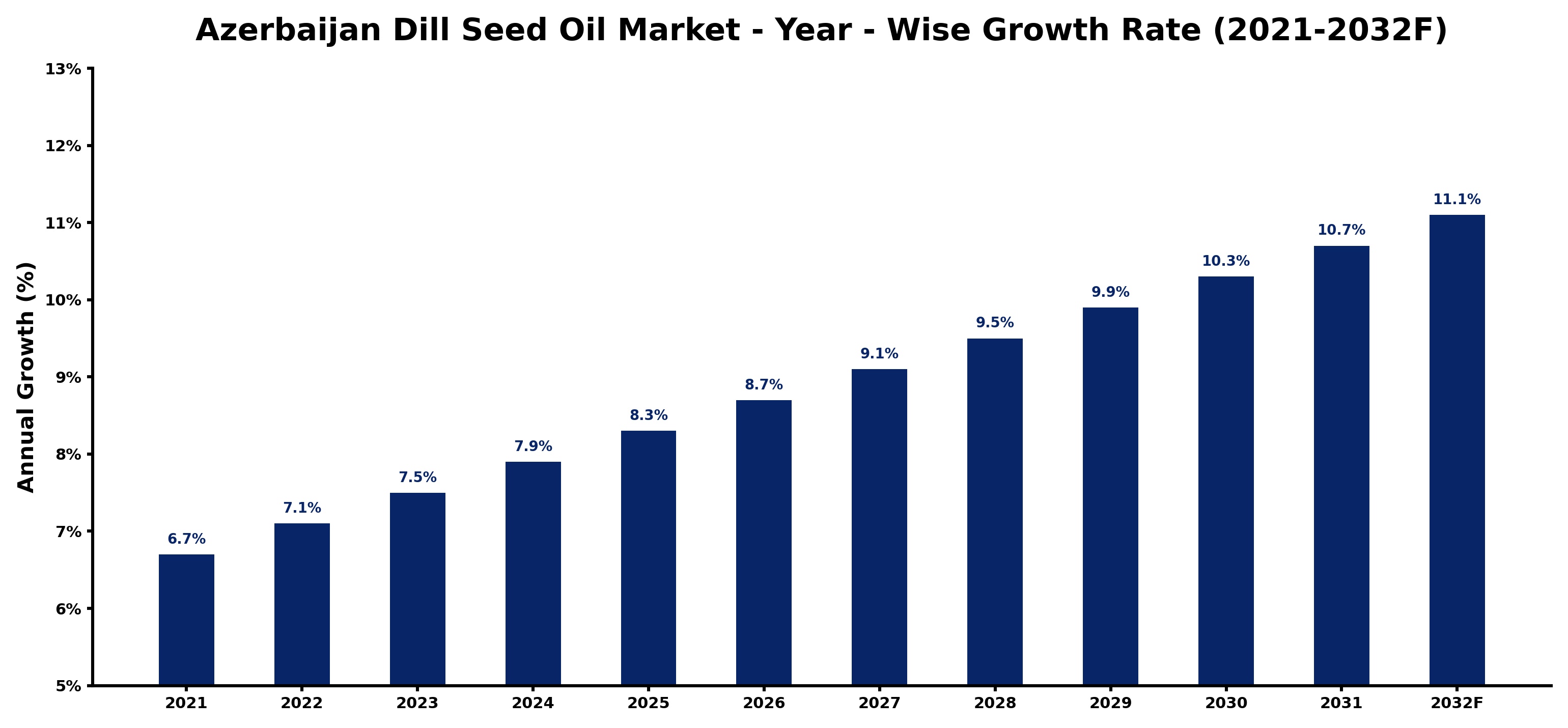
The table below presents the year‑wise growth rates along with the key drivers influencing the market
| Year | Growth Rate | Major Drivers |
| 2021 | 6.7% | Growing urbanization and commercial development |
| 2022 | 7.1% | Expansion of manufacturing activities |
| 2023 | 7.5% | Government infrastructure modernization initiatives |
| 2024 | 7.9% | Expansion of manufacturing activities |
| 2025 | 8.3% | Increasing industrial infrastructure investments |
| 2026 | 8.7% | Increasing industrial automation investments |
| 2027 | 9.1% | Growing renewable energy integration projects |
| 2028 | 9.5% | Rising electricity demand across industries |
| 2029 | 9.9% | Expansion of transportation and logistics networks |
| 2030 | 10.3% | Expansion of manufacturing activities |
| 2031 | 10.7% | Expansion of manufacturing activities |
| 2032 | 11.1% | Increasing industrial infrastructure investments |
Note - Market size estimations and growth projections presented in this report are based on 6Wresearch's advanced forecasting approach, validated with industry datasets as of June 2026.
Azerbaijan Dill Seed Oil Market Synopsis
Recently, the Azerbaijan dill seed oil market has witnessed a robust momentum, supported by escalating interest in wellness products. However, as consumers become increasingly discerning, the focus on quality and authenticity will become paramount. This trend suggests a shift towards more stringent quality measures and sustainable practices within the industry.
Looking ahead, the market is expected to capitalize on the growing popularity of aromatherapy and holistic wellness, further driving the demand for dill seed oil. As investment in innovation and distribution networks heightens, local producers are likely to gain a competitive edge, enhancing their market presence both domestically and internationally.
Azerbaijan Dill Seed Oil Market Key Takeaways
- The market is experiencing steady growth driven by demand for natural and organic products.
- Rising consumer awareness of the health benefits associated with dill seed oil is influencing purchasing behaviors.
- Product innovation and enhanced distribution strategies are critical for market players aiming to capitalize on this trend.
- Government support for agricultural production is enhancing the sector's competitiveness.
- Investors are recognizing the lucrative potential of dill seed oil in both domestic and global markets.
Evaluation of Restraints in Azerbaijan Dill Seed Oil Market
Despite its potential, the Azerbaijan dill seed oil market faces significant challenges. Limited awareness of the product among consumers restricts market penetration, while the lack of standardized quality control can undermine consumer trust. Additionally, competition from established international producers creates a challenging landscape for local businesses. These factors necessitate focused marketing initiatives, robust quality assurance measures, and strategic partnerships to improve market visibility and bolster consumer confidence.
Azerbaijan Dill Seed Oil Market Trends
A prominent trend shaping the Azerbaijan dill seed oil market is the growing consumer preference for natural and organic ingredients. This inclination is prompting a shift away from synthetic alternatives, thereby boosting the demand for dill seed oil. Furthermore, the oil's incorporation into aromatherapy and wellness products highlights its soothing and calming effects, appealing to a broader audience interested in holistic health solutions. Innovations in product formulations and creative marketing approaches are also emerging as essential strategies for market participants.
Azerbaijan Dill Seed Oil Market Opportunities
The investment landscape for the Azerbaijan dill seed oil market is ripe with opportunities. As global demand for natural and organic products continues to rise, there is significant potential for local producers to enhance their offerings and tap into export markets. The favorable climate for dill cultivation further supports this growth, providing an ideal environment for high-quality production. Collaborations with local farmers and the establishment of efficient distribution channels can create pathways for successful market entry and expansion.
Government Initiatives in the Azerbaijan Dill Seed Oil Market
The Azerbaijani government has enacted various policies to nurture the dill seed oil market. Initiatives include financial support and subsidies for dill farmers, aimed at boosting production levels. Furthermore, stringent quality standards and regulatory measures are in place to ensure product safety and credibility. Research and development programs are also being promoted to enhance production efficiency and sustainability, solidifying the competitive advantage of Azerbaijani dill seed oil in the global marketplace.
Future Insights of the Azerbaijan Dill Seed Oil Market
As we look towards the future, the Azerbaijan dill seed oil market appears well-positioned for sustained growth from 2026 to 2032. The rising consumer shift towards natural ingredients in food, cosmetics, and wellness products will drive demand for dill seed oil. Supportive governmental policies and increasing investments in innovation will also serve as critical enablers for market expansion. The growing interest in aromatherapy and holistic wellness further enhances the market's potential, suggesting a favorable outlook for both producers and investors.
Azerbaijan Dill Seed Oil Market Latest Developments (May 2025 - June 2026)
In recent months, the Azerbaijan dill seed oil market has witnessed notable developments. Industry stakeholders are increasingly focused on enhancing product quality and implementing more efficient production techniques. Simultaneously, partnerships and collaborations are being established to expand distribution networks and tap into emerging markets. This strategic focus reflects the sector's commitment to adapting to consumer demands and positioning itself competitively on the international stage.
Azerbaijan Dill Seed Oil Market - Key Attractiveness of the Report
- 10 Years of Market Numbers
- Historical Data Starting from 2022 to 2025
- Base Year: 2025
- Forecast Data until 2032
- Key Performance Indicators Impacting the Market
- Major Upcoming Developments and Projects
Key Highlights of the Report:
- Azerbaijan Dill Seed Oil Market Outlook
- Market Size of Azerbaijan Dill Seed Oil Market, 2025
- Forecast of Azerbaijan Dill Seed Oil Market, 2032
- Historical Data and Forecast of Azerbaijan Dill Seed Oil Revenues & Volume for the Period 2022-2032F
- Azerbaijan Dill Seed Oil Market Trend Evolution
- Azerbaijan Dill Seed Oil Market Drivers and Challenges
- Azerbaijan Dill Seed Oil Price Trends
- Azerbaijan Dill Seed Oil Porter's Five Forces
- Azerbaijan Dill Seed Oil Industry Life Cycle
- Historical Data and Forecast of Azerbaijan Dill Seed Oil Market Revenues & Volume By Type for the Period 2022-2032F
- Historical Data and Forecast of Azerbaijan Dill Seed Oil Market Revenues & Volume By Anethum Graveolens Seed Oil for the Period 2022-2032F
- Historical Data and Forecast of Azerbaijan Dill Seed Oil Market Revenues & Volume By Anethum Sowa Seed Oil for the Period 2022-2032F
- Historical Data and Forecast of Azerbaijan Dill Seed Oil Market Revenues & Volume By Application for the Period 2022-2032F
- Historical Data and Forecast of Azerbaijan Dill Seed Oil Market Revenues & Volume By Flavor for the Period 2022-2032F
- Historical Data and Forecast of Azerbaijan Dill Seed Oil Market Revenues & Volume By Fragrance for the Period 2022-2032F
- Historical Data and Forecast of Azerbaijan Dill Seed Oil Market Revenues & Volume By Pharmaceutical for the Period 2022-2032F
- Historical Data and Forecast of Azerbaijan Dill Seed Oil Market Revenues & Volume By Skincare for the Period 2022-2032F
- Historical Data and Forecast of Azerbaijan Dill Seed Oil Market Revenues & Volume By Aromatherapy for the Period 2022-2032F
- Azerbaijan Dill Seed Oil Import Export Trade Statistics
- Market Opportunity Assessment By Type
- Market Opportunity Assessment By Application
- Azerbaijan Dill Seed Oil Top Companies Market Share
- Azerbaijan Dill Seed Oil Competitive Benchmarking By Technical and Operational Parameters
- Azerbaijan Dill Seed Oil Company Profiles
- Azerbaijan Dill Seed Oil Key Strategic Recommendations






































