Azerbaijan Electrical and electronics Market Summary
The azerbaijan electrical and electronics market was estimated at USD 563 Million in 2025 and is projected to reach USD 933 Million by 2032, growing at a CAGR of 8.6% from 2026 to 2032.
Azerbaijan Electrical and electronics Market Year-wise Growth Rate and Key Drivers
This graph highlights how the Azerbaijan Electrical and electronics Market has steadily grown over the past five years, supported by major growth factors.
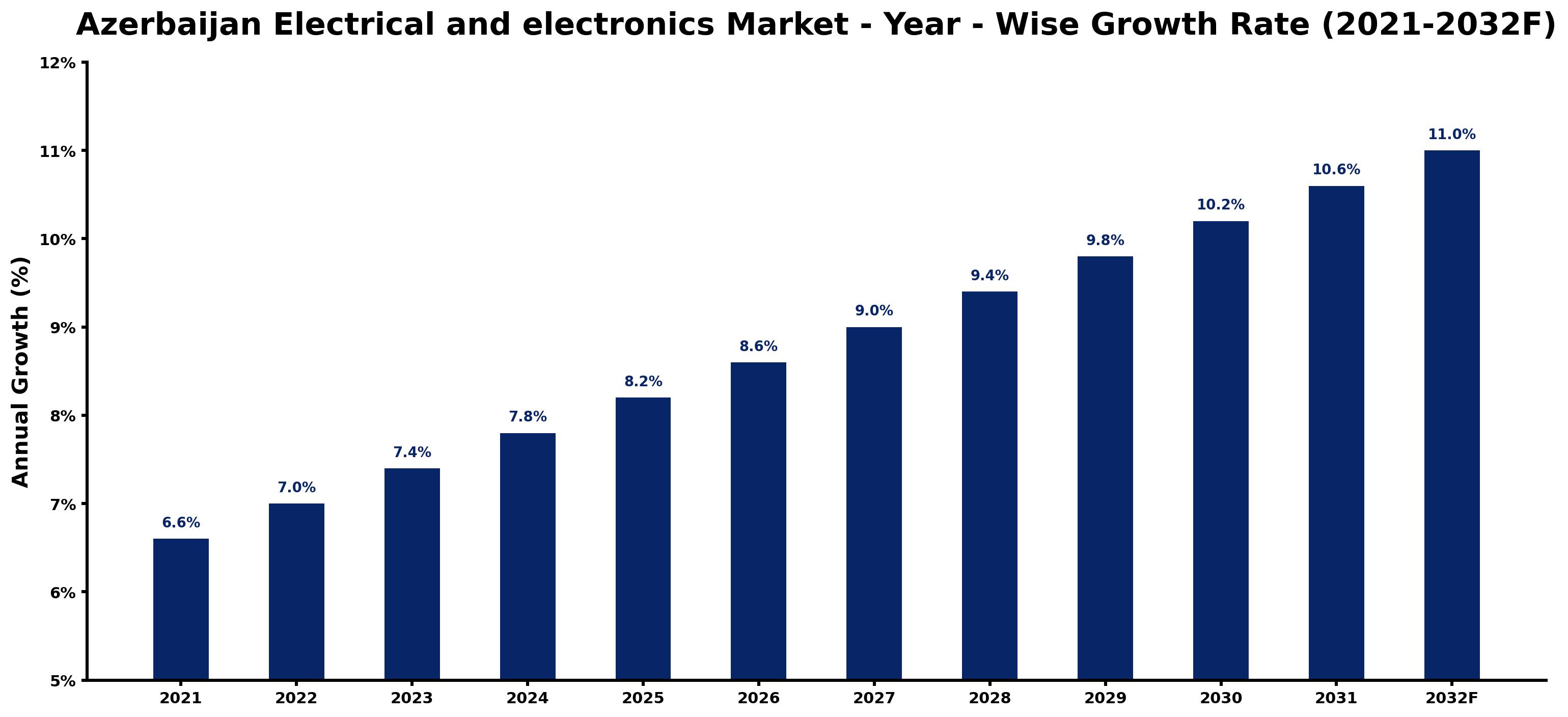
The table below presents the year wise growth rates along with the key drivers influencing the market
| Year | Growth Rate | Major Drivers |
| 2021 | 6.6% | Post-pandemic recovery spurred consumer electronics purchases across urban markets. |
| 2022 | 7.0% | Infrastructure investments attracted foreign players to Azerbaijan's electrical sector. |
| 2023 | 7.4% | Local manufacturers began to diversify product offerings, enhancing competition and innovation. |
| 2024 | 7.8% | Rising urbanization necessitated smart grid solutions and energy-efficient devices. |
| 2025 | 8.2% | Increased focus on renewable energy solutions reshaped market dynamics and consumer preferences. |
| 2026 | 8.6% | Technological collaborations emerged, fostering local talent and boosting research capabilities. |
| 2027 | 9.0% | Consumer awareness around sustainability encouraged eco-friendly electronics usage among households. |
| 2028 | 9.4% | E-commerce platforms expanded, facilitating easier access to electrical goods in remote areas. |
| 2029 | 9.8% | The installation of advanced power management systems minimized energy losses during distribution. |
| 2030 | 10.2% | Local universities initiated programs targeting skills development in electronics engineering fields. |
| 2031 | 10.6% | Corporate sector investments in smart technology amplified demand for advanced electrical solutions. |
| 2032 | 11.0% | A robust supply chain network improved logistics, enhancing product availability throughout the country. |
Note - Market size estimations and growth projections presented in this report are based on 6Wresearch's advanced forecasting approach, validated with industry datasets as of June 2026.
Azerbaijan Electrical and electronics Market Synopsis
The Azerbaijan Electrical and electronics Market is projected to reach 8.6% and witness significant growth during the forecast period (2026-2032). Driven by urbanization, industrialization, and a burgeoning infrastructure development agenda, the market is on a path of steady expansion. A marked increase in the demand for consumer electronics, household appliances, and industrial equipment is shaping its trajectory. The government's commitment to diversifying the economy through technology and innovation is further catalyzing the growth of this sector. Additionally, the rise of a middle-class population, coupled with increasing disposable incomes, is encouraging the adoption of smart technologies and energy-efficient products throughout Azerbaijan.
Azerbaijan Electrical and electronics Market Growth Drivers
Several factors are propelling the growth of the Azerbaijan Electrical and electronics Market. First, urbanization in urban areas is leading to greater demand for advanced electrical solutions and consumer electronics. As cities expand, the need for modern infrastructure, equipped with the latest technologies, becomes critical.
- Industrialization efforts are fostering an environment conducive to manufacturing and the establishment of production facilities, increasing the demand for industrial equipment.
- The local population's growing preference for smart home technologies underlines a transition toward energy-efficient and convenient living solutions.
- The government's progressive economic policies are creating a more favorable landscape for investment in the electrical and electronics sector.
- International brands are increasingly entering the market, enhancing competition and providing consumers with diverse choices of high-quality products.
Azerbaijan Electrical and electronics Market Trends and Opportunities
In the Azerbaijan Electrical and electronics Market, notable trends are shaping consumer preferences and industry evolution. There's an increasing shift towards smart home technologies, which integrate convenience and energy management.
- The demand for smart appliances, including refrigerators, washing machines, and lighting solutions, is witnessing a rapid escalation as efficiency becomes a priority.
- Connected devices, particularly in the Internet of Things (IoT) sector, are gaining traction, allowing households to optimize energy usage and enhance security.
- Sustainability remains at the forefront, with consumers increasingly favoring eco-friendly products that align with energy-saving principles.
- Companies are focused on innovation, developing products that not only meet current market demands but also anticipate future needs.
- As community awareness about environmental impact grows, there is a rising interest in sustainable electronics that minimize carbon footprints.
Azerbaijan Electrical and electronics Market Challenges and Restraints
Despite the optimistic outlook for the Azerbaijan Electrical and electronics Market, several challenges persist. One significant hurdle is the limited domestic production capacity, which means the market heavily relies on imports.
- Companies face challenges related to inconsistent regulations that can complicate operational procedures and compliance.
- Intellectual property protection remains a critical concern, as inadequate enforcement can stifle innovation and deter foreign investments.
- Fluctuations in global trade dynamics can lead to instability in pricing and availability of essential components.
- The lack of local manufacturing capabilities further complicates the competitive landscape, making it difficult for domestic brands to thrive.
- Investment in technology adoption is slowed by the need for infrastructure improvements and skilled workforce development.
Azerbaijan Electrical and electronics Market Investment Opportunities
The Azerbaijan Electrical and electronics Market presents numerous avenues for investment, particularly in emerging sectors such as renewable energy and smart technologies. The government's emphasis on diversifying energy sources opens doors for investment in solar and wind power initiatives.
- The increasing integration of smart technologies into everyday life creates opportunities for entrepreneurs and investors who can deliver innovative IoT solutions.
- Industrial automation is growing, as sectors seek to enhance productivity through the adoption of advanced technologies and machinery.
- Investing in infrastructure improvements is crucial, and projects that focus on modernizing electrical grids and promoting smart energy solutions can be highly beneficial.
- Research and development activities aimed at innovation in consumer electronics can attract significant funding and partnerships.
- The country's commitment to sustainability enhances the investment landscape for eco-friendly and energy-efficient products.
Azerbaijan Electrical and electronics Market Government Investment and Initiatives
The Azerbaijani government has instituted various policies to bolster the Electrical and Electronics market. Through an array of incentives and subsidies, the government encourages both domestic and foreign investments.
- Tax incentives are provided to stimulate growth in the electrical sector, making it an attractive environment for new ventures.
- Research and development support is emphasized to foster innovation and technological advancements within the industry.
- Regulations have been established to ensure that products meet quality and safety standards, which is vital for consumer protection and market confidence.
- Investment in infrastructure aimed at sustaining the growth of the electrical and electronics sector is actively promoted.
- The government actively engages in promoting sustainable practices within the industry, reflecting a broader commitment to environmental responsibility.
Azerbaijan Electrical and electronics Market Latest Developments (May 2025 - June 2026)
Recent developments in the Azerbaijan Electrical and electronics Market indicate a significant shift towards digitalization and innovation. Various initiatives have been launched to modernize the production facilities and enhance manufacturing capabilities. The focus has been on integrating advanced technologies into existing infrastructure, thereby increasing operational efficiency.
- Investment in renewable energy projects is gaining momentum, aligning with global sustainability goals.
- The government has initiated public-private partnerships to propel advancements in smart grid technologies.
- Consumer interest in energy-efficient appliances has led to an influx of new product offerings, addressing the demand for eco-friendly solutions.
- The market landscape is seeing an increase in collaborations between local and international firms aimed at driving innovation and competitiveness.
- Regulatory frameworks are being updated to support new technologies and ensure a conducive environment for market growth.
Azerbaijan Electrical and electronics Market - Key Attractiveness of the Report
- 10 Years of Market Numbers
- Historical Data Starting from 2022 to 2025
- Base Year: 2025
- Forecast Data until 2032
- Key Performance Indicators Impacting the Market
- Major Upcoming Developments and Projects
Key Highlights of the Report:
- Azerbaijan Electrical and electronics Market Outlook
- Market Size of Azerbaijan Electrical and electronics Market, 2025
- Forecast of Azerbaijan Electrical and electronics Market, 2032F
- Historical Data and Forecast of Azerbaijan Electrical and electronics Revenues & Volume for the Period 2022-2032F
- Azerbaijan Electrical and electronics Market Trend Evolution
- Azerbaijan Electrical and electronics Market Drivers and Challenges
- Azerbaijan Electrical and electronics Price Trends
- Azerbaijan Electrical and electronics Porter's Five Forces
- Azerbaijan Electrical and electronics Industry Life Cycle
- Historical Data and Forecast of Azerbaijan Electrical and electronics Market Revenues & Volume By Type for the Period 2022-2032F
- Historical Data and Forecast of Azerbaijan Electrical and electronics Market Revenues & Volume By Electric Motors for the Period 2022-2032F
- Historical Data and Forecast of Azerbaijan Electrical and electronics Market Revenues & Volume By Primary And Storage Batteries for the Period 2022-2032F
- Historical Data and Forecast of Azerbaijan Electrical and electronics Market Revenues & Volume By Generators for the Period 2022-2032F
- Historical Data and Forecast of Azerbaijan Electrical and electronics Market Revenues & Volume By Semiconductors for the Period 2022-2032F
- Historical Data and Forecast of Azerbaijan Electrical and electronics Market Revenues & Volume By Household Appliances for the Period 2022-2032F
- Historical Data and Forecast of Azerbaijan Electrical and electronics Market Revenues & Volume By Applications for the Period 2022-2032F
- Historical Data and Forecast of Azerbaijan Electrical and electronics Market Revenues & Volume By Online for the Period 2022-2032F
- Historical Data and Forecast of Azerbaijan Electrical and electronics Market Revenues & Volume By Offline for the Period 2022-2032F
- Azerbaijan Electrical and electronics Import Export Trade Statistics
- Market Opportunity Assessment By Type
- Market Opportunity Assessment By Applications
- Azerbaijan Electrical and electronics Top Companies Market Share
- Azerbaijan Electrical and electronics Competitive Benchmarking By Technical and Operational Parameters
- Azerbaijan Electrical and electronics Company Profiles
- Azerbaijan Electrical and electronics Key Strategic Recommendations






































