Azerbaijan Electrical Equipment Market Summary
The azerbaijan electrical equipment market was estimated at USD 1276 Million in 2025 and is projected to reach USD 2310 Million by 2032, growing at a CAGR of 10.2% from 2026 to 2032.
Azerbaijan Electrical Equipment Market Year-wise Growth Rate and Key Drivers
This graph highlights how the Azerbaijan Electrical Equipment Market has steadily grown over the past five years, supported by major growth factors.
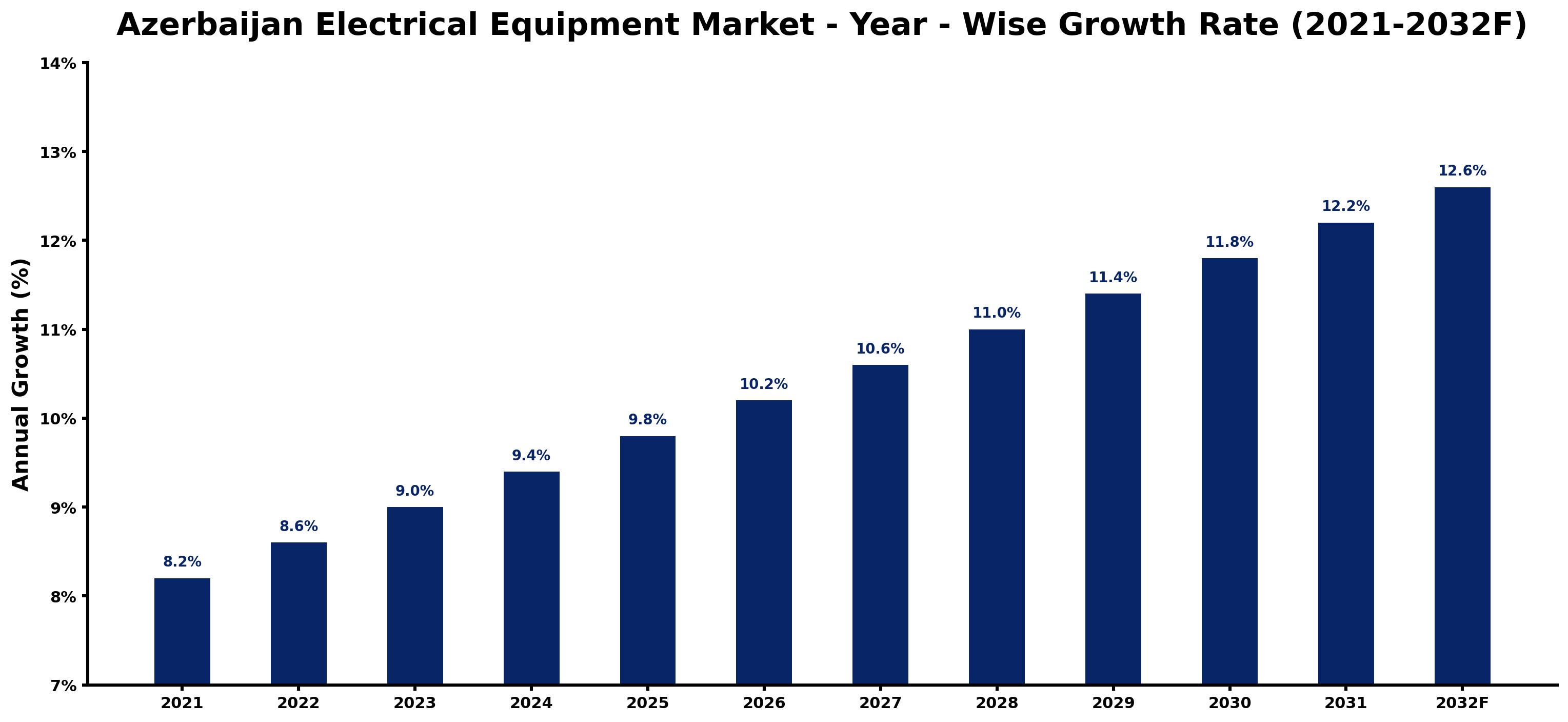
The table below presents the year wise growth rates along with the key drivers influencing the market
| Year | Growth Rate | Major Drivers |
| 2021 | 8.2% | Post-pandemic recovery efforts spurred investments in infrastructure and electrical projects. |
| 2022 | 8.6% | Local manufacturers started enhancing product offerings to meet international quality standards. |
| 2023 | 9.0% | New construction in urban areas necessitated upgraded electrical installations and systems. |
| 2024 | 9.4% | Collaborations between local firms and foreign partners facilitated technology transfer and innovation. |
| 2025 | 9.8% | Increased urbanization prompted demand for reliable power supply solutions across cities. |
| 2026 | 10.2% | The push for renewable energy sources intensified competition within the electrical equipment sector. |
| 2027 | 10.6% | Large-scale industrial projects required advanced electrical equipment for efficiency and productivity. |
| 2028 | 11.0% | Investment in smart grid technologies became crucial for modernizing the national electricity grid. |
| 2029 | 11.4% | Rising energy costs spurred interest in energy-efficient electrical systems and appliances. |
| 2030 | 11.8% | Emerging trends in electric vehicles opened new market segments for charging infrastructure. |
| 2031 | 12.2% | Regional connectivity projects highlighted the need for robust electrical equipment and support. |
| 2032 | 12.6% | With a focus on sustainability, green technologies gained traction among consumers and businesses. |
Note - Market size estimations and growth projections presented in this report are based on 6Wresearch's advanced forecasting approach, validated with industry datasets as of June 2026.
Azerbaijan Electrical Equipment Market Synopsis
The Azerbaijan Electrical Equipment Market is projected to reach 10.2% and witness significant growth during the forecast period (2026-2032). This sector is increasingly being shaped by the nation's industrialization efforts, infrastructure improvements, and a strategic focus on enhancing the energy sector through government initiatives. The various segments within the market, which include generators, transformers, cables, switchgear, and lighting solutions, play a critical role in supporting the demands of a growing economy.
Azerbaijan Electrical Equipment Market Growth Drivers
Several key factors are driving the growth of the Azerbaijan Electrical Equipment Market, notably:
- The push for industrialization is prompting investments in electrical infrastructure, elevating demand for quality equipment.
- Government-led initiatives in the energy sector aim to modernize existing facilities, which in turn stimulates market activity.
- An increasing focus on sustainability and energy efficiency is shifting consumer preferences towards advanced electrical solutions.
- Infrastructure development projects across the country create opportunities for a variety of electrical equipment applications.
- The rise of smart technologies and automation systems enhances the necessity for improved electrical components, driving further market innovation.
Azerbaijan Electrical Equipment Market Trends and Opportunities
The market is evolving with several notable trends, presenting opportunities for industry stakeholders:
- The trend of adopting energy-efficient products reflects a growing societal awareness surrounding environmental sustainability.
- Smart home devices and automation systems are becoming increasingly mainstream, leading manufacturers to invest in cutting-edge technology.
- Renewable energy sources such as solar power are gaining traction, which is expected to drive demand for allied electrical equipment.
- Modernizing the electrical grid is critical for improving reliability and efficiency, influencing substantial investments in infrastructure.
- A competitive landscape features both local and international suppliers innovating across diverse product categories.
Azerbaijan Electrical Equipment Market Challenges and Restraints
Despite its growth potential, the Azerbaijan Electrical Equipment Market faces several challenges:
- There is a reliance on imports due to limited domestic production capacity, which can affect supply and price stability.
- Fluctuating raw material prices can place pressure on manufacturers' profitability, leading to market volatility.
- Inadequate infrastructure in certain regions complicates distribution logistics, hindering market access for various products.
- A shortage of skilled labor limits the capability to produce specialized electrical equipment, impacting overall market efficiency.
- Bureaucratic hurdles and inconsistent regulations pose barriers for new market entrants and expanding businesses.
Azerbaijan Electrical Equipment Market Investment Opportunities
The Azerbaijan Electrical Equipment Market presents several investment opportunities fueled by key market dynamics:
- Infrastructure development projects offer opportunities for manufacturers to participate in supplying essential electrical components.
- The industrial sector's growth enhances the demand for reliable electrical solutions, prompting a favorable investment climate.
- Investments in renewable energy technologies such as solar panels and wind turbines reflect a growing focus on sustainable energy sources.
- Local partnerships and joint ventures can serve as effective strategies for foreign investors aiming to establish a market presence.
- The ongoing modernization of electrical infrastructure presents new channels for innovation and investment in electrical equipment.
Azerbaijan Electrical Equipment Market Government Investment and Initiatives
The Azerbaijani government has introduced various policies and initiatives to foster the development of the Electrical Equipment Market. These measures include:
- Incentives and subsidies aimed at promoting the production and import of energy-efficient electrical equipment.
- Regulatory frameworks designed to ensure compliance with product quality and safety standards, thus enhancing consumer trust.
- Public spending directed towards enhancing energy infrastructure, focusing on modernization and sustainability.
- Initiatives to promote investment in renewable energy sources, signaling a commitment to a diversified energy portfolio.
- Long-term development plans that align with national goals for energy efficiency and reduced environmental impact.
Azerbaijan Electrical Equipment Market Latest Developments (May 2025 - June 2026)
In the recent period from May 2025 to June 2026, the Azerbaijan Electrical Equipment Market has seen a series of significant developments:
- Heightened government investment in smart energy solutions has drawn attention to the importance of technological integration.
- There has been an increase in collaborative projects between the public and private sectors focusing on energy-efficient technologies.
- Growing public awareness regarding renewable energy has influenced shifts in consumer preferences towards environmentally friendly products.
- New regulations have been enacted to ensure adherence to international safety and quality standards, reinforcing market integrity.
- The trend towards digitalization is noticeable, with companies adopting smart grid technologies and IoT solutions in their offerings.
Azerbaijan Electrical Equipment Market - Key Attractiveness of the Report
- 10 Years of Market Numbers
- Historical Data Starting from 2022 to 2025
- Base Year: 2025
- Forecast Data until 2032
- Key Performance Indicators Impacting the Market
- Major Upcoming Developments and Projects
Key Highlights of the Report:
- Azerbaijan Electrical Equipment Market Outlook
- Market Size of Azerbaijan Electrical Equipment Market, 2025
- Forecast of Azerbaijan Electrical Equipment Market, 2032F
- Historical Data and Forecast of Azerbaijan Electrical Equipment Revenues & Volume for the Period 2022-2032F
- Azerbaijan Electrical Equipment Market Trend Evolution
- Azerbaijan Electrical Equipment Market Drivers and Challenges
- Azerbaijan Electrical Equipment Price Trends
- Azerbaijan Electrical Equipment Porter's Five Forces
- Azerbaijan Electrical Equipment Industry Life Cycle
- Historical Data and Forecast of Azerbaijan Electrical Equipment Market Revenues & Volume By Types for the Period 2022-2032F
- Historical Data and Forecast of Azerbaijan Electrical Equipment Market Revenues & Volume By Electronic and electrical wires and cables for the Period 2022-2032F
- Historical Data and Forecast of Azerbaijan Electrical Equipment Market Revenues & Volume By Batteries and accumulators for the Period 2022-2032F
- Historical Data and Forecast of Azerbaijan Electrical Equipment Market Revenues & Volume By Wiring devices for the Period 2022-2032F
- Historical Data and Forecast of Azerbaijan Electrical Equipment Market Revenues & Volume By Electric lighting equipment for the Period 2022-2032F
- Historical Data and Forecast of Azerbaijan Electrical Equipment Market Revenues & Volume By Others for the Period 2022-2032F
- Historical Data and Forecast of Azerbaijan Electrical Equipment Market Revenues & Volume By Applications for the Period 2022-2032F
- Historical Data and Forecast of Azerbaijan Electrical Equipment Market Revenues & Volume By Residential end-users for the Period 2022-2032F
- Historical Data and Forecast of Azerbaijan Electrical Equipment Market Revenues & Volume By Non-residential end-users for the Period 2022-2032F
- Azerbaijan Electrical Equipment Import Export Trade Statistics
- Market Opportunity Assessment By Types
- Market Opportunity Assessment By Applications
- Azerbaijan Electrical Equipment Top Companies Market Share
- Azerbaijan Electrical Equipment Competitive Benchmarking By Technical and Operational Parameters
- Azerbaijan Electrical Equipment Company Profiles
- Azerbaijan Electrical Equipment Key Strategic Recommendations






































