Azerbaijan Energy Security Market Size & Growth Rate (2026-2032)
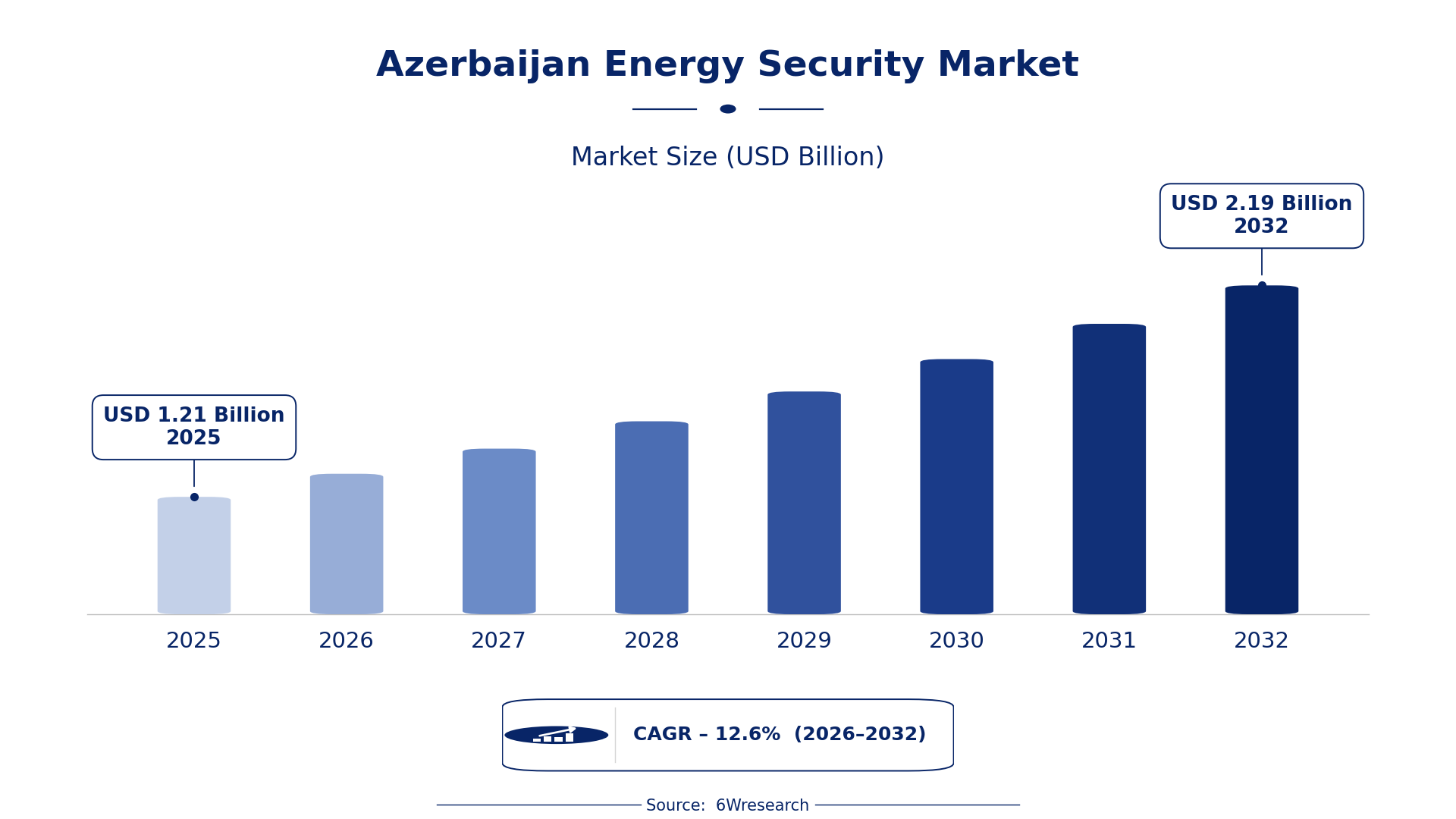
The Azerbaijan Energy Security Market was estimated at USD 1208 Million in 2025 and is projected to reach USD 2187 Million by 2032, growing at a CAGR of 12.6% from 2026 to 2032.
Azerbaijan Energy Security Market Synopsis
Azerbaijan's geographic positioning as a critical energy transit hub significantly influences its energy security demands. Its substantial oil and gas reserves provide not only local energy security but also play a vital role in supplying energy to neighboring regions, positioning the country as an energy bridge between Europe and Asia.
With the government’s increasing focus on renewable energy and infrastructure development, Azerbaijan is actively transforming its energy landscape. This shift aims not only to enhance energy independence but also to secure a sustainable energy future, mitigating risks associated with geopolitical tensions and fluctuating global energy prices.
Azerbaijan Energy Security Market Year-wise Growth Rate and Key Drivers
This graph illustrates the annual growth rates of the Azerbaijan Energy Security Market from 2021 to 2032, highlighting a steady upward trajectory and projected expansion over the forecast period.
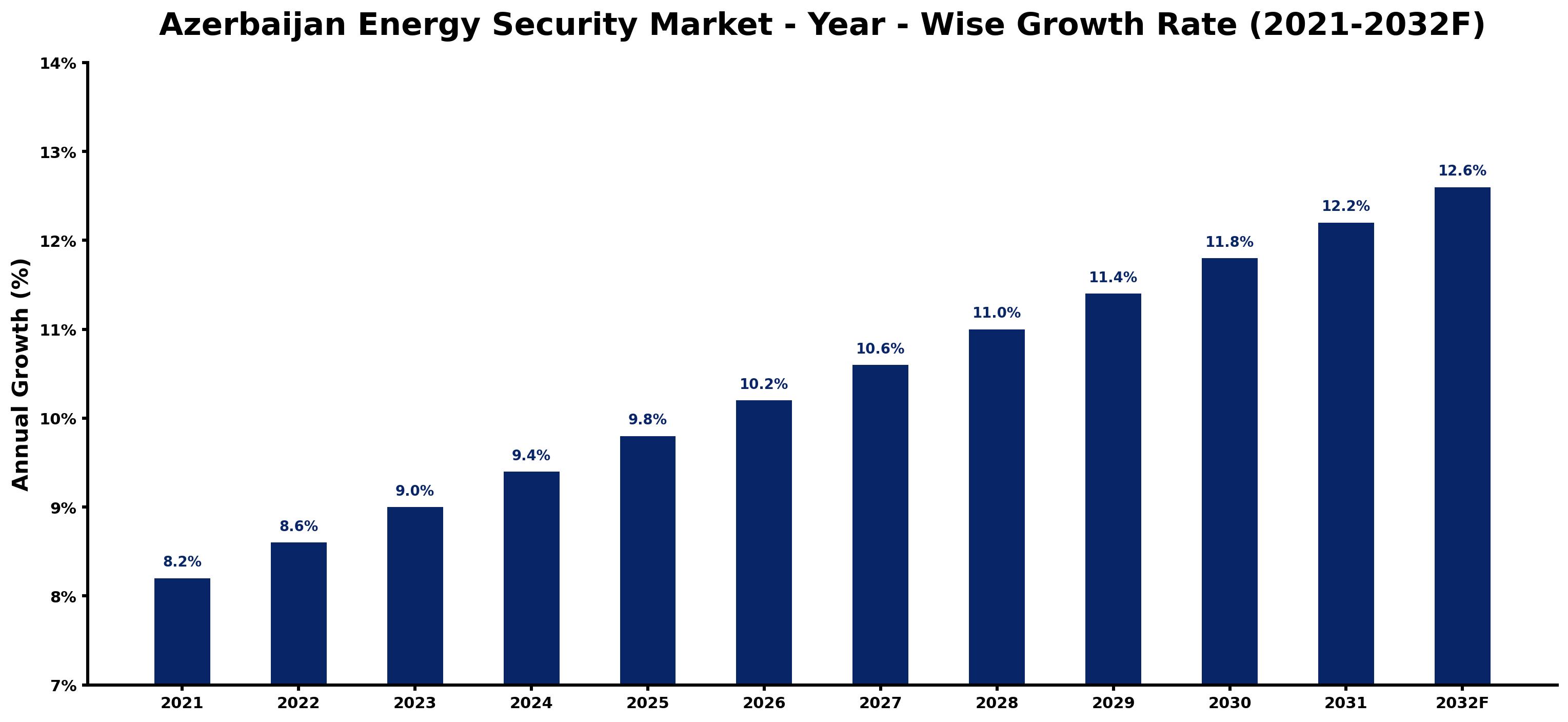
The table below presents the year‑wise growth rates along with the key drivers influencing the market
| Year | Growth Rate | Major Drivers |
| 2021 | 8.2% | Increased investment in local energy infrastructure projects |
| 2022 | 8.6% | Azerbaijan's strategic gas export agreements enhance energy security |
| 2023 | 9.0% | Government policy promoting renewable energy technologies |
| 2024 | 9.4% | Rising foreign investments in Azerbaijan's energy sector |
| 2025 | 9.8% | Local oil production capacity expansion initiatives underway |
| 2026 | 10.2% | Strengthened regulatory framework for energy efficiency programs |
| 2027 | 10.6% | Incentives for renewable energy project development introduced |
| 2028 | 11.0% | Collaboration with EU on energy diversification projects |
| 2029 | 11.4% | Increasing domestic energy consumption boosting market demand |
| 2030 | 11.8% | Local technological advancements in energy storage solutions |
| 2031 | 12.2% | Government focus on reducing energy import dependency |
| 2032 | 12.6% | Public-private partnerships in energy resilience initiatives |
Note: Market size estimations and growth projections presented in this report are based on 6Wresearch's proprietary forecasting methodology, utilizing the latest available industry data, government publications, and primary research inputs.
Azerbaijan Energy Security Market Key Takeaways
Below are some of the specific key takeaways from the market, including:
- Azerbaijan's strategic location underpins its role as a key player in the global energy supply chain.
- Government policies favor investment in renewable energy technologies to diversify energy sources.
- The market is witnessing a significant transformation with increased emphasis on energy efficiency initiatives.
- Recent geopolitical developments have heightened the focus on enhancing energy infrastructure resilience.
- Investment opportunities abound in renewable energy, energy efficiency, and modernization of existing infrastructures.
Evaluation of Restraints in Azerbaijan Energy Security Market
Despite its potential, the Azerbaijan Energy Security Market is hampered by various constraints. Geopolitical tensions in the Caspian region create uncertainty, affecting investment flows and project stability. on top of that, a heavy reliance on traditional fossil fuels leaves the market vulnerable to global price swings. Aging infrastructure compounds these challenges, necessitating substantial investment for upgrades. Until these issues are effectively addressed, achieving a robust and resilient energy sector will remain complex.
Azerbaijan Energy Security Market Trends
A pronounced shift towards renewable energy sources defines the current trajectory of Azerbaijan's energy security market. The government has initiated numerous solar and wind projects aimed at reducing dependence on fossil fuels. Additionally, energy efficiency measures are gaining traction, with investments in modern technologies that optimize consumption patterns. Enhancing cybersecurity and improving grid infrastructure are also crucial trends as the country seeks to ensure reliability in its energy supply amidst global uncertainty.
Azerbaijan Energy Security Market Opportunities
The market presents multiple avenues for growth and investment, particularly in renewable energy sectors. With government backing for projects that promote solar and wind energy, investors are increasingly drawn to this evolving sector. Opportunities also lie in modernizing aging energy infrastructures and developing energy efficiency technologies. By capitalizing on these trends, stakeholders can help forge a more sustainable and secure energy future for Azerbaijan.
Government Initiatives in the Azerbaijan Energy Security Market
The Azerbaijani government plays a crucial role in shaping the energy security market through its policies and initiatives. With an eye on diversifying energy sources and enhancing sustainability, recent legislative measures focus on fostering an energy sector that is both secure and resilient. The government has actively sought partnerships with international entities to bolster its energy infrastructure, making this an essential period for public policy in the energy domain.
- A recently completed initiative, the Southern Gas Corridor, aims to diversify gas supply routes to Europe and enhance energy security.
- A current program focuses on expanding renewable energy capacity through wind and solar projects aligned with the National Action Plan.
- A planned public-private partnership is expected to upgrade energy efficiency measures across urban infrastructures by 2028.
- A regulatory framework was introduced in early 2025 mandating energy consumption transparency for major energy suppliers.
- A new cybersecurity initiative, now underway, focuses on safeguarding critical energy infrastructure against potential cyber threats.
Future Insights of the Azerbaijan Energy Security Market
Looking ahead to 2026-2032, Azerbaijan's energy security market is set for transformation driven by diversification and modernization initiatives. The government’s commitment to expanding renewable energy capacity is expected to reduce reliance on fossil fuels significantly. Ongoing projects, such as the Southern Gas Corridor, coupled with investments in energy efficiency and infrastructure upgrades, will enhance overall energy stability. A collaborative approach with neighboring countries will also strengthen regional energy security and ensure a resilient market in the face of evolving global challenges.
Azerbaijan Energy Security Market Latest Developments
In the past year, the Azerbaijan Energy Security Market has witnessed significant activity aimed at reinforcing its energy framework. Initiatives focusing on renewable energy and infrastructure resilience have gained momentum, reflecting the country’s commitment to a sustainable energy future. Enhanced cooperation with international energy companies has also marked a noteworthy trend, paving the way for further investments and partnerships in the sector.
- An initiative that began in early 2023 aims to install new wind farms across coastal regions, projected to be completed by early 2024.
- A major technology vendor announced a partnership in Q1 2023 to enhance energy efficiency in urban districts through advanced smart grid solutions.
- A new public-private initiative focused on energy storage technology is currently underway, expected to be completed by late 2024.
- In 2023, a regulatory review was initiated to streamline processes for renewable energy project approvals, enhancing investment attractiveness.
- A rollout for a nationwide energy conservation awareness campaign is planned to begin in mid-2026, promoting sustainable practices among consumers.
Azerbaijan Energy Security Market - Key Attractiveness of the Report
- 10 Years of Market Numbers
- Historical Data Starting from 2022 to 2025
- Base Year: 2025
- Forecast Data until 2032
- Key Performance Indicators Impacting the Market
- Major Upcoming Developments and Projects
Key Highlights of the Report:
- Azerbaijan Energy Security Market Outlook
- Market Size of Azerbaijan Energy Security Market, 2025
- Forecast of Azerbaijan Energy Security Market, 2032
- Historical Data and Forecast of Azerbaijan Energy Security Revenues & Volume for the Period 2022-2032F
- Azerbaijan Energy Security Market Trend Evolution
- Azerbaijan Energy Security Market Drivers and Challenges
- Azerbaijan Energy Security Price Trends
- Azerbaijan Energy Security Porter's Five Forces
- Azerbaijan Energy Security Industry Life Cycle
- Historical Data and Forecast of Azerbaijan Energy Security Market Revenues & Volume By Power Plants for the Period 2022-2032F
- Historical Data and Forecast of Azerbaijan Energy Security Market Revenues & Volume By Nuclear for the Period 2022-2032F
- Historical Data and Forecast of Azerbaijan Energy Security Market Revenues & Volume By Thermal for the Period 2022-2032F
- Historical Data and Forecast of Azerbaijan Energy Security Market Revenues & Volume By Hydro for the Period 2022-2032F
- Historical Data and Forecast of Azerbaijan Energy Security Market Revenues & Volume By Oil for the Period 2022-2032F
- Historical Data and Forecast of Azerbaijan Energy Security Market Revenues & Volume By Gas for the Period 2022-2032F
- Historical Data and Forecast of Azerbaijan Energy Security Market Revenues & Volume By Renewable Energy for the Period 2022-2032F
- Historical Data and Forecast of Azerbaijan Energy Security Market Revenues & Volume By Technologies for the Period 2022-2032F
- Historical Data and Forecast of Azerbaijan Energy Security Market Revenues & Volume By Physical for the Period 2022-2032F
- Historical Data and Forecast of Azerbaijan Energy Security Market Revenues & Volume By Network Security for the Period 2022-2032F
- Azerbaijan Energy Security Import Export Trade Statistics
- Market Opportunity Assessment By Power Plants
- Market Opportunity Assessment By Technologies
- Azerbaijan Energy Security Top Companies Market Share
- Azerbaijan Energy Security Competitive Benchmarking By Technical and Operational Parameters
- Azerbaijan Energy Security Company Profiles
- Azerbaijan Energy Security Key Strategic Recommendations






































