Azerbaijan Ergonomic Chair Market Size, Share & Growth Rate
The Azerbaijan Ergonomic Chair Market was estimated at USD 886 Million in 2025 and is projected to reach USD 1586 Million by 2032, growing at a CAGR of 8.7% from 2026 to 2032. This robust growth trajectory is fueled by increasing awareness of ergonomics' critical role in enhancing workplace productivity and employee health. As more companies transition towards modern work environments, the demand for ergonomic chairs that support long hours of sitting continues to rise, reflecting a shift towards greater employee welfare.
Azerbaijan Ergonomic Chair Market Year-wise Growth Rate and Key Drivers
This graph highlights how the Azerbaijan Ergonomic Chair Market has steadily grown over the years, supported by major growth factors.
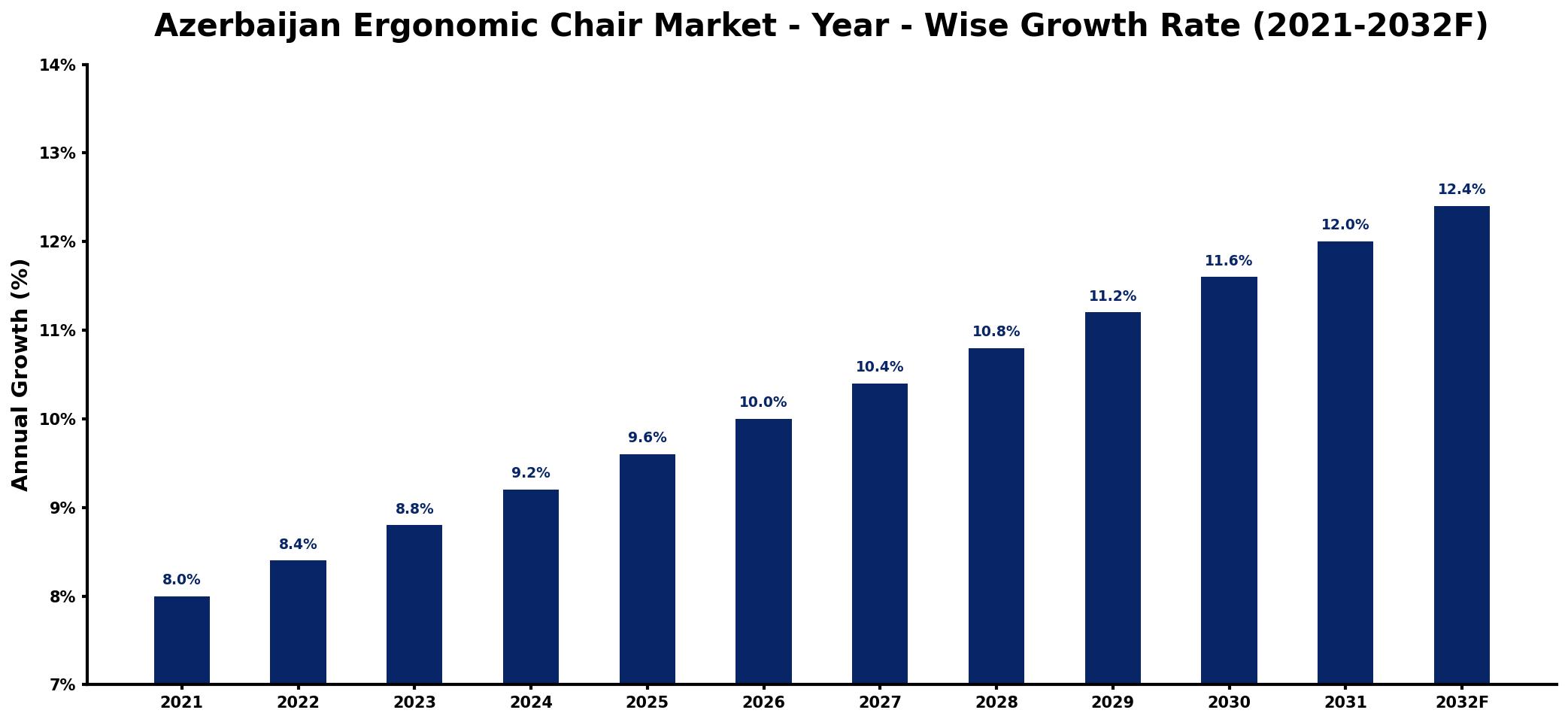
The table below presents the year‑wise growth rates along with the key drivers influencing the market
| Year | Growth Rate | Major Drivers |
| 2021 | 8.0% | rise in remote work culture |
| 2022 | 8.4% | increased awareness of health |
| 2023 | 8.8% | growing demand for comfort |
| 2024 | 9.2% | expansion of office spaces |
| 2025 | 9.6% | investments in workplace wellness |
| 2026 | 10.0% | enhanced focus on productivity |
| 2027 | 10.4% | surge in online shopping |
| 2028 | 10.8% | development of smart technologies |
| 2029 | 11.2% | growing preference for customization |
| 2030 | 11.6% | increased emphasis on sustainability |
| 2031 | 12.0% | growing emerging market penetration |
| 2032 | 12.4% | rising trend in minimalism |
Note: Market size estimations and growth projections presented in this report are based on 6Wresearch's proprietary forecasting methodology, utilizing the latest available industry data, government publications, and primary research inputs.
Azerbaijan Ergonomic Chair Market Synopsis
The rising trend of remote work in Azerbaijan has significantly influenced the ergonomic chair market. Consumers are now seeking products that enhance home office setups, leading to an increased focus on multifunctional and aesthetically pleasing designs. This shift emphasizes the importance of comfort, support, and adaptability in ergonomic chairs, as individuals prioritize their health and well-being while working from home.
Moreover, Azerbaijani businesses are increasingly recognizing the long-term benefits of investing in ergonomic solutions. Companies are motivated not only by the desire to enhance employee comfort but also by the potential to reduce healthcare costs associated with musculoskeletal disorders. This trend is prompting a growing supply of ergonomic chair options tailored to local consumer preferences, highlighting an evolving market landscape.
Azerbaijan Ergonomic Chair Market Key Takeaways
- The ergonomic chair market in Azerbaijan is on an upward trajectory, driven by health-conscious consumers.
- Companies are incorporating innovative features to meet the demands of remote workers.
- Sustainability is emerging as a significant trend, with increased demand for eco-friendly materials.
- Awareness campaigns are vital for educating both businesses and consumers about ergonomic benefits.
- The market presents lucrative opportunities for local and international manufacturers alike.
Evaluation of Restraints in Azerbaijan Ergonomic Chair Market
Despite the positive outlook, the Azerbaijan Ergonomic Chair Market faces certain restraints that may impede growth. A notable limitation is the insufficient awareness among both consumers and businesses regarding the critical advantages of ergonomic chairs. Many individuals lack knowledge about how these chairs can significantly improve posture, mitigate health risks, and enhance productivity. Furthermore, the availability of high-quality ergonomic options remains sporadic, compounded by challenges in effective distribution channels and competitive pricing. Addressing these issues through targeted educational initiatives and strategic partnerships will be essential for market players aiming to unlock the full potential of this growing sector.
Azerbaijan Ergonomic Chair Market Trends
The Azerbaijan Ergonomic Chair Market is currently witnessing several emerging trends. A significant focus on customizable features is reshaping the demand landscape, with consumers increasingly seeking chairs that offer adjustable lumbar support, armrests, and seat height. Moreover, the integration of sustainability within product design is gaining traction, as eco-conscious consumers prioritize chairs made from renewable materials. Additionally, the growing emphasis on aesthetics is prompting manufacturers to innovate designs that not only cater to ergonomic needs but also enhance the overall ambiance of office spaces.
Azerbaijan Ergonomic Chair Market Opportunities
Investment opportunities in the Azerbaijan Ergonomic Chair Market are ripe for exploration, especially as the awareness of ergonomic furniture continues to expand. Local production of ergonomic chairs tailored to consumer preferences can yield substantial returns. Companies that innovate by offering features such as breathable materials and ergonomic customization will likely attract a broader clientele. Additionally, forging strategic collaborations with local businesses and co-working spaces presents a strong avenue for growth, as companies increasingly prioritize comfortable work environments for their employees.
Government Initiatives in the Azerbaijan Ergonomic Chair Market
The Azerbaijani government has introduced various initiatives aimed at regulating and promoting the ergonomic chair market. These policies focus on ensuring product quality, safety, and compliance with established ergonomic standards. Moreover, the government is advocating for local manufacturing of ergonomic chairs by providing incentives and subsidies to support manufacturers. Concurrently, awareness campaigns are being rolled out to educate both businesses and consumers about the benefits of ergonomic furniture, further fostering a healthier work environment across the nation.
Future Insights of the Azerbaijan Ergonomic Chair Market
The future of the Azerbaijan Ergonomic Chair Market appears promising, driven by a growing cultural shift towards prioritizing employee health and comfort. By 2032, we can expect a more significant proliferation of ergonomic solutions as workplaces evolve to meet the demands of modern employees. The increasing number of startups and small businesses focusing on enhancing employee well-being will contribute to sustained market growth. As remote working remains prevalent, the demand for ergonomic home office solutions will also create continuous opportunities for innovation and investment in this sector.
Azerbaijan Ergonomic Chair Market Latest Developments (2025 - 2026)
Recent developments in the Azerbaijan Ergonomic Chair Market highlight an increasing alignment with global trends towards health and sustainability. Manufacturers are integrating advanced technologies into ergonomic chairs, enhancing comfort and user experience. Furthermore, industry players are actively participating in awareness campaigns, which aim to educate consumers about the benefits of ergonomic seating solutions, thereby fostering a more informed consumer base. This proactive approach is expected to drive innovation and market expansion over the coming years.
Azerbaijan Ergonomic Chair Market - Key Attractiveness of the Report
- 10 Years of Market Numbers
- Historical Data Starting from 2022 to 2025
- Base Year: 2025
- Forecast Data until 2032
- Key Performance Indicators Impacting the Market
- Major Upcoming Developments and Projects
Key Highlights of the Report:
- Azerbaijan Ergonomic Chair Market Outlook
- Market Size of Azerbaijan Ergonomic Chair Market, 2025
- Forecast of Azerbaijan Ergonomic Chair Market, 2032
- Historical Data and Forecast of Azerbaijan Ergonomic Chair Revenues & Volume for the Period 2022-2032F
- Azerbaijan Ergonomic Chair Market Trend Evolution
- Azerbaijan Ergonomic Chair Market Drivers and Challenges
- Azerbaijan Ergonomic Chair Price Trends
- Azerbaijan Ergonomic Chair Porter's Five Forces
- Azerbaijan Ergonomic Chair Industry Life Cycle
- Historical Data and Forecast of Azerbaijan Ergonomic Chair Market Revenues & Volume By Application for the Period 2022-2032F
- Historical Data and Forecast of Azerbaijan Ergonomic Chair Market Revenues & Volume By Enterprise Procurement for the Period 2022-2032F
- Historical Data and Forecast of Azerbaijan Ergonomic Chair Market Revenues & Volume By Government Procurement for the Period 2022-2032F
- Historical Data and Forecast of Azerbaijan Ergonomic Chair Market Revenues & Volume By School Procurement for the Period 2022-2032F
- Historical Data and Forecast of Azerbaijan Ergonomic Chair Market Revenues & Volume By Individual Procurement for the Period 2022-2032F
- Historical Data and Forecast of Azerbaijan Ergonomic Chair Market Revenues & Volume By Other for the Period 2022-2032F
- Azerbaijan Ergonomic Chair Import Export Trade Statistics
- Market Opportunity Assessment By Application
- Azerbaijan Ergonomic Chair Top Companies Market Share
- Azerbaijan Ergonomic Chair Competitive Benchmarking By Technical and Operational Parameters
- Azerbaijan Ergonomic Chair Company Profiles
- Azerbaijan Ergonomic Chair Key Strategic Recommendations






































