Azerbaijan Facade Market Size, Share & Growth Rate
The Azerbaijan Facade Market was estimated at USD 1436 Million in 2025 and is projected to reach USD 2642 Million by 2032, growing at a CAGR of 9.1% from 2026 to 2032. This growth is primarily driven by a surge in construction activities across urban and rural areas, coupled with increasing government investment in infrastructure projects. The emphasis on energy-efficient and aesthetically modern building solutions further fuels demand, as stakeholders seek to align with global sustainability standards.
Azerbaijan Facade Market Year-wise Growth Rate and Key Drivers
This graph highlights how the Azerbaijan Facade Market has steadily grown over the years, supported by major growth factors.
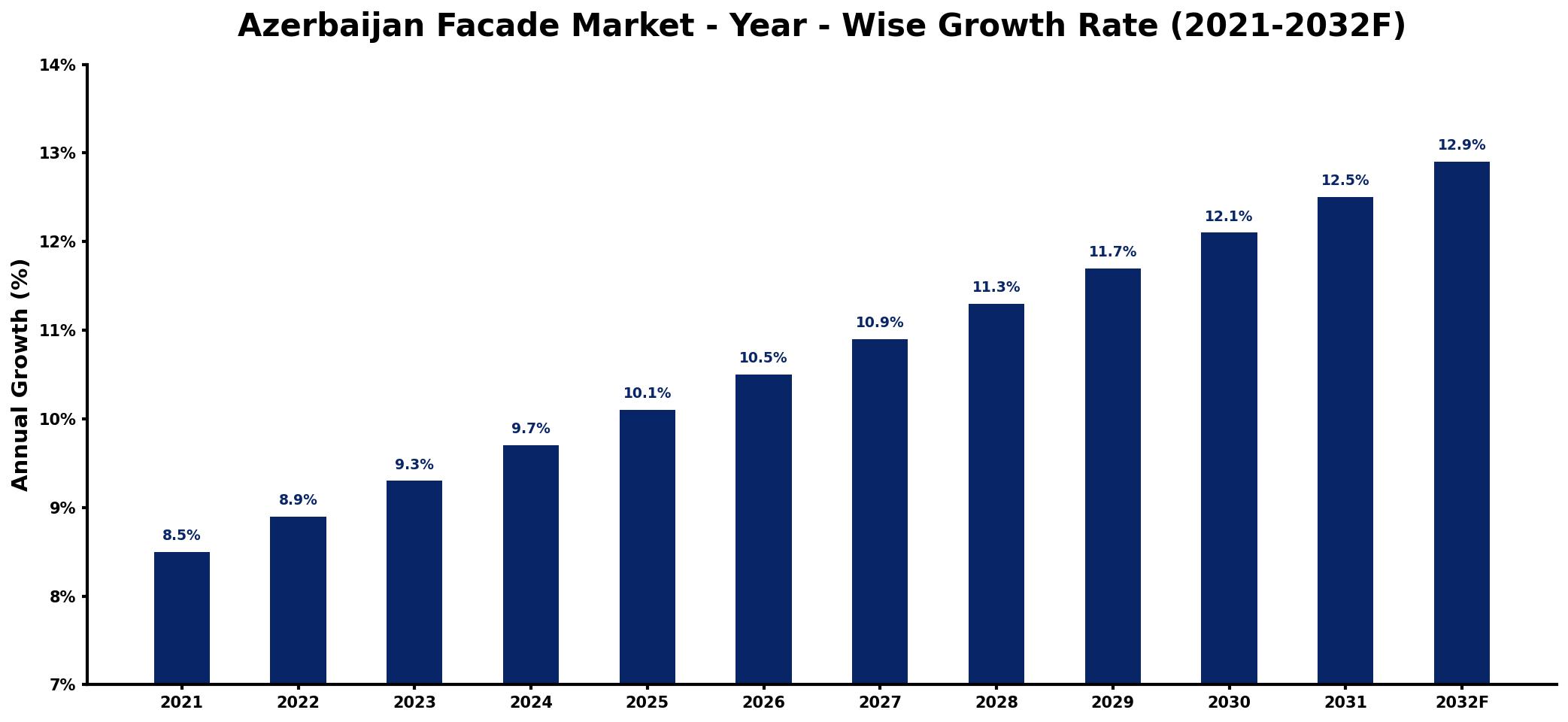
The table below presents the year‑wise growth rates along with the key drivers influencing the market
| Year | Growth Rate | Major Drivers |
| 2021 | 8.5% | Rising urban construction projects |
| 2022 | 8.9% | Increased government infrastructure investments |
| 2023 | 9.3% | Growing demand for energy efficiency |
| 2024 | 9.7% | Expansion of commercial real estate |
| 2025 | 10.1% | Surge in residential building permits |
| 2026 | 10.5% | Technological advancements in materials |
| 2027 | 10.9% | Increased foreign direct investment flow |
| 2028 | 11.3% | Strengthening of construction regulations |
| 2029 | 11.7% | Growth in luxury property developments |
| 2030 | 12.1% | Demand for sustainable building practices |
| 2031 | 12.5% | Enhanced architectural design trends |
| 2032 | 12.9% | Rise in renovation and retrofitting |
Note: Market size estimations and growth projections presented in this report are based on 6Wresearch's proprietary forecasting methodology, utilizing the latest available industry data, government publications, and primary research inputs.
Azerbaijan Facade Market Synopsis
The growing trend for innovative facade designs is reshaping the construction landscape in Azerbaijan. With the government's push for modernization and the construction of environmentally sustainable buildings, there is a notable uptick in the adoption of diverse facade materials, including glass, metal, and stone cladding.
Additionally, urban development initiatives are increasingly integrating smart technologies within facade systems, enhancing building performance while catering to aesthetic sensibilities. This convergence of technology and design is setting a new benchmark for construction projects, further elevating market dynamics.
Azerbaijan Facade Market Key Takeaways
- The market shows a strong trajectory, with a projected value increase driven by construction growth and modernization efforts.
- Innovative and sustainable facade solutions are becoming a priority for both commercial and residential buildings.
- Smart technologies are increasingly being integrated into facade designs to enhance overall building functionality.
- Collaboration among stakeholders is essential to navigate challenges related to skilled labor and material sourcing.
- The governments commitment to green building initiatives supports an optimistic market outlook.
Evaluation of Restraints in Azerbaijan Facade Market
Despite the promising outlook, the Azerbaijan facade market faces significant constraints. A primary challenge is the shortage of skilled labor, which hinders project quality and timelines. The dependency on imported materials exacerbates cost fluctuations and can disrupt supply chains, posing risks to project completion. Additionally, bureaucratic hurdles and the regulatory environment can lead to delays, complicating the smooth execution of facade initiatives. Addressing these limitations requires a strategic focus on training and collaboration among industry players.
Azerbaijan Facade Market Trends
The Azerbaijan facade market is increasingly leaning towards energy-efficient solutions, driven by stringent building regulations and the global push for sustainability. This trend is complemented by a growing preference for modern facade designs that not only meet aesthetic demands but also incorporate advanced technologies for enhanced building performance. High-quality materials such as aluminum, glass, and composite panels are gaining popularity, as they offer durability while meeting eco-friendly standards. The market is thus evolving towards more innovative, visually striking, and functional facade options.
Azerbaijan Facade Market Opportunities
With rapid urbanization in Azerbaijan, the facade market is ripe with investment opportunities. There is a notable demand for high-quality facade materials and systems as new commercial and residential projects emerge. Investors can explore opportunities in supplying innovative and sustainable facade technologies, capitalizing on the governments focus on energy efficiency. Collaborating with local stakeholders can enhance project delivery and meet the growing expectations of developers seeking cutting-edge building solutions.
Government Initiatives in the Azerbaijan Facade Market
The Azerbaijani government has implemented a series of initiatives aimed at improving the facade market. Regulations emphasize energy efficiency, building aesthetics, and safety standards. The State Committee on Urban Planning and Architecture oversees facade design approvals to ensure compliance with these regulations. Incentives for using sustainable materials are being promoted, encouraging developers to adopt greener practices in their projects. This regulatory framework supports the alignment of local construction practices with international standards.
Future Insights of the Azerbaijan Facade Market
Looking ahead to 2026-2032, the Azerbaijan facade market is poised for sustained growth, fueled by ongoing urban development and government-backed infrastructure initiatives. As the demand for modern and energy-efficient building facades continues to rise, companies are expected to adopt innovative materials and technologies. The growing focus on sustainability will drive further investments in eco-friendly facade solutions. Overall, the market presents a promising landscape for stakeholders committed to adapting to evolving industry demands and standards.
Azerbaijan Facade Market Latest Developments (2025 - 2026)
Recent developments in the Azerbaijan facade market reveal a notable shift towards smart facade technologies. Industry players are increasingly experimenting with advanced materials and designs to meet the rising demand for energy efficiency. Government initiatives promoting green building practices are also gaining momentum, encouraging investments in sustainable building solutions. Furthermore, there is an emphasis on collaborative approaches among stakeholders to address challenges related to skilled labor and supply chain management.
Azerbaijan Facade Market - Key Attractiveness of the Report
- 10 Years of Market Numbers
- Historical Data Starting from 2022 to 2025
- Base Year: 2025
- Forecast Data until 2032
- Key Performance Indicators Impacting the Market
- Major Upcoming Developments and Projects
Key Highlights of the Report:
- Azerbaijan Facade Market Outlook
- Market Size of Azerbaijan Facade Market, 2025
- Forecast of Azerbaijan Facade Market, 2032
- Historical Data and Forecast of Azerbaijan Facade Revenues & Volume for the Period 2022-2032F
- Azerbaijan Facade Market Trend Evolution
- Azerbaijan Facade Market Drivers and Challenges
- Azerbaijan Facade Price Trends
- Azerbaijan Facade Porter's Five Forces
- Azerbaijan Facade Industry Life Cycle
- Historical Data and Forecast of Azerbaijan Facade Market Revenues & Volume By Product for the Period 2022-2032F
- Historical Data and Forecast of Azerbaijan Facade Market Revenues & Volume By Ventilated Facades for the Period 2022-2032F
- Historical Data and Forecast of Azerbaijan Facade Market Revenues & Volume By Non-ventilated Facades for the Period 2022-2032F
- Historical Data and Forecast of Azerbaijan Facade Market Revenues & Volume By Others for the Period 2022-2032F
- Historical Data and Forecast of Azerbaijan Facade Market Revenues & Volume By End-use for the Period 2022-2032F
- Historical Data and Forecast of Azerbaijan Facade Market Revenues & Volume By Commercial for the Period 2022-2032F
- Historical Data and Forecast of Azerbaijan Facade Market Revenues & Volume By Residential for the Period 2022-2032F
- Historical Data and Forecast of Azerbaijan Facade Market Revenues & Volume By Industrial for the Period 2022-2032F
- Azerbaijan Facade Import Export Trade Statistics
- Market Opportunity Assessment By Product
- Market Opportunity Assessment By End-use
- Azerbaijan Facade Top Companies Market Share
- Azerbaijan Facade Competitive Benchmarking By Technical and Operational Parameters
- Azerbaijan Facade Company Profiles
- Azerbaijan Facade Key Strategic Recommendations






































