Azerbaijan Fans and Ventilators Market Summary
The azerbaijan fans and ventilators market was estimated at USD 314 Million in 2025 and is projected to reach USD 577 Million by 2032, growing at a CAGR of 10.5% from 2026 to 2032.
Azerbaijan Fans and Ventilators Market Year-wise Growth Rate and Key Drivers
This graph highlights how the Azerbaijan Fans and Ventilators Market has steadily grown over the past five years, supported by major growth factors.
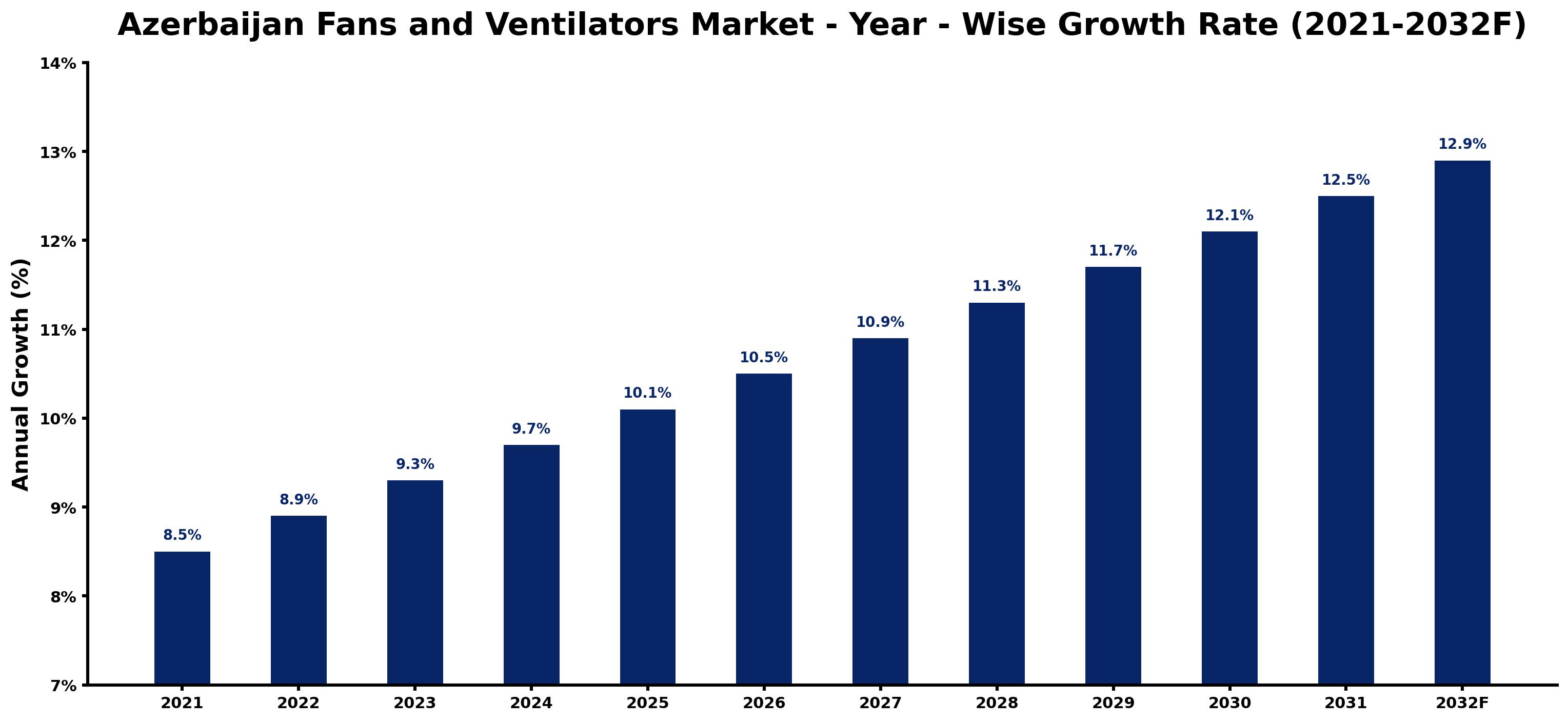
The table below presents the year wise growth rates along with the key drivers influencing the market
| Year | Growth Rate | Major Drivers |
| 2021 | 8.5% | The Azerbaijan fans and ventilators market witnessed initial recovery following pandemic-related interruptions. |
| 2022 | 8.9% | Increased construction activities in urban areas necessitated better ventilation solutions in new buildings. |
| 2023 | 9.3% | Consumer awareness regarding indoor air quality began shaping preferences for advanced ventilation systems. |
| 2024 | 9.7% | Partnerships between local manufacturers and foreign brands fostered innovation in the product offerings. |
| 2025 | 10.1% | Rapid urbanization led to a surge in demand for effective cooling and ventilation solutions. |
| 2026 | 10.5% | The expanding hospitality sector emphasized the need for efficient HVAC systems in hotels. |
| 2027 | 10.9% | Technological advancements improved energy efficiency, attracting environmentally conscious consumers to the market. |
| 2028 | 11.3% | Economic diversification efforts resulted in increased investments in the construction and infrastructure sectors. |
| 2029 | 11.7% | Aging infrastructures prompted upgrades, renewing interest in modern ventilation systems across industries. |
| 2030 | 12.1% | Focus on energy-efficient buildings encouraged the adoption of smart ventilation technologies in residential areas. |
| 2031 | 12.5% | Rising temperatures due to climate change heightened the importance of effective air circulation systems. |
| 2032 | 12.9% | Market competition intensified, driving innovation and lowering prices for advanced ventilation solutions. |
Note - Market size estimations and growth projections presented in this report are based on 6Wresearch's advanced forecasting approach, validated with industry datasets as of June 2026.
Azerbaijan Fans and Ventilators Market Synopsis
The Azerbaijan Fans and Ventilators Market is projected to reach 10.5% and witness significant growth during the forecast period (2026-2032). This expansion is primarily driven by the increasing demand for HVAC systems, industrial fans, and advanced ventilation solutions across multiple sectors, including construction, manufacturing, and agriculture. As urbanization progresses and industrial activities intensify, the necessity for efficient ventilation and air circulation in residential, commercial, and industrial infrastructures becomes ever more salient. Moreover, government regulations emphasizing energy efficiency and environmental sustainability are propelling market growth, as stakeholders seek to comply with these mandates.
Azerbaijan Fans and Ventilators Market Growth Drivers
Several factors are contributing to the growth of the Azerbaijan Fans and Ventilators Market, including:
- Urbanization is leading to the development of new residential and commercial buildings, necessitating advanced ventilation systems to ensure air quality and comfort.
- Industrialization in Azerbaijan results in increased demand for robust ventilation solutions in factories and manufacturing facilities, which is crucial for maintaining operational efficiency.
- The sector's focus on improving indoor air quality drives the adoption of modern fans and ventilators, as stakeholders recognize the health benefits associated with adequate airflow.
- Regulatory frameworks promoting energy efficiency compel manufacturers and businesses to upgrade to energy-efficient fan and ventilation systems, aligning with broader sustainability goals.
- Advancements in fan technology, including the development of smarter and quieter systems, enhance user experience and further stimulate demand in various applications.
Azerbaijan Fans and Ventilators Market Challenges and Restraints
Despite its promising growth trajectory, the Azerbaijan Fans and Ventilators Market faces certain challenges:
- The need for energy efficiency is paramount; manufacturers must innovate to create solutions that meet rising energy standards without compromising performance.
- Noise reduction remains a critical concern, especially in residential areas where quiet operation is imperative for consumer satisfaction.
- Compliance with stringent regulations regarding energy consumption and noise emissions can pose significant challenges for manufacturers aiming to enter or expand in the market.
- Market participants must navigate fluctuations in raw material costs, which can affect production and pricing strategies.
- The rapid pace of technological advancements necessitates continuous investment in R&D to keep up with competitors and market expectations.
Azerbaijan Fans and Ventilators Market Government Investment and Initiatives
The Azerbaijani government plays a pivotal role in shaping the Fans and Ventilators Market through various initiatives aimed at enhancing energy efficiency and promoting sustainable development:
- Implementation of building codes that mandate the inclusion of efficient ventilation systems in new constructions is becoming increasingly common, improving overall air quality standards.
- Investment in infrastructure projects across urban areas is expected to bolster demand for efficient HVAC systems and industrial fans, further stimulating market growth.
- Government incentives for adopting green technology and energy-efficient solutions encourage businesses to upgrade their systems, fostering a market conducive to innovation.
- Public spending on environmental sustainability initiatives is likely to enhance awareness and drive the establishment of stricter indoor air quality standards.
- Policies that promote the use of locally manufactured components can support domestic production capabilities while ensuring compliance with international standards.
Azerbaijan Fans and Ventilators Market Latest Developments (May 2025 - June 2026)
In the period from May 2025 to June 2026, the Azerbaijan Fans and Ventilators Market has experienced several noteworthy developments:
- There has been an increasing focus on the integration of smart technologies in ventilation systems, enhancing operational efficiency and user control.
- Trade shows and industry events have emphasized renewable energy solutions, generating interest in fans and ventilators that utilize sustainable sources.
- A growing public awareness of indoor air quality has led to increased consumer demand for high-performance ventilation systems, promoting advancements in design and functionality.
- Partnerships between local manufacturers and international technology providers have emerged, aimed at improving product offerings and market competitiveness.
- Regulatory bodies have started issuing revised guidelines on energy efficiency standards, compelling manufacturers to adapt their products accordingly in order to remain compliant.
Azerbaijan Fans and Ventilators Market - Key Attractiveness of the Report
- 10 Years of Market Numbers
- Historical Data Starting from 2022 to 2025
- Base Year: 2025
- Forecast Data until 2032
- Key Performance Indicators Impacting the Market
- Major Upcoming Developments and Projects
Key Highlights of the Report:
- Azerbaijan Fans and Ventilators Market Outlook
- Market Size of Azerbaijan Fans and Ventilators Market, 2025
- Forecast of Azerbaijan Fans and Ventilators Market, 2032
- Historical Data and Forecast of Azerbaijan Fans and Ventilators Revenues & Volume for the Period 2022-2032F
- Azerbaijan Fans and Ventilators Market Trend Evolution
- Azerbaijan Fans and Ventilators Market Drivers and Challenges
- Azerbaijan Fans and Ventilators Price Trends
- Azerbaijan Fans and Ventilators Porter's Five Forces
- Azerbaijan Fans and Ventilators Industry Life Cycle
- Historical Data and Forecast of Azerbaijan Fans and Ventilators Market Revenues & Volume By Material for the Period 2022-2032F
- Historical Data and Forecast of Azerbaijan Fans and Ventilators Market Revenues & Volume By Metal for the Period 2022-2032F
- Historical Data and Forecast of Azerbaijan Fans and Ventilators Market Revenues & Volume By Composite for the Period 2022-2032F
- Historical Data and Forecast of Azerbaijan Fans and Ventilators Market Revenues & Volume By Rubber for the Period 2022-2032F
- Historical Data and Forecast of Azerbaijan Fans and Ventilators Market Revenues & Volume By Plastic for the Period 2022-2032F
- Historical Data and Forecast of Azerbaijan Fans and Ventilators Market Revenues & Volume By Application for the Period 2022-2032F
- Historical Data and Forecast of Azerbaijan Fans and Ventilators Market Revenues & Volume By Interior for the Period 2022-2032F
- Historical Data and Forecast of Azerbaijan Fans and Ventilators Market Revenues & Volume By Exterior for the Period 2022-2032F
- Historical Data and Forecast of Azerbaijan Fans and Ventilators Market Revenues & Volume By Structural for the Period 2022-2032F
- Historical Data and Forecast of Azerbaijan Fans and Ventilators Market Revenues & Volume By Powertrain for the Period 2022-2032F
- Historical Data and Forecast of Azerbaijan Fans and Ventilators Market Revenues & Volume By Vehicle Types for the Period 2022-2032F
- Historical Data and Forecast of Azerbaijan Fans and Ventilators Market Revenues & Volume By Passenger Vehicles for the Period 2022-2032F
- Historical Data and Forecast of Azerbaijan Fans and Ventilators Market Revenues & Volume By Light Commercial Vehicles for the Period 2022-2032F
- Historical Data and Forecast of Azerbaijan Fans and Ventilators Market Revenues & Volume By Heavy Commercial Vehicles for the Period 2022-2032F
- Azerbaijan Fans and Ventilators Import Export Trade Statistics
- Market Opportunity Assessment By Material
- Market Opportunity Assessment By Application
- Market Opportunity Assessment By Vehicle Types
- Azerbaijan Fans and Ventilators Top Companies Market Share
- Azerbaijan Fans and Ventilators Competitive Benchmarking By Technical and Operational Parameters
- Azerbaijan Fans and Ventilators Company Profiles
- Azerbaijan Fans and Ventilators Key Strategic Recommendations






































