Azerbaijan Feldspar Market Size, Share & Growth Rate
The Azerbaijan Feldspar Market was estimated at USD 1343 Million in 2025 and is projected to reach USD 2315 Million by 2032, growing at a CAGR of 8.1% from 2026 to 2032. This remarkable growth trajectory is being driven by the rising demand for feldspar across key sectors such as ceramics and glass manufacturing, where its unique properties make it an invaluable ingredient. Additionally, the ongoing expansion of the construction sector in Azerbaijan is fueling further consumption of feldspar-based materials, particularly in infrastructure projects.
Azerbaijan Feldspar Market Year-wise Growth Rate and Key Drivers
This graph highlights how the Azerbaijan Feldspar Market has steadily grown over the years, supported by major growth factors.
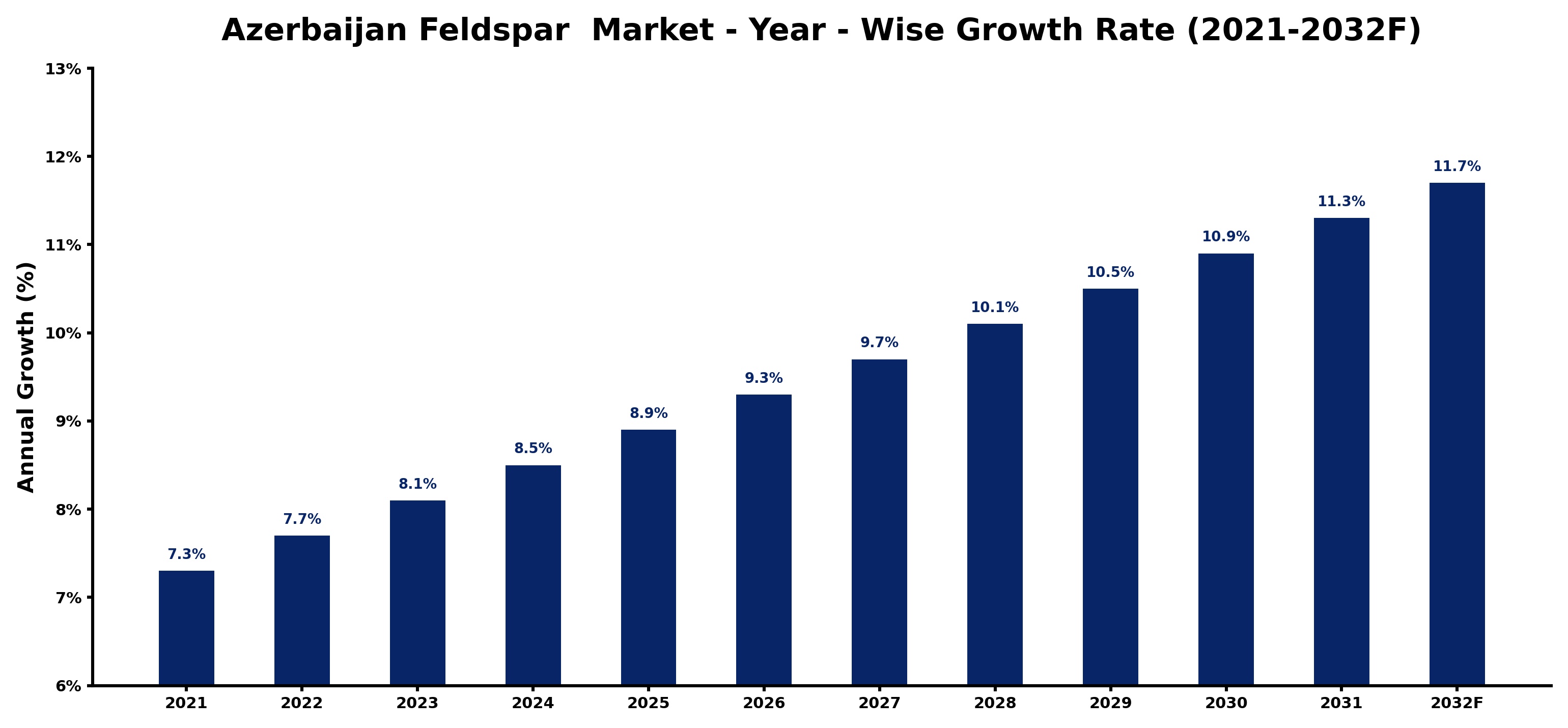
The table below presents the year‑wise growth rates along with the key drivers influencing the market
| Year | Growth Rate | Major Drivers |
| 2021 | 7.3% | Domestic ceramic tile production surge drives feldspar material demand |
| 2022 | 7.7% | Technology adoption in feldspar mining boosted operational efficiency levels |
| 2023 | 8.1% | Local feldspar extraction improvements boosted ceramic manufacturing capacity |
| 2024 | 8.5% | New feldspar processing facilities boost regional ceramic production capacity |
| 2025 | 8.9% | Higher feldspar production capacity utilization boosted ceramic manufacturing output |
| 2026 | 9.3% | Investment in mining infrastructure boosts feldspar extraction capacity |
| 2027 | 9.7% | Investment in local mining operations boosts feldspar production capabilities |
| 2028 | 10.1% | Domestic feldspar processing upgrades attract significant manufacturing investments |
| 2029 | 10.5% | Modern processing technologies enhanced feldspar extraction efficiency in Azerbaijan |
| 2030 | 10.9% | Feldspar mining investments boosted local ceramics production capacity |
| 2031 | 11.3% | Digitalization of mining processes boosted feldspar extraction efficiency |
| 2032 | 11.7% | Modernized extraction techniques boost feldspar yield and quality |
Note - Market size estimations and growth projections presented in this report are based on 6Wresearch's advanced forecasting approach, validated with industry datasets as of June 2026.
Azerbaijan Feldspar Market Synopsis
The Azerbaijan feldspar market is currently characterized by a robust demand from various industries, predominantly ceramics, glass, and construction. This demand underscores the essential role feldspar plays in production processes, thanks to its durability and chemical resistance. Local mining operations are actively supporting this growth by providing a steady supply of quality feldspar, which is crucial for meeting both domestic and international market needs.
At the same time, there is a notable shift towards sustainable practices in the mining industry. Producers are increasingly adopting eco-friendly methodologies, reflecting a broader commitment to responsible sourcing. This trend is not only enhancing the market's reputation but also aligning with global demands for environmentally conscious materials, further reinforcing the position of Azerbaijan in the global feldspar landscape.
Azerbaijan Feldspar Market Key Takeaways
- The Azerbaijan feldspar market is witnessing a growth spurt driven by demand from ceramics, glass, and construction industries.
- Local mining operations ensure a stable supply chain, fostering market resilience and growth potential.
- Sustainable mining practices are becoming increasingly prioritized by industry players, enhancing the market's appeal.
- Technological advancements in extraction and processing methods are improving operational efficiency and product quality.
- The market's future outlook is optimistic, bolstered by both domestic consumption and export opportunities.
Evaluation of Restraints in Azerbaijan Feldspar Market
Despite its growth potential, the Azerbaijan feldspar market faces significant challenges that could hinder progress. One primary limitation is the restricted availability of high-quality feldspar deposits, which creates sourcing difficulties for manufacturers. This scarcity can elevate production costs, thereby affecting the overall profitability of the sector. Furthermore, competition from global producers with larger reserves complicates Azerbaijan's efforts to enhance its market penetration and export capabilities. These factors necessitate strategic approaches from stakeholders to navigate the complexities of supply and demand.
Azerbaijan Feldspar Market Trends
Emerging trends within the Azerbaijan feldspar market highlight a growing focus on innovation and sustainability. There is a marked shift towards the use of feldspar in products such as sanitaryware and eco-friendly tiles, driven by the high alumina content and low iron oxide levels of local feldspar. Additionally, advancements in mining technologies are streamlining extraction and processing methods, enabling producers to meet the evolving demands of the market more effectively. These trends not only enhance product quality but also cater to the increasing demand for environmentally responsible materials.
Azerbaijan Feldspar Market Opportunities
Investment opportunities in the Azerbaijan feldspar market are particularly promising, fueled by the country's rich reserves and growing international demand. There is significant potential for investment in mining and processing facilities to address both domestic and export markets. As the government continues to create a favorable environment for foreign investment, opportunities for partnerships with local entities are on the rise. Modernizing existing production infrastructures and exploring untapped deposits could lead to substantial growth and returns for investors in this dynamic sector.
Government Initiatives in the Azerbaijan Feldspar Market
The Azerbaijani government has taken proactive measures to regulate the feldspar mining and export industries. The Ministry of Ecology and Natural Resources plays a crucial role in overseeing extraction activities, ensuring compliance with environmental standards and promoting sustainable mining practices. Furthermore, the government has instituted export restrictions to prioritize domestic industrial needs while simultaneously fostering local business growth. These initiatives are designed to balance economic development with environmental protection, providing a stable framework for the feldspar market.
Future Insights of the Azerbaijan Feldspar Market
Looking ahead to the period from 2026 to 2032, the Azerbaijan feldspar market is set for robust growth, buoyed by increasing demand across key industrial sectors. The rich reserves of high-quality feldspar will continue to support the growing construction and infrastructure development projects in the country. Furthermore, the rise in the production of feldspar-based products like tiles and sanitaryware highlights the sector's adaptability to market trends. While external challenges such as fluctuating raw material prices may pose risks, strategic innovations in mining technology and sustainable practices will likely empower Azerbaijan to solidify its position as a significant player in the global feldspar market.
Azerbaijan Feldspar Market Latest Developments (May 2025 - June 2026)
Recent developments in the Azerbaijan feldspar market indicate a continued focus on sustainability and technological advancements. Industry stakeholders are increasingly prioritizing investments in eco-friendly mining operations, reflecting a growing awareness of environmental impact. Additionally, collaborations among local producers are being explored to enhance processing capabilities and improve overall product quality. With the government's supportive policies in place, the market is strategically positioned to leverage these developments for future growth.
Azerbaijan Feldspar Market - Key Attractiveness of the Report
- 10 Years of Market Numbers
- Historical Data Starting from 2022 to 2025
- Base Year: 2025
- Forecast Data until 2032
- Key Performance Indicators Impacting the Market
- Major Upcoming Developments and Projects
Key Highlights of the Report:
- Azerbaijan Feldspar Market Outlook
- Market Size of Azerbaijan Feldspar Market, 2025
- Forecast of Azerbaijan Feldspar Market, 2032
- Historical Data and Forecast of Azerbaijan Feldspar Revenues & Volume for the Period 2022-2032F
- Azerbaijan Feldspar Market Trend Evolution
- Azerbaijan Feldspar Market Drivers and Challenges
- Azerbaijan Feldspar Price Trends
- Azerbaijan Feldspar Porter's Five Forces
- Azerbaijan Feldspar Industry Life Cycle
- Historical Data and Forecast of Azerbaijan Feldspar Market Revenues & Volume By Type for the Period 2022-2032F
- Historical Data and Forecast of Azerbaijan Feldspar Market Revenues & Volume By Plagioclase feldspar for the Period 2022-2032F
- Historical Data and Forecast of Azerbaijan Feldspar Market Revenues & Volume By K-feldspar for the Period 2022-2032F
- Historical Data and Forecast of Azerbaijan Feldspar Market Revenues & Volume By End-users for the Period 2022-2032F
- Historical Data and Forecast of Azerbaijan Feldspar Market Revenues & Volume By Glassmaking for the Period 2022-2032F
- Historical Data and Forecast of Azerbaijan Feldspar Market Revenues & Volume By Ceramics for the Period 2022-2032F
- Historical Data and Forecast of Azerbaijan Feldspar Market Revenues & Volume By Pottery for the Period 2022-2032F
- Historical Data and Forecast of Azerbaijan Feldspar Market Revenues & Volume By Others for the Period 2022-2032F
- Azerbaijan Feldspar Import Export Trade Statistics
- Market Opportunity Assessment By Type
- Market Opportunity Assessment By End-users
- Azerbaijan Feldspar Top Companies Market Share
- Azerbaijan Feldspar Competitive Benchmarking By Technical and Operational Parameters
- Azerbaijan Feldspar Company Profiles
- Azerbaijan Feldspar Key Strategic Recommendations






































