Azerbaijan Fencing Market Size, Share & Growth Rate
The Azerbaijan Fencing Market was estimated at USD 1463 Million in 2025 and is projected to reach USD 2453 Million by 2032, growing at a CAGR of 7.7% from 2026 to 2032. This robust growth trajectory is primarily fueled by escalating construction activities and a significant focus on enhancing security and privacy within various sectors. With government initiatives bolstering infrastructural development and a rising demand for aesthetically pleasing fencing solutions, the market is set for a transformative period.
Azerbaijan Fencing Market Year-wise Growth Rate and Key Drivers
This graph highlights how the Azerbaijan Fencing Market has steadily grown over the years, supported by major growth factors.
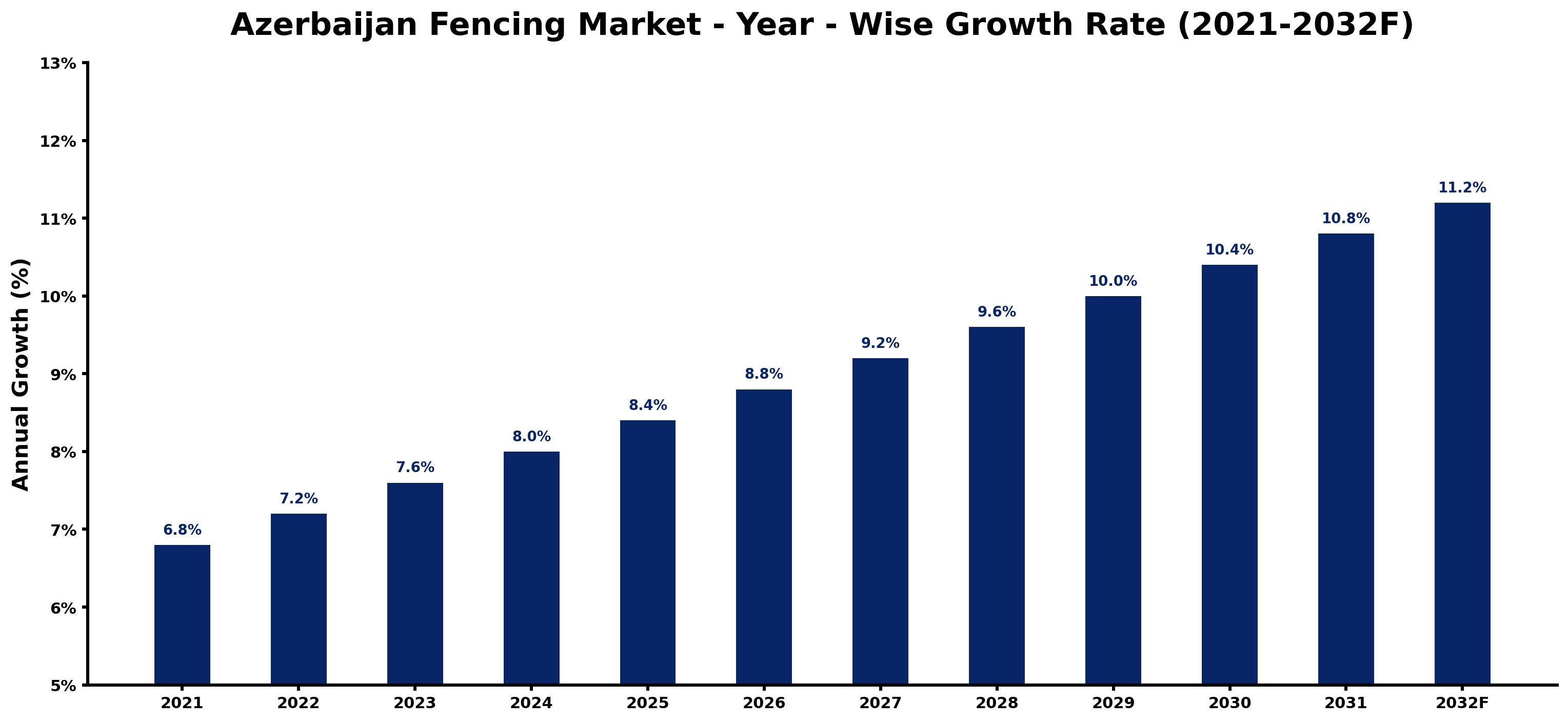
The table below presents the year‑wise growth rates along with the key drivers influencing the market
| Year | Growth Rate | Major Drivers |
| 2021 | 6.8% | Expansion of commercial construction activities |
| 2022 | 7.2% | Expansion of manufacturing activities |
| 2023 | 7.6% | Growing urbanization and commercial development |
| 2024 | 8.0% | Expansion of transportation and logistics networks |
| 2025 | 8.4% | Rising electricity demand across industries |
| 2026 | 8.8% | Rapid growth in telecom and data center sectors |
| 2027 | 9.2% | Expansion of transportation and logistics networks |
| 2028 | 9.6% | Increasing smart city development projects |
| 2029 | 10.0% | Growing urbanization and commercial development |
| 2030 | 10.4% | Rapid growth in telecom and data center sectors |
| 2031 | 10.8% | Increasing industrial infrastructure investments |
| 2032 | 11.2% | Government infrastructure modernization initiatives |
Note - Market size estimations and growth projections presented in this report are based on 6Wresearch's advanced forecasting approach, validated with industry datasets as of June 2026.
Azerbaijan Fencing Market Synopsis
Recently, the Azerbaijan fencing market has shown resilience, driven by a surge in construction and urban development projects. This momentum is expected to continue as more stakeholders prioritize security and visual appeal in fencing solutions. However, the market is evolving, and a shift towards advanced materials and innovative designs is becoming increasingly evident.
As the market progresses, there is a burgeoning interest in customizable fencing options that not only serve practical purposes but also enhance property aesthetics. With a commitment to sustainability, more consumers are gravitating toward eco-friendly materials, marking a notable transition in consumer preferences and the future landscape of the Azerbaijan fencing market.
Azerbaijan Fencing Market Key Takeaways
- Growing construction activities are a primary driver of demand for fencing solutions in Azerbaijan.
- High-quality, durable materials such as aluminum and wrought iron are increasingly sought after by consumers.
- Government initiatives focusing on border security and public safety are enhancing market prospects.
- Sustainability trends are pushing the popularity of eco-friendly fencing materials.
- Intense competition is leading to innovations and improvements in fencing design and functionality.
Evaluation of Restraints in Azerbaijan Fencing Market
The Azerbaijan fencing market encounters several restraints that may limit its overall growth. A significant challenge lies in the limited awareness of fencing as a sport among the general populace, leading to a smaller participant base compared to more popular sports. Moreover, the prohibitive costs associated with fencing equipment can deter potential entrants. The infrastructure needed for training and development remains inadequate, further compounding the issue. Additionally, the absence of substantial government support for fencing programs restricts opportunities for expansion and innovation in the sport, potentially stalling growth.
Azerbaijan Fencing Market Trends
The market is currently witnessing a heightened demand for premium and aesthetically appealing fencing solutions. This trend is spurred by growing concerns over property security, leading customers to prefer durable materials such as aluminum and wrought iron. Innovative designs that enhance visual appeal are also gaining traction, as consumers seek unique solutions for their properties. Furthermore, sustainability is increasingly influencing purchasing decisions, with eco-friendly materials becoming popular choices among environmentally conscious buyers. This indicates a clear movement towards sophisticated and customizable fencing options that merge functionality with aesthetic value.
Azerbaijan Fencing Market Opportunities
Investment opportunities abound in the Azerbaijan fencing market, particularly in response to the thriving construction sector. The increasing need for security solutions across residential, commercial, and industrial properties presents a lucrative avenue for both local and foreign investors. There is a growing potential for manufacturing and distributing high-quality fencing materials, such as steel and wire mesh. Additionally, innovations in fencing technologies that offer enhanced security features are drawing interest. Collaborations with local construction firms or government infrastructure projects are also promising paths for market entry and growth.
Government Initiatives in the Azerbaijan Fencing Market
The Azerbaijani government plays a vital role in shaping the fencing market through various policies and initiatives aimed at supporting local businesses. Key policies regulate the import and export activities of fencing materials, ensuring adherence to quality standards. Incentives are offered to local businesses to promote innovation and growth within the industry. Furthermore, regulations focus on the safety and security of fencing installations, particularly in sensitive areas. These efforts reflect the government's commitment to fostering a competitive, sustainable fencing market while prioritizing quality and safety.
Future Insights of the Azerbaijan Fencing Market
Looking ahead to the period between 2026 and 2032, the Azerbaijan fencing market is poised for steady growth, largely attributed to ongoing urbanization and infrastructural development. The demand for residential and commercial properties is anticipated to increase, which will further drive the need for effective fencing solutions that enhance both security and aesthetics. As government efforts to improve public safety and amenities continue, market growth is expected to gain momentum. The integration of technological advancements in fencing materials and designs will also play a crucial role in shaping the future landscape of this market, although fluctuations in raw material prices and economic uncertainties may present challenges.
Azerbaijan Fencing Market Latest Developments (May 2025 - June 2026)
Recent developments within the Azerbaijan fencing market indicate a shift towards increased innovation and quality enhancement among local manufacturers. There has been a noticeable rise in the introduction of modern designs and materials aimed at meeting the growing consumer demand for aesthetic and durable solutions. Furthermore, local businesses are exploring collaborative efforts to leverage government support for infrastructure projects, leading to potential growth in market access and service offerings. As the focus on public safety continues, the demand for reliable fencing solutions is expected to rise, reflecting broader trends in construction and urban development.
Azerbaijan Fencing Market - Key Attractiveness of the Report
- 10 Years of Market Numbers
- Historical Data Starting from 2022 to 2025
- Base Year: 2025
- Forecast Data until 2032
- Key Performance Indicators Impacting the Market
- Major Upcoming Developments and Projects
Key Highlights of the Report:
- Azerbaijan Fencing Market Outlook
- Market Size of Azerbaijan Fencing Market, 2025
- Forecast of Azerbaijan Fencing Market, 2032
- Historical Data and Forecast of Azerbaijan Fencing Revenues & Volume for the Period 2022-2032F
- Azerbaijan Fencing Market Trend Evolution
- Azerbaijan Fencing Market Drivers and Challenges
- Azerbaijan Fencing Price Trends
- Azerbaijan Fencing Porter's Five Forces
- Azerbaijan Fencing Industry Life Cycle
- Historical Data and Forecast of Azerbaijan Fencing Market Revenues & Volume By Material for the Period 2022-2032F
- Historical Data and Forecast of Azerbaijan Fencing Market Revenues & Volume By Metal for the Period 2022-2032F
- Historical Data and Forecast of Azerbaijan Fencing Market Revenues & Volume By Wood for the Period 2022-2032F
- Historical Data and Forecast of Azerbaijan Fencing Market Revenues & Volume By Plastic & Composite for the Period 2022-2032F
- Historical Data and Forecast of Azerbaijan Fencing Market Revenues & Volume By Concrete for the Period 2022-2032F
- Historical Data and Forecast of Azerbaijan Fencing Market Revenues & Volume By Distribution Channel for the Period 2022-2032F
- Historical Data and Forecast of Azerbaijan Fencing Market Revenues & Volume By Online for the Period 2022-2032F
- Historical Data and Forecast of Azerbaijan Fencing Market Revenues & Volume By Retail for the Period 2022-2032F
- Historical Data and Forecast of Azerbaijan Fencing Market Revenues & Volume By Installation for the Period 2022-2032F
- Historical Data and Forecast of Azerbaijan Fencing Market Revenues & Volume By Do-It-Yourself for the Period 2022-2032F
- Historical Data and Forecast of Azerbaijan Fencing Market Revenues & Volume By Contractor for the Period 2022-2032F
- Historical Data and Forecast of Azerbaijan Fencing Market Revenues & Volume By Application for the Period 2022-2032F
- Historical Data and Forecast of Azerbaijan Fencing Market Revenues & Volume By Residential for the Period 2022-2032F
- Historical Data and Forecast of Azerbaijan Fencing Market Revenues & Volume By Agricultural for the Period 2022-2032F
- Historical Data and Forecast of Azerbaijan Fencing Market Revenues & Volume By Industrial for the Period 2022-2032F
- Historical Data and Forecast of Azerbaijan Fencing Market Revenues & Volume By End-users for the Period 2022-2032F
- Historical Data and Forecast of Azerbaijan Fencing Market Revenues & Volume By Government for the Period 2022-2032F
- Historical Data and Forecast of Azerbaijan Fencing Market Revenues & Volume By Petroleum & Chemicals for the Period 2022-2032F
- Historical Data and Forecast of Azerbaijan Fencing Market Revenues & Volume By Military & Defense for the Period 2022-2032F
- Historical Data and Forecast of Azerbaijan Fencing Market Revenues & Volume By Mining for the Period 2022-2032F
- Historical Data and Forecast of Azerbaijan Fencing Market Revenues & Volume By Energy & Power for the Period 2022-2032F
- Historical Data and Forecast of Azerbaijan Fencing Market Revenues & Volume By Transport for the Period 2022-2032F
- Historical Data and Forecast of Azerbaijan Fencing Market Revenues & Volume By Others for the Period 2022-2032F
- Azerbaijan Fencing Import Export Trade Statistics
- Market Opportunity Assessment By Material
- Market Opportunity Assessment By Distribution Channel
- Market Opportunity Assessment By Installation
- Market Opportunity Assessment By Application
- Market Opportunity Assessment By End-users
- Azerbaijan Fencing Top Companies Market Share
- Azerbaijan Fencing Competitive Benchmarking By Technical and Operational Parameters
- Azerbaijan Fencing Company Profiles
- Azerbaijan Fencing Key Strategic Recommendations






































