Azerbaijan Fruit Powder Market Size, Share & Growth Rate
The Azerbaijan Fruit Powder Market was estimated at USD 1400 Million in 2025 and is projected to reach USD 2453 Million by 2032, growing at a CAGR of 8.3% from 2026 to 2032. This robust growth trajectory is being driven by the increasing consumer demand for convenient food solutions and heightened health consciousness among the population. As consumers opt for products with longer shelf lives and minimal processing, fruit powders are emerging as a favored alternative, particularly in sectors like food and beverages, nutraceuticals, and cosmetics.
Azerbaijan Fruit Powder Market Year-wise Growth Rate and Key Drivers
This graph highlights how the Azerbaijan Fruit Powder Market has steadily grown over the years, supported by major growth factors.
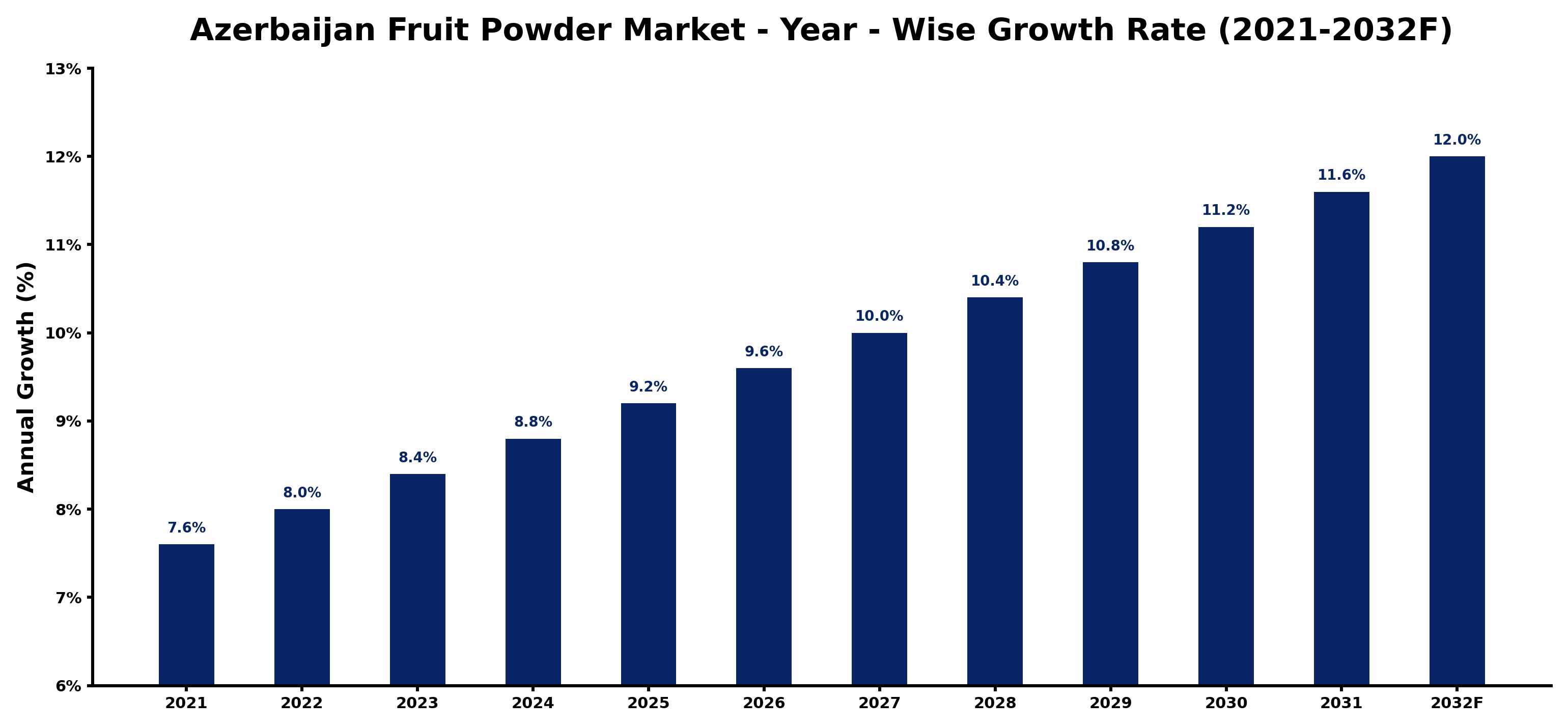
The table below presents the year‑wise growth rates along with the key drivers influencing the market
| Year | Growth Rate | Major Drivers |
| 2021 | 7.6% | Export driven fruit powder investments boost local processing facility capacity |
| 2022 | 8.0% | Improved processing technology boosted fruit powder quality and yield |
| 2023 | 8.4% | Revived food processing investments boost fruit powder production capacity |
| 2024 | 8.8% | Domestic investments in fruit processing facilities boost powder production capacity |
| 2025 | 9.2% | Improved drying technologies enhanced fruit powder quality and yield |
| 2026 | 9.6% | Fruit drying facilities upgrade boosts Azerbaijan's powder production efficiency |
| 2027 | 10.0% | Fruit processing technology upgrades boost Azerbaijan's powder output efficiency |
| 2028 | 10.4% | Fruit processing facilities upgrade to meet export quality standards |
| 2029 | 10.8% | Higher fruit processing facility investments boosted powder production capacity |
| 2030 | 11.2% | Supply chain recovery boosted fruit powder manufacturing efficiency |
| 2031 | 11.6% | Modernized drying technology boosts fruit powder production efficiency |
| 2032 | 12.0% | Production facilities expanded capacity for high quality fruit powder exports |
Note - Market size estimations and growth projections presented in this report are based on 6Wresearch's advanced forecasting approach, validated with industry datasets as of June 2026.
Azerbaijan Fruit Powder Market Synopsis
The Azerbaijan fruit powder market is experiencing a dynamic transformation, characterized by a rising preference for organic and natural products. Consumers are gravitating towards fruit powders that not only promise convenience but also offer health benefits without artificial additives. This trend reflects a broader shift towards cleaner labels and transparency in food production.
Additionally, the market is witnessing a surge in interest for locally sourced exotic fruit powders like pomegranate and apricot, which are integral to Azerbaijan's agricultural identity. This local flavor, combined with innovative processing techniques, has positioned the market for substantial growth, attracting both domestic and international attention.
Azerbaijan Fruit Powder Market Key Takeaways
- The market is experiencing significant growth fueled by increasing consumer demand for healthy and convenient food options.
- There is a marked shift towards organic and natural fruit powders, reflecting a growing trend for clean-label products.
- Local indigenous fruits are gaining popularity, enhancing the diversity of product offerings available in the market.
- Investment opportunities in processing and innovative product development are becoming increasingly attractive to investors.
- Government support and favorable policies are creating a conducive environment for market expansion and innovation.
Evaluation of Restraints in Azerbaijan Fruit Powder Market
Despite its promising growth, the Azerbaijan fruit powder market faces certain challenges that may hinder its potential. Maintaining consistent quality and flavor in fruit powders is crucial for consumer retention and loyalty. Additionally, fluctuations in raw material costs can pressure pricing strategies, complicating competitive positioning. Moreover, many consumers remain unaware of the benefits of fruit powders, which can limit market penetration. Regulatory hurdles regarding food safety, labeling, and certifications further add complexity for companies looking to navigate this space. To thrive, industry players must prioritize research and development, forge strong supplier relationships, and educate the market about the nutritional advantages of fruit powders.
Azerbaijan Fruit Powder Market Trends
A key trend in the Azerbaijan fruit powder market is the escalating consumer inclination towards natural ingredients. The rise of health awareness is leading to a demand for fruit powders that are devoid of artificial additives and preservatives. Additionally, innovative processing techniques are enhancing the appeal of fruit powders, allowing for greater retention of flavor and nutrients. The increasing variety of available fruit powders is catering to diverse dietary needs, thereby expanding the market's potential customer base.
Azerbaijan Fruit Powder Market Opportunities
The Azerbaijan fruit powder market is ripe with investment opportunities, particularly in establishing new processing facilities that utilize local fruit resources. There is also potential for creating unique fruit powder blends that cater to health-conscious consumers. Collaborating with local farmers not only ensures a steady supply of high-quality raw materials but also supports the local economy. With the increasing interest in clean-label and organic products, investors who focus on high-quality offerings are well-positioned to capture a significant market share.
Government Initiatives in the Azerbaijan Fruit Powder Market
The Azerbaijani government has implemented various initiatives aimed at bolstering the fruit powder industry. These include financial incentives for producers and support for research and development efforts. Programs are also in place to improve infrastructure and logistics, facilitating better supply chain management for fruit powder production. Through these measures, the government is not only enhancing domestic capabilities but also positioning the industry to compete in international markets.
Future Insights of the Azerbaijan Fruit Powder Market
Looking ahead to 2026-2032, the Azerbaijan fruit powder market is poised for significant expansion. As consumer demand for convenient, nutritious food continues to grow, fruit powders will likely play an increasingly important role in various applications. The rising focus on health and wellness, coupled with the preference for natural ingredients, is expected to drive product innovation and diversification. Companies that successfully adapt to these trends will find fertile ground for growth and profitability in the coming years.
Azerbaijan Fruit Powder Market Latest Developments (May 2025 - June 2026)
In recent months, the Azerbaijan fruit powder market has seen a notable uptick in product innovation, with several companies launching new lines of organic fruit powders to meet consumer demand. There has also been a surge in collaborations between local farmers and processors, aimed at enhancing the supply chain and ensuring sustainable sourcing. Additionally, educational campaigns have been initiated to raise awareness about the health benefits of fruit powders, further driving consumer interest in this burgeoning market.
Azerbaijan Fruit Powder Market - Key Attractiveness of the Report
- 10 Years of Market Numbers
- Historical Data Starting from 2022 to 2025
- Base Year: 2025
- Forecast Data until 2032
- Key Performance Indicators Impacting the Market
- Major Upcoming Developments and Projects
Key Highlights of the Report:
- Azerbaijan Fruit Powder Market Outlook
- Market Size of Azerbaijan Fruit Powder Market, 2025
- Forecast of Azerbaijan Fruit Powder Market, 2032
- Historical Data and Forecast of Azerbaijan Fruit Powder Revenues & Volume for the Period 2022-2032F
- Azerbaijan Fruit Powder Market Trend Evolution
- Azerbaijan Fruit Powder Market Drivers and Challenges
- Azerbaijan Fruit Powder Price Trends
- Azerbaijan Fruit Powder Porter's Five Forces
- Azerbaijan Fruit Powder Industry Life Cycle
- Historical Data and Forecast of Azerbaijan Fruit Powder Market Revenues & Volume By Type for the Period 2022-2032F
- Historical Data and Forecast of Azerbaijan Fruit Powder Market Revenues & Volume By Banana for the Period 2022-2032F
- Historical Data and Forecast of Azerbaijan Fruit Powder Market Revenues & Volume By Grapes for the Period 2022-2032F
- Historical Data and Forecast of Azerbaijan Fruit Powder Market Revenues & Volume By Blueberry for the Period 2022-2032F
- Historical Data and Forecast of Azerbaijan Fruit Powder Market Revenues & Volume By Mango for the Period 2022-2032F
- Historical Data and Forecast of Azerbaijan Fruit Powder Market Revenues & Volume By others for the Period 2022-2032F
- Historical Data and Forecast of Azerbaijan Fruit Powder Market Revenues & Volume By Application for the Period 2022-2032F
- Historical Data and Forecast of Azerbaijan Fruit Powder Market Revenues & Volume By Bakery & Confectionery for the Period 2022-2032F
- Historical Data and Forecast of Azerbaijan Fruit Powder Market Revenues & Volume By Dairy & Frozen Desserts for the Period 2022-2032F
- Historical Data and Forecast of Azerbaijan Fruit Powder Market Revenues & Volume By Beverages for the Period 2022-2032F
- Historical Data and Forecast of Azerbaijan Fruit Powder Market Revenues & Volume By Food Supplements for the Period 2022-2032F
- Historical Data and Forecast of Azerbaijan Fruit Powder Market Revenues & Volume By others for the Period 2022-2032F
- Azerbaijan Fruit Powder Import Export Trade Statistics
- Market Opportunity Assessment By Type
- Market Opportunity Assessment By Application
- Azerbaijan Fruit Powder Top Companies Market Share
- Azerbaijan Fruit Powder Competitive Benchmarking By Technical and Operational Parameters
- Azerbaijan Fruit Powder Company Profiles
- Azerbaijan Fruit Powder Key Strategic Recommendations






































