Azerbaijan Glass Fiber Reinforced Concrete Market Summary
The azerbaijan glass fiber reinforced concrete market was estimated at USD 683 Million in 2025 and is projected to reach USD 1203 Million by 2032, growing at a CAGR of 9.7% from 2026 to 2032.
Azerbaijan Glass Fiber Reinforced Concrete Market Year-wise Growth Rate and Key Drivers
This graph highlights how the Azerbaijan Glass Fiber Reinforced Concrete Market has steadily grown over the past five years, supported by major growth factors.
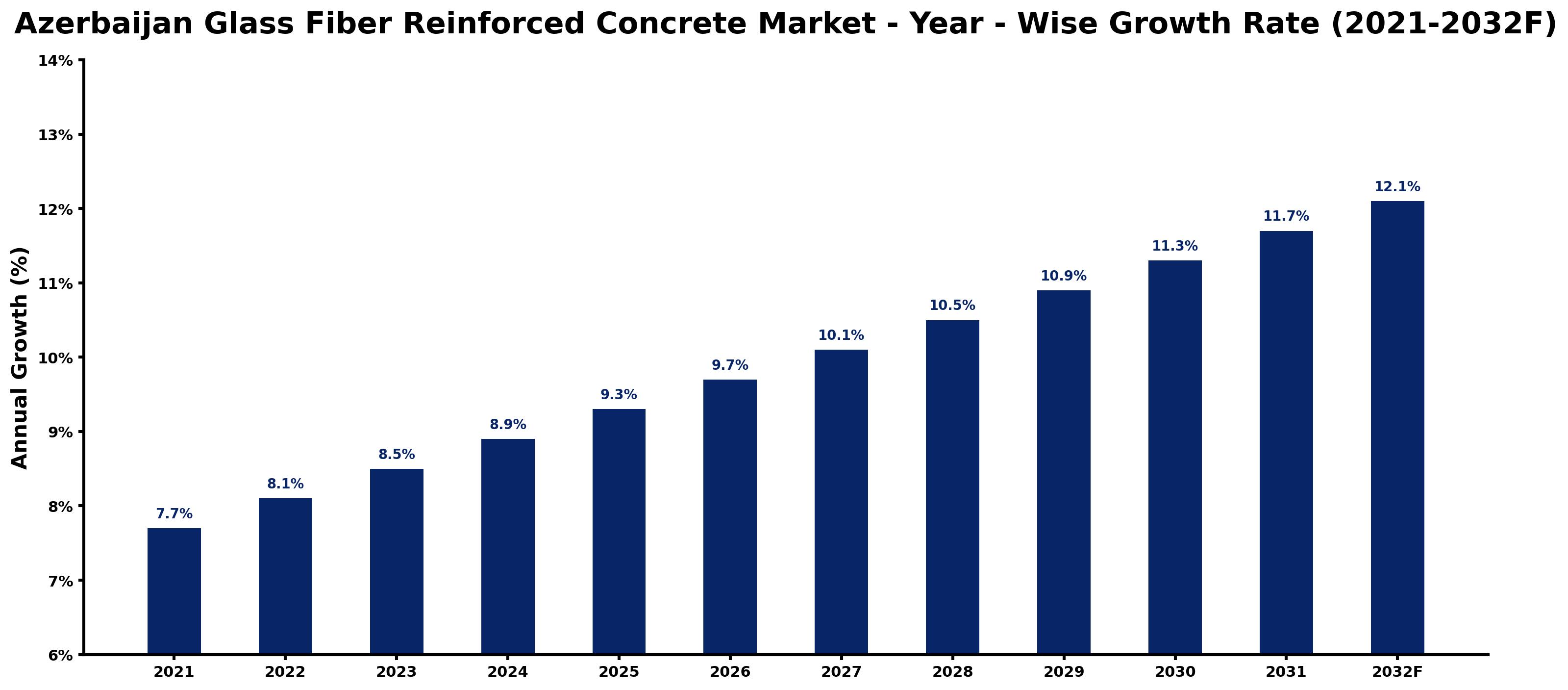
The table below presents the year wise growth rates along with the key drivers influencing the market
| Year | Growth Rate | Major Drivers |
| 2021 | 7.7% | Construction projects in Azerbaijan show a renewed confidence in long-lasting materials. |
| 2022 | 8.1% | Local architecture trends favor innovative materials, boosting glass fiber concrete applications. |
| 2023 | 8.5% | Infrastructure investments support the shift towards sustainable and durable building solutions. |
| 2024 | 8.9% | Demand for earthquake-resistant structures influences material selections in urban developments. |
| 2025 | 9.3% | A surge in residential projects highlights the need for lightweight construction materials. |
| 2026 | 9.7% | The adoption of advanced building techniques creates opportunities for glass fiber integration. |
| 2027 | 10.1% | Environmental concerns spark interest in materials that enhance energy efficiency in buildings. |
| 2028 | 10.5% | Regional construction collaborations enhance the popularity of glass fiber reinforced concrete. |
| 2029 | 10.9% | A vibrant real estate market pushes for innovative, resilient construction materials. |
| 2030 | 11.3% | Technological innovations in production improve the affordability of glass fiber materials. |
| 2031 | 11.7% | Sustainability goals in urban planning drive demand for eco-friendly construction solutions. |
| 2032 | 12.1% | The legacy of successful projects establishes glass fiber concrete as a trusted choice. |
Note - Market size estimations and growth projections presented in this report are based on 6Wresearch's advanced forecasting approach, validated with industry datasets as of June 2026.
Azerbaijan Glass Fiber Reinforced Concrete Market Synopsis
The Azerbaijan Glass Fiber Reinforced Concrete Market is projected to reach 9.7% and witness significant growth during the forecast period (2026-2032). This market encompasses the production, distribution, and utilization of composite materials synthesized from cement, sand, water, and glass fibers. The application of glass fiber reinforced concrete (GFRC) is extensive, primarily in construction projects including architectural facades, cladding panels, decorative elements, and lightweight structures. The preference for GFRC is attributed to its superior strength, durability, and design flexibility.
Azerbaijan Glass Fiber Reinforced Concrete Market Growth Drivers
The growth trajectory of the Azerbaijan Glass Fiber Reinforced Concrete Market is propelled by several key factors:
- The construction industry's increasing demand for lightweight building materials that offer durability plays a crucial role in the popularity of GFRC.
- GFRC's high strength, flexibility in design, and weather resistance make it an attractive option for modern architectural applications.
- Significant investments in infrastructure development, including public and private sector projects, directly foster market expansion.
- The rise in awareness and adoption of sustainable construction practices among developers encourages the utilization of GFRC for environmentally friendly building solutions.
- Architectural innovation and advancements in material technology are driving the demand for GFRC, as it allows for creative expressions without compromising structural integrity.
Azerbaijan Glass Fiber Reinforced Concrete Market Challenges and Restraints
Despite the promising outlook for the Azerbaijan Glass Fiber Reinforced Concrete Market, challenges persist that may hinder growth:
- The market encounters barriers related to material innovation and ongoing education regarding the advantages of GFRC among architects and engineers.
- Market acceptance issues arise from the limited familiarity with GFRC's benefits and applications, which can slow down its adoption.
- Concerns about cost competitiveness relative to traditional concrete solutions may deter stakeholders in selecting GFRC for various projects.
- A lack of reliable supply chains for GFRC materials can hinder the ability of contractors to utilize this technology consistently across projects.
- Challenges in meeting regulatory compliance for construction materials, particularly in terms of quality control and performance standards, can restrict market growth.
Azerbaijan Glass Fiber Reinforced Concrete Market Government Investment and Initiatives
Government policies and initiatives play a pivotal role in shaping the landscape of the Azerbaijan Glass Fiber Reinforced Concrete Market. Authorities are committed to enhancing construction standards and promoting the adoption of innovative building materials, including GFRC. Policies may involve:
- Investment in infrastructure development and renovation projects that prioritize modern materials to improve building performance.
- Establishment of specifications and quality control standards specific to GFRC to ensure consistency and safety in construction.
- Incentives for adopting GFRC solutions to reduce long-term maintenance costs and enhance the durability of structures.
- Promotion of green building certification programs that favor the use of sustainable materials, aligning with global environmental standards.
- Support for research and development initiatives aimed at enhancing GFRC technology and expanding its applications in the construction sector.
Azerbaijan Glass Fiber Reinforced Concrete Market Latest Developments (May 2025 - June 2026)
The period from May 2025 to June 2026 is marked by notable advancements in the Azerbaijan Glass Fiber Reinforced Concrete Market, reflecting the evolving nature of construction practices. Recent developments include a heightened emphasis on architectural creativity using GFRC, leading to innovative construction projects that highlight the material's aesthetic and functional advantages. Moreover, industry stakeholders have initiated collaborations to streamline supply chains, ensuring timely access to GFRC materials. Significant strides have been made in public awareness campaigns aimed at educating the construction sector about the benefits of GFRC, addressing previous challenges related to market acceptance. Additionally, regulatory bodies are working on refining standards that govern the use of GFRC, enhancing product quality and safety in construction applications.
Azerbaijan Glass Fiber Reinforced Concrete Market - Key Attractiveness of the Report
- 10 Years of Market Numbers
- Historical Data Starting from 2022 to 2025
- Base Year: 2025
- Forecast Data until 2032
- Key Performance Indicators Impacting the Market
- Major Upcoming Developments and Projects
Key Highlights of the Report:
- Azerbaijan Glass Fiber Reinforced Concrete Market Outlook
- Market Size of Azerbaijan Glass Fiber Reinforced Concrete Market, 2025
- Forecast of Azerbaijan Glass Fiber Reinforced Concrete Market, 2032
- Historical Data and Forecast of Azerbaijan Glass Fiber Reinforced Concrete Revenues & Volume for the Period 2022-2032F
- Azerbaijan Glass Fiber Reinforced Concrete Market Trend Evolution
- Azerbaijan Glass Fiber Reinforced Concrete Market Drivers and Challenges
- Azerbaijan Glass Fiber Reinforced Concrete Price Trends
- Azerbaijan Glass Fiber Reinforced Concrete Porter's Five Forces
- Azerbaijan Glass Fiber Reinforced Concrete Industry Life Cycle
- Historical Data and Forecast of Azerbaijan Glass Fiber Reinforced Concrete Market Revenues & Volume By Process for the Period 2022-2032F
- Historical Data and Forecast of Azerbaijan Glass Fiber Reinforced Concrete Market Revenues & Volume By Spray for the Period 2022-2032F
- Historical Data and Forecast of Azerbaijan Glass Fiber Reinforced Concrete Market Revenues & Volume By Premix for the Period 2022-2032F
- Historical Data and Forecast of Azerbaijan Glass Fiber Reinforced Concrete Market Revenues & Volume By Hybrid for the Period 2022-2032F
- Historical Data and Forecast of Azerbaijan Glass Fiber Reinforced Concrete Market Revenues & Volume By Applications for the Period 2022-2032F
- Historical Data and Forecast of Azerbaijan Glass Fiber Reinforced Concrete Market Revenues & Volume By Architecture for the Period 2022-2032F
- Historical Data and Forecast of Azerbaijan Glass Fiber Reinforced Concrete Market Revenues & Volume By Civil Construction for the Period 2022-2032F
- Historical Data and Forecast of Azerbaijan Glass Fiber Reinforced Concrete Market Revenues & Volume By Engineering for the Period 2022-2032F
- Historical Data and Forecast of Azerbaijan Glass Fiber Reinforced Concrete Market Revenues & Volume By Commercial for the Period 2022-2032F
- Historical Data and Forecast of Azerbaijan Glass Fiber Reinforced Concrete Market Revenues & Volume By Residential for the Period 2022-2032F
- Historical Data and Forecast of Azerbaijan Glass Fiber Reinforced Concrete Market Revenues & Volume By Building for the Period 2022-2032F
- Historical Data and Forecast of Azerbaijan Glass Fiber Reinforced Concrete Market Revenues & Volume By Defense for the Period 2022-2032F
- Historical Data and Forecast of Azerbaijan Glass Fiber Reinforced Concrete Market Revenues & Volume By Others for the Period 2022-2032F
- Azerbaijan Glass Fiber Reinforced Concrete Import Export Trade Statistics
- Market Opportunity Assessment By Process
- Market Opportunity Assessment By Applications
- Azerbaijan Glass Fiber Reinforced Concrete Top Companies Market Share
- Azerbaijan Glass Fiber Reinforced Concrete Competitive Benchmarking By Technical and Operational Parameters
- Azerbaijan Glass Fiber Reinforced Concrete Company Profiles
- Azerbaijan Glass Fiber Reinforced Concrete Key Strategic Recommendations






































