Azerbaijan Glass Tiles Market Size, Share & Growth Rate
The Azerbaijan Glass Tiles Market was estimated at USD 936 Million in 2025 and is projected to reach USD 1750 Million by 2032, growing at a CAGR of 9.4% from 2026 to 2032. This robust growth trajectory is driven primarily by rapid urbanization, coupled with extensive infrastructure development initiatives across the country. As Azerbaijan increasingly embraces modern aesthetics in both residential and commercial environments, the demand for versatile and durable glass tiles is on the rise.
Azerbaijan Glass Tiles Market Year-wise Growth Rate and Key Drivers
This graph highlights how the Azerbaijan Glass Tiles Market has steadily grown over the years, supported by major growth factors.
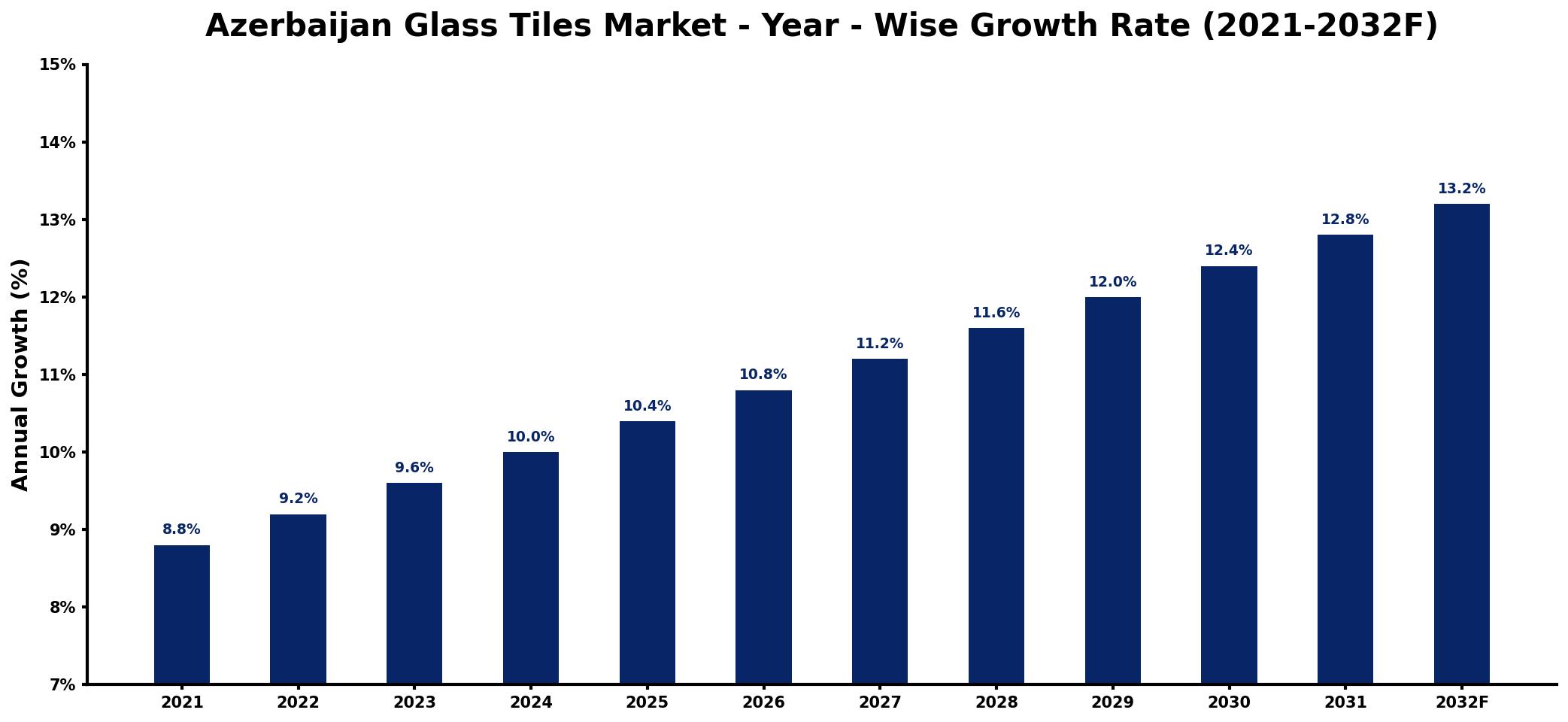
The table below presents the year‑wise growth rates along with the key drivers influencing the market
| Year | Growth Rate | Major Drivers |
| 2021 | 8.8% | Rising demand in construction sector |
| 2022 | 9.2% | Increased investments in infrastructure projects |
| 2023 | 9.6% | Growth in home renovation activities |
| 2024 | 10.0% | Surge in eco-friendly building materials |
| 2025 | 10.4% | rising procurement volume requirements |
| 2026 | 10.8% | Higher consumer preference for aesthetics |
| 2027 | 11.2% | Technological advancements in manufacturing |
| 2028 | 11.6% | growing commercial sector adoption |
| 2029 | 12.0% | Increase in export opportunities |
| 2030 | 12.4% | Enhanced distribution networks established |
| 2031 | 12.8% | Rise in urbanization and population |
| 2032 | 13.2% | Development of smart building technologies |
Note: Market size estimations and growth projections presented in this report are based on 6Wresearch's proprietary forecasting methodology, utilizing the latest available industry data, government publications, and primary research inputs.
Azerbaijan Glass Tiles Market Synopsis
A notable aspect of the Azerbaijan Glass Tiles Market is the rising preference for sustainable building materials, which aligns with contemporary consumer values. Glass tiles, appreciated for their ease of maintenance and longevity, have become an increasingly popular choice for high-end renovations and new constructions.
Moreover, ongoing urban development projects are encouraging the adoption of glass tiles in various applications, from residential kitchens to commercial spaces, enhancing the overall aesthetic appeal. As a result, the market is witnessing a surge in demand, creating a favorable environment for growth and innovation.
Azerbaijan Glass Tiles Market Key Takeaways
- The market is benefitting from rising urbanization and infrastructure investments.
- Glass tiles are increasingly favored for their aesthetic versatility and sustainable attributes.
- Consumer preferences are shifting towards modern and durable building materials.
- Local regulations promote domestic production while ensuring quality and sustainability.
- The competitive landscape includes alternatives like ceramics and natural stone tiles, influencing market dynamics.
Evaluation of Restraints in Azerbaijan Glass Tiles Market
While the Azerbaijan Glass Tiles Market is positioned for growth, it contends with several restraints. Chief among these is the fierce competition from ceramic, porcelain, and natural stone tiles that dominate consumer preferences. Additionally, the pricing dynamics associated with glass tiles can deter potential buyers, especially in a market where cost-effectiveness is crucial. Installation and maintenance costs also factor into the decision-making process for end-users, potentially hampering wider adoption.
Azerbaijan Glass Tiles Market Trends
Current trends in the Azerbaijan Glass Tiles Market reveal a growing inclination towards eco-friendly products. Designers and architects are increasingly incorporating glass tiles into innovative design solutions, driven by a rising consumer consciousness regarding sustainability. Furthermore, advancements in technology are allowing manufacturers to produce glass tiles with enhanced durability and design options, reflecting broader trends in personalization and customization.
Azerbaijan Glass Tiles Market Opportunities
The Azerbaijan Glass Tiles Market presents genuine growth opportunities in the renovation sector, as urban dwellers seek to modernize their homes. Additionally, the push for green building practices opens avenues for glass tiles to be integrated into more projects, emphasizing their sustainable features. There is also potential for increased exports as local production becomes more competitive, allowing Azerbaijan to tap into international markets.
Government Initiatives in the Azerbaijan Glass Tiles Market
The government of Azerbaijan plays a pivotal role in shaping the glass tiles market through various policies and initiatives. Regulatory frameworks focus on improving construction standards, which directly influences the quality of building materials used. Additionally, import/export tariffs affect market dynamics, encouraging the use of domestically produced tiles. Such incentives not only promote local industries but also align with broader objectives of enhancing infrastructure and urban development.
Future Insights of the Azerbaijan Glass Tiles Market
Looking ahead to the period between 2026 and 2032, the Azerbaijan Glass Tiles Market is set for a transformative phase. The convergence of urbanization, technological advancements, and evolving consumer preferences will likely drive sustained demand for glass tiles. As construction practices increasingly prioritize sustainability, the market stands poised for exponential growth, paving the way for innovations that enhance both functionality and aesthetics.
Azerbaijan Glass Tiles Market Latest Developments (2025 - 2026)
Recent trends in the Azerbaijan Glass Tiles Market indicate a shift towards innovative production techniques, enabling manufacturers to meet rising consumer demands for customization and eco-friendliness. Industry stakeholders are increasingly collaborating with designers to explore new applications for glass tiles, further integrating them into modern architectural projects. These developments reflect a proactive response to market dynamics and an ongoing commitment to sustainability.
Azerbaijan Glass Tiles Market - Key Attractiveness of the Report
- 10 Years of Market Numbers
- Historical Data Starting from 2022 to 2025
- Base Year: 2025
- Forecast Data until 2032
- Key Performance Indicators Impacting the Market
- Major Upcoming Developments and Projects
Key Highlights of the Report:
- Azerbaijan Glass Tiles Market Outlook
- Market Size of Azerbaijan Glass Tiles Market, 2025
- Forecast of Azerbaijan Glass Tiles Market, 2032
- Historical Data and Forecast of Azerbaijan Glass Tiles Revenues & Volume for the Period 2022-2032F
- Azerbaijan Glass Tiles Market Trend Evolution
- Azerbaijan Glass Tiles Market Drivers and Challenges
- Azerbaijan Glass Tiles Price Trends
- Azerbaijan Glass Tiles Porter's Five Forces
- Azerbaijan Glass Tiles Industry Life Cycle
- Historical Data and Forecast of Azerbaijan Glass Tiles Market Revenues & Volume By Manufacturing Process for the Period 2022-2032F
- Historical Data and Forecast of Azerbaijan Glass Tiles Market Revenues & Volume By Smalti Tiles for the Period 2022-2032F
- Historical Data and Forecast of Azerbaijan Glass Tiles Market Revenues & Volume By Fused Tiles for the Period 2022-2032F
- Historical Data and Forecast of Azerbaijan Glass Tiles Market Revenues & Volume By Sintered Tiles for the Period 2022-2032F
- Historical Data and Forecast of Azerbaijan Glass Tiles Market Revenues & Volume By Cast Tiles for the Period 2022-2032F
- Historical Data and Forecast of Azerbaijan Glass Tiles Market Revenues & Volume By Other for the Period 2022-2032F
- Historical Data and Forecast of Azerbaijan Glass Tiles Market Revenues & Volume By Product Type for the Period 2022-2032F
- Historical Data and Forecast of Azerbaijan Glass Tiles Market Revenues & Volume By Matte-finished Glass Tile for the Period 2022-2032F
- Historical Data and Forecast of Azerbaijan Glass Tiles Market Revenues & Volume By Smooth Glass Tile for the Period 2022-2032F
- Historical Data and Forecast of Azerbaijan Glass Tiles Market Revenues & Volume By End-User Industry for the Period 2022-2032F
- Historical Data and Forecast of Azerbaijan Glass Tiles Market Revenues & Volume By Residential for the Period 2022-2032F
- Historical Data and Forecast of Azerbaijan Glass Tiles Market Revenues & Volume By Commercial for the Period 2022-2032F
- Historical Data and Forecast of Azerbaijan Glass Tiles Market Revenues & Volume By Infrastructure for the Period 2022-2032F
- Azerbaijan Glass Tiles Import Export Trade Statistics
- Market Opportunity Assessment By Manufacturing Process
- Market Opportunity Assessment By Product Type
- Market Opportunity Assessment By End-User Industry
- Azerbaijan Glass Tiles Top Companies Market Share
- Azerbaijan Glass Tiles Competitive Benchmarking By Technical and Operational Parameters
- Azerbaijan Glass Tiles Company Profiles
- Azerbaijan Glass Tiles Key Strategic Recommendations






































