Azerbaijan Gold Bullion Market Size, Share & Growth Rate
The Azerbaijan Gold Bullion Market was estimated at USD 1258 Million in 2025 and is projected to reach USD 2378 Million by 2032, growing at a CAGR of 9.5% from 2026 to 2032. This growth trajectory is primarily fueled by the increasing demand for physical gold as a safe-haven asset in response to global economic uncertainties and geopolitical tensions. Additionally, government initiatives aimed at promoting gold investment are likely to further enhance market participation among both retail and institutional investors.
Azerbaijan Gold Bullion Market Year-wise Growth Rate and Key Drivers
This graph highlights how the Azerbaijan Gold Bullion Market has steadily grown over the years, supported by major growth factors.
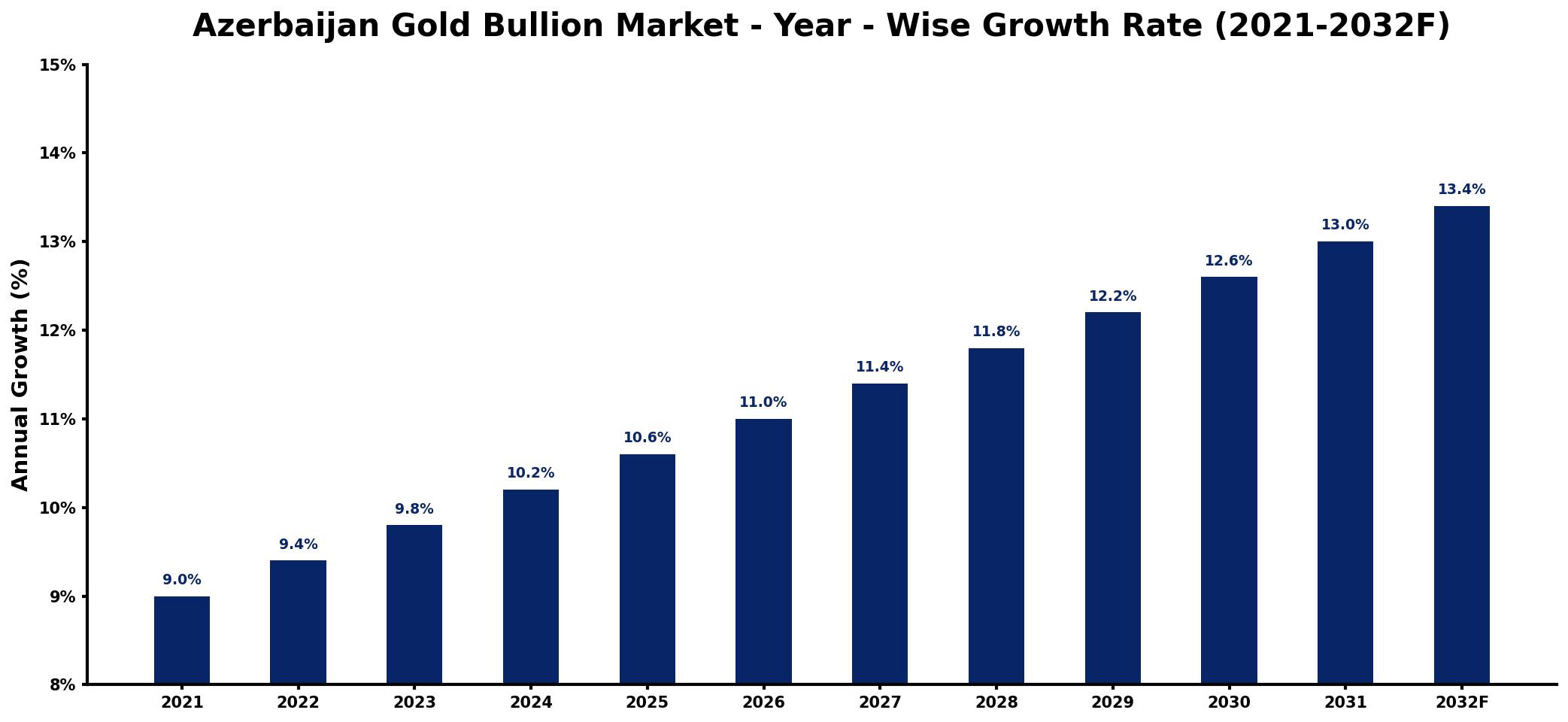
The table below presents the year‑wise growth rates along with the key drivers influencing the market
| Year | Growth Rate | Major Drivers |
| 2021 | 9.0% | Increased investor interest worldwide |
| 2022 | 9.4% | Growing demand from jewelry sector |
| 2023 | 9.8% | Rising inflation hedging strategies |
| 2024 | 10.2% | Expansion in luxury goods market |
| 2025 | 10.6% | Surge in central bank purchases |
| 2026 | 11.0% | Strengthening economic stability forecast |
| 2027 | 11.4% | Increased retail investor participation |
| 2028 | 11.8% | Heightened geopolitical uncertainty driving |
| 2029 | 12.2% | Emerging market investment diversification |
| 2030 | 12.6% | Technological advancements in mining |
| 2031 | 13.0% | Growing popularity of sustainable investments |
| 2032 | 13.4% | Expansion of financial product offerings |
Note: Market size estimations and growth projections presented in this report are based on 6Wresearch's proprietary forecasting methodology, utilizing the latest available industry data, government publications, and primary research inputs.
Azerbaijan Gold Bullion Market Synopsis
In Azerbaijan, the gold bullion market has seen a surge in interest as both retail investors and high-net-worth individuals recognize the asset's value in diversifying their portfolios. The availability of a range of gold bullion products, including locally minted coins and internationally recognized bars, has made it easier for investors to access this market.
Government efforts to educate the public about the benefits of gold investment are paving the way for more robust market participation. Despite facing certain regulatory challenges, the overall outlook remains optimistic as awareness of gold's potential as a secure store of value continues to grow.
Azerbaijan Gold Bullion Market Key Takeaways
- The growing demand for physical gold as a hedge against economic volatility drives market expansion.
- Government incentives and educational programs are enhancing investor participation in the sector.
- Increased awareness among the population about gold as an investment option is positively impacting market dynamics.
- The availability of diverse gold bullion products from local and international sources is attracting a wider range of investors.
- Future market growth will be contingent on overcoming challenges related to regulation and market infrastructure.
Evaluation of Restraints in Azerbaijan Gold Bullion Market
Despite its growth potential, the Azerbaijan Gold Bullion Market faces several constraints. Limited public awareness and understanding of gold as an investment option can hinder broader participation. The lack of efficient infrastructure for trading and securely storing physical gold presents additional barriers. Regulatory constraints also contribute to market apprehension, while concerns about counterfeit products further complicate the landscape. Investors must navigate fluctuations in global gold prices and currency exchange rates, which can add layers of uncertainty to their investment strategies.
Azerbaijan Gold Bullion Market Trends
Emerging trends within the Azerbaijan Gold Bullion Market reflect a marked shift towards physical gold as a preferred investment choice. Increased interest in gold-backed investment products is becoming commonplace, with more investors turning to tangible assets amidst economic uncertainty. Additionally, the ongoing global economic instability stemming from the COVID-19 pandemic has strengthened the position of gold as a safe-haven asset. This trend of seeking stability through physical gold is expected to continue, solidifying the market's growth trajectory.
Azerbaijan Gold Bullion Market Opportunities
Investment opportunities in the Azerbaijan Gold Bullion Market are vast, primarily due to the rising appetite for physical gold. With government policies favoring gold as a strategic asset, investors have a prime opportunity to purchase gold bullion bars and coins through reputable dealers or banks. The fluctuations in global gold prices also present potential for price appreciation, allowing savvy investors to capitalize on market dynamics. Educational initiatives to raise awareness about gold's investment benefits will further unlock opportunities for market expansion.
Government Initiatives in the Azerbaijan Gold Bullion Market
The Azerbaijani government has enacted various measures to regulate and stimulate the gold bullion market. Policies instituted by the State Customs Committee mandate that individuals declare gold bullion over a certain weight when traveling internationally, thereby deterring illegal trade. Furthermore, the Central Bank of Azerbaijan plays a critical role by overseeing the import and export of gold to ensure compliance with international regulations. Taxation on gold transactions is also applied to balance revenue generation with market stability, aiming to promote a robust trading environment.
Future Insights of the Azerbaijan Gold Bullion Market
The future of the Azerbaijan Gold Bullion Market appears bright as economic uncertainties and inflation concerns drive interest in gold as a protective asset. As Azerbaijan continues to grow economically, supported by its oil and gas sector, the appeal of gold as a hedge against volatility is likely to increase. With sustained government efforts to promote gold as a viable investment and a continued development of trading infrastructure, the market is well-positioned for growth. However, stakeholders must remain vigilant regarding regulatory changes and competition from alternative investments that could shape future dynamics.
Azerbaijan Gold Bullion Market Latest Developments (2025 - 2026)
Recent developments within the Azerbaijan Gold Bullion Market indicate a significant push towards enhancing trading platforms and improving transparency in transactions. Efforts to combat counterfeit products have led to the implementation of stricter regulations and technological advancements aimed at verifying the authenticity of gold bullion. Additionally, rising global gold prices have prompted increased interest from both retail and institutional investors, reflecting a positive trend in market engagement and activity.
Azerbaijan Gold Bullion Market - Key Attractiveness of the Report
- 10 Years of Market Numbers
- Historical Data Starting from 2022 to 2025
- Base Year: 2025
- Forecast Data until 2032
- Key Performance Indicators Impacting the Market
- Major Upcoming Developments and Projects
Key Highlights of the Report:
- Azerbaijan Gold Bullion Market Outlook
- Market Size of Azerbaijan Gold Bullion Market, 2025
- Forecast of Azerbaijan Gold Bullion Market, 2032
- Historical Data and Forecast of Azerbaijan Gold Bullion Revenues & Volume for the Period 2022-2032F
- Azerbaijan Gold Bullion Market Trend Evolution
- Azerbaijan Gold Bullion Market Drivers and Challenges
- Azerbaijan Gold Bullion Price Trends
- Azerbaijan Gold Bullion Porter's Five Forces
- Azerbaijan Gold Bullion Industry Life Cycle
- Historical Data and Forecast of Azerbaijan Gold Bullion Market Revenues & Volume By Type for the Period 2022-2032F
- Historical Data and Forecast of Azerbaijan Gold Bullion Market Revenues & Volume By Gold Bar for the Period 2022-2032F
- Historical Data and Forecast of Azerbaijan Gold Bullion Market Revenues & Volume By Gold Coin for the Period 2022-2032F
- Historical Data and Forecast of Azerbaijan Gold Bullion Market Revenues & Volume By Distribution Channel for the Period 2022-2032F
- Historical Data and Forecast of Azerbaijan Gold Bullion Market Revenues & Volume By Online for the Period 2022-2032F
- Historical Data and Forecast of Azerbaijan Gold Bullion Market Revenues & Volume By Offline for the Period 2022-2032F
- Azerbaijan Gold Bullion Import Export Trade Statistics
- Market Opportunity Assessment By Type
- Market Opportunity Assessment By Distribution Channel
- Azerbaijan Gold Bullion Top Companies Market Share
- Azerbaijan Gold Bullion Competitive Benchmarking By Technical and Operational Parameters
- Azerbaijan Gold Bullion Company Profiles
- Azerbaijan Gold Bullion Key Strategic Recommendations






































