Azerbaijan Greenhouse Horticulture Market Size, Share & Growth Rate
The Azerbaijan Greenhouse Horticulture Market was estimated at USD 257 Million in 2025 and is projected to reach USD 325 Million by 2032, growing at a CAGR of 3.4% from 2026 to 2032. This growth trajectory is propelled by the increasing domestic demand for fresh, pesticide-free produce and the strategic government initiatives aimed at enhancing agricultural productivity. As technological advancements continue to reshape farming practices, the market's potential for expansion appears robust and enticing for investors.
Azerbaijan Greenhouse Horticulture Market Year-wise Growth Rate and Key Drivers
This graph highlights how the Azerbaijan Greenhouse Horticulture Market has steadily grown over the years, supported by major growth factors.
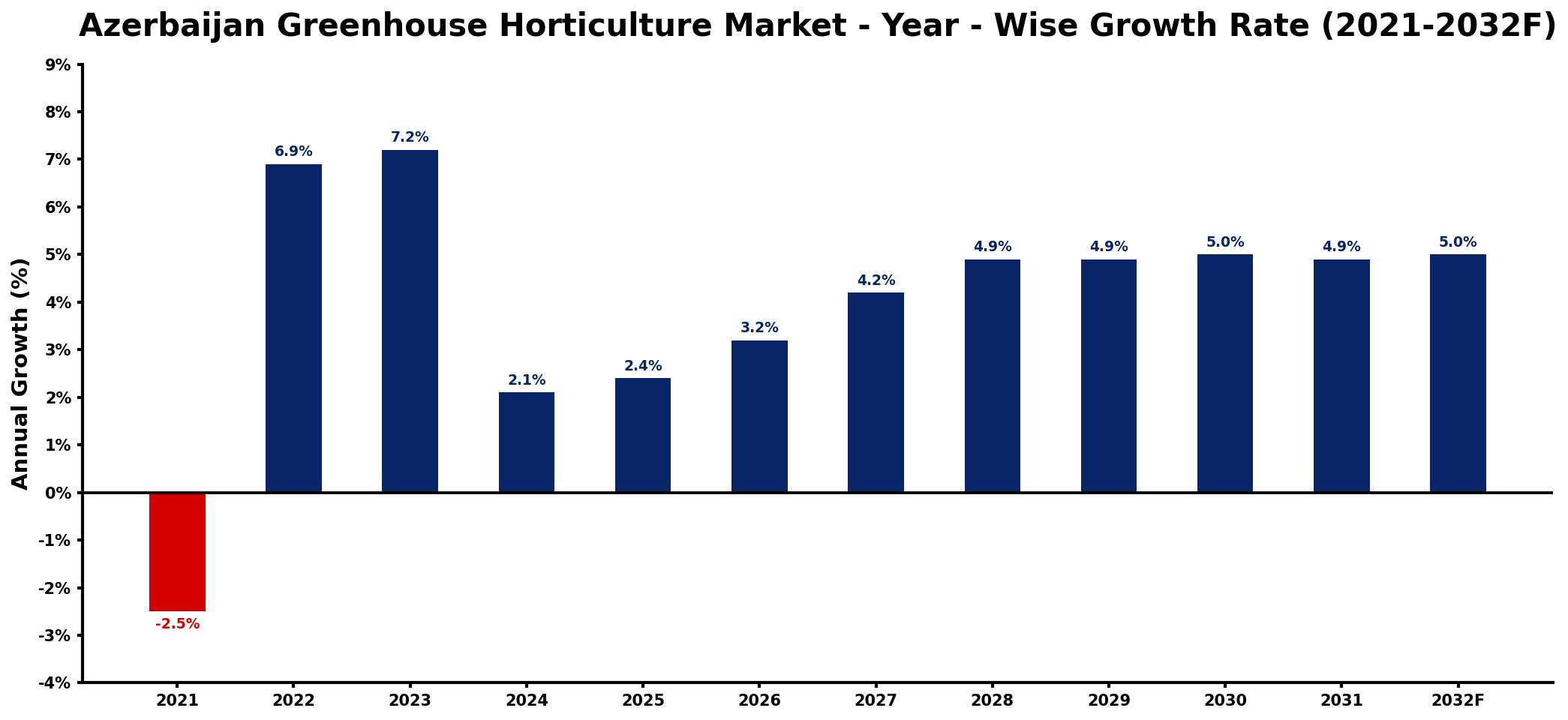
The table below presents the year‑wise growth rates along with the key drivers influencing the market
| Year | Growth Rate | Major Drivers |
| 2021 | -2.5% | reduced consumer purchasing power |
| 2022 | 6.9% | increased investment in technology |
| 2023 | 7.2% | growing export market opportunities |
| 2024 | 2.1% | rising health consciousness among consumers |
| 2025 | 2.4% | expansion of local production facilities |
| 2026 | 3.2% | improvements in supply chain logistics |
| 2027 | 4.2% | increased government support initiatives |
| 2028 | 4.9% | growing interest in sustainable practices |
| 2029 | 4.9% | enhanced agricultural research funding |
| 2030 | 5.0% | expansion into new markets |
| 2031 | 4.9% | collaborations with international partners |
| 2032 | 5.0% | adoption of innovative farming techniques |
Note: Market size estimations and growth projections presented in this report are based on 6Wresearch's proprietary forecasting methodology, utilizing the latest available industry data, government publications, and primary research inputs.
Azerbaijan Greenhouse Horticulture Market Synopsis
In Azerbaijan, the burgeoning preference for high-quality and locally sourced produce is fostering a vibrant greenhouse horticulture sector. A variety of crops, notably tomatoes, cucumbers, and peppers, are being cultivated, allowing growers to meet both local and international demand effectively.
Moreover, the countrys climate is highly conducive to greenhouse farming, supporting year-round cultivation. This climatic advantage, combined with technological innovation, positions Azerbaijan as an emerging hub for greenhouse horticulture in the region.
Azerbaijan Greenhouse Horticulture Market Key Takeaways
- Strong growth driven by increasing consumer preference for fresh, locally produced vegetables.
- Government initiatives play a crucial role in enhancing agricultural productivity and sustainability.
- Modern greenhouse technologies are being adopted to improve crop yields and reduce environmental impact.
- Investment opportunities abound in sustainable practices and advanced greenhouse systems.
- Strategic collaborations are fostering innovation and knowledge-sharing among market stakeholders.
Evaluation of Restraints in Azerbaijan Greenhouse Horticulture Market
Despite its growth potential, the Azerbaijan greenhouse horticulture market faces notable constraints. Limited access to advanced technology hampers the efficiency and productivity of growers. Additionally, the infrastructure necessary for effective production and distribution remains underdeveloped, leading to challenges in bringing products to market promptly. Furthermore, inconsistency in government policies and support can create uncertainty, making long-term planning and investment more complex for stakeholders.
Azerbaijan Greenhouse Horticulture Market Trends
The market is currently witnessing a significant shift towards sustainable farming practices, including organic cultivation and the implementation of energy-efficient greenhouse structures. Technological trends such as hydroponic systems and vertical farming are gaining traction, allowing growers to maximize yield while optimizing resource use. Furthermore, there is a growing consumer preference for high-value crops, which is steering cultivation strategies towards premium quality vegetables that cater to sophisticated tastes.
Azerbaijan Greenhouse Horticulture Market Opportunities
Investment opportunities in the Azerbaijan greenhouse horticulture market are becoming increasingly attractive, driven by the demand for high-quality agricultural products. Investors can benefit from modernizing greenhouse technologies and enhancing infrastructure to support the growing appetite for fresh produce, flowers, and herbs. Additionally, implementing sustainable agricultural practices and advanced irrigation systems is anticipated to boost both productivity and profitability in the sector.
Government Initiatives in the Azerbaijan Greenhouse Horticulture Market
The Azerbaijani government has launched a series of policies designed to foster the growth of the greenhouse horticulture sector. These include providing financial assistance, tax incentives, and subsidies to stimulate investment in greenhouse farming. Moreover, the government is dedicated to improving critical infrastructure, such as irrigation systems, which is essential for enhancing productivity. There is also an emphasis on promoting environmentally friendly practices to ensure the long-term sustainability of the industry.
Future Insights of the Azerbaijan Greenhouse Horticulture Market
Looking ahead to 2026-2032, the Azerbaijan greenhouse horticulture market is set for steady growth, supported by rising consumer demand for fresh produce and the increasing awareness of the benefits of greenhouse cultivation. With advancements in technology and a favorable climate for agricultural activities, the sector is expected to expand significantly. Investments in innovative practices and efficient resource management will further enhance productivity, positioning the market for sustained success in both domestic and export arenas.
Azerbaijan Greenhouse Horticulture Market Latest Developments (2025 - 2026)
In recent months, the Azerbaijan greenhouse horticulture market has seen a surge in activity, with an emphasis on technology adoption and sustainable farming practices. Collaborative projects between local farmers, agricultural researchers, and governmental bodies are paving the way for innovation and efficiency improvements. As a result, stakeholders are increasingly focusing on high-value crop production to better meet evolving consumer preferences.
Azerbaijan Greenhouse Horticulture Market - Key Attractiveness of the Report
- 10 Years of Market Numbers
- Historical Data Starting from 2022 to 2025
- Base Year: 2025
- Forecast Data until 2032
- Key Performance Indicators Impacting the Market
- Major Upcoming Developments and Projects
Key Highlights of the Report:
- Azerbaijan Greenhouse Horticulture Market Outlook
- Market Size of Azerbaijan Greenhouse Horticulture Market, 2025
- Forecast of Azerbaijan Greenhouse Horticulture Market, 2032
- Historical Data and Forecast of Azerbaijan Greenhouse Horticulture Revenues & Volume for the Period 2022-2032F
- Azerbaijan Greenhouse Horticulture Market Trend Evolution
- Azerbaijan Greenhouse Horticulture Market Drivers and Challenges
- Azerbaijan Greenhouse Horticulture Price Trends
- Azerbaijan Greenhouse Horticulture Porter's Five Forces
- Azerbaijan Greenhouse Horticulture Industry Life Cycle
- Historical Data and Forecast of Azerbaijan Greenhouse Horticulture Market Revenues & Volume By Material Type for the Period 2022-2032F
- Historical Data and Forecast of Azerbaijan Greenhouse Horticulture Market Revenues & Volume By Glass for the Period 2022-2032F
- Historical Data and Forecast of Azerbaijan Greenhouse Horticulture Market Revenues & Volume By Plastic for the Period 2022-2032F
- Historical Data and Forecast of Azerbaijan Greenhouse Horticulture Market Revenues & Volume By Crop Type for the Period 2022-2032F
- Historical Data and Forecast of Azerbaijan Greenhouse Horticulture Market Revenues & Volume By Fruits and Vegetables for the Period 2022-2032F
- Historical Data and Forecast of Azerbaijan Greenhouse Horticulture Market Revenues & Volume By Flowers and Ornamentals for the Period 2022-2032F
- Historical Data and Forecast of Azerbaijan Greenhouse Horticulture Market Revenues & Volume By Nursery Crops for the Period 2022-2032F
- Historical Data and Forecast of Azerbaijan Greenhouse Horticulture Market Revenues & Volume By Others for the Period 2022-2032F
- Historical Data and Forecast of Azerbaijan Greenhouse Horticulture Market Revenues & Volume By Technology for the Period 2022-2032F
- Historical Data and Forecast of Azerbaijan Greenhouse Horticulture Market Revenues & Volume By Heating System for the Period 2022-2032F
- Historical Data and Forecast of Azerbaijan Greenhouse Horticulture Market Revenues & Volume By Cooling System for the Period 2022-2032F
- Azerbaijan Greenhouse Horticulture Import Export Trade Statistics
- Market Opportunity Assessment By Material Type
- Market Opportunity Assessment By Crop Type
- Market Opportunity Assessment By Technology
- Azerbaijan Greenhouse Horticulture Top Companies Market Share
- Azerbaijan Greenhouse Horticulture Competitive Benchmarking By Technical and Operational Parameters
- Azerbaijan Greenhouse Horticulture Company Profiles
- Azerbaijan Greenhouse Horticulture Key Strategic Recommendations






































