Azerbaijan Groceries Market Summary
The azerbaijan groceries market was estimated at USD 1439 Million in 2025 and is projected to reach USD 2577 Million by 2032, growing at a CAGR of 10.0% from 2026 to 2032.
Azerbaijan Groceries Market Year-wise Growth Rate and Key Drivers
This graph highlights how the Azerbaijan Groceries Market has steadily grown over the past five years, supported by major growth factors.
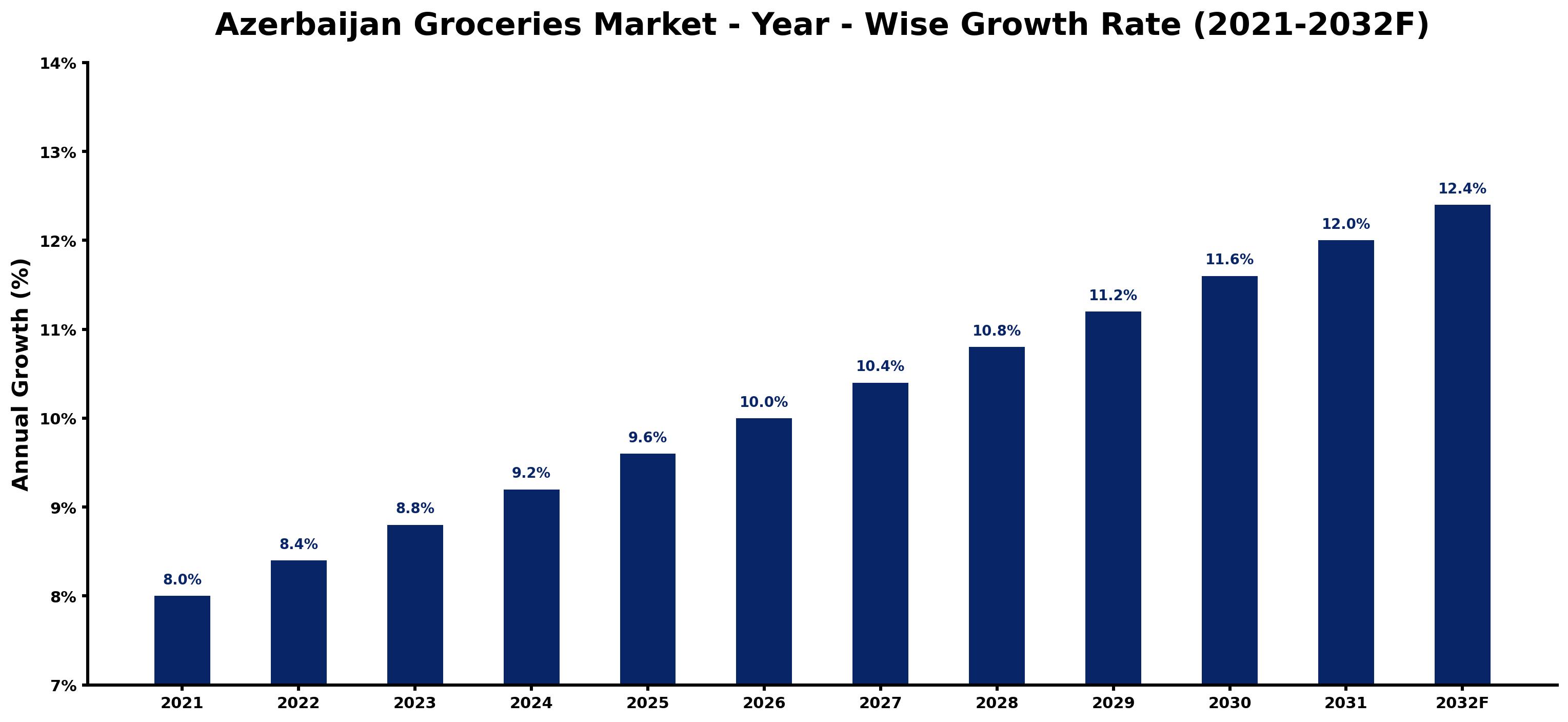
The table below presents the year wise growth rates along with the key drivers influencing the market
| Year | Growth Rate | Major Drivers |
| 2021 | 8.0% | Post-lockdown retail projects emphasized fresh produce accessibility across urban areas. |
| 2022 | 8.4% | E-commerce trends influenced grocery shopping habits, boosting online purchase frequency significantly. |
| 2023 | 8.8% | Local sourcing initiatives helped elevate the presence of regional agricultural products. |
| 2024 | 9.2% | Increased urbanization led to higher demand for convenient grocery delivery services. |
| 2025 | 9.6% | Sustainability awareness prompted a surge in organic and eco-friendly product offerings. |
| 2026 | 10.0% | Adoption of technology in supply chains improved inventory management and reduced waste. |
| 2027 | 10.4% | Cultural shifts towards health-conscious eating spurred growth in nutritional product lines. |
| 2028 | 10.8% | Improvements in transportation infrastructure enabled wider distribution of grocery goods. |
| 2029 | 11.2% | Strong public interest in food safety led to stricter quality control measures. |
| 2030 | 11.6% | Innovative marketing strategies targeted younger demographics via social media platforms. |
| 2031 | 12.0% | Collaboration between local farms and retailers strengthened direct-to-consumer channels. |
| 2032 | 12.4% | Emergence of specialty grocery stores catered to expatriates and diverse communities. |
Note - Market size estimations and growth projections presented in this report are based on 6Wresearch's advanced forecasting approach, validated with industry datasets as of June 2026.
Azerbaijan Groceries Market Synopsis
The Azerbaijan Groceries Market is projected to reach 10.0% and witness significant growth during the forecast period (2026-2032). This market is expected to experience a compound annual growth rate (CAGR) of 5.3%, primarily driven by an increasing population and rising disposable incomes among consumers. The expansion of retail infrastructure, facilitated by economic reforms implemented by the government, is notably enhancing access to a variety of grocery options, including packaged and convenience foods.
Azerbaijan Groceries Market Growth Drivers
The growth of the Azerbaijan Groceries Market can be attributed to several key factors:
- The increasing population, coupled with a demographic shift towards urban living, is elevating the demand for diverse grocery options across urban centers.
- Rising disposable incomes among consumers are leading to enhanced purchasing power, enabling families to opt for higher-quality grocery products and convenience foods.
- The development of retail infrastructure, particularly the proliferation of supermarkets and hypermarkets, is improving consumer access to a broader range of grocery products.
- Government initiatives, including tax exemptions on essential grocery items, are further incentivizing shopping behavior and increasing demand for groceries.
- The trend towards online shopping is reshaping the grocery landscape, with many consumers preferring the convenience of e-commerce platforms for their grocery needs.
Azerbaijan Groceries Market Trends and Opportunities
Within the Azerbaijan Groceries Market, several emerging trends and opportunities can influence future growth:
- There is a noticeable shift in consumer preferences towards organic and health-conscious food products, creating opportunities for businesses to cater to this growing segment.
- The introduction of loyalty programs and personalized marketing strategies by grocery retailers is becoming increasingly common, enhancing customer retention and boosting sales.
- Technology adoption in grocery shopping, such as the use of mobile apps and e-commerce platforms, is reshaping consumer experiences and improving operational efficiencies for retailers.
- Collaboration between local producers and retailers is becoming essential to meet increasing consumer demand for fresh and locally sourced products.
- The rise of sustainability concerns is prompting retailers to focus on eco-friendly packaging and sourcing methods, aligning with consumer values and improving brand perception.
Azerbaijan Groceries Market Challenges and Restraints
While the Azerbaijan Groceries Market exhibits promising growth potential, it faces several challenges that may hinder progress:
- Fluctuations in import tariffs and local regulations can impact the availability and pricing of grocery products, creating volatility in the market.
- Consumer price sensitivity may lead to a preference for lower-cost options, potentially affecting the profitability of premium grocery segments.
- Supply chain disruptions, exacerbated by global events, can lead to inventory shortages and operational challenges for retailers.
- The reliance on traditional shopping methods by segments of the population may impede the full-scale adoption of online grocery shopping.
- Intense competition among retailers can lead to price wars, negatively impacting profit margins across the grocery sector.
Azerbaijan Groceries Market Government Investment and Initiatives
The Azerbaijan government is actively investing in initiatives aimed at boosting the groceries market through various public spending and development plans. These include:
- Implementation of economic reforms that are designed to stimulate domestic production and reduce reliance on imports, fostering growth within local grocery sectors.
- Provision of incentives, such as tax exemptions for certain grocery products, aimed at increasing affordability and accessibility for consumers.
- Investment in infrastructure improvements, including transportation and logistics networks, to enhance the distribution of grocery products across urban and rural areas.
- Support for small and medium-sized enterprises (SMEs) in the grocery sector through funding and resource allocation to facilitate their growth and integration into the market.
- Promotion of agricultural reforms that encourage sustainable farming practices, ultimately leading to a more robust supply of fresh groceries for consumers.
Azerbaijan Groceries Market Latest Developments (May 2025 - June 2026)
Recent developments within the Azerbaijan Groceries Market from May 2025 to June 2026 indicate notable trends and shifts in the industry landscape:
- The proliferation of digital platforms for grocery shopping has seen a substantial increase, with more retailers launching online services in response to changing consumer behavior.
- Partnerships between grocery retailers and local producers are on the rise, ensuring a fresher, more diverse range of products for consumers while supporting local agriculture.
- Health and wellness trends are influencing product offerings, with many retailers expanding their selections of organic and health-focused grocery items.
- Retailers are increasingly implementing sustainability initiatives, including waste reduction programs and eco-friendly packaging solutions to meet consumer expectations.
- Government policies aimed at enhancing food safety and quality standards are evolving, impacting how groceries are produced, marketed, and regulated.
Azerbaijan Groceries Market - Key Attractiveness of the Report
- 10 Years of Market Numbers
- Historical Data Starting from 2022 to 2025
- Base Year: 2025
- Forecast Data until 2032
- Key Performance Indicators Impacting the Market
- Major Upcoming Developments and Projects
Key Highlights of the Report:
- Azerbaijan Groceries Market Outlook
- Market Size of Azerbaijan Groceries Market, 2025
- Forecast of Azerbaijan Groceries Market, 2032F
- Historical Data and Forecast of Azerbaijan Groceries Revenues & Volume for the Period 2022-2032F
- Azerbaijan Groceries Market Trend Evolution
- Azerbaijan Groceries Market Drivers and Challenges
- Azerbaijan Groceries Price Trends
- Azerbaijan Groceries Porter's Five Forces
- Azerbaijan Groceries Industry Life Cycle
- Historical Data and Forecast of Azerbaijan Groceries Market Revenues & Volume By Product Types for the Period 2022-2032F
- Historical Data and Forecast of Azerbaijan Groceries Market Revenues & Volume By Packaged Food for the Period 2022-2032F
- Historical Data and Forecast of Azerbaijan Groceries Market Revenues & Volume By Unpackaged Food for the Period 2022-2032F
- Historical Data and Forecast of Azerbaijan Groceries Market Revenues & Volume By Drinks for the Period 2022-2032F
- Historical Data and Forecast of Azerbaijan Groceries Market Revenues & Volume By Tobacco for the Period 2022-2032F
- Historical Data and Forecast of Azerbaijan Groceries Market Revenues & Volume By Household Products for the Period 2022-2032F
- Historical Data and Forecast of Azerbaijan Groceries Market Revenues & Volume By Others for the Period 2022-2032F
- Historical Data and Forecast of Azerbaijan Groceries Market Revenues & Volume By Distribution Channel for the Period 2022-2032F
- Historical Data and Forecast of Azerbaijan Groceries Market Revenues & Volume By Supermarkets & Hypermarkets for the Period 2022-2032F
- Historical Data and Forecast of Azerbaijan Groceries Market Revenues & Volume By Convenience Store for the Period 2022-2032F
- Historical Data and Forecast of Azerbaijan Groceries Market Revenues & Volume By Online for the Period 2022-2032F
- Azerbaijan Groceries Import Export Trade Statistics
- Market Opportunity Assessment By Product Types
- Market Opportunity Assessment By Distribution Channel
- Azerbaijan Groceries Top Companies Market Share
- Azerbaijan Groceries Competitive Benchmarking By Technical and Operational Parameters
- Azerbaijan Groceries Company Profiles
- Azerbaijan Groceries Key Strategic Recommendations






































