Azerbaijan Hospital Equipment And Supplies Market Size, Share & Growth Rate
The Azerbaijan Hospital Equipment And Supplies Market was estimated at USD 614 Million in 2025 and is projected to reach USD 1081 Million by 2032, growing at a CAGR of 8.4% from 2026 to 2032. This upward trajectory is bolstered by substantial government investments aimed at healthcare infrastructure enhancement and an increasing focus on modernizing medical facilities. Additionally, the burgeoning medical tourism sector is compelling hospitals to upgrade their equipment to meet international standards, further driving market growth.
Azerbaijan Hospital Equipment And Supplies Market Year-wise Growth Rate and Key Drivers
This graph highlights how the Azerbaijan Hospital Equipment And Supplies Market has steadily grown over the years, supported by major growth factors.
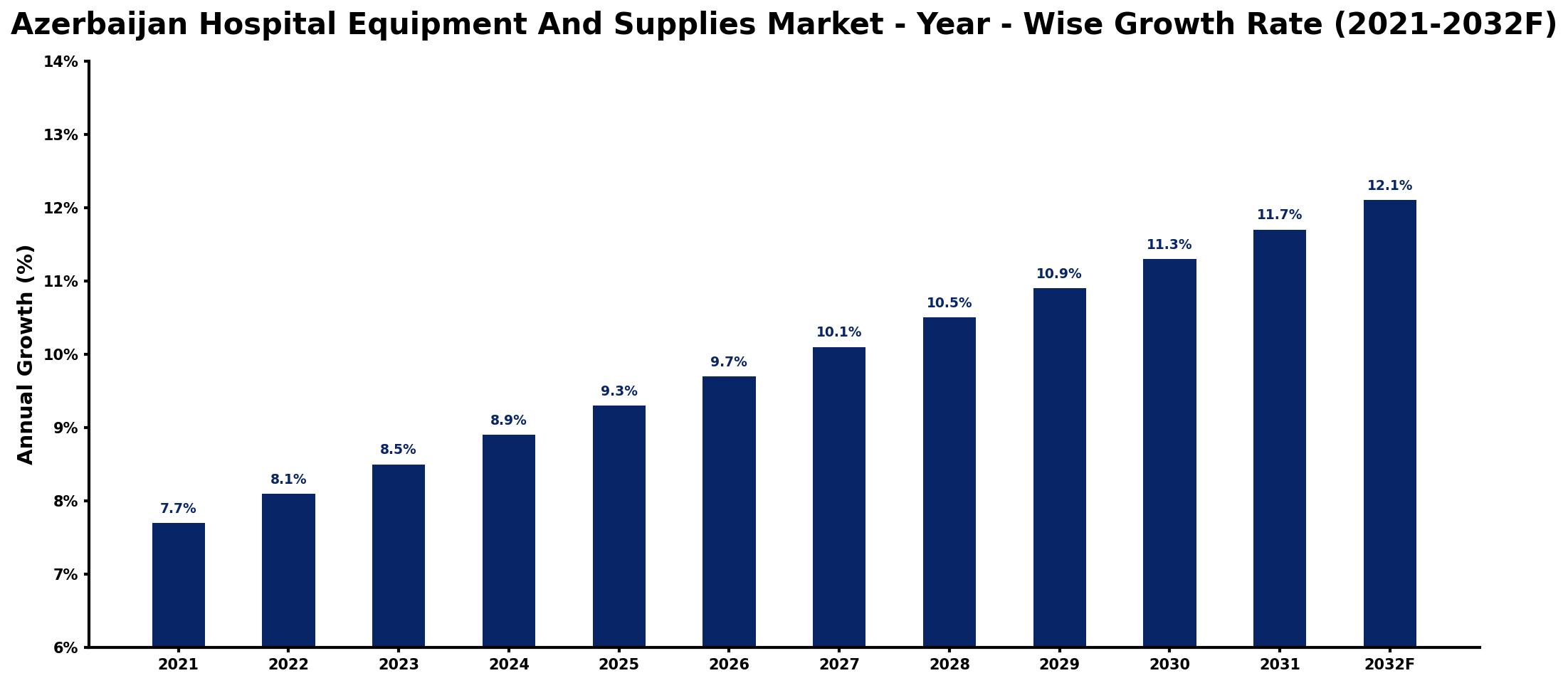
The table below presents the year‑wise growth rates along with the key drivers influencing the market
| Year | Growth Rate | Major Drivers |
| 2021 | 7.7% | increased healthcare infrastructure investments |
| 2022 | 8.1% | growing aging population demand |
| 2023 | 8.5% | rising awareness of health services |
| 2024 | 8.9% | expansion of private healthcare facilities |
| 2025 | 9.3% | advancements in medical technology adoption |
| 2026 | 9.7% | increased government healthcare funding |
| 2027 | 10.1% | growing telemedicine service utilization |
| 2028 | 10.5% | rising chronic disease prevalence |
| 2029 | 10.9% | enhanced medical training programs |
| 2030 | 11.3% | stronger distribution network expansion |
| 2031 | 11.7% | increased foreign direct investments |
| 2032 | 12.1% | growing emphasis on preventive care |
Note: Market size estimations and growth projections presented in this report are based on 6Wresearch's proprietary forecasting methodology, utilizing the latest available industry data, government publications, and primary research inputs.
Azerbaijan Hospital Equipment And Supplies Market Synopsis
Recent momentum in Azerbaijans hospital equipment and supplies market reflects a robust commitment to enhancing healthcare services through improved infrastructure and advanced medical technology. However, as the government continues to push for modernization, the market is poised for significant growth, aligning with healthcare demands and patient expectations.
Azerbaijans strategic investments in healthcare facilities are critical to its market evolution. In parallel, the countrys aspirations to become a leading medical tourism destination create an urgency for local hospitals to adopt cutting-edge medical equipment and high-quality supplies, which are essential for providing top-notch healthcare services.
Azerbaijan Hospital Equipment And Supplies Market Key Takeaways
- Growing healthcare infrastructure investments are driving equipment demand across facilities.
- The influx of medical tourists is prompting hospitals to upgrade to internationally accepted standards.
- Government initiatives are focused on ensuring quality, safety, and affordability in healthcare supplies.
- Challenges such as budget constraints can impact procurement capabilities and service delivery.
- Regulatory frameworks are enhancing market transparency and competitive dynamics.
Evaluation of Restraints in Azerbaijan Hospital Equipment And Supplies Market
Despite the promising growth of the Azerbaijan hospital equipment and supplies market, significant restraints remain. Primarily, budget constraints pose challenges for healthcare facilities, as limited funding affects the procurement of advanced medical equipment and supplies. This situation can hinder hospitals from maintaining adequate inventory levels necessary for delivering comprehensive patient care. Moreover, financial limitations may restrict the ability to adopt innovative technologies, ultimately impacting the quality of healthcare services provided across the nation.
Azerbaijan Hospital Equipment And Supplies Market Trends
Emerging trends in the Azerbaijan hospital equipment and supplies market include the integration of smart technologies into medical devices, enhancing diagnostic and treatment processes. Additionally, there is a noticeable shift toward environmentally sustainable medical supplies, as healthcare providers increasingly recognize the importance of eco-friendly practices. Another trend is the rising emphasis on telemedicine, necessitating advanced telehealth equipment and infrastructure to support remote patient care.
Azerbaijan Hospital Equipment And Supplies Market Opportunities
The Azerbaijan market presents genuine opportunities for growth, particularly in the medical tourism segment. As international patients seek affordable yet high-quality healthcare services, hospitals are encouraged to invest in state-of-the-art equipment and technologies. Furthermore, public-private partnerships can foster innovation and improve the procurement process, paving the way for an efficient and competitive market environment. There is also room for development in training programs for healthcare professionals, ensuring the effective utilization of advanced medical technologies.
Government Initiatives in the Azerbaijan Hospital Equipment And Supplies Market
The Azerbaijani government is actively promoting initiatives aimed at strengthening the healthcare sector, focusing on infrastructure development and quality service delivery. Policies are being implemented to enhance access to essential medical supplies and advanced equipment for healthcare facilities across the country. Additionally, the government supports various training programs for healthcare professionals to ensure that they are well-equipped to utilize new technologies, thereby improving overall patient outcomes.
Future Insights of the Azerbaijan Hospital Equipment And Supplies Market
Looking ahead to 2026-2032, the Azerbaijan hospital equipment and supplies market is expected to continue its expansion, fueled by ongoing government investments and a burgeoning medical tourism industry. As healthcare providers modernize their facilities to accommodate a growing influx of international patients, the demand for advanced medical technologies and high-quality consumables will remain strong. Furthermore, continuous improvements in regulatory frameworks will foster a competitive landscape, promoting innovation and better healthcare delivery.
Azerbaijan Hospital Equipment And Supplies Market Latest Developments (2025 - 2026)
Recent developments in the Azerbaijan hospital equipment and supplies market indicate a strategic focus on upgrading existing healthcare infrastructure and enhancing service capabilities. Healthcare providers are increasingly prioritizing investments in modern medical equipment in response to the rising number of medical tourists. Additionally, there is a growing trend toward implementing telehealth solutions and sustainable practices within healthcare facilities, reflecting the market's adaptability to changing patient needs and global health trends.
Azerbaijan Hospital Equipment And Supplies Market - Key Attractiveness of the Report
- 10 Years of Market Numbers
- Historical Data Starting from 2022 to 2025
- Base Year: 2025
- Forecast Data until 2032
- Key Performance Indicators Impacting the Market
- Major Upcoming Developments and Projects
Key Highlights of the Report:
- Azerbaijan Hospital Equipment And Supplies Market Outlook
- Market Size of Azerbaijan Hospital Equipment And Supplies Market, 2025
- Forecast of Azerbaijan Hospital Equipment And Supplies Market, 2032
- Historical Data and Forecast of Azerbaijan Hospital Equipment And Supplies Revenues & Volume for the Period 2022-2032F
- Azerbaijan Hospital Equipment And Supplies Market Trend Evolution
- Azerbaijan Hospital Equipment And Supplies Market Drivers and Challenges
- Azerbaijan Hospital Equipment And Supplies Price Trends
- Azerbaijan Hospital Equipment And Supplies Porter's Five Forces
- Azerbaijan Hospital Equipment And Supplies Industry Life Cycle
- Historical Data and Forecast of Azerbaijan Hospital Equipment And Supplies Market Revenues & Volume By Product for the Period 2022-2032F
- Historical Data and Forecast of Azerbaijan Hospital Equipment And Supplies Market Revenues & Volume By Sterilization And Disinfectant Equipment for the Period 2022-2032F
- Historical Data and Forecast of Azerbaijan Hospital Equipment And Supplies Market Revenues & Volume By Disposable Hospital Supplies Patient Examination Devices for the Period 2022-2032F
- Historical Data and Forecast of Azerbaijan Hospital Equipment And Supplies Market Revenues & Volume By Syringes And Needles for the Period 2022-2032F
- Historical Data and Forecast of Azerbaijan Hospital Equipment And Supplies Market Revenues & Volume By Application for the Period 2022-2032F
- Historical Data and Forecast of Azerbaijan Hospital Equipment And Supplies Market Revenues & Volume By OEMs for the Period 2022-2032F
- Historical Data and Forecast of Azerbaijan Hospital Equipment And Supplies Market Revenues & Volume By Aftermarket for the Period 2022-2032F
- Azerbaijan Hospital Equipment And Supplies Import Export Trade Statistics
- Market Opportunity Assessment By Product
- Market Opportunity Assessment By Application
- Azerbaijan Hospital Equipment And Supplies Top Companies Market Share
- Azerbaijan Hospital Equipment And Supplies Competitive Benchmarking By Technical and Operational Parameters
- Azerbaijan Hospital Equipment And Supplies Company Profiles
- Azerbaijan Hospital Equipment And Supplies Key Strategic Recommendations






































