Azerbaijan Industrial Analytics Market Size & Growth Rate (2026-2032)
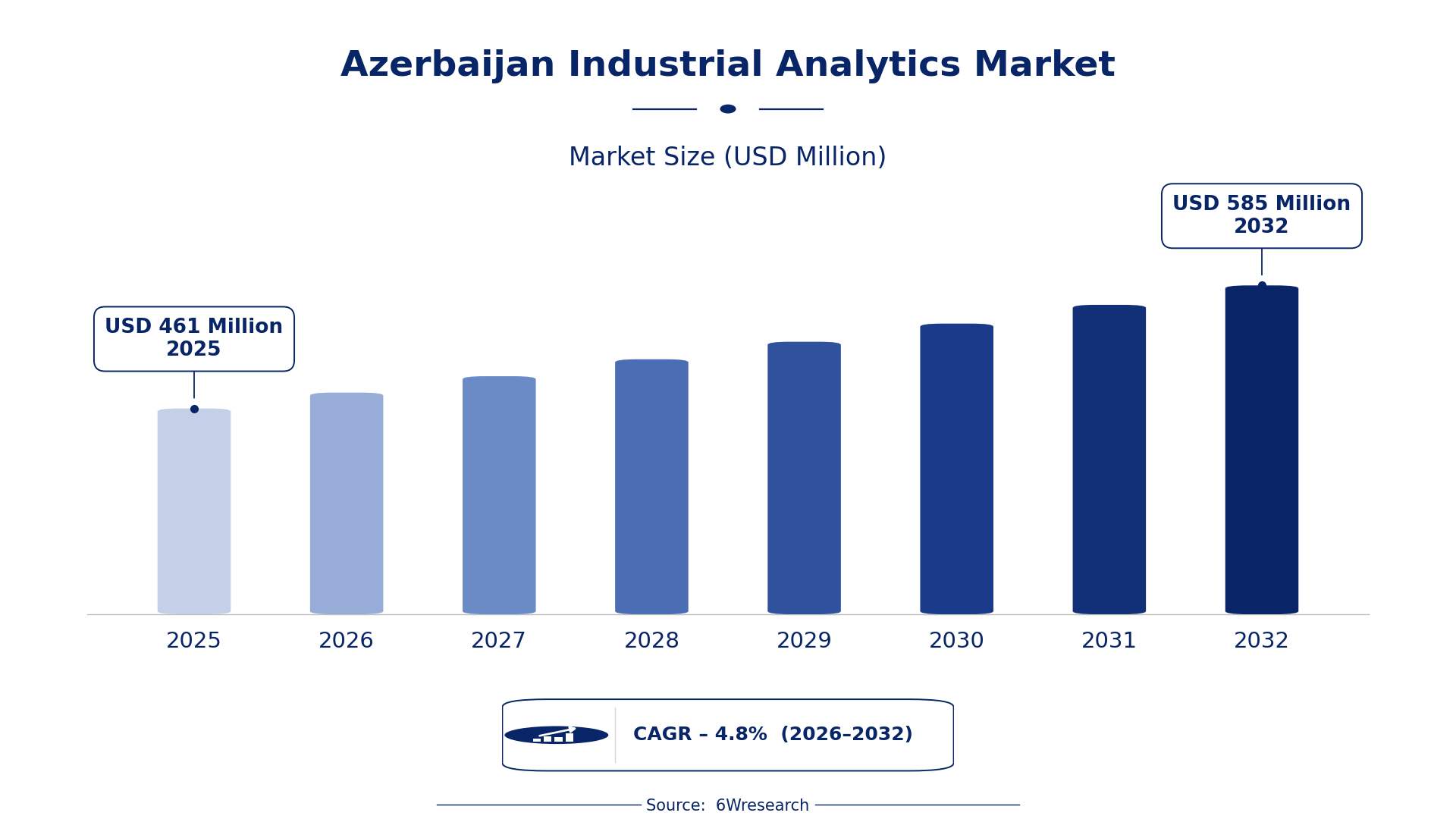
The Azerbaijan Industrial Analytics Market was estimated at USD 461 Million in 2025 and is projected to reach USD 585 Million by 2032, growing at a CAGR of 4.8% from 2026 to 2032.
Azerbaijan Industrial Analytics Market Synopsis
The Azerbaijan Industrial Analytics Market is witnessing a notable shift as industries increasingly leverage advanced analytics to enhance efficiency and reduce operational costs. With strong contributions from sectors like oil and gas, manufacturing, and utilities, the demand for tailored analytics solutions is on the rise, fundamentally altering how businesses operate.
Investments in cloud-based analytics and the integration of Internet of Things (IoT) devices are setting the stage for innovative data-driven strategies. As Azerbaijan progresses towards a digital economy, industrial analytics is becoming a critical component for companies aiming to gain a competitive edge in both local and international markets.
Azerbaijan Industrial Analytics Market Year-wise Growth Rate and Key Drivers
This graph illustrates the annual growth rates of the Azerbaijan Industrial Analytics Market from 2021 to 2032, highlighting a steady upward trajectory and projected expansion over the forecast period.
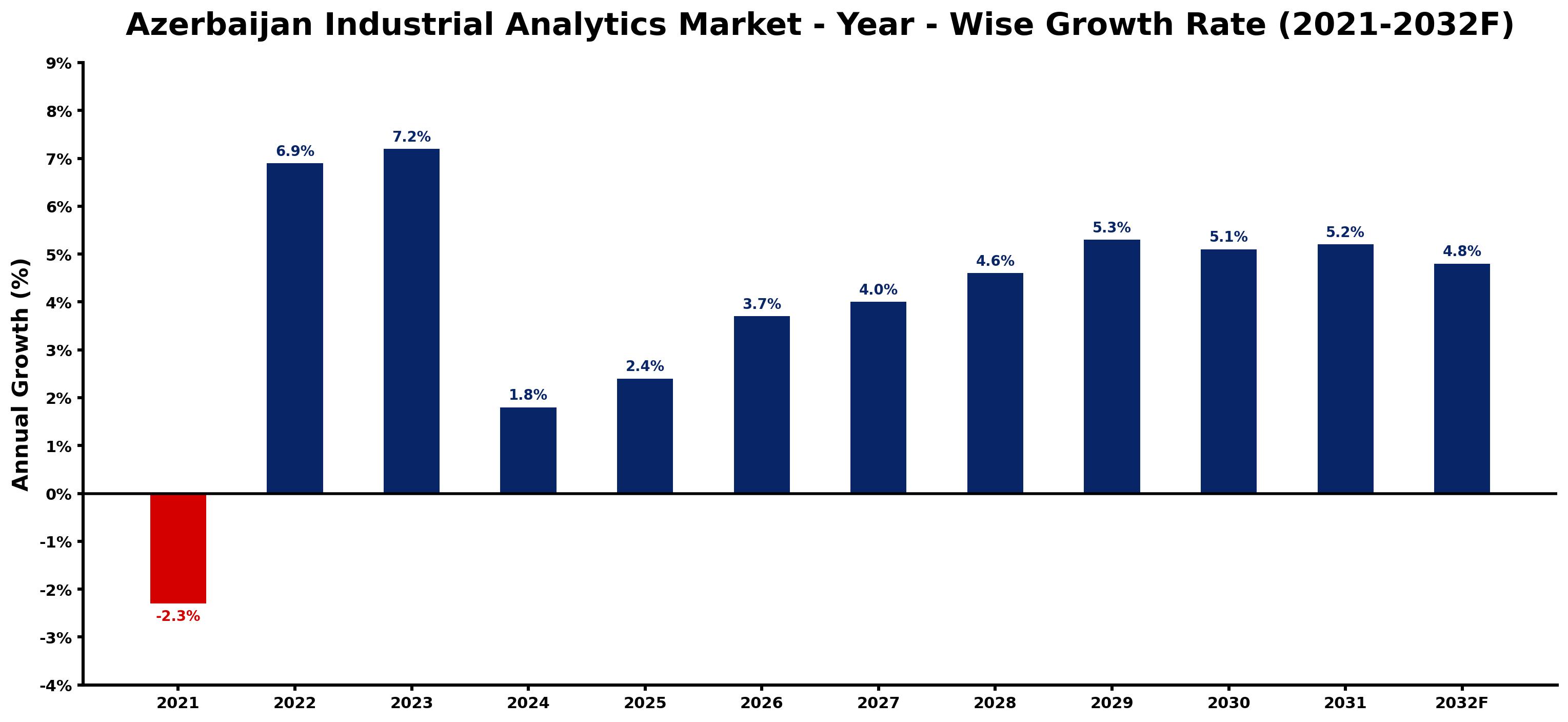
The table below presents the year‑wise growth rates along with the key drivers influencing the market
| Year | Growth Rate | Major Drivers |
| 2021 | -2.3% | Reduced investment from SOCAR due to lower oil prices. |
| 2022 | 6.9% | Increased demand for predictive maintenance in oil sector |
| 2023 | 7.2% | Government support for digital transformation in manufacturing |
| 2024 | 1.8% | Rising local investment in smart factory technologies |
| 2025 | 2.4% | Growing focus on operational efficiency in heavy industries |
| 2026 | 3.7% | Implementation of Industry 4.0 initiatives by local enterprises |
| 2027 | 4.0% | Young workforce engaged in data science education |
| 2028 | 4.6% | Surge in local partnerships for AI analytics development |
| 2029 | 5.3% | Adoption of IoT solutions for real-time analytics |
| 2030 | 5.1% | National policies promoting data-driven decision-making |
| 2031 | 5.2% | Strengthening of cybersecurity regulations fostering analytics growth |
| 2032 | 4.8% | Encouragement of sustainable practices boosting analytics use |
Note: Market size estimations and growth projections presented in this report are based on 6Wresearch's proprietary forecasting methodology, utilizing the latest available industry data, government publications, and primary research inputs.
Azerbaijan Industrial Analytics Market Key Takeaways
Below are some of the specific key takeaways from the market, including:
- The market is experiencing a steady growth trajectory fueled by the adoption of Industry 4.0 technologies.
- Cloud-based analytics solutions are becoming increasingly popular for their scalability and flexibility.
- The integration of artificial intelligence and machine learning is enhancing predictive maintenance capabilities.
- Challenges such as limited awareness among SMEs and data security concerns are hindering broader adoption.
- Government initiatives aimed at digital transformation are creating favorable conditions for market growth.
Evaluation of Restraints in Azerbaijan Industrial Analytics Market
The Azerbaijan Industrial Analytics Market faces several obstacles that impede its growth. A prevalent lack of awareness about the advantages of industrial analytics, especially among small and medium enterprises, is a significant barrier. Many organizations remain hesitant to invest in advanced analytics due to perceived costs and the complexity of implementation.
on top of that, the shortage of skilled professionals in data analytics limits the ability of companies to utilize these technologies effectively. Concerns surrounding data security and privacy further exacerbate the situation, as businesses are cautious about sharing sensitive information. Infrastructure deficiencies in certain regions also complicate the collection and analysis of real-time data, which is essential for effective industrial analytics.
Azerbaijan Industrial Analytics Market Trends
A clear trend in the Azerbaijan Industrial Analytics Market is the increasing reliance on artificial intelligence and machine learning to process vast amounts of industrial data. Real-time analytics is becoming a standard expectation, allowing businesses to optimize operations on the fly. Companies are also favoring cloud-based analytics solutions, which provide enhanced accessibility and scalability.
The proliferation of IIoT devices is another pivotal trend, enabling organizations to gather valuable data for more informed decision-making. This convergence of technologies is not merely about data collection but rather about transforming that data into actionable insights that drive operational efficiency and innovation.
Azerbaijan Industrial Analytics Market Opportunities
Investment opportunities in the Azerbaijan Industrial Analytics Market are abundant, particularly as industries prioritize digital transformation. The demand for predictive maintenance solutions, tailored analytics software, and IoT platforms is on the rise, opening avenues for investors and solution providers alike.
Collaborations with local companies can yield fruitful partnerships, especially given the government's support for innovation and modernization initiatives. As organizations increasingly recognize the importance of data-driven strategies, the potential for market expansion remains significant.
Government Initiatives in the Azerbaijan Industrial Analytics Market
The Azerbaijani government is actively fostering the growth of the Industrial Analytics Market through various initiatives. Recently, they completed the rollout of a national digital infrastructure program aimed at enhancing connectivity and data accessibility across industries. This initiative is expected to bolster the analytics capabilities of numerous sectors.
Currently, the government is implementing regulatory frameworks that provide tax incentives and subsidies for companies investing in industrial analytics technologies. on top of that, plans are underway to establish a center for data analytics research and development, set to launch in the coming years, aimed at promoting collaboration between academia and industry.
Future Insights of the Azerbaijan Industrial Analytics Market
Looking ahead to 2026-2032, the Azerbaijan Industrial Analytics Market is on track for sustained growth. As digitalization continues to permeate the industrial sector, the demand for advanced analytics solutions will only intensify. With the government’s commitment to digital transformation, organizations will increasingly adopt technologies such as IoT and big data analytics.
As industries pivot toward data-driven decision-making and predictive maintenance, the market will likely experience a wave of innovation. This evolution will not only enhance operational efficiencies but also position Azerbaijani companies favorably in the global market.
Azerbaijan Industrial Analytics Market Latest Developments
In the past year, the Azerbaijan Industrial Analytics Market has seen significant advancements. A major technology vendor recently completed a rollout of its predictive maintenance solution, enhancing operational efficiency for several industrial clients. Ongoing collaborations with local enterprises are focused on developing customized analytics platforms tailored to specific industry needs.
Looking ahead, a new initiative to integrate AI capabilities into existing analytics solutions is expected to launch in the second half of 2026, promising to elevate the sophistication of data analytics in the region.
Azerbaijan Industrial Analytics Market - Key Attractiveness of the Report
- 10 Years of Market Numbers
- Historical Data Starting from 2022 to 2025
- Base Year: 2025
- Forecast Data until 2032
- Key Performance Indicators Impacting the Market
- Major Upcoming Developments and Projects
Key Highlights of the Report:
- Azerbaijan Industrial Analytics Market Outlook
- Market Size of Azerbaijan Industrial Analytics Market, 2025
- Forecast of Azerbaijan Industrial Analytics Market, 2032
- Historical Data and Forecast of Azerbaijan Industrial Analytics Revenues & Volume for the Period 2022-2032F
- Azerbaijan Industrial Analytics Market Trend Evolution
- Azerbaijan Industrial Analytics Market Drivers and Challenges
- Azerbaijan Industrial Analytics Price Trends
- Azerbaijan Industrial Analytics Porter's Five Forces
- Azerbaijan Industrial Analytics Industry Life Cycle
- Historical Data and Forecast of Azerbaijan Industrial Analytics Market Revenues & Volume By Component for the Period 2022-2032F
- Historical Data and Forecast of Azerbaijan Industrial Analytics Market Revenues & Volume By Software for the Period 2022-2032F
- Historical Data and Forecast of Azerbaijan Industrial Analytics Market Revenues & Volume By Service for the Period 2022-2032F
- Historical Data and Forecast of Azerbaijan Industrial Analytics Market Revenues & Volume By Software for the Period 2022-2032F
- Historical Data and Forecast of Azerbaijan Industrial Analytics Market Revenues & Volume By Operational analytics for the Period 2022-2032F
- Historical Data and Forecast of Azerbaijan Industrial Analytics Market Revenues & Volume By Risk analytics for the Period 2022-2032F
- Historical Data and Forecast of Azerbaijan Industrial Analytics Market Revenues & Volume By Financial analytics for the Period 2022-2032F
- Historical Data and Forecast of Azerbaijan Industrial Analytics Market Revenues & Volume By Marketing analytics for the Period 2022-2032F
- Historical Data and Forecast of Azerbaijan Industrial Analytics Market Revenues & Volume By Customer analytics for the Period 2022-2032F
- Historical Data and Forecast of Azerbaijan Industrial Analytics Market Revenues & Volume By Workforce analytics for the Period 2022-2032F
- Historical Data and Forecast of Azerbaijan Industrial Analytics Market Revenues & Volume By Service for the Period 2022-2032F
- Historical Data and Forecast of Azerbaijan Industrial Analytics Market Revenues & Volume By Managed services for the Period 2022-2032F
- Historical Data and Forecast of Azerbaijan Industrial Analytics Market Revenues & Volume By Professional services for the Period 2022-2032F
- Historical Data and Forecast of Azerbaijan Industrial Analytics Market Revenues & Volume By Analytics Type for the Period 2022-2032F
- Historical Data and Forecast of Azerbaijan Industrial Analytics Market Revenues & Volume By Descriptive for the Period 2022-2032F
- Historical Data and Forecast of Azerbaijan Industrial Analytics Market Revenues & Volume By Diagnostic for the Period 2022-2032F
- Historical Data and Forecast of Azerbaijan Industrial Analytics Market Revenues & Volume By Predictive for the Period 2022-2032F
- Historical Data and Forecast of Azerbaijan Industrial Analytics Market Revenues & Volume By Prescriptive for the Period 2022-2032F
- Historical Data and Forecast of Azerbaijan Industrial Analytics Market Revenues & Volume By Organization size for the Period 2022-2032F
- Historical Data and Forecast of Azerbaijan Industrial Analytics Market Revenues & Volume By Large enterprises for the Period 2022-2032F
- Historical Data and Forecast of Azerbaijan Industrial Analytics Market Revenues & Volume By Small and medium-sized enterprises for the Period 2022-2032F
- Azerbaijan Industrial Analytics Import Export Trade Statistics
- Market Opportunity Assessment By Component
- Market Opportunity Assessment By Software
- Market Opportunity Assessment By Service
- Market Opportunity Assessment By Analytics Type
- Market Opportunity Assessment By Organization size
- Azerbaijan Industrial Analytics Top Companies Market Share
- Azerbaijan Industrial Analytics Competitive Benchmarking By Technical and Operational Parameters
- Azerbaijan Industrial Analytics Company Profiles
- Azerbaijan Industrial Analytics Key Strategic Recommendations






































