Azerbaijan Industrial Computers Market Summary
The azerbaijan industrial computers market was estimated at USD 384 Million in 2025 and is projected to reach USD 488 Million by 2032, growing at a CAGR of 3.6% from 2026 to 2032.
Azerbaijan Industrial Computers Market Year-wise Growth Rate and Key Drivers
This graph highlights how the Azerbaijan Industrial Computers Market has steadily grown over the past five years, supported by major growth factors.
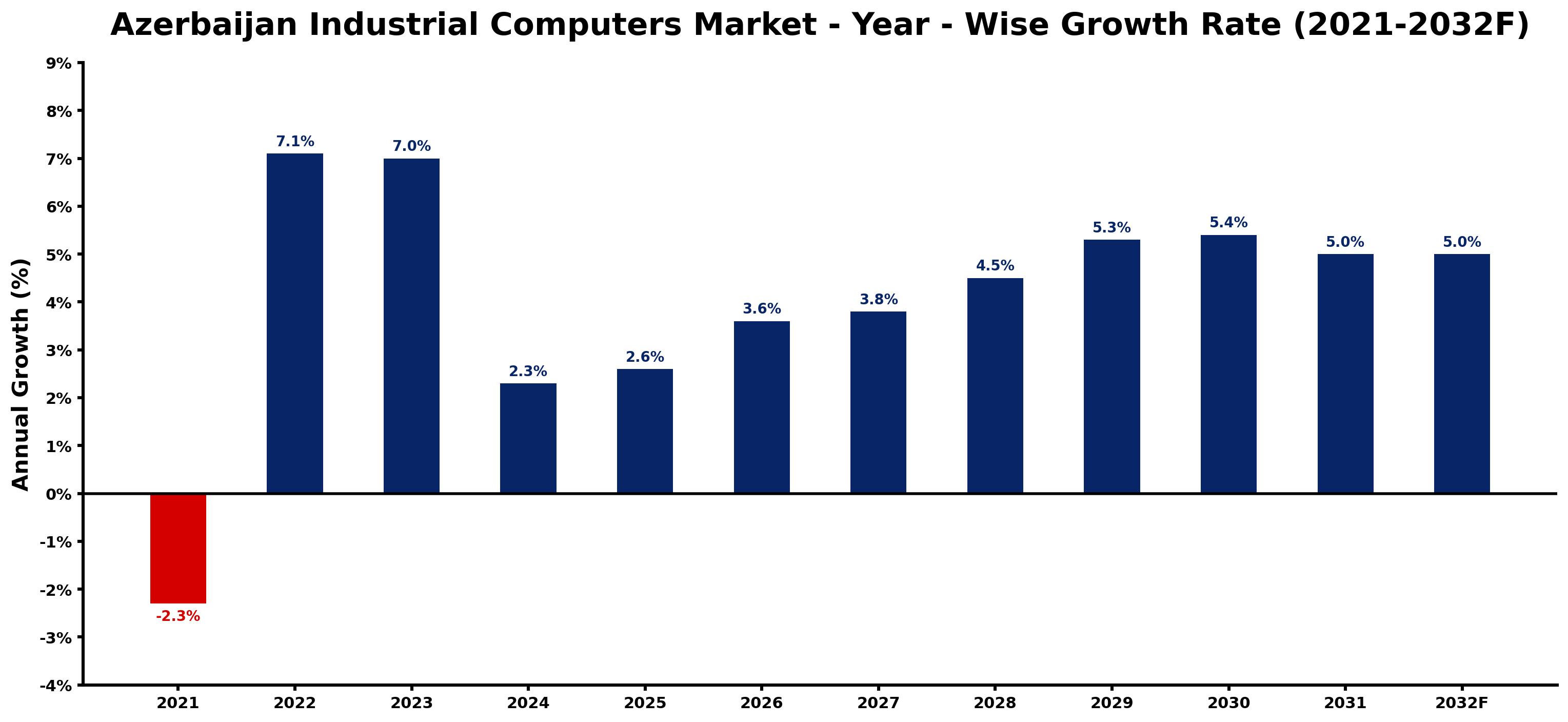
The table below presents the year wise growth rates along with the key drivers influencing the market
| Year | Growth Rate | Major Drivers |
| 2021 | -2.3% | Supply chain disruptions significantly hindered production capabilities, leading to increased delivery times and diminished market availability. |
| 2022 | 7.1% | Local players enter the market, enhancing competition and product offerings significantly. |
| 2023 | 7.0% | Technological integration with IoT devices becomes essential for operational efficiency. |
| 2024 | 2.3% | Emerging sectors like renewable energy generate new opportunities for industrial computers. |
| 2025 | 2.6% | Significant investments in infrastructure projects support demand for advanced computing solutions. |
| 2026 | 3.6% | Industrial automation trends push companies to upgrade their computing technology. |
| 2027 | 3.8% | A shift towards localized production reduces lead times and enhances supply chains. |
| 2028 | 4.5% | Cybersecurity threats increase the need for robust computing systems in industries. |
| 2029 | 5.3% | The oil and gas sector revitalizes, driving investments in specialized computing systems. |
| 2030 | 5.4% | Increased focus on data analytics spurs demand for high-performance industrial computers. |
| 2031 | 5.0% | Transition towards smart manufacturing requires seamless integration of advanced technologies. |
| 2032 | 5.0% | Sustainability goals prompt industries to seek energy-efficient computing solutions. |
Note - Market size estimations and growth projections presented in this report are based on 6Wresearch's advanced forecasting approach, validated with industry datasets as of June 2026.
Azerbaijan Industrial Computers Market Synopsis
The Azerbaijan Industrial Computers Market is projected to reach 3.6% and witness significant growth during the forecast period (2026-2032). This growth is primarily fueled by the increasing levels of automation and digital transformation in key sectors such as manufacturing, oil and gas, and transportation. The demand for robust and reliable industrial computing solutions is becoming paramount as industries seek to enhance productivity and operational efficiency.
Azerbaijan Industrial Computers Market Growth Drivers
Several factors are driving the expansion of the Azerbaijan Industrial Computers Market. Firstly, the ongoing digitalization trends across various industries are leading to an increased reliance on advanced computing technologies. This transition is particularly evident in sectors where precision and real-time data processing are critical. Secondly, government initiatives to support industrial growth and technological advancements are fostering a conducive environment for market expansion.
- The rise of Industry 4.0 technologies is encouraging companies to invest in sophisticated industrial computing solutions, enhancing automation and data analytics capabilities.
- Ruggedized industrial computers capable of withstanding extreme conditions are increasingly sought after, especially in the oil and gas industry.
- Growing digital infrastructure is facilitating better connectivity and data management, which is essential for modern industrial operations.
- The introduction of regulations focusing on cybersecurity is prompting industries to upgrade their computing systems to protect sensitive information.
- Investment in local manufacturing capabilities is expected to reduce reliance on imports, thereby stabilizing prices and improving supply chain reliability.
Azerbaijan Industrial Computers Market Trends and Opportunities
The Azerbaijan Industrial Computers Market is witnessing notable trends that present new opportunities for growth. The rising demand for compact and modular industrial PCs reflects the need for space-efficient solutions within facilities. Additionally, the integration of IoT, AI, and edge computing technologies into industrial processes is transforming how companies operate and manage their systems.
- There is an increasing focus on enhancing cybersecurity features in industrial computers, driven by the need to protect critical infrastructure from cyber threats.
- The migration towards cloud-based services for remote monitoring and data analysis is influencing product development, with more devices incorporating these capabilities.
- Advanced connectivity options, including 5G and Wi-Fi 6, are becoming essential for supporting the growing digitization of industrial operations.
- Companies are increasingly adopting high-performance industrial computing systems that can handle complex tasks and large data volumes efficiently.
- Partnerships between technology providers and local businesses are fostering innovation and enabling tailored solutions that meet the specific needs of Azerbaijani industries.
Azerbaijan Industrial Computers Market Challenges and Restraints
Despite the promising outlook, the Azerbaijan Industrial Computers Market faces several challenges that could hinder its growth. A significant challenge is the limited awareness among businesses regarding advanced industrial computing technologies and their benefits. Additionally, inadequate infrastructure for data management and connectivity poses obstacles to seamless operations.
- There is a notable shortage of skilled professionals capable of effectively implementing and maintaining sophisticated industrial computing systems.
- The reliance on imported technologies can lead to fluctuations in pricing and supply chain disruptions, affecting overall market stability.
- Regulatory compliance is increasingly complex, and businesses must invest resources in ensuring their systems meet evolving standards.
- Cybersecurity concerns remain a priority, necessitating ongoing investment in protective measures to safeguard industrial data.
- Economic fluctuations can impact industrial growth, creating uncertainty in investment decisions within the market.
Azerbaijan Industrial Computers Market Investment Opportunities
The Azerbaijan Industrial Computers Market is ripe with investment opportunities driven by the country's expanding industrial base and a growing push towards automation technologies. Investors may find attractive avenues in sectors such as manufacturing and oil and gas, where the need for advanced computing solutions is acute.
- Investing in rugged industrial computers designed for challenging environments presents significant potential, especially in resource-intensive sectors.
- Opportunities in embedded systems for factory automation are expanding, aligning with the global shift towards smart factories.
- The adoption of Industrial Internet of Things (IIoT) solutions is accelerating, providing a platform for innovative industrial computing applications.
- Collaborating with local distributors can enhance market penetration and access to a broader customer base, facilitating growth.
- Focus on partnerships that drive technological innovation can yield long-term returns as the market continues to evolve.
Azerbaijan Industrial Computers Market Government Investment and Initiatives
The Azerbaijani government is actively promoting the growth of the industrial computers market through a series of investments and initiatives aimed at fostering technological advancement and industrial productivity. These policies are designed to enhance the competitiveness of local industries, encouraging investments in modern computing technologies.
- Government incentives, including tax breaks and grants, encourage businesses to invest in state-of-the-art industrial computing solutions.
- Public spending on infrastructure development is aimed at improving the overall ecosystem, crucial for enabling advanced industrial computing.
- Efforts to develop industrial parks and clusters are fostering collaboration and innovation within the technological sector.
- Focus on enhancing cybersecurity measures in industrial systems is leading to the creation of regulations that ensure reliability and safety.
- Ongoing support for research and development initiatives is enabling local firms to innovate and create tailored solutions for the Azerbaijani market.
Azerbaijan Industrial Computers Market Latest Developments (May 2025 - June 2026)
Recent developments in the Azerbaijan Industrial Computers Market from May 2025 to June 2026 indicate a strong trajectory of innovation and adaptation to emerging technologies. Businesses are progressively adopting advanced computing solutions to optimize their operations. The focus on integrating IoT and AI into industrial processes has intensified, leading to greater efficiencies and productivity gains.
- Market participants are increasingly prioritizing the development of cybersecurity protocols to address the growing risks associated with cyber threats.
- Investment in training programs is gaining momentum to address the skills gap and ensure adequate expertise within the workforce.
- The introduction of new ruggedized computing platforms reflects the demand for devices capable of performing in extreme conditions.
- Collaborations between technology providers and industrial operators are fostering synergies that drive innovation and enhance product offerings.
- Government policies focusing on supporting tech startups are contributing to a more dynamic and competitive market landscape.
Azerbaijan Industrial Computers Market - Key Attractiveness of the Report
- 10 Years of Market Numbers
- Historical Data Starting from 2022 to 2025
- Base Year: 2025
- Forecast Data until 2032
- Key Performance Indicators Impacting the Market
- Major Upcoming Developments and Projects
Key Highlights of the Report:
- Azerbaijan Industrial Computers Market Outlook
- Market Size of Azerbaijan Industrial Computers Market, 2025
- Forecast of Azerbaijan Industrial Computers Market, 2032F
- Historical Data and Forecast of Azerbaijan Industrial Computers Revenues & Volume for the Period 2022-2032F
- Azerbaijan Industrial Computers Market Trend Evolution
- Azerbaijan Industrial Computers Market Drivers and Challenges
- Azerbaijan Industrial Computers Price Trends
- Azerbaijan Industrial Computers Porter's Five Forces
- Azerbaijan Industrial Computers Industry Life Cycle
- Historical Data and Forecast of Azerbaijan Industrial Computers Market Revenues & Volume By Type for the Period 2022-2032F
- Historical Data and Forecast of Azerbaijan Industrial Computers Market Revenues & Volume By Panel for the Period 2022-2032F
- Historical Data and Forecast of Azerbaijan Industrial Computers Market Revenues & Volume By Box for the Period 2022-2032F
- Historical Data and Forecast of Azerbaijan Industrial Computers Market Revenues & Volume By Embedded for the Period 2022-2032F
- Historical Data and Forecast of Azerbaijan Industrial Computers Market Revenues & Volume By Din Rail for the Period 2022-2032F
- Historical Data and Forecast of Azerbaijan Industrial Computers Market Revenues & Volume By Rack Mount for the Period 2022-2032F
- Historical Data and Forecast of Azerbaijan Industrial Computers Market Revenues & Volume By Thin Client for the Period 2022-2032F
- Historical Data and Forecast of Azerbaijan Industrial Computers Market Revenues & Volume By Technology for the Period 2022-2032F
- Historical Data and Forecast of Azerbaijan Industrial Computers Market Revenues & Volume By Resistive for the Period 2022-2032F
- Historical Data and Forecast of Azerbaijan Industrial Computers Market Revenues & Volume By Capacitive for the Period 2022-2032F
- Historical Data and Forecast of Azerbaijan Industrial Computers Market Revenues & Volume By Others for the Period 2022-2032F
- Historical Data and Forecast of Azerbaijan Industrial Computers Market Revenues & Volume By ?End Use for the Period 2022-2032F
- Historical Data and Forecast of Azerbaijan Industrial Computers Market Revenues & Volume By Automotive for the Period 2022-2032F
- Historical Data and Forecast of Azerbaijan Industrial Computers Market Revenues & Volume By Chemicals for the Period 2022-2032F
- Historical Data and Forecast of Azerbaijan Industrial Computers Market Revenues & Volume By Electronics for the Period 2022-2032F
- Historical Data and Forecast of Azerbaijan Industrial Computers Market Revenues & Volume By Oil & Gas for the Period 2022-2032F
- Historical Data and Forecast of Azerbaijan Industrial Computers Market Revenues & Volume By Food & Beverages for the Period 2022-2032F
- Historical Data and Forecast of Azerbaijan Industrial Computers Market Revenues & Volume By Pharmaceuticals for the Period 2022-2032F
- Historical Data and Forecast of Azerbaijan Industrial Computers Market Revenues & Volume By Others for the Period 2022-2032F
- Azerbaijan Industrial Computers Import Export Trade Statistics
- Market Opportunity Assessment By Type
- Market Opportunity Assessment By Technology
- Market Opportunity Assessment By ?End Use
- Azerbaijan Industrial Computers Top Companies Market Share
- Azerbaijan Industrial Computers Competitive Benchmarking By Technical and Operational Parameters
- Azerbaijan Industrial Computers Company Profiles
- Azerbaijan Industrial Computers Key Strategic Recommendations






































