Azerbaijan Industrial Sugar Market Size, Share & Growth Rate
The Azerbaijan Industrial Sugar Market was estimated at USD 183 Million in 2025 and is projected to reach USD 233 Million by 2032, growing at a CAGR of 3.5% from 2026 to 2032. This promising growth trajectory is primarily fueled by the increasing demand from the food and beverage industry as consumer preferences shift towards sugar-rich products. Additionally, the expansion of the pharmaceutical and chemical sectors in Azerbaijan is amplifying the requirement for industrial sugar as a versatile raw material.
Azerbaijan Industrial Sugar Market Year-wise Growth Rate and Key Drivers
This graph highlights how the Azerbaijan Industrial Sugar Market has steadily grown over the years, supported by major growth factors.
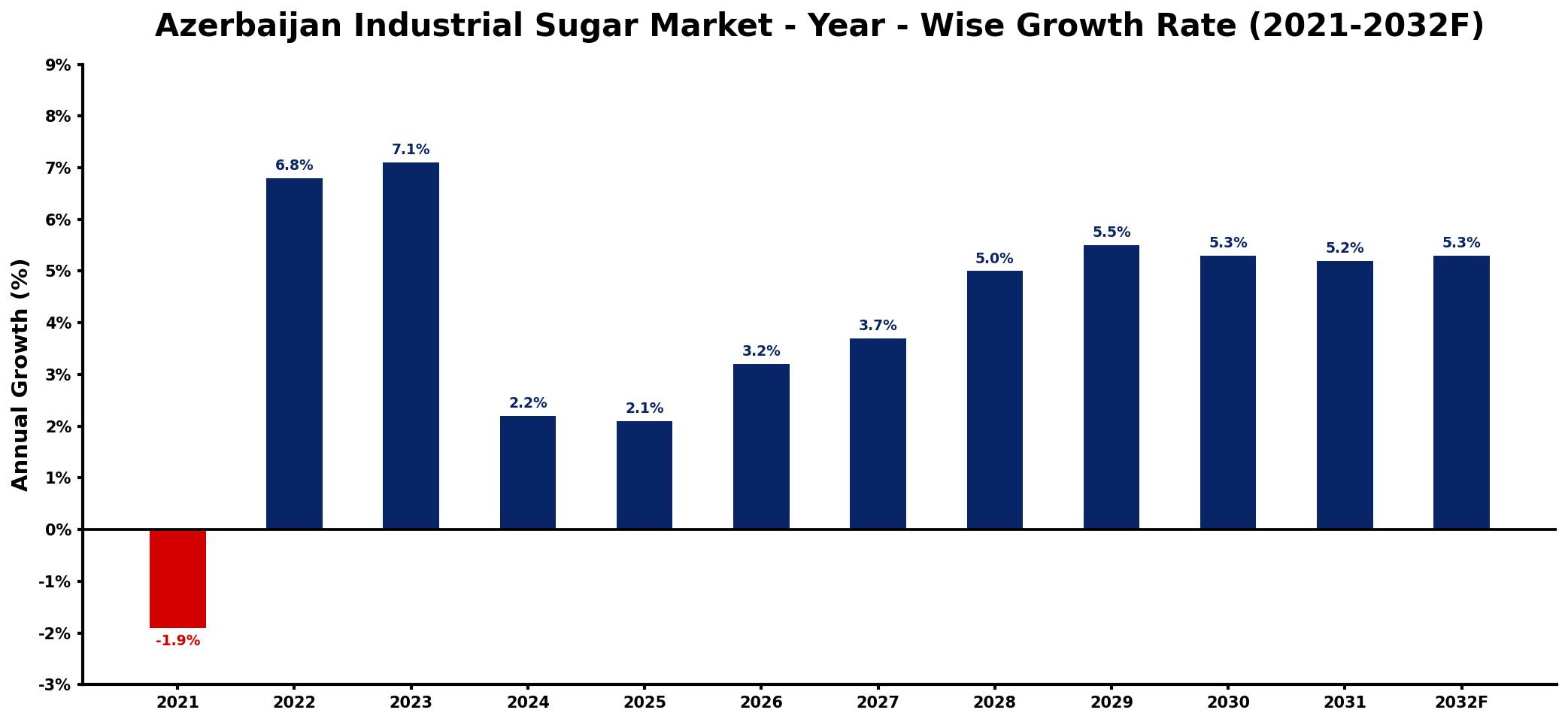
The table below presents the year‑wise growth rates along with the key drivers influencing the market
| Year | Growth Rate | Major Drivers |
| 2021 | -1.9% | decreased demand from manufacturing sector |
| 2022 | 6.8% | increased investment in food processing |
| 2023 | 7.1% | growing popularity of confectionery products |
| 2024 | 2.2% | expansion of beverage production facilities |
| 2025 | 2.1% | rising consumption in bakery sector |
| 2026 | 3.2% | increased exports to neighboring countries |
| 2027 | 3.7% | development of new processing technologies |
| 2028 | 5.0% | growing demand for packaged foods |
| 2029 | 5.5% | rising export shipment volumes |
| 2030 | 5.3% | increased government support for agriculture |
| 2031 | 5.2% | rising health consciousness among consumers |
| 2032 | 5.3% | growth in alternative sweetener applications |
Note: Market size estimations and growth projections presented in this report are based on 6Wresearch's proprietary forecasting methodology, utilizing the latest available industry data, government publications, and primary research inputs.
Azerbaijan Industrial Sugar Market Synopsis
In recent years, Azerbaijan has witnessed a robust growth in its food processing sector, leading to heightened consumption of industrial sugar across various applications. This surge can be attributed to rising disposable incomes, population growth, and evolving consumer preferences favoring sweetness in food and beverages.
Moreover, the pharmaceutical and chemical industries are increasingly recognizing the role of industrial sugar in production processes, driving further demand. This dynamic landscape positions the Azerbaijan Industrial Sugar Market as a crucial player in supporting diverse manufacturing needs and enhancing product offerings.
Azerbaijan Industrial Sugar Market Key Takeaways
- The market is experiencing steady growth due to increasing demand from the food and beverage sector.
- Industrial sugar is essential across various manufacturing applications, including pharmaceuticals and chemicals.
- Population growth and rising incomes are contributing to changes in consumer preferences toward sugar-laden products.
- Government policies aim to enhance market stability and promote sustainable practices.
- Opportunities for investment exist in food processing, pharmaceuticals, and chemical manufacturing sectors.
Evaluation of Restraints in Azerbaijan Industrial Sugar Market
Despite its potential for growth, the Azerbaijan Industrial Sugar Market faces notable restraints. Price volatility remains a critical concern, affecting the profit margins of manufacturers. Additionally, disruptions in the supply chain can lead to inconsistencies in product availability. Regulatory constraints surrounding sugar imports and exports may also hinder the market's expansion, as can the increasing competition from alternative sweeteners. These factors underscore the need for market players to adopt robust strategies to navigate the complexities of the environment effectively.
Azerbaijan Industrial Sugar Market Trends
Current trends indicate a growing inclination towards sustainable sourcing practices and clean label products among consumers. This shift is prompting manufacturers to reassess their sugar usage and explore organic or less processed alternatives. Moreover, technological advancements in sugar production and processing are enhancing efficiency, thereby driving innovation within the industry. As sustainability becomes a priority, the market is expected to see further developments in eco-friendly production techniques.
Azerbaijan Industrial Sugar Market Opportunities
There lies significant potential for growth and investment in the Azerbaijan Industrial Sugar Market, particularly within the food processing, pharmaceutical, and specialty chemicals sectors. As the demand for processed foods and beverages increases, businesses can leverage this trend to expand product offerings. Furthermore, investments in advanced processing technologies can improve production efficiency and sustainability, allowing companies to enhance their competitive edge in the market.
Government Initiatives in the Azerbaijan Industrial Sugar Market
The Azerbaijani government is committed to bolstering the industrial sugar market through a series of initiatives aimed at ensuring food security and promoting sustainable practices. Regulatory frameworks have been established to maintain production quotas and set quality standards for sugar products. Additionally, the government is likely to offer incentives for investments in agricultural advancements, research and development, and technology adoption within the sugar industry. These initiatives aim to foster stability and resilience in the market while supporting rural development.
Future Insights of the Azerbaijan Industrial Sugar Market
Looking ahead to the period from 2026 to 2032, the Azerbaijan Industrial Sugar Market is poised for transformative growth. The expansion of the food and beverage sector, coupled with rising health consciousness among consumers, will shape market dynamics. Moreover, advancements in sugar production methods and a continued focus on sustainability will redefine industry standards. As market players adapt to these changes, the focus will shift towards innovation and responsiveness to consumer demands, driving long-term success.
Azerbaijan Industrial Sugar Market Latest Developments (2025 - 2026)
Recent developments in the Azerbaijan Industrial Sugar Market indicate a burgeoning collaboration between government and private sectors to enhance production capabilities. Innovations in processing technologies have begun to emerge, promising increased efficiency and sustainability. Additionally, there has been a notable interest from international investors looking to tap into Azerbaijan's potential as a regional manufacturing hub, particularly in the context of food processing and pharmaceuticals.
Azerbaijan Industrial Sugar Market - Key Attractiveness of the Report
- 10 Years of Market Numbers
- Historical Data Starting from 2022 to 2025
- Base Year: 2025
- Forecast Data until 2032
- Key Performance Indicators Impacting the Market
- Major Upcoming Developments and Projects
Key Highlights of the Report:
- Azerbaijan Industrial Sugar Market Outlook
- Market Size of Azerbaijan Industrial Sugar Market, 2025
- Forecast of Azerbaijan Industrial Sugar Market, 2032
- Historical Data and Forecast of Azerbaijan Industrial Sugar Revenues & Volume for the Period 2022-2032F
- Azerbaijan Industrial Sugar Market Trend Evolution
- Azerbaijan Industrial Sugar Market Drivers and Challenges
- Azerbaijan Industrial Sugar Price Trends
- Azerbaijan Industrial Sugar Porter's Five Forces
- Azerbaijan Industrial Sugar Industry Life Cycle
- Historical Data and Forecast of Azerbaijan Industrial Sugar Market Revenues & Volume By Type for the Period 2022-2032F
- Historical Data and Forecast of Azerbaijan Industrial Sugar Market Revenues & Volume By White sugar for the Period 2022-2032F
- Historical Data and Forecast of Azerbaijan Industrial Sugar Market Revenues & Volume By Brown sugar for the Period 2022-2032F
- Historical Data and Forecast of Azerbaijan Industrial Sugar Market Revenues & Volume By Liquid sugar for the Period 2022-2032F
- Historical Data and Forecast of Azerbaijan Industrial Sugar Market Revenues & Volume By Form for the Period 2022-2032F
- Historical Data and Forecast of Azerbaijan Industrial Sugar Market Revenues & Volume By Granulated for the Period 2022-2032F
- Historical Data and Forecast of Azerbaijan Industrial Sugar Market Revenues & Volume By Powdered for the Period 2022-2032F
- Historical Data and Forecast of Azerbaijan Industrial Sugar Market Revenues & Volume By Syrup for the Period 2022-2032F
- Historical Data and Forecast of Azerbaijan Industrial Sugar Market Revenues & Volume By Application for the Period 2022-2032F
- Historical Data and Forecast of Azerbaijan Industrial Sugar Market Revenues & Volume By Dairy for the Period 2022-2032F
- Historical Data and Forecast of Azerbaijan Industrial Sugar Market Revenues & Volume By Bakery for the Period 2022-2032F
- Historical Data and Forecast of Azerbaijan Industrial Sugar Market Revenues & Volume By Confectionery for the Period 2022-2032F
- Historical Data and Forecast of Azerbaijan Industrial Sugar Market Revenues & Volume By Beverage for the Period 2022-2032F
- Historical Data and Forecast of Azerbaijan Industrial Sugar Market Revenues & Volume By Canned & frozen foods for the Period 2022-2032F
- Historical Data and Forecast of Azerbaijan Industrial Sugar Market Revenues & Volume By Pharmaceuticals for the Period 2022-2032F
- Historical Data and Forecast of Azerbaijan Industrial Sugar Market Revenues & Volume By Other food items for the Period 2022-2032F
- Historical Data and Forecast of Azerbaijan Industrial Sugar Market Revenues & Volume By Source for the Period 2022-2032F
- Historical Data and Forecast of Azerbaijan Industrial Sugar Market Revenues & Volume By Cane sugar for the Period 2022-2032F
- Historical Data and Forecast of Azerbaijan Industrial Sugar Market Revenues & Volume By Beet sugar for the Period 2022-2032F
- Azerbaijan Industrial Sugar Import Export Trade Statistics
- Market Opportunity Assessment By Type
- Market Opportunity Assessment By Form
- Market Opportunity Assessment By Application
- Market Opportunity Assessment By Source
- Azerbaijan Industrial Sugar Top Companies Market Share
- Azerbaijan Industrial Sugar Competitive Benchmarking By Technical and Operational Parameters
- Azerbaijan Industrial Sugar Company Profiles
- Azerbaijan Industrial Sugar Key Strategic Recommendations






































